


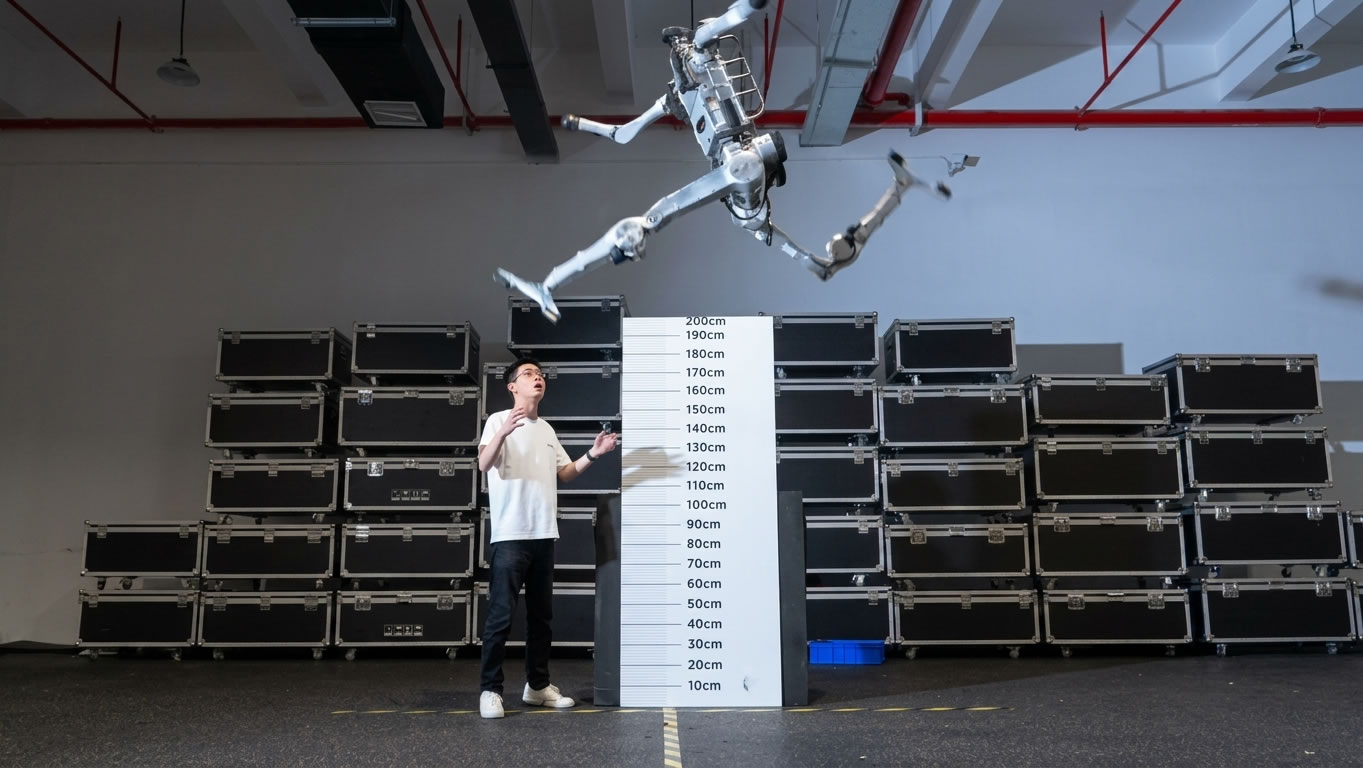
Unitree Robotics has unveiled a new humanoid robot called “Superman”, which the company says can jump about 2 meters from a standing position and reach a peak running speed of 12.66 meters per second.
The company released a 30-second video of Superman on August 17. In the video, Superman is shown with a leg length of 0.85 meters, reaching 12.66 m/s while running and performing a standing vertical jump of about 2 meters.
At 12.66 m/s, Superman’s published peak speed is above the widely cited 12.42 m/s peak recorded for Usain Bolt during his 9.58-second 100-meter world-record run in Berlin in 2009. The comparison is based on peak speed, however, and does not mean the robot has beaten Bolt’s 100-meter record.
Unitree said Superman was developed in just over three months and that there is still significant room for improvement.
A 2-Meter Standing Jump
The jump is one of the more striking parts of the demonstration because Superman takes off from a stationary position rather than using a running approach.
A standing jump puts substantial demands on a humanoid robot’s lower-body system. The robot has to generate high forces quickly while coordinating its hip, knee and ankle joints, then control the landing without losing balance.
Unitree has not published detailed specifications for Superman’s weight, actuator configuration, peak joint torque or battery capacity. Without those figures, there is not enough public information to judge the robot’s power-to-weight ratio or energy efficiency from the jump alone.
Unitree has published more extensive specifications for its H1 humanoid, but those figures should not be applied directly to Superman, which is a separate platform.
The jump also should not be treated as an official human athletic record. Robotic demonstrations and sanctioned sporting events use different definitions and testing conditions. Unitree’s result is better understood as a measured demonstration of the robot’s vertical performance.
12.66 m/s Puts Superman Above Bolt’s Widely Cited Peak Speed
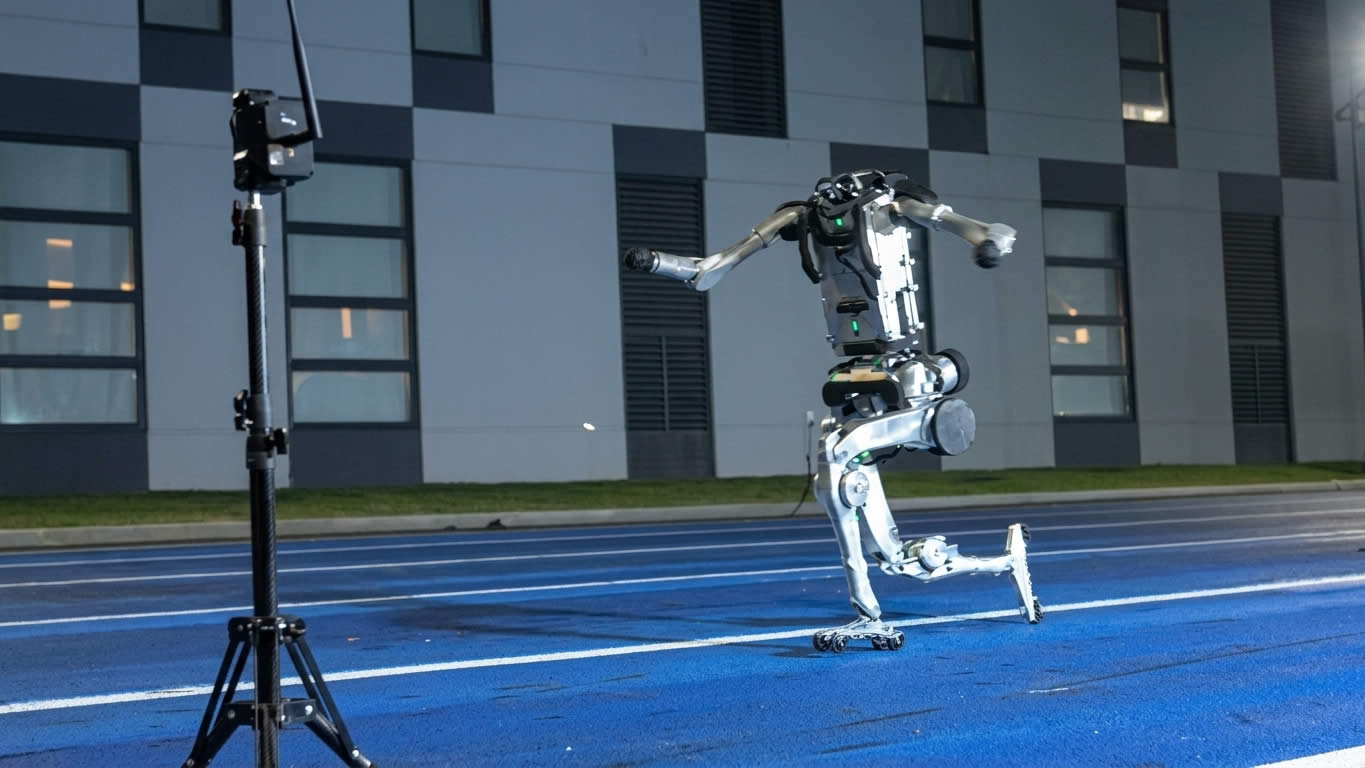
The running figure is easier to compare.
A speed of 12.66 m/s is about 45.6 km/h. Analyses of Usain Bolt’s 9.58-second world-record run in Berlin in 2009 have put his maximum speed at roughly 12.3 to 12.4 m/s, depending on the measurement method.
On that basis, Unitree’s published peak is higher.
But the comparison has limits. Peak speed is not the same as 100-meter performance. A robot can reach a high instantaneous speed without maintaining it over the distance of a full race, and factors such as acceleration, braking, stability and energy consumption become important over longer runs.
So the more precise claim is that Superman has reached a published peak running speed above the range commonly cited for Bolt’s maximum speed, not that it has beaten Bolt’s 100-meter world record.
Unitree Has Been Pushing Humanoid Running Speeds
Superman follows a series of high-speed locomotion tests from Unitree Robotics.
On April 11, the company said its H1 humanoid had exceeded 10 m/s in a running test.
The progression shows where Unitree has been focusing much of its development effort. Running at higher speeds leaves less time for the robot to recover from instability and puts greater loads on the actuators, structure and control system.
The challenge is not simply getting the motors to turn faster. The entire machine has to remain stable through repeated impacts while handling the resulting mechanical loads.
That makes Unitree’s 12.66 m/s figure more interesting as a demonstration of the robot’s overall motion system than as a standalone humanoid robot speed number.
Three Months of Development
Unitree said Superman was developed in just over three months, suggesting that the robot is still an early platform rather than a finished commercial product.
The short development timeline also highlights the pace of iteration in the humanoid robotics market. Companies are increasingly competing not only on whether a robot can walk, but on how quickly they can improve dynamic movement, integrate new hardware and test those changes.
The timing is also notable because Unitree is already producing humanoid robots at a substantial scale. On August 12, the company said about 18,000 bipedal humanoid robots had rolled off its production lines.
That gives Superman a broader context. Unitree is working on both ends of the humanoid robotics problem: pushing the limits of dynamic movement while scaling manufacturing.
The Harder Test Is Repeatability
A 12.66 m/s peak speed makes an obvious headline. For the robotics industry, the next questions are harder.
Can Superman maintain a high running speed for more than a brief burst? How many times can it repeat a 2-meter standing jump without excessive wear on its joints? How much battery power does that performance require? Can it maintain control on different surfaces, or recover from an unexpected change in terrain?
Those questions will matter more for commercial applications than a single peak measurement.
A factory humanoid does not need to outrun a world-class sprinter, and a warehouse robot does not need to jump two meters. What matters is whether the machine can move quickly enough, remain stable, operate for long periods and perform useful work without excessive maintenance.
For now, Superman remains an early platform with limited public specifications. The harder test will be whether Unitree can turn its headline-grabbing performance into something repeatable, durable and useful in real-world operation.
More technical data from the company could help clarify whether Superman is primarily a technology demonstrator or the basis for another production humanoid robot platform.
Unitree is expected to appear at the 2026 World Robot Conference in Beijing, which runs from August 19 to 23 at the Beiren Etrong International Exhibition & Convention Center.
