

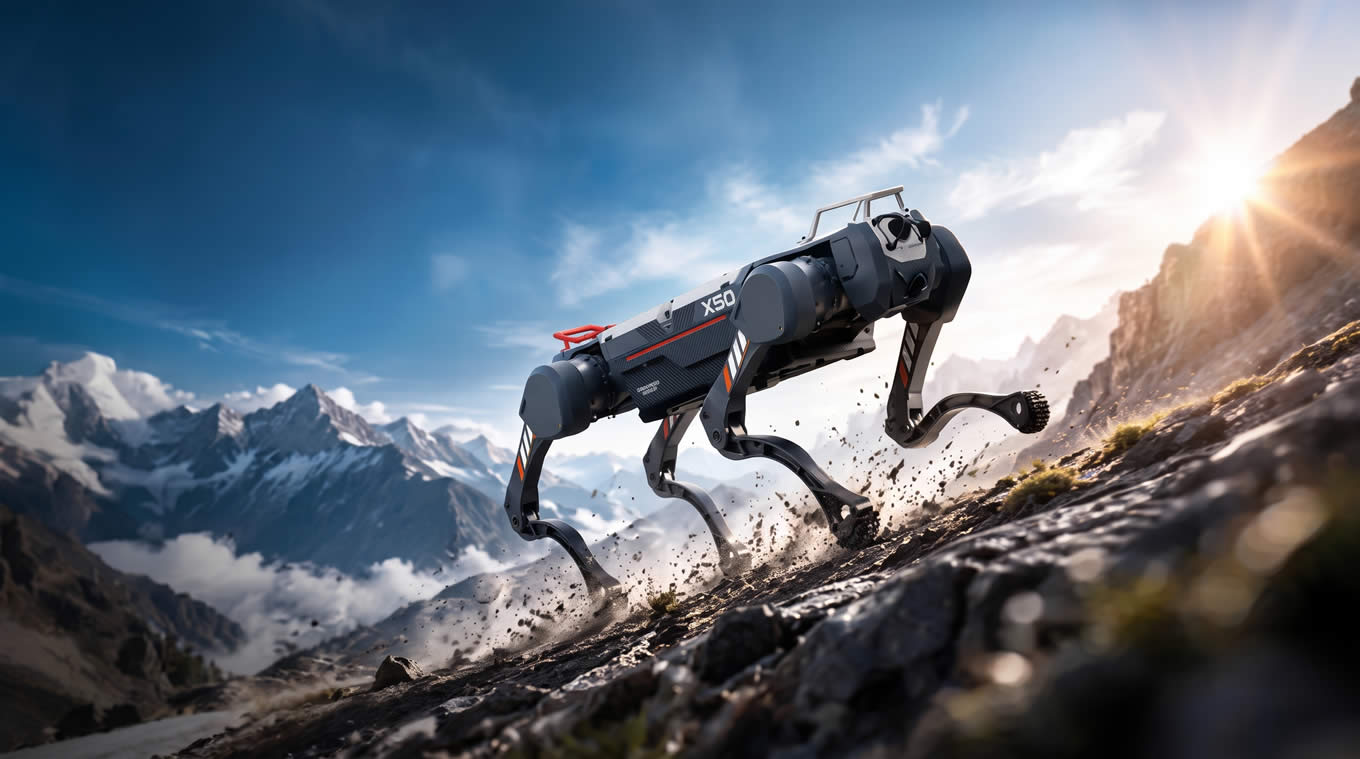
A charged fire hose is a small rocket pointed sideways. Open the nozzle and the reaction force runs back through the coupling into whatever is holding it: a shoulder, a doorframe, a length of pipe. On flat ground that is a nuisance. At the top of a stairwell in a building that is already burning, with nowhere to brace, it is where the attack stops.
Founded in 2017, DEEP Robotics has been building quadrupeds for industrial work since 2018. On November 6 the Hangzhou company added the machine it had been missing: the X50, rated to carry 50 kilograms — 110 pounds — while it walks.
The payload gets the headline, but the engineering is somewhere else. Quadrupeds have stood under heavy loads for years. The X50 is being sold on what it does while moving, and on one claim in particular: that it can hold a nozzle against recoil at the top of a flight of stairs, with tools bolted to its back instead of a camera.
Same body, two and a half times the load
DEEP’s previous workhorse is the X30, rated at 44 pounds of continuous payload. That covers a thermal camera, a gas sensor, a lidar head. It does not cover a hydraulic crimping tool, a bundle of insulator strings, or a grounding set.
The X50 carries 110 pounds. What makes that worth a launch event is the accounting around it. By DEEP’s own published figures, the X30 weighs 123 pounds with its battery. The X50 weighs 127. Four pounds more machine, two and a half times the rated load, and, on the company’s account, no growth in body size.
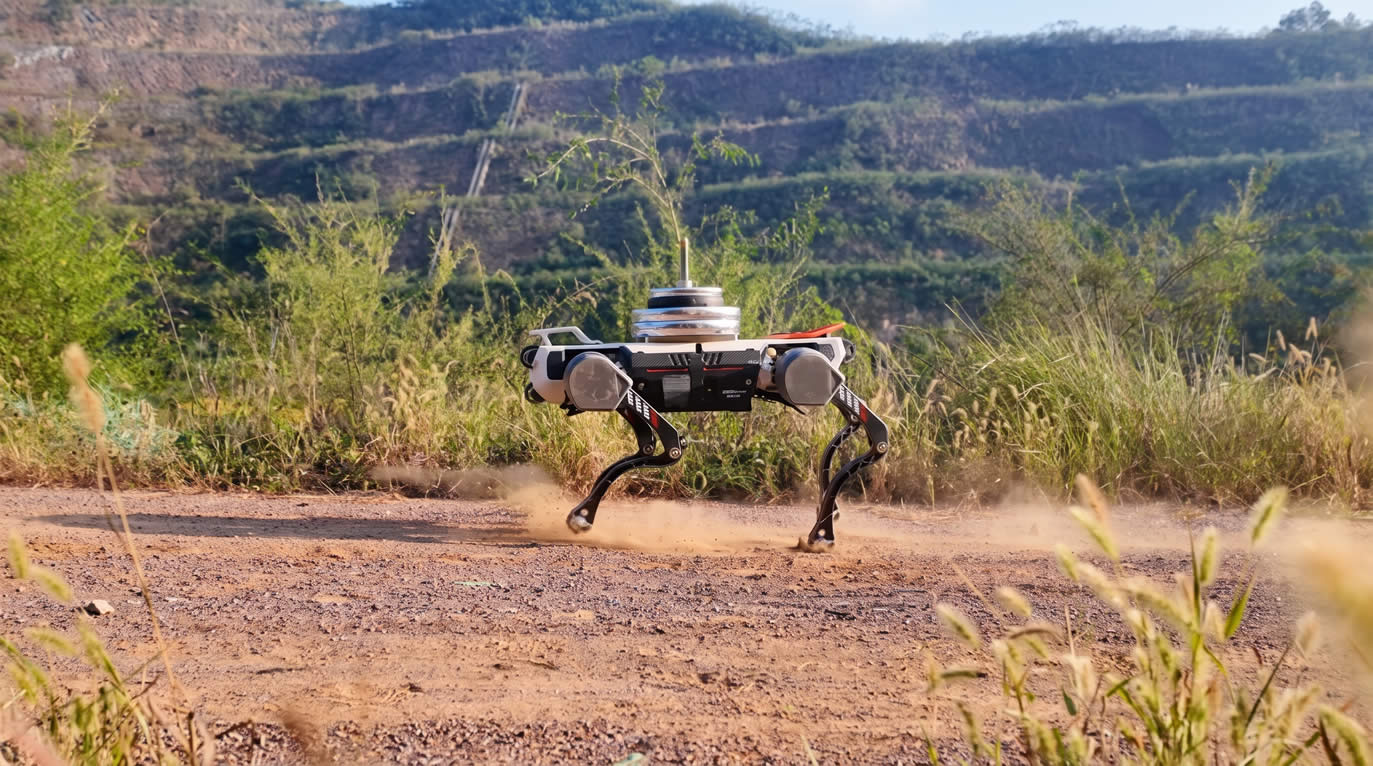
That is not a bigger robot. That is a different joint system. DEEP credits a stiffer, faster-acting leg actuator and a control stack that picks a foothold before the foot commits to it, rather than correcting after the body has already started to tip.
Put the number next to the competition and the picture changes. Boston Dynamics built Spot for inspection rounds and priced it at $74,500 in 2020. Unitree’s B2 is the closer comparison, and it sells for a fraction of the price. Unitree quotes more than 88 pounds of walking payload — a floor, not a ceiling — and a top speed above 13 mph, which is a peak rather than a working figure. DEEP quotes 110 pounds, and 6.7 mph carrying all of it. Those numbers are not measured the same way, and the gap between them is smaller than the launch language implies. What DEEP is selling is that payload on stairs, which is the harder claim to test.
| Machine | Rated payload | Notes |
|---|---|---|
| DEEP X30 | 44 lb | camera, gas sensor, lidar head |
| DEEP X50 | 110 lb | hydraulic tools, insulator strings, hose and nozzle |
| Unitree B2 | 88 lb+ | faster, and close on payload |
| Boston Dynamics Spot | 31 lb | the benchmark; $74,500 at launch |
DEEP does not publish list prices, which is maddening for anyone trying to write a budget. Its IPO prospectus does disclose that the X series averaged 287,500 yuan — roughly $40,000 — across 681 units sold in 2025. Assume the X50 is quoted above that average, and assume the quote arrives with integration, spare batteries, a charger and a service contract folded in.
The fine print on two kilometers
DEEP’s headline claim is that the X50 sustains 3 meters per second over a 2-kilometer run with its full 50-kilogram payload. In units that mean something on a job site: 6.7 mph, 1.24 miles, 110 pounds on its back.
Do the division and the same sentence changes character. Two kilometers at three meters per second is 667 seconds. Eleven minutes.
That is not a knock. Eleven minutes of sustained running under rated load is a genuinely hard thing to ask of a leg actuator, and the fireground work it was built for is bursty by nature: cross the yard, climb two flights, stop, work. What matters on a shift is how many trips it makes between battery swaps.
But it is worth separating the two endurance numbers that appear on the same datasheet. One is a sprint test at rated load. The other is a runtime figure at a fixed payload, which is a different experiment. Neither tells you what a four-hour shift looks like with a hose attached, and DEEP has not published a mission profile that does.
Strip out the marketing and the datasheet is the more cautious document.
| Published figure | X50 / X50 Pro |
|---|---|
| Continuous payload | 110 lb |
| Runtime at 110 lb | about 2 hours |
| Runtime at 44 lb | about 3.5 hours |
| Working walk speed | 3.4 mph |
| Sustained run speed | 6.7 mph |
| Sustained-run test | 1.24 miles at 6.7 mph, fully loaded |
| Consecutive stair riser | 10 inches |
| Slope | 35 degrees, surface dependent |
| Ingress protection | IP67 |
| Operating temperature | −4 to 131 °F |
| Weight with battery | 127 lb / 132 lb |
There is also a 10 mph peak buried in the footnotes, measured in a lab and, by the company’s own admission, not made available to customers for safety reasons. A vendor that publishes its best number and then disowns it is worth reading carefully, and here the caution reads as competence rather than evasion.
One more footnote deserves attention: a standing load limit of 440 pounds, which DEEP explicitly says is not an operating condition. It is the kind of number that ends up in a slide deck with the caveat deleted. The figure that counts is 110 pounds, moving.
Where the machine is actually new
Look closely and the X50 is not a new sensor platform. The base model carries the X30’s hardware: four lidar units, one wide-angle camera, two eight-core processors; the Pro adds a third. What changed is what the machine does with it — lidar point clouds fused with inertial data, and a learned locomotion policy that picks a foothold a step or two ahead instead of correcting after the foot has landed.
That matters most on stairs with open risers, the kind bolted to boiler houses, chemical plants and older factories, where a foot that misses does not slide — it goes through the gap and the machine goes down with 110 pounds on top of it. DEEP has sold that trick since the X30, at 44 pounds. The X50’s claim is the same terrain with two and a half times the load aboard, which is a different problem: weight raises the center of gravity, and the margin for a missed foothold narrows sharply.
The datasheet does move, if modestly: 10-inch risers against the X30’s 8, and 35-degree slopes against 30. The Chinese launch materials go further, with ledge climbs of about 31 inches and gaps of 27 inches between stone blocks. Those are demo conditions, filmed, and the 10-inch riser figure is the one a safety officer will read. Both can be true. Only one of them is a specification.
The enclosure is rated IP67: dust-tight, and rated for brief immersion. The rating does not, by itself, establish resistance to high-pressure water jets. The temperature range is wide on paper, though performance falls off toward the extremes.
What the Pro buys, and what nobody has measured
Two versions ship, and the spec sheet makes them look closer than the invoice will.
| X50 | X50 Pro | |
|---|---|---|
| Continuous payload | 110 lb | 110 lb |
| Weight with battery | 127 lb | 132 lb |
| Eight-core processors | 2 | 3 |
| Power connections | 72 V battery interface | 5 V, 12 V, 24 V |
| Data connections | Ethernet, Wi-Fi | Ethernet, Wi-Fi, USB 2.0/3.0 |
| SLAM mapping and localization | not listed | listed |
| Autonomous navigation | not listed | listed |
| List price | not published | not published |
Read that difference carefully, because it describes two different sales motions. The base X50 is an operator-guided hauler: it avoids obstacles and returns to its dock on its own, but it will not map a route or run one unattended. The Pro will, which is what a substation inspection contract actually requires. What separates them is software, and software is what turns a tool into a coworker. It will be priced accordingly.
Nobody outside DEEP has published a long-duration trial. The company’s figures are its own test data, labeled as such, and the Chinese launch coverage reads as one press release with different logos. A skeptical buyer should read the payload rating as a ceiling that includes the bracket, cables and case, not as the weight of the tool. Mounting hardware eats capacity, and so does an auxiliary battery.
There is also a physics problem nobody puts in the brochure. A loaded X50 is 237 pounds of machine and cargo. If it goes down in a stairwell, in a plant, at three in the morning, a recovery crew still has to haul that weight out. That is a design constraint as real as any torque figure, and it decides whether a pilot program gets renewed.
A company that stopped being a curiosity
The X50 lands at an awkward moment for its maker. DEEP’s application for a Shanghai STAR Market listing was accepted in May, moved into the inquiry stage later that month, and updated its prospectus in September. It is seeking 2.5 billion yuan, about $350 million. Its 2025 revenue was 337 million yuan, roughly $47 million, with a net profit of 28.7 million yuan, or about $4 million — its first profitable year, and a rare thing in this category. The half-year figures filed in September cut against that: 259 million yuan of revenue in six months, and a net loss of 8.8 million yuan.
Frost & Sullivan puts DEEP first in global quadruped revenue for industrial applications in 2025, having passed Boston Dynamics in 2024. Unitree is the bigger company by most other measures: 1.7 billion yuan in 2025 revenue, and a 32.4 percent share of global quadruped unit sales in 2024 against DEEP’s 18.9 percent, according to IDC.
The two are not chasing the same buyer, and the X50 is the clearest statement of that yet. Unitree sells capability at a price that makes research labs and hobbyists into customers. DEEP sells uptime to a utility, and a utility’s procurement office does not buy robots on the strength of a YouTube video. The company’s own prospectus makes the same point, with unusual candor: its brand recognition lags global rivals, which raises the cost of building trust abroad, where it booked 18.12 percent of revenue in 2025.
The reference deployment is Singapore, where SP Group has been using an X30 nicknamed SPock for underground cable-tunnel inspections since late 2024 — hot, humid, unlit, and precisely the environment where a camera on a pole cannot go and a human being should not have to.
What a fire department actually signs
The firefighting pitch is the most seductive and the hardest to close. A machine that carries a hose up a stairwell and braces against recoil takes over one of the most physically punishing parts of the job. It also removes that work from a person who trained for it, which is a labor conversation wearing a technology costume, and it will be had in every department that pilots one.
Then there is the paperwork. NFPA codes do not yet give a chief a way to evaluate a legged robot, and insurers have no track record with a 127-pound machine parked on a landing. NIST and ASTM have published test methods for emergency-response robots, but turning those into acceptance criteria for interior firefighting is a separate job nobody has finished. The gap does not stop a sale, but it slows one, and it pushes the decision onto whoever will run the pilot and sign the memo.
None of that argues against the hardware. What DEEP has published is still a specification sheet, from a company that has spent nine years learning that the buyer who needs 110 pounds carried is a different buyer from the one who needs a camera walked around a substation. The X50 is built for the first one. Whether that buyer exists in the numbers DEEP needs is the question its IPO roadshow will have to answer.
The hose is still the test. A machine braced on a landing, nozzle locked, water going where it was aimed, and nobody standing on the stairs behind it — that is the picture the company is selling. The rest is a purchase order.
