

The gripper opens to 6.3 inches. The slot in the ice cream machine is 7.1 inches wide. That leaves four-tenths of an inch of clearance on each side, and the arm has to find it at speed with a paper cup of soft-serve already starting to slump.
At the APEC 2026 news center in Shenzhen this week, the arm found the gap 99 times out of 100, according to Chuangjie Zhilian, the local integrator that wrote the scheduling software. Treat that as a vendor claim. The line of journalists waiting for ice cream was not a claim. It was a line.
The building is Hall 2 of the Shenzhen Convention and Exhibition Center in Futian, about 160,000 square feet of workspace for the press corps covering the 33rd APEC Economic Leaders’ Meeting, which opens Nov. 18. China last hosted APEC in 2014. The robots are the part the cameras stop for. The part reporters actually use is quieter: an editing agent that pulls clips from the day’s feeds and generates multilingual subtitles, an XR studio, a counter where DJI, Insta360, Canon and Nikon lend gear for free.
Two minutes thirty, counter to table
Ordering is deliberately dull. A reporter taps a tablet, types or says what they want, and a language model turns it into an order. What happens next is the part worth watching.
That scheduling layer — the company calls the approach agent-to-agent, or A2A — takes the order apart and hands the pieces to hardware and models from different companies. On one path, a dual-arm robot picks the cup while a third-party world model handles perception, causal reasoning and the fine-grained arm motion, solving a collision-free sequence inside the space the gripper has left. On the other, a voice kiosk catches the request and a JAKA Lumi mobile manipulator from Shanghai-based collaborative robot maker JAKA collects the cup, navigates the floor and sets it down at the table.
End to end, about two and a half minutes. In the best cases, delivery to the table took under a minute.
Almost every robot demo of the past three years has been one vendor running one model on hardware it tuned for one room. This one was assembled from parts that had never met, in front of an audience that would have noticed a stall. The claim is less photogenic than a robot pouring latte art, and more useful. No convention center, airport or hospital is going to buy its entire robotics stack from a single supplier. If these machines are going to be deployed by the thousand, somebody has to make the handoffs work between companies that compete with each other.
It was still a demo. The menu was fixed, the lighting was steady, and the floor was clear of the luggage carts and small children that make real venues difficult. But interoperability is the right problem to be working on, and it is the one part of this that no single company can solve alone.
The arm is the easy part
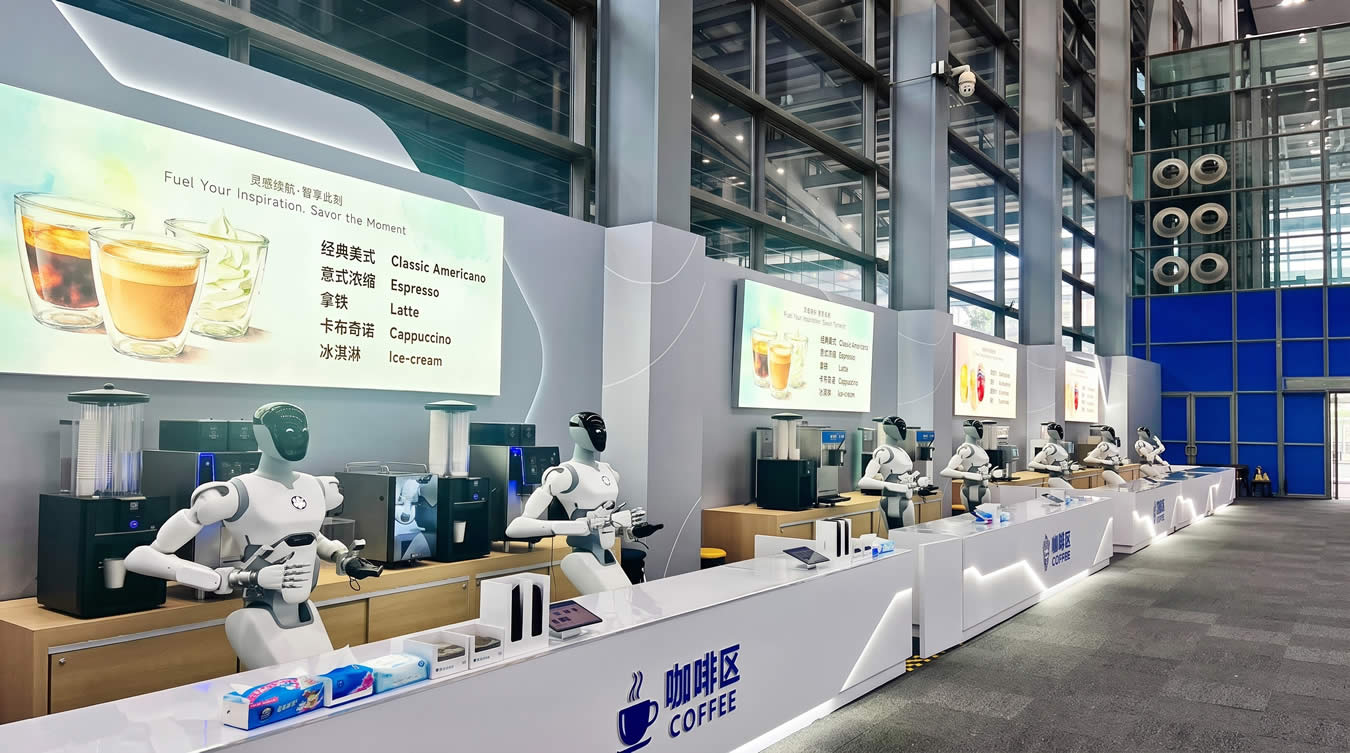
A few dozen feet away, seven humanoids from AI² Robotics were running a drinks counter. The company’s numbers for the week: more than 5,000 journalists served, at a rate of 45 coffees, 30 ice creams and 30 juices an hour across the seven machines. A separate coffee unit in the tech services area was turning out 500 to 600 cups a day, with APEC logos worked into the latte art.
Throughput is the easy number. The part that matters is what the robots had their hands on.
They did not use a purpose-built dispensing rig. They worked the same commercial espresso machine, ice cream machine and juicer that a café or a hotel breakfast room buys, unmodified — buttons, portafilter, everything — the way a new hire would on day one. AI² says the behavior comes from its in-house vision-language-action model rather than from motion scripts written for this room, and that the robots needed no retraining when they arrived in a hall whose tables, machine layout and lighting differed from its own stores.
Operating a commercial espresso machine is a narrow skill, repeated a few hundred times a shift. But narrow skills that transfer between sites without an engineer on the floor are what separate a product from a demonstration, and the machine does not get bored at cup 400 or wander off when the queue is longest.
Getting in took work of a duller kind. AI² says roughly 2,000 volunteers put the robots through safety and stress tests in waves before the event, and that the news center’s organizers ran their own security challenges — attempts to trip, block or confuse the machines — before certifying them for a hall where people stand within arm’s reach of a robot holding hot liquid.
The company, founded in 2023 and valued at more than 20 billion yuan (about $3 billion) after a round this summer, has spent the week arguing that 2026 is the year embodied AI stopped being a stage trick. Its founder and chief executive, Guo Yandong, says it is in commercial talks with more than a third, approaching half, of APEC’s 21 economies, naming Singapore, Vietnam, Indonesia, South Korea and Australia. Talks are not contracts. In six months, the gap between the two will be the number to watch.
Elsewhere in the building, X Square Robot had parked one of its wheeled, dual-arm machines beside a row of massage chairs. It offered water and candy to reporters who had been on their feet since dawn, and when they left it cleared the table, dropping wrappers, bottles and cups into a bin. The company is backed by ByteDance, Meituan, Alibaba and Xiaomi, and has versions of the same machine in nursing homes, scenic areas and parcel-sorting warehouses. Nobody puts table-busing on a conference stage. Hotels and care homes need it done at two in the morning.
| Where | Machine | Job | Scale |
|---|---|---|---|
| News center, tech services | Coffee robot | Espresso with APEC latte art | 500–600 cups a day |
| News center, break area | AI² Robotics AlphaBot ×7 | Coffee, ice cream, juice | 45 + 30 + 30 per hour |
| News center, rest area | Chuangjie A2A + JAKA Lumi | Order to table, ice cream | 2 min 30 s end to end |
| News center, lounge | X Square Robot service unit | Water, candy, clearing tables | — |
| Qianhai plaza | Leju Kuavo ×10 | Patrol, 4 fixed routes | 3,000+ flags in 2 months |
| Qianhai streets | Taiyi street sweeper | Cleaning, bagging, docking | Pilot; production Jan. 2027 |
Meanwhile, in Qianhai, the boring version
Across town, the same story was unfolding with no camera crew.
Leju Robotics says ten Kuavo humanoids are walking four fixed patrol routes around a mixed office and retail complex in Qianhai. They move autonomously over curbs and mixed pavement and report what they see: someone smoking where smoking is banned, waste dumped where it shouldn’t be, two-wheelers parked across a walkway, a construction barrier left without warning signage. In two months of regular operation, the company says, they flagged more than 3,000 such incidents.
The current Kuavo 5 stands 5-foot-8 and weighs 140 pounds, with a top running speed near 4.3 mph, the sort of specification that invites jokes about robots jogging past the security guard. The number that matters is 3,000, and the question that follows is what a human supervisor does with 3,000 flags. A patrol robot that writes a log nobody reads is a camera on legs.
A few blocks away, a sweeper from Taiyi, a Shenzhen robot company, was working Qianhai’s core streets. Taiyi puts its onboard compute at 256 TOPS; the machine narrows to pass between parked cars, automatically seals the litter it collects into bags, and returns to a dock to charge and refill its water tank. It is also, by the company’s own account, a pilot: volume production is slated for January 2027.
The timeline is the most honest thing in the whole APEC robot program. The leaders are in town for two days. A municipal cleaning contract runs for years and has to survive a rainy February.
A summit with a sales desk
The commercial subtext is not subtle. The APEC CEO Summit, held Nov. 17–18 at the Qianhai International Conference Center, brought together more than 2,000 business and government delegates, including representatives from 115 Fortune Global 500 companies, and the robot founders worked the room as hard as the bankers did.
Host cities do this. What is different this time is the merchandise. A bridge or a stadium is something a government can order. A robot is a product that has to win 21 separate markets, each with its own safety rules, labor costs and import duties, and most of those markets have never bought a humanoid robot before.
Which is why the patrol routes and the sweepers may end up mattering more than the coffee bar. A robot holding a municipal contract has already cleared the hurdles that kill most deployments: certification, insurance, a maintenance agreement, and a customer who can cancel. That paperwork is also the first thing a foreign buyer asks to see, which makes the Qianhai routes a better advertisement than anything on display at the news center.
What the shipment numbers don’t say
The counterweight sits in the shipment data, and the people running these companies know it.
Two research firms counted the same six months and came back with different numbers, which says something about how young the market still is. Counterpoint Research put global humanoid shipments at more than 22,000 units in the first half of 2026, up nearly 300 percent year on year. IDC counted close to 25,000 and growth of 432 percent.
Both agree on the shape of it. Counterpoint’s top five vendors — Agibot, Unitree, Galbot, UBTECH and Leju — are all Chinese and took 86 percent of shipments between them. Agibot alone shipped about 9,700 units and Unitree more than 7,000; together, roughly three-quarters of the market. IDC puts Chinese vendors above 95 percent of global shipments and Chinese buyers at about 78 percent of demand, which makes the country both the factory and the customer.
Then there is what the machines were bought for. Counterpoint found that entertainment and performance, together with data production and research, still made up more than 60 percent of shipments. Intelligent manufacturing reached 13 percent, warehousing and logistics 5. Separately, the China Academy of Information and Communications Technology reported this year that a substantial share of deployed embodied AI devices run fewer than ten days a month.
The order book points the same way. The Humanoid Robot Scenario Application Alliance counted at least 218 publicly disclosed contract awards in China in the first half, worth 1.72 billion yuan, about $260 million. Education and research institutes took 55.5 percent of them, government and state-backed platforms 20.6 percent, industrial and technology companies 21.1 percent — and by industry accounts, much of that last slice is still sample testing, showroom displays and training pilots rather than production-line purchasing.
An industry report published on 36Kr this year put the share of announced intent and framework orders that becomes binding contracts and paid deliveries at 10 to 20 percent.
None of that makes the APEC deployments fake. They are early, and the incentives are worth stating plainly. For a robot company, a summit week is close to the ideal customer: dense foot traffic, a fixed menu, constant press attention, and no requirement that the unit still be working in March.
The deployments that will settle the argument are the ones nobody photographs — a patrol route in its eighth month, a sweeper that needs servicing twice a quarter, a coffee counter where uptime is the only number anyone tracks.
The news center closes once the leaders leave. The machines get packed up, and some will reappear at the next trade show, doing the same trick for a different crowd.
Come February, the ten in Qianhai will be the test: are they still walking their four routes on a Tuesday morning, filing reports about illegally parked scooters to somebody who has to read them?
