

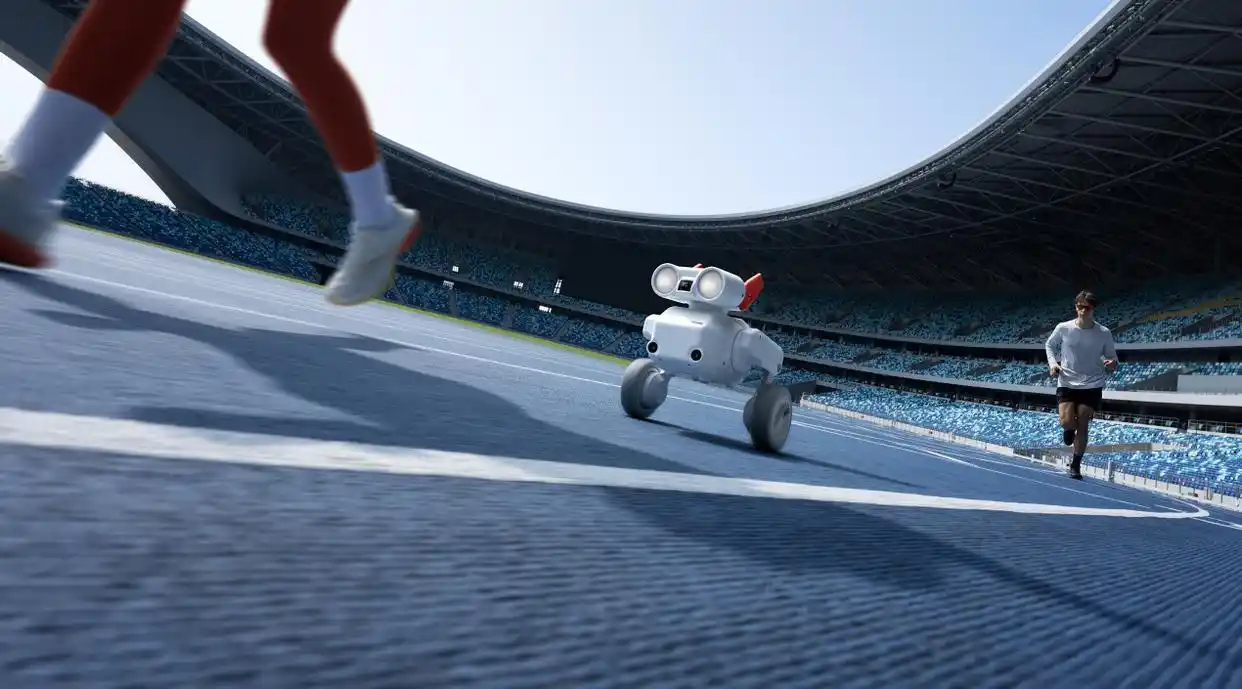
Mondo Robotics raised $5 million on Kickstarter for a robot you could not buy. Four months later it is in a box with a shipping label, and the only part left to prove is the one no campaign page could test.
SHENZHEN — Sean Hollister has spent fifteen years editing at CNET, Gizmodo and Engadget, and he now reviews gadgets for The Verge. So when an Instagram clip crossed his feed this summer showing a knee-high robot sprinting across a park with a camera where its head should be, he did what experienced people do. He assumed it was fake. Not staged — generated.
“Surely consumer robots aren’t that smart and agile in 2026?”
Two hours with a real one moved him, though not all the way. “Truth is, Beni does need work,” he concluded. “But my first two-hour demo was so much fun, I badly want one for myself.”
That was July, when Beni was a Kickstarter campaign with a video and a delivery estimate. On Tuesday it became something you can buy with a credit card and have by the weekend. Mondo Robotics, the Shenzhen company behind it, opened retail sales at $749 in the United States and ¥4,999 in China, where JD.com has it in stock. The crowdfunding page that closed in September with 7,926 backers and $5,003,232 pledged against a $50,000 goal is now a historical document.
Anyone can cut a convincing crowdfunding video. What Mondo has now is a claim that has to survive a Tuesday afternoon in a park with a six-year-old and a dog.
What actually showed up
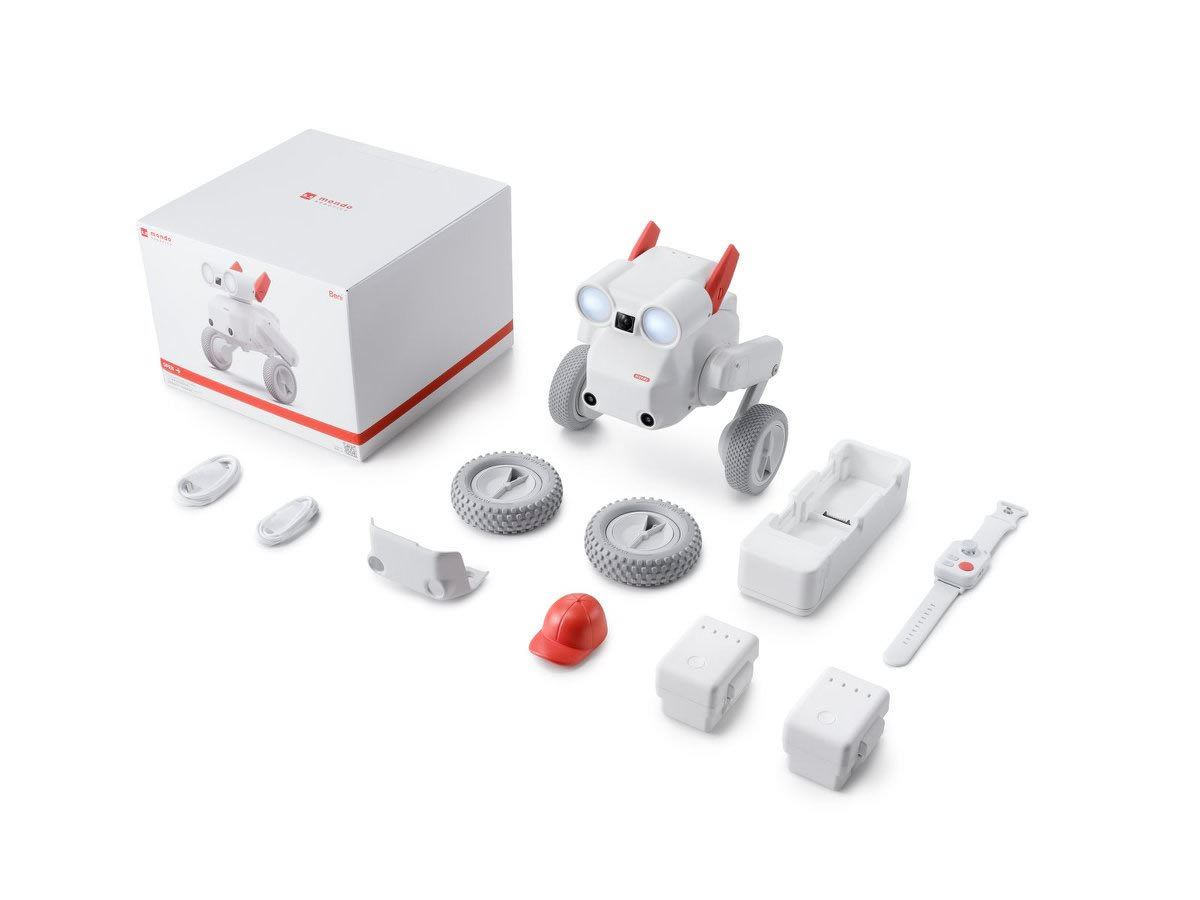
Much of the English-language coverage calls Beni a robot dog. It is not one. It has two wheels on the ends of two articulated legs — a wheel-legged machine, the same family as Boston Dynamics’ Handle, minus the hydraulic budget and the industrial price.
The legs are not decoration. Motors in the shoulders fling the lower legs downward to launch the thing off the ground; spring-loaded cylindrical joints soak up the landing. When it ends up on its side, which it will, it rotates those legs until the wheels are underneath it again and stands back up. In his demo Hollister ran it repeatedly into walls and off ledges, and it came back with scuffs.
The numbers are respectable for the money. Top speed is 17.9 mph, fast enough to hold a skateboarder on flat ground. A 10-inch vertical jump clears a curb without stopping. The camera pairs a 1/1.3-inch sensor with a 155-degree lens and records 4K60 in 10-bit HDR, 3K60 vertical, or 1080p at 120 for slow motion. Storage is 32GB onboard plus a microSD slot. The battery is a 31-watt-hour pack rated at ninety minutes and an hour to charge, and you swap it rather than wait.
One detail worth flagging, because it says something about the last four months: the units reviewers handled in July topped out at 4K30. The retail spec sheet says 4K60. Somewhere between the prototype and the pallet, the imaging pipeline got faster.
It weighs four pounds, folds to something you can carry one-handed, and is explicitly not waterproof — no rain, no puddles, no snow. It will run between 32°F and 104°F.
The quadrant nobody was standing in
There is a tidy way to think about camera hardware, and Mondo’s pitch leans on it hard. Action cameras own the first-person view. Drones own the air. Gimbal cameras own the handheld shot. What is left is ground level, moving with the subject — and that quadrant has been empty for years, because the only way to fill it was to hire a person.
Mondo says Beni fills it. The claim is marketing, but the gap is real, and the reason it existed is more interesting than the gap itself.
Ground-level autonomous filming was blocked by regulation as much as by engineering. Any drone worth filming with needs registration, a Remote ID broadcast, and a legal place to launch. National parks are out. Stadium airspace is out on game days. A growing list of city parks and beaches are out, and the ones that are not out often have a neighbor with a lawyer. The result is that an entire category of shots — following someone through a trail run, a tennis rally, a kid on a bike — has been practically unavailable to anyone unwilling to break a rule or hire a camera operator.
Beni needs no license, makes no noise worth complaining about, and fits under a park bench. It is a better argument than any claim about being first, and Mondo knows it. The company’s own materials spend more space on where you can shoot than on what the robot can do.

The tracking is the whole product
The parts are mostly a manufacturing problem, and Shenzhen is very good at those. Wheels, articulated legs, springs, camera modules — factories there have been turning all of it out for years. The software is the open question: deciding where the robot should be while you move. It separates a gadget that follows you from a camera you can forget about.
Hollister’s demo found the seam. In his session he had to activate the tracking modes manually. The robot’s two forward-facing 150-degree obstacle cameras and its UWB wrist tracker were not enough to stop it from clipping corners, hitting walls, or rolling into his foot while it tried to keep pace with his kick scooter. It did noticeably better when he simply walked through downtown Oakland.
That was the state of the art in July, and it points at the specific problem Mondo has to have solved: re-acquisition. Following a person across an empty parking lot is a solved problem — a phone can do it. Following a child who runs behind a tree, a dog that cuts into a crowd, or a skater who disappears over the lip of a ramp and comes back forty yards away in a different posture is not. Losing the subject for two seconds is the difference between footage and nothing.
The architecture Mondo describes is end-to-end neural control trained with reinforcement learning, with the head able to rotate independently of the body — it can spin fully backwards to film you from the front, which is how the machine gets away with only two forward sensors when it is tracking from the side. The company also talks openly about the problem that has kept legged robots out of living rooms: getting a policy that works on one machine to behave the same way on the ten-thousandth unit off the line. It is a manufacturing problem dressed as an AI problem, and it is the one where a Shenzhen supply chain matters more than a clever paper.
No independent review of the retail firmware has been published yet. Not a knock — just the current state of the evidence. The Verge’s two hours were on a prototype in July, and the software has had four months since.
Two DJI people and an Optimus engineer
The reason to take the claim seriously is the payroll.
Mondo Robotics was founded in January 2025. Its chief executive, Gao Jianrong, spent years at DJI running supply chain, marketing, RoboMaster and the education division — which is to say his trade is not demos, it is getting complicated hardware into millions of boxes without the failure rate eating the brand. Its co-founder and CTO, Shuo Yang, studied at Hong Kong University of Science and Technology under Li Zexiang, the professor behind DJI’s founding generation, and later became a technical director at DJI. From there he went to Carnegie Mellon for a PhD, then to Tesla, where he worked on algorithms and control for Optimus, the humanoid program.
That combination is the whole thesis. A team in Palo Alto can build the demo. A team in Shenzhen can build the factory. Mondo has about 150 people split across both, with backing from Sequoia China, Meituan’s Longzhu fund and Matrix Partners China — and the founders’ real asset is that the factory is a short drive from the office where the control team sits.
There is a second signal in the research. In March the company published an end-to-end robot learning framework, DiT4DiT, developed with HKUST Guangzhou, with plans to open-source the code and weights. Consumer hardware companies do not usually open-source work like that.
A camera company, not a companion company
The most deliberate decision Mondo made is about what Beni is not.
It is not a companion robot, and the company has been disciplined about refusing that frame even though the product invites it. Beni has eyes that light up, ears you can swap, a head that tilts when you talk to it, and a repertoire of coos and hops that reviewers keep describing in emotional terms. The Verge’s writer felt guilty slamming it into walls. People on social media are already making it outfits.
None of that is the pitch. The pitch is skateboarding, running, tennis, dog walking and filming your own kids, in roughly that order. The reasoning, which people close to the consumer robotics market have made for years, is that companionship is a weak business: buyers like the idea, the novelty wears off, and the hardware ends up on a shelf next to a Jibo. Imaging, by contrast, is a market DJI and Insta360 have already proved people will pay for repeatedly, and where the buyer can articulate exactly what they want before they see it.
Positioning Beni as a camera also keeps it out of two fights it would lose. It is not competing with a drone on reach or with a gimbal on portability. It is a third angle, sold to people who already own the other two.
Kickstarter backers paid $549. Retail is $749 for the standard kit — one battery, wrist tracker, standard wheels — and $899 for the explore kit, which adds two batteries, a charging hub and off-road wheels. In China the standard kit is ¥4,999, about $700 at current rates. Backers got roughly a quarter off for believing early.
The endorsement Mondo leads with is Andy Macdonald‘s — nine-time world champion and, at 51, the oldest skateboarder ever to compete at an Olympics. He is exactly the customer the product was designed around: someone whose sport is nearly impossible to film alone, because the good angle is knee height, moving at speed, and there is no second person willing to lie on the concrete for a hobby.

The case against
Seven hundred and forty-nine dollars is real money. A good gimbal camera costs less than that, and so does an action camera with a tripod thrown in, and neither needs a firmware update to stop rolling into your shins.
The limitations are not hidden, which is to Mondo’s credit, but they are limitations. Ninety minutes of battery, measured at 1080p30 with stabilization on — at 4K60 expect less. No water resistance at all, which rules out a large share of the places people actually take cameras. The tracking is optimized for people and dogs, and not much else. The camera sits about eight inches off the ground, so almost every shot looks up at the subject; that is either the signature look or a ceiling, depending on what you shoot.
Then there is the base rate. Crowdfunded hardware fails often enough that the safe assumption is failure, and the consumer robot category has a graveyard with recognizable headstones: Jibo, whose servers went dark; Anki, which sold millions of units and still ran out of money. Beni’s personality is its best defense against that fate and also its biggest risk, because personality is what makes an unused object feel like a betrayal instead of clutter.
And the speed cuts both ways. Shipping from stock two months after a campaign closes is extraordinary — most hardware campaigns take a year to eighteen months, and many never arrive. But it also means Mondo built inventory against 7,926 orders, not against evidence that anyone else wants one. Nor is this quite the global retail launch the press release implies: it is direct-to-consumer in the US and Europe, and JD.com in China. Beni is not on a shelf in a store yet, where a stranger can pick it up, turn it over, and put it back down.
The second buyer
The $5,003,232 is spent. The 7,926 backers have their machines or are about to. Neither number tells you whether this is a business, because both were collected from people who had already decided.
The number that matters now is smaller and harder to get. It belongs to someone who never opened the campaign page, who has no particular interest in robots, and who saw one of these things at the edge of a skate park on a Saturday — parked, head tilted up, waiting while somebody dropped into a bowl and rode out the other side. That person has to go home, find the site, and decide whether $749 is a sensible price for a camera that runs.
