

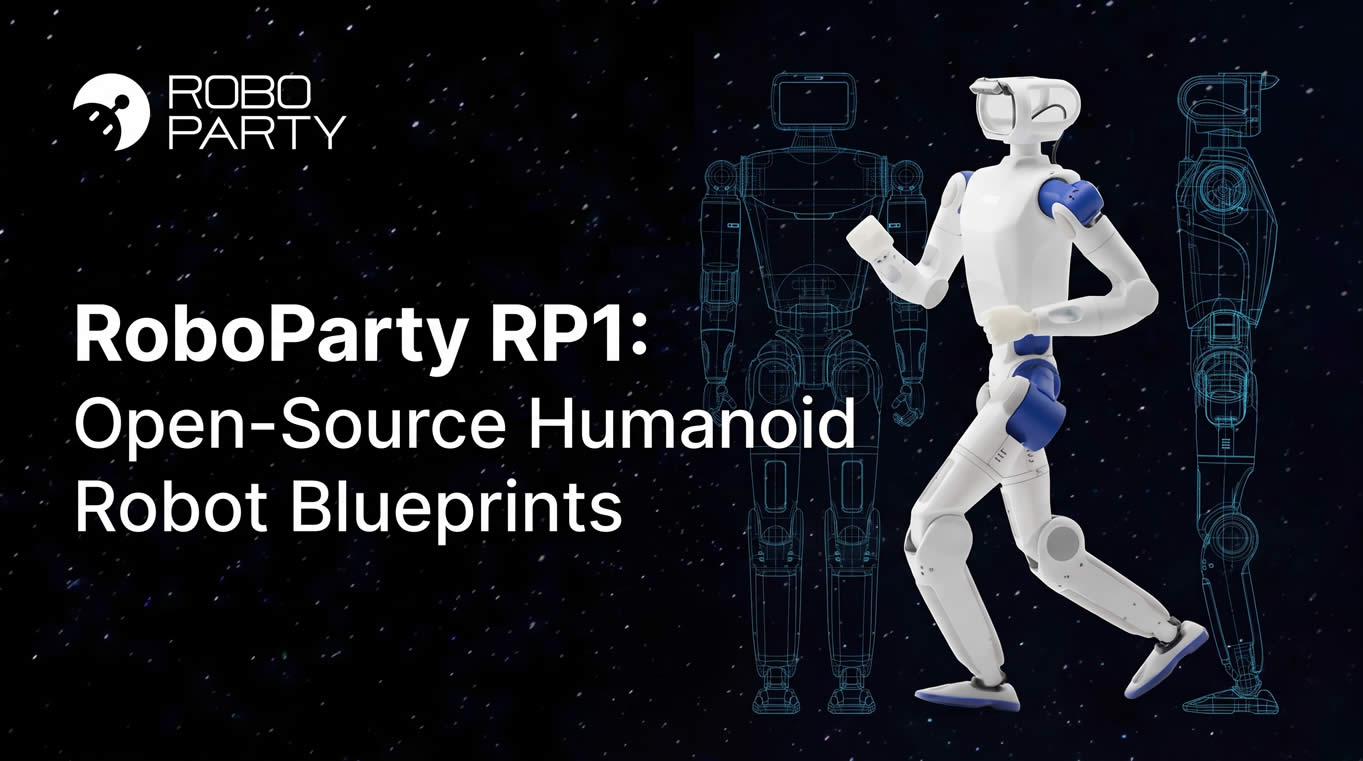
The Shanghai startup has open-sourced the CAD, the bill of materials and the motor designs for its RP1 biped. Building one is now a supply-chain problem rather than a secrets problem.
PITTSBURGH – The sign at the RoboParty booth at IROS 2026 said “Kick Me,” and visitors took it literally. The company’s own footage from the David L. Lawrence Convention Center shows visitors shoving the biped from the side and kicking one leg out from under it. Each time, it staggers, regains its balance and waits to be kicked again.
RoboParty had come to Pittsburgh with a booth, a sign and one thing to prove. The machine does not fall over.
About two weeks later, the company did something with far less footage potential. It published the robot.
The GitHub repository is titled, without much poetry, “An OpenSource Full-Stack Platform for Agentic Humanoids.” It is mostly a signpost. The material sits across a dozen sibling repositories: mechanical CAD and engineering drawings, a bill of materials, PCB layouts, wiring harnesses, 3D models, the design files for RoboParty’s own ROMOMO joint modules, firmware, motor drivers, gait algorithms, ROS 2 middleware, an SDK, a simulator and the training code. The firmware and deployment stack are GPL-3.0, the training code is BSD-3-Clause, and the hardware design files are under CERN-OHL-W-2.0, a license written for open hardware rather than borrowed from software.
Humanoid robot makers publish URDFs and highlight reels. A bill of materials that lets a builder identify and source the parts is a different kind of document, and a much rarer one.
The datasheet is the interesting part
The launch video runs through the usual beats: the robot jogs, absorbs a shove, picks itself up off the floor. The spec sheet is where the claims can be checked, and it says more.
RP1 is 1.35 meters tall and weighs about 39 kilograms with battery and end effectors. Twenty-four active degrees of freedom, or 30 on the Pro model, which adds a two-axis neck and two more degrees of freedom in each arm. Payload: 3 kilograms. Top running speed: 4 m/s. It climbs a 30-degree slope and clears a 50-millimeter step. The joints are RoboParty’s own modules, built around an inner-rotor motor and two-stage planetary gearing; the 100-millimeter version peaks at 160 newton-meters. A 10 Ah battery buys about three hours; it is hot-swappable and recharges at 140 W over USB-C.
The standard compute module is built around a Rockchip RK3588. An Nvidia Jetson Orin NX is optional.
Those numbers describe a research platform, not a production-floor workhorse – which is the point of the pitch: a machine meant to be taken apart by the people who use it rather than serviced by the people who sold it. What RoboParty has not said is what it costs.
What “open” covers, and what it leaves out
The parts usually kept proprietary are the ones published: drawings for the body and the joint modules, the BOM, the PCB files. Heads, hands and end effectors are swappable, with four head configurations (locomotion, interaction, data collection, perception) and hands with six or 22 degrees of freedom.
Splitting the repositories by medium, and putting a hardware license on hardware, is the right instinct. Plenty of projects do not bother.
The gaps are elsewhere. roboparty_train, the Isaac Lab workspace where locomotion policies get trained, has 196 stars, 52 forks and no repository-wide license, which under default copyright leaves its own code without a clear grant. It is a thin shell in any case: a README and two Git submodules, robolab and rsl_rl, both BSD-3-Clause. The motion-capture tools are Apache-2.0, and the reinforcement-learning framework UFO is under a custom license. A developer assembling a reproducible pipeline has to reconcile several sets of terms – and find one conspicuous gap.
Then there is the duller question, the one that decides whether any of this matters: an open BOM is only as open as its supply chain. Can the parts be sourced in small quantities outside China? At what lead time, and at what markup? RoboParty sells its earlier robot through a Chinese storefront. It has not announced pricing or export plans for RP1.
Not the first, but further
RoboParty did not invent this move. AgiBot open-sourced its X1 humanoid robot in October 2024 – full drawings, BOM, an assembly SOP, training and inference code – and the gesture was widely read as a rebuke to the assumption that humanoid know-how belongs behind a wall.
Since then, most of the open-source work in humanoid robotics has been on the software side. In July, Ant Group’s embodied-AI unit released LingBot-VLA 2.0, a vision-language-action model pretrained on about 60,000 hours of data: 50,000 hours of robot trajectories covering 20 configurations from 17 manufacturers, and 10,000 hours of first-person human video. Google DeepMind shipped Gemini Robotics 2 the same month – one VLA checkpoint that drives a whole humanoid from feet to fingertips, plus an on-device version that adapts to a new pair of arms in a few hours, typically from fewer than 200 examples.
Both go after the same constraint: a model that works on exactly one machine has a small market. But cross-embodiment is still a research problem. DeepMind’s own announcement calls transferring a learned skill from one body to another “incredibly difficult,” and adaptation costs data and time even when it works. The better the models get at hopping between bodies, the more valuable an open, modifiable body becomes.
The kid in the dorm
Huang Yi was a first-year undergraduate at Harbin Institute of Technology in late 2023 when he and several roommates spent a few dozen days building a 1.2-meter biped for about 15,000 yuan, roughly $2,100. They called it AlexBot. Huang decided it was not good for much, so he put the mechanical design, the electronics, the control code, the algorithms and the build log on Zhihu, GitHub and Feishu, and moved on with his life.
Then strangers started building it.
That is the part he keeps coming back to. A student project normally ends with a demo video and a grade. AlexBot ended with strangers building copies in their own workshops. RoboParty was founded in February 2025; its first product, ROBOTO Origin, turned the DIY route into something you could buy in parts, and by this August it was shipping around 100 units a month. In January this year, engineers from Tsinghua’s Yao Class and Peking University’s Zhi Class joined to staff a research arm, RoboParty Lab, which now maintains Party OS and a handful of published projects with names like UFO, MimicLite and INTACT.
Huang, who is 22 and would rather be called a robotics enthusiast than a CEO, frames the strategy as arithmetic rather than idealism. A startup either wins by owning enough of the market that its choices become the standard, or it wins by letting other people build on its platform. RoboParty picked the second. Every open generation drops a set of default answers into the field: how many degrees of freedom a humanoid needs, which motors belong in the hips, how training data gets organized, which interface a model uses to reach a real machine. Defaults, repeated often enough, harden into standards.
The evidence that this is working is thin, but it is not zero. In August, a contributor posting as toonasinensis opened a pull request against UFO, RoboParty’s open-source humanoid control framework, arguing that the default action mapping could not reach the configured joint ranges – the soft limits the controller is supposed to respect. The proposed fix is an opt-in remapping that leaves existing behavior as the default, and it came with bilingual documentation and 20 tests. In a controlled A/B run on two GPUs, same motion data, same seed, same optimizer, both branches trained for about 106 million environment steps. Joint-limit and torque-limit penalties fell 43.27 percent and 72.42 percent. The author’s own caveat: one robot, one seed.
One person, one patch, one simulated result. The pull request is still open, and it says nothing yet about the RP1 that was kicked around in Pittsburgh. It is, though, an artifact that a highlight reel cannot produce.
A hundred units, or a hundred developers
In July the company raised close to 500 million yuan, about $70 million, across an Angel++ round and a Pre-A round. Shunwei Capital, Matrix Partners China, Xiaomi’s strategic investment arm and SenseTime Guoxiang put money into the first; CATL took the second alone. Huang has said that not all money is alike, and that choosing investors comes down to fit. Xiaomi brings manufacturing. CATL brings the factories that might one day buy robots.
He has also said no. A listed company wanted more than 100 units and exclusive distribution rights in parts of the overseas market. Huang turned it down: a hundred units do not mean much right now, he argued, while a hundred good developers mean a great deal. An overseas institution later asked for 500, and RoboParty shipped 20 or 30 while other customers waited two to three months. The target for 2027 is 2,000.
That is where the story stops being about GitHub. Going from “someone wants 500” to “we can reliably deliver 500” is a supply-chain problem, and 2,000 units a year is a different company from the one that exists today.
The part nobody has solved
The business model is the least finished thing about RoboParty. Selling bodies, modules and engineering services works, but it is also what every other humanoid company plans to do. The platform version, the one Huang describes, borrows from Android: open the base layer, grow the installed base, then earn on the tools, services and compatibility layer around it. Whether RoboParty can build that layer – certification, developer tooling, a data flywheel – will not be answered by a repository.
Neither will the brain. Huang likens embodied AI to a marathon: the body has covered a quarter of the course, the cerebellum is at the halfway mark, the brain has managed a kilometer or two. RoboParty’s hardware and locomotion are ahead of its models, and if Party OS and its whole-body work do not keep pace, the entry point to the ecosystem ends up belonging to whichever model company sits a layer above.
At IROS, the invitation was physical: kick the robot, see whether it stays up. The repository is the same invitation in a different register, and the answer will not come from Shanghai. It will come from whoever manages to build one.
