

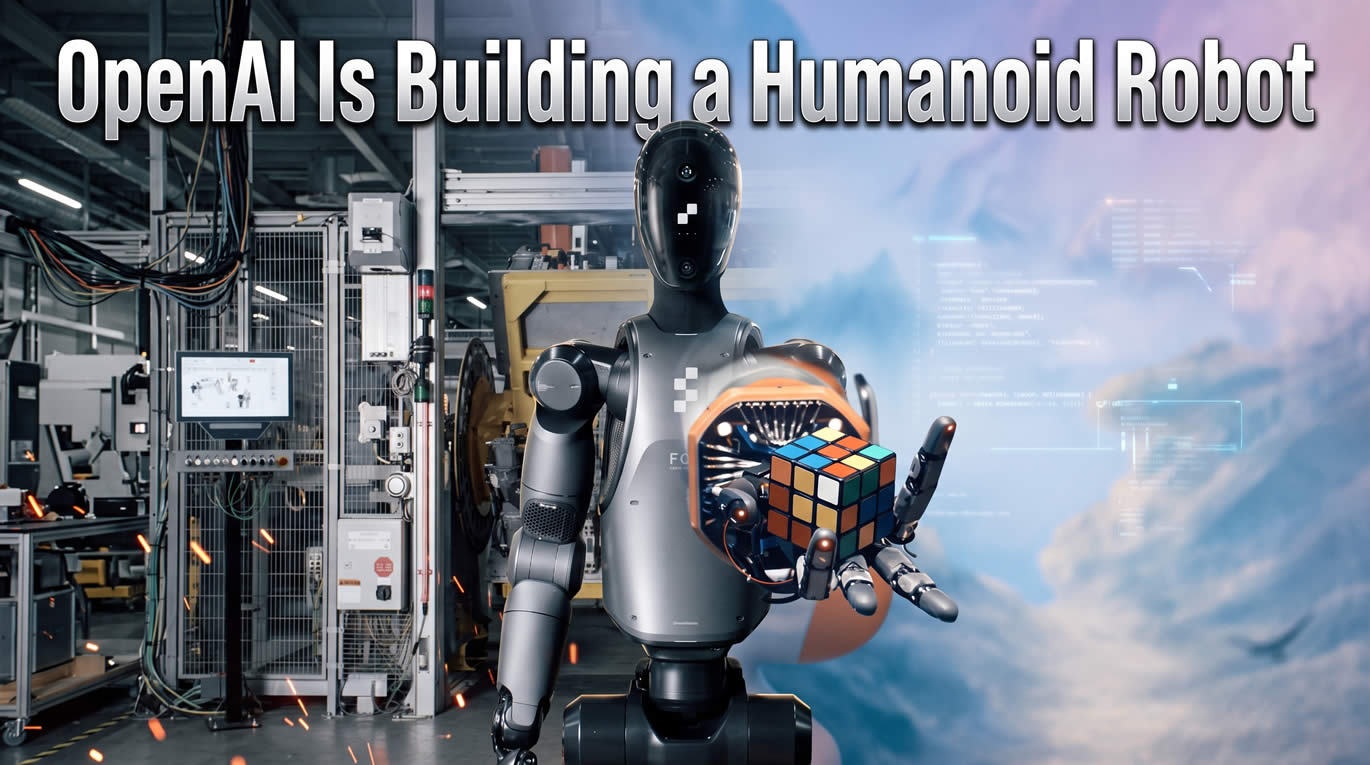
Sam Altman expects a humanoid demo in 2027. The company is hiring as though the body were the hard part.
On the Sources podcast this month, Sam Altman was asked whether OpenAI would actually build a humanoid robot. His answer was two words. “We will.”
The case he made was architectural. “The world is very much designed for people,” he said. Doors, keyboards, workbenches: all of it assumes a body of roughly one size, so “matching that form factor seems good.” What he waved away was the machine itself. The interesting problem, he said, was “the brain that makes the robot work” — whether a model can look at a room, work out what to do in it, and recover when the room disagrees.
A month earlier he had put a date on it. “I think we’ll have a cool demo in ,” he told Fortune in September. “I don’t think there will be robots walking the streets for a few years longer.”
So: a demo in two years, a product eventually, no price, no stated form factor, no hardware partner. The interview is not the most informative document OpenAI has published about this. The careers page is.
Twenty-Seven Openings
OpenAI’s site currently lists 27 roles tagged Robotics, up from about a dozen in May. The postings are all in San Francisco, and the ones I read put the work on site four or five days a week. Read the titles in sequence and a supply chain assembles itself: control systems software, electrical engineering, PCB layout, engineering technician for actuators, manufacturing engineer for motors and actuators, mechanical design engineer for motor prototyping, a mechanical engineer to build dynamometer and actuator test infrastructure, a lead safety engineer, a field engineer, a procurement coordinator, a technical commodity manager.
The commodity manager posting is unusually direct. “We’re a growing hardware company,” it says, and the hire will source precision machining, gears and mechanical components, EMS and PCBA work, and contract manufacturing — first for prototypes, then for new product introduction, then for high-volume production. “We’re hiring for where we’re headed, not just where we are today.”
The actuator roles are more specific still. One is for a manufacturing engineer to own stator stacking, winding, termination and potting, which is the sequence by which copper wire becomes a motor, along with the fixtures, gauges and work instructions that make the result repeatable. Another is to plan builds of “complete actuator assemblies ready for robot integration.” The salary band for the first runs to $318,000.
Stators are what a company builds when it has decided not to buy frameless torque motors from somebody else. OpenAI has not said it is making its own motors. It is hiring the people who would.
One phrase recurs across the listings and deserves attention: the team works across “a broad range of robotic form factors.” Plural, and not necessarily bipedal.
What Dactyl Proved
OpenAI has been here before, which is part of what makes this strange.
OpenAI’s first robot was a hand. Dactyl, built on Shadow Robot’s five-fingered hardware, learned to manipulate objects entirely in simulation using reinforcement learning and a technique called automatic domain randomization, then transferred what it had learned to the physical machine. By it could solve a Rubik’s Cube one-handed. It was the cleanest public demonstration that a policy trained in a simulator could survive contact with the real world.
OpenAI stood the team down in ; the decision became public the following year. The explanation at the time was priorities; the underlying constraint was data. A robot generates experience at the rate of one gripper, one object, one attempt. Language models were drinking from a firehose. The compute went where the data was.
What has changed is where the data comes from. Video models trained on internet-scale footage develop something that functions like an intuition about objects, contact and consequence. The wager behind OpenAI Robotics is that a world model can substitute for the physical experience the company could not afford to collect in 2019.
The staffing says as much. The team grew out of an internal world simulation research group led by Aditya Ramesh, who co-created DALL·E and led research on Sora. When Altman announced the group on , he described that project as having evolved into the robotics effort over the past year. Putting the video-generation researcher in charge of the robot is a claim about which half of the problem OpenAI believes it owns.
The Partner Who Left
There is a defensive logic here too, and it is easier to date.
In , the OpenAI Startup Fund led a $23.5 million round in 1X Technologies, a Norwegian humanoid maker — the fund’s first hardware investment. In , OpenAI put money into Figure‘s $675 million Series B, alongside Microsoft, Nvidia and Jeff Bezos, at a $2.6 billion valuation. The division of labor was clean. Figure built the body. OpenAI supplied the vision-language model. Figure 01 took voice instructions, identified objects and handed things to people, and the videos did the rest.
The arrangement lasted about a year. On , Figure’s Brett Adcock announced that the company was ending the collaboration, citing a breakthrough. Sixteen days later Figure published Helix, its own vision-language-action model. Adcock’s subsequent argument was that a general-purpose model trained on text and images could not be tuned to the sensing and control of a specific machine — that embodiment was not an API call.
For OpenAI that is structural rather than personal. A model supplier to a robot company sits where any component vendor sits: the customer captures the margin, the deployment data and the relationship, and eventually internalizes the component. If humanoids turn out to matter, the model needs to be attached to a body that somebody controls, and OpenAI does not control one.
What a Demo Buys
Set the 2027 date against the rest of the field. Tesla has converted its Fremont line for the Model S and Model X to build Optimus Gen 3. 1X unveiled NEO last October at $20,000 and began delivering it to American homes in June, and the machine still leans on remote human operators for the tasks it cannot manage alone. Figure, valued at $39 billion in its last disclosed round, has been shipping hardware and building its own actuators for longer than OpenAI has had a robotics team. Chinese vendors — AgiBot, Unitree and UBTECH among them — accounted for most of the roughly 22,000 humanoids Counterpoint Research counted in the first half of .
A demo in 2027 would put OpenAI where several of those companies were two or three years ago on hardware, and ahead of all of them on the model, if the model works. That “if” is carrying most of the weight.
The company’s own framing is modest. Its job listings describe a short-term goal of robots that help skilled workers build infrastructure, and a long-term goal of a personal robot for anyone who wants one. That is not a consumer product timeline. It reads like a company planning to spend several years doing what Figure did in 2023 and 2024: learning to build a machine in small numbers, badly, and then less badly.
Which is the tension in the announcement. Altman says the body is the easy part, and the body is precisely what OpenAI is hiring for — stator winding, potting, fixtures, dynamometers, commodity managers, a field engineer. Nobody builds an actuator test bench for a demo.
The Deadline After the Deadline
The generous reading is that OpenAI has the sequencing right. Intelligence is the scarce input. Hardware is drifting toward commodity, with a deep supplier base in Shenzhen and a shallow one in California, and whoever solves the brain can buy or build the rest. The less generous reading is that this is 2020 in reverse: a lab that left hardware because physical data was too expensive, returning with a better story about data and no more manufacturing experience than it had then.
Both can hold for a while. The 2027 demo will not settle it either way. A hand solving a Rubik’s Cube on stage proves what Dactyl proved in 2019 — that simulation can teach a policy — and says nothing about whether a factory can build ten thousand of something.
What would settle it is duller. A bill of materials. A mean time between failures. A price, a customer who paid it, and a year of uptime afterwards.
OpenAI has given itself until 2027 to produce a demonstration. The harder deadline is the one that follows, and nobody has announced that date yet.
