


The IP5 filing data show China's lead widening quickly. The harder question is whether a lead in robot bodies turns into control of robot brains, and of the factories that build them.
China's grip on humanoid robot patents tightened again this year, and the margin is no longer small enough to dismiss as a blip.
Under the IP5 dataset, China's share of humanoid robot patents reached 60.8% in the first half of 2026, up from 51.8% in 2024. The United States slid from 27.3% to 21.8%. South Korea, once seen as a natural challenger in robotics hardware, fell to 4.6%.
Filing volumes are even more lopsided. In the first six months of 2026, China filed 1,584 humanoid robot patent applications. The United States filed 113. South Korea filed 35, roughly one for every 45 filed by China. Across the whole of 2025 the totals were 2,573, 640 and 97.
There is one important caveat: patent applications are typically published 18 months after filing. The 2026 figures describe a map still being drawn, not a final tally. They are best read as a signal of where the industry is placing its bets.
Humanoid robot patents: the gap in numbers
| Measure | China | United States | South Korea |
|---|---|---|---|
| Share of humanoid patents, H1 2026 | 60.8% | 21.8% | 4.6% |
| Share of humanoid patents, 2024 | 51.8% | 27.3% | — |
| Applications filed, H1 2026 | 1,584 | 113 | 35 |
| Applications filed, full-year 2025 | 2,573 | 640 | 97 |
| Robot foundation model patents, H1 2026 | 66.3% | 14.1% | 8.8% |
| Applications filed, 2020–2025 | 7,705 | 1,561 | — |
Sources: IP5 statistics; LexisNexis; Morgan Stanley. Japan ranked third over 2020–2025 with 1,102 applications. "Share" and "applications filed" are separate measures and do not share a common denominator.
The five offices behind the number
IP5 is shorthand for the world's five largest patent offices: China's CNIPA, the USPTO, the European Patent Office, the Japan Patent Office, and South Korea's KIPO. Together, the five offices handle a large share of the world's patent filings, including PCT applications, making IP5 data a useful proxy for global industrial trends.
Humanoid robots suit this kind of analysis unusually well. A machine that walks, sees, grips and reasons has to solve mechanical structure, joint modules, motion control, visual perception, force sensing, localization and navigation, dexterous manipulation, AI models, power management and human-robot interaction, all at once. That is less a product than a reassembly of an entire intelligence stack for the physical world. Its most valuable patents rarely show up on the outside.
The action is moving from hands to brains
The composition of that patent stack is changing quickly.
In 2024, humanoid patent activity clustered in the "limb layer": mechanical structures, joints, actuators, the hardware that makes a robot move. By 2025 the balance had flipped. Patents in the "brain layer" approached 50% of the total, while the limb layer fell below 25%.
China's growth in the brain layer has been steep. LexisNexis, the information analytics firm, reports that Chinese patent activity grew roughly fivefold in control-and-planning architectures over the past decade and roughly doubled in interaction systems. In robot foundation models (RFMs), the frontier of the field, China held 66.3% of patents in the first half of 2026, against 14.1% for the United States and 8.8% for South Korea.
The driver is familiar by now. Once generative AI gave machines the ability to parse natural language and plan multi-step tasks, embodied intelligence stopped being a research slogan and became an engineering program. China's accumulated strength in large models feeds directly into the brain layer of its robots.
A lead that was years in the making
It is tempting to read the 2026 numbers as a sudden land grab. The longer record argues otherwise.
Morgan Stanley's humanoid-robot almanac, published in December 2025, counted 7,705 Chinese humanoid-related applications over the five years from 2020 to 2025. The United States filed 1,561, about a fifth of China's total. Japan was third with 1,102.
The comparison that keeps surfacing is electric vehicles. A decade ago, China's EV patent surge looked like volume for its own sake, and few observers expected the battery chemistry behind it to underwrite a trillion-dollar industry. The humanoid robot curve is tracking the same shape, only faster.
Who is actually building the moat
Aggregate share says little about who owns the technology, or how good it is.
LexisNexis analyzed more than 26,000 patent families to rank humanoid startups by patent strength. The top five are all Chinese. Shanghai's Fourier Intelligence and AgiBot take the first two places, followed by Shenzhen's LimX Dynamics and Pudu Robotics, with Hangzhou's Unitree fifth. Shenzhen's Leju Robotics ranks ninth.
UBTech, excluded from that ranking because it is a listed company rather than a startup, shows what a concentrated strategy looks like. As of the end of June 2026, the Shenzhen company held 3,112 granted patents, including 1,857 invention patents and 530 granted overseas. Its portfolio is built around deployment rather than demonstration. The Walker S2, for instance, can swap its own battery in about three minutes, a trick that rests on a cluster of patents covering dual-arm coordination, battery management and visual positioning. A separate UBTech patent for a servo driver, aimed at bringing a core humanoid component in-house, won a China Patent Excellence Award.
Unitree took a different route. The Hangzhou company built its reputation on quadruped robots and pushed deep into legged locomotion control and high-performance joint motors. It has filed 261 patent applications across eight countries and regions, about 50 of them international PCT filings, covering China, the United States, Japan and Europe. In July 2025 it became the only Chinese robotics company among that year's ten WIPO Global Award winners.
LexisNexis also found something counterintuitive about focus. Among the ten institutions with the strongest humanoid patent portfolios, nine devote less than 10% of their total patent holdings to humanoids. The exception is UBTech, whose humanoid-related patents make up more than a quarter of its entire portfolio. In an industry this young, going all-in matters more than spreading bets.
Where China still trails
Volume is not the same as technical leadership, and the numbers reveal a clear gap.
LexisNexis rates the United States highest on average patent quality. American inventors hold only about 5% of active morphology-related patent families but contribute roughly 11% of global portfolio strength in that area, more than twice their share by volume. US patents also score highest on average quality in each of the three core domains: interaction systems, morphology and control-and-planning.
The implication cuts both ways. American firms trying to design around Chinese patents run into a wall of volume. Chinese firms trying to sell into the United States run into a different obstacle: fewer patents, but a higher average quality.
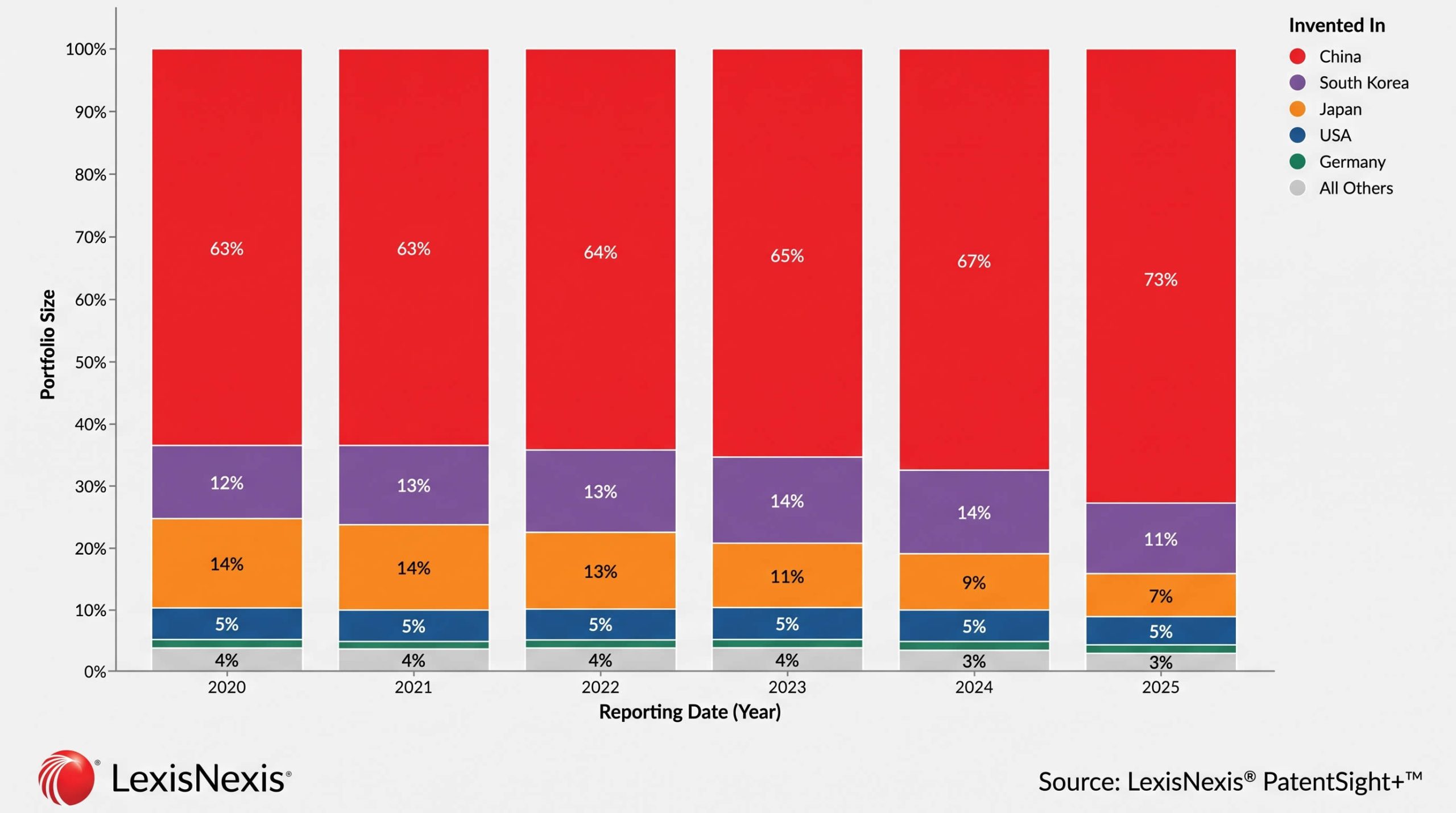
Weight the same patents by portfolio strength, though, and the picture shifts again. By the end of 2025, China accounted for 63% of global portfolio strength in morphology-related technology, against about 11% for the United States and 10% for Japan. The overall quality of Chinese filings is climbing quickly. Building a dense portfolio of genuinely high-value patents simply takes longer.
The cost gap between a patent and a product
A second caution comes from the supply chain. Semiconductors account for only about 5% of a humanoid robot's bill of materials. The remaining cost is concentrated in actuators, reducers, rare-earth magnets and the labor involved in 40 to 60 hours of manual assembly. None of these cost components follow Moore's Law.
That is the chasm a patent lead has to cross before it becomes an industrial one. Dominance in filings buys negotiating leverage and design freedom. It does not, on its own, make a hand cheaper to build.
Patents are national, and so is the risk
Patent rights are territorial, and that shapes the game more than headline share suggests. Measured by inventor location, China accounted for 73% of active morphology-related patent families by the end of 2025, and those filings sit in patent offices around the world. Even if the US market closed to Chinese robot imports, American manufacturers could still find Chinese intellectual property standing between them and core technology. Forbes has gone further, suggesting US companies may eventually need to license Chinese IP.
The parallel to telecom is hard to avoid. When Huawei secured a leading position in 5G standard-essential patents, every equipment vendor in the world had to reckon with its terms. Whether humanoid robots replay that script is an open question, but the direction of travel is legible.
Litigation risk is rising in step. In 2025, Unitree was targeted in what looked like a classic case of patent trolling: a company whose business was food and household goods acquired an "electronic dog" patent and sued Unitree five days later, claiming ¥500. During the appeal it raised the demand to ¥80 million, then abruptly dropped it back to ¥500. China's Supreme People's Court dismissed the appeals and upheld the earlier finding that Unitree had not infringed; a counterclaim then produced a ruling that the suits amounted to malicious litigation. Cases like it are a reminder that in a hot sector IP is both a moat and a weapon, and that a standing early-warning and response function matters more than reacting case by case.
Meanwhile, the hardest engineering problem sits exactly where the patents are thickest. Dexterous hands remain the obstacle even Tesla has not cleared. It has published patents covering the technology, and it is still preparing Optimus for mass production, with the hand still the outstanding challenge.
After 60.8%
The 60.8% is best read as a milestone, not an endpoint.
China's position rests on advantages that are hard to copy quickly: a deep supply chain, fast engineering iteration and sustained policy support. The patent strategies now on display, from UBTech's full-stack self-development to Unitree's global filing campaign to the rise of newer entrants such as Fourier Intelligence and AgiBot, have shifted from accumulating volume toward pushing for quality.
But a patent is not a product, and a product is not a commodity. The distance from a lab demo to a factory line, and from a factory line to a living room, is measured in cost, safety and the unglamorous work of fitting a machine to messy real-world environments.
The next three to five years are the window in which humanoid robotics stops being a patent story and becomes an industry story. The companies that reach volume production and a working commercial loop first will have the strongest say in shaping the industry.
Sources: IP5 patent statistics; LexisNexis (Patent Asset Index); Morgan Stanley humanoid-robot research; WIPO; Forbes; China's Supreme People's Court.
