



Machines under a meter tall accounted for more than half of global humanoid sales by unit in the first half of 2026, and under 4% of the money.
Ask someone to picture a humanoid robot and you will get roughly the same drawing: a machine about the height of a person, two legs, two arms. For three years that was also the industry’s answer. Tesla’s Optimus helped establish the full-size humanoid as the industry’s default image. Founders pitched it, investors sized the market around it, and conference stages filled with machines standing somewhere between 1.6 and 1.9 meters, doing their best impression of a person.
That agreement has come apart. Not because anyone gave up on the human-sized robot, but because two other sizes turned out to sell.
There is no standard ruler
Nobody agrees on where small begins. Frost & Sullivan’s 2026 Global Humanoid Robot Market Research Report draws the line at 100 centimeters. The people who actually build these machines tend to use a wider band, roughly 60 centimeters to 1.4 meters, with anything under 60 centimeters drifting toward the desktop-toy category and anything past 1.4 meters edging back toward full size.
The definitional mess matters less than the direction of travel. In the first half of 2026, robots below that 100-centimeter line accounted for 19,700 of the 36,000 humanoid robots sold worldwide. More than half the market by unit. Those 19,700 machines brought in about $19 million, against a global total of $540 million. Just under 4%.
A much smaller group did the opposite. Frost & Sullivan calls them full-size embodied-AI humanoids: at least 160 centimeters tall, carrying 200 TOPS or more of onboard compute, able to work without teleoperation or pre-scripted routines. There were 5,800 of them, about 16% of units sold. They generated $324 million, or about 60% of total humanoid robot revenue in the first half of 2026.
Those two groups of machines are not really competing. They go to different customers, at wildly different prices, for reasons that barely overlap.
The counting problem
Before drawing conclusions from any of this, it is worth knowing that the research firms do not agree on how many humanoid robots were sold at all.
IDC puts first-half global shipments closer to 25,000 units and the market above $740 million, and has raised its 2030 forecast past 750,000 units a year. BTIG, counting production by the leading makers such as Unitree and AgiBot, arrived at roughly 31,000 machines. It found that only 32% were full-size and just 13% were bipedal. Most of the rest were smaller, and many were wheeled rather than legged.
Three firms, three different totals, and a spread wide enough to make any single figure worth questioning. They are not directly comparable: Frost & Sullivan reports sales, IDC tracks shipments, and BTIG estimates production by leading manufacturers, with the methodological detail behind that estimate notably thin. None of them publishes a full methodology, and each tracks a slightly different population.
Why small robots suddenly work
Making a humanoid small used to be harder than making one big. The bottleneck sat in the joint. A knee or a hip needs a reducer, a motor and a driver stacked together, and that stack does not shrink politely. Build it small enough and you lose torque. Build it strong enough and it no longer fits.
Quasi-direct-drive actuators changed the arithmetic. QDD designs run at low gear ratios, a design choice that makes them responsive and easy to control, but they demand more motor current and more thermal headroom. That trade-off gets punishing at human scale, where a joint has to move real body mass through a real lever arm. Shrink the robot and the problem relaxes: mass falls with the cube of length, and the torque a joint must supply falls faster still. Small robots are not simply cheaper to build. They are the size at which the current generation of actuators works well.
Figurobot’ NIA-FR02 shows how far the parts have come. The 60-centimeter desktop humanoid weighs about 1.5 kilograms, and the company’s product page lists up to 34 degrees of freedom, driven by its own micro joint servos measuring 6 to 8 millimeters across — roughly the width of a pencil.
What buyers are actually paying for
Price is where small robots stop being a technical story and start being a consumer one.
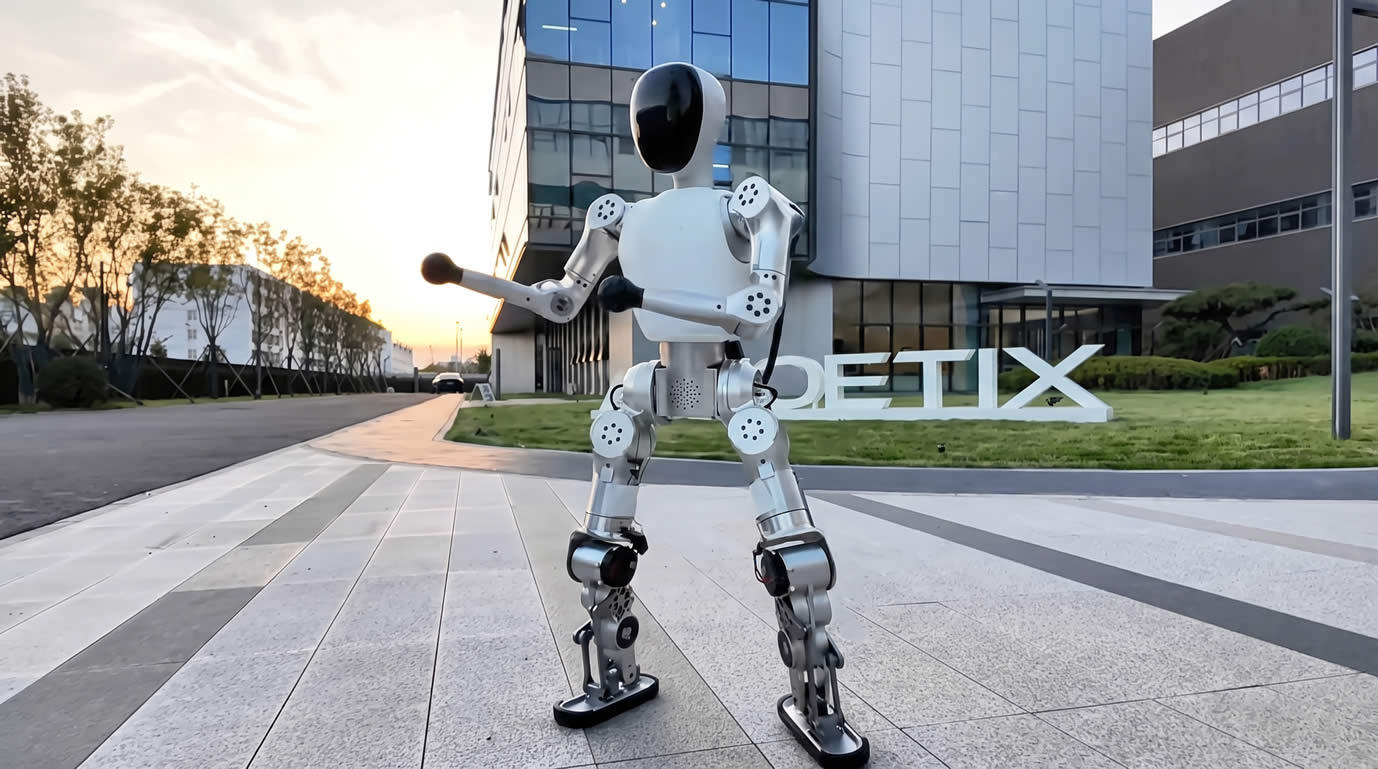
Noetix Robotics sells the Bumi for 9,998 yuan, around $1,400. Its first 500 units sold out in two days when it launched on JD.com in October 2025. Zeroth, the robotics brand of Suzhou-based JoyIn, launched the Bridge at 8,888 yuan and said it sold more than 600 units on day one. Unitree’s R1 Air lists at 29,900 yuan, though at about 1.2 meters it sits above the small-robot line, and Booster Robotics prices its K1 the same. High Torque Robotics prices its Mini Pi from about 26,800 yuan, with a home version around 50,000 yuan due later.
A price band like that brings consumer expectations with it. A 1.8-meter machine standing in a living room is a liability question before it is a product. A 90-centimeter one is lighter and easier to live with; a fall can still hurt, but the risk of serious injury is far lower, which clears a much lower psychological bar. Smaller frames and batteries also make it ship more like an appliance: standard freight, and repair costs well below those of a full-size unit. Cheap units fail cheap, which means companies iterate faster and dare to try more.
The catch is that cheap also means thin. Companionship, coding education, exhibition and performance are real jobs, but optional ones. Frost & Sullivan treats both as early-stage use cases, and the report identifies production work as the fastest-growing application, with value tied more directly to measurable output.
The other end of the ruler
While the low end went shopping, the high end split into two camps: machines built for spectacle, and machines built for work no person should have to do.
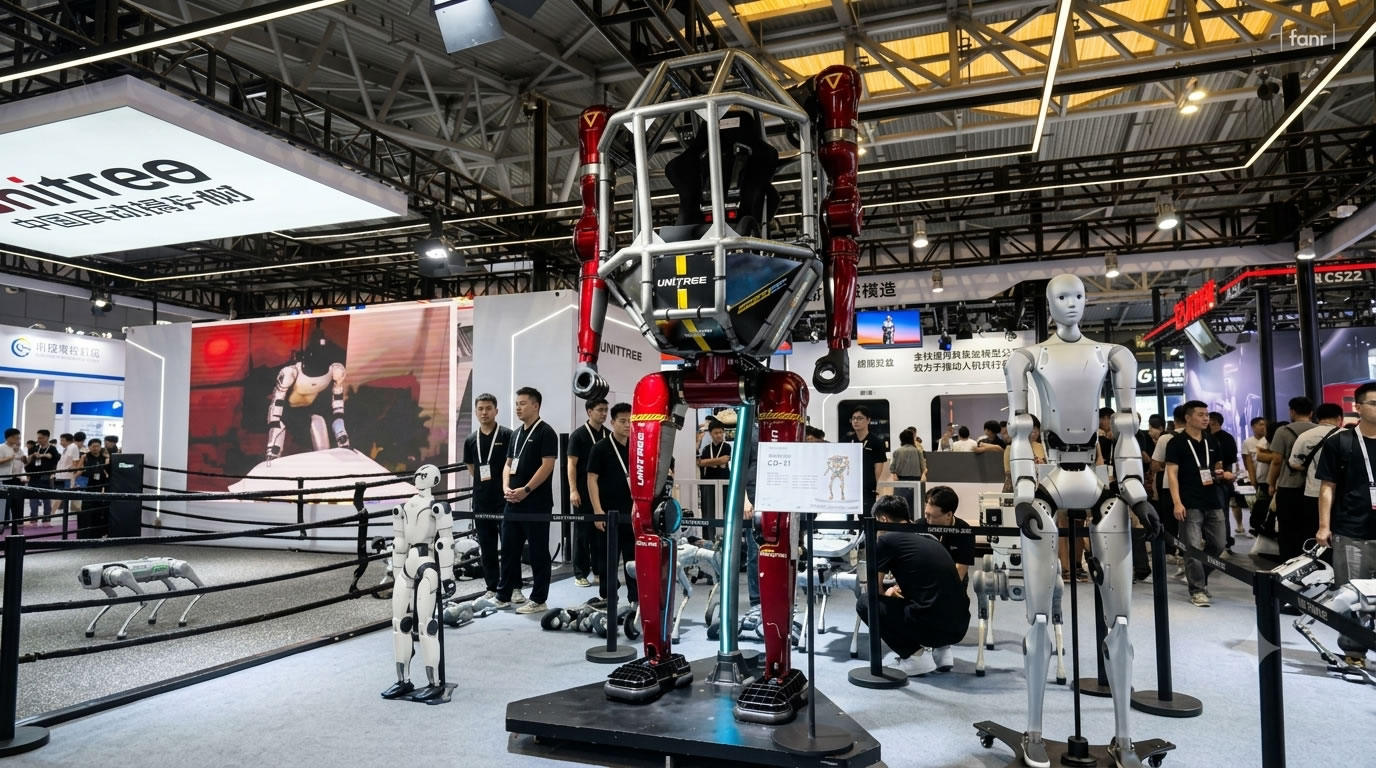
Unitree’s GD01, launched in May, is a manned transformable mecha standing about 2.7 meters and weighing roughly 500 kilograms with a rider aboard. It switches between bipedal walking and quadrupedal crawling, and starts at 3.9 million yuan. The GD01 is the most expensive product Unitree has unveiled to date. At the Global Digital Trade Expo in Hangzhou in September, visitors queued to see it, but no sales had been reported by the end of the event.
Wang Xingxing, Unitree’s founder, was unbothered. Speaking at the expo, he called large robots “an unstoppable trend for the industry” and added that even if Unitree had not built one, another company would have within a few years.
The framing is worth taking seriously. Small robots answer the question of how a robot gets into daily life. Big ones are being built for tasks that are difficult, dangerous or physically demanding for people. Whether they can do those jobs reliably and autonomously is a separate question.
NeodraDynamics is aiming at exactly those conditions. Its 4-meter super-humanoid carries 41 active degrees of freedom, 39 of them driven by digital hydraulic linear actuators, with a claimed single-arm payload of 300 kilograms. The company names nuclear maintenance, deep-sea work, mining and emergency rescue as target markets. In each of them the human body is the limiting factor: radiation keeps crews out, pressure keeps divers shallow, and collapsed rock makes manual clearing slow and dangerous. A machine that can go where people cannot is not competing with a Bumi on price. It is competing with an excavator.
There is a theatrical version of this too. At the World Robot Conference in Beijing in August, Zhongjian Technology showed a concept humanoid called ZERO that stands two storeys tall. Zhongjian is a listed garden-machinery manufacturer in Zhejiang that built the machine through a robotics subsidiary, which tells you how far the supply chain has spread. TitanAI went further: its Zhaocai, developed with JD.com, stands 6 meters, with close to 50 kilograms in one arm alone. Both are showpieces rather than products, and neither has a published price or a named customer.
The middle is the squeeze
Which leaves the size everyone spent three years chasing.
A plain full-size humanoid now has the worst of both ends. It costs far more than a consumer machine and does far less than a heavy-duty one. Nobody buys one on impulse, and it cannot yet replace a worker on a production line without a supervisor standing nearby. Frost & Sullivan’s breakdown makes the distinction sharp: full-size humanoids as a whole moved about 8,400 units in the first half of 2026, but it was the 5,800 with genuine autonomous capability that took the lion’s share — $324 million of the $540 million total. Being tall was never the product. Being able to work is.
That is where the money has begun to concentrate. Production-floor deployments generated $78 million in the first half of 2026, up from $47 million for all of 2025, with unit volumes rising from 700 in the whole of 2025 to 1,200 in the first half. UBTech leads the segment and opened an industrial humanoid factory in September with planned capacity above 10,000 units a year. Its Walker S machines are handling parts and running inspections inside auto and electronics plants, on a small scale and under close supervision. A modest start, and the only part of this market where the customer is buying labor rather than novelty.
What the split actually means
It is tempting to read all of this as small robots winning. The unit numbers say so. The revenue numbers say the opposite, and revenue is what keeps companies alive.
The more interesting reading is narrower. The industry is conceding that there is no single correct size, because there is no single job. A machine that sits on a desk teaching a child to code has almost nothing in common with one that walks into a reactor building, beyond the fact that both have two arms and a head. Forcing them into one specification was always a marketing decision dressed up as an engineering one.
For now the two ends of the market are being financed by different kinds of money. Small robots are paid for by consumers at retail, one unit at a time. Big ones are paid for by industrial customers with capital budgets and procurement cycles measured in years. The open question is whether industrial buyers will ever order these larger robots in volume.
Sources:
- Frost & Sullivan’s 2026 Global Humanoid Robot Market Research Report.
- IDC’s Worldwide Annual Humanoid Robotics Tracker.
- A BTIG research note on humanoid robotics, as reported by Seeking Alpha.
- Unitree’s official GD01 launch announcement and founder Wang Xingxing’s keynote at the 5th Global Digital Trade Expo.
- Zeroth’s September 2, 2026 press release.
- NeodraDynamics’ official website and its WRC 2026 launch materials.
- Xinhua and Science and Technology Daily’s coverage of ZERO at WRC 2026.
