


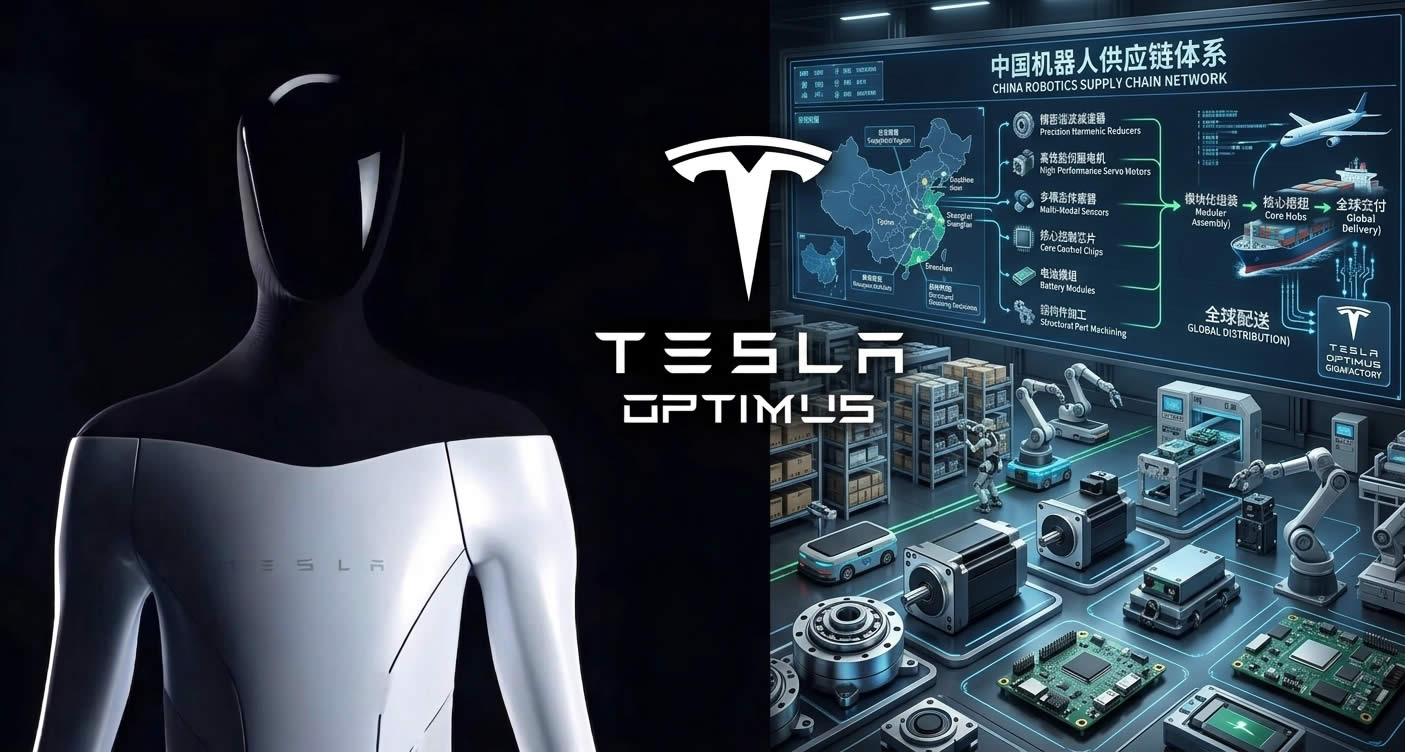
Tesla is getting closer to the point where Optimus has to become a manufactured product rather than a robotics demonstration. In mid-September, Tesla’s robotics team began auditing suppliers in China’s Yangtze River Delta, including Ningbo-based Tuopu Group, Sanhua Intelligent Controls and Joyson Electronics, according to Chinese financial media reports. The companies are already part of Tesla’s automotive supply chain and have been developing components relevant to humanoid robots.
The timing is notable. Just weeks earlier, the U.S. Federal Communications Commission had added foreign-produced advanced robotic devices to its Covered List, creating a new regulatory barrier for qualifying foreign-made robots seeking access to the U.S. market. The rule is broader than a China-specific ban, but the move has been widely discussed in the context of Chinese humanoid and quadruped robots. The FCC later introduced a conditional-approval process for certain foreign-produced devices.
So while Washington is making the U.S. market harder for some foreign-made advanced robots to enter, Tesla is looking to Chinese factories for part of the manufacturing infrastructure it needs to scale its own humanoid robot.
The answer looks different on the factory floor.
Tesla Is Auditing Chinese Suppliers for Optimus
Tesla has not publicly disclosed a final list of Chinese suppliers for Optimus, nor has it confirmed the size of any production orders linked to the latest audits. Chinese reports have said the inspections cover companies including Tuopu, Sanhua and Joyson, with the work extending across the Yangtze River Delta.
The South China Morning Post reported on September 18 that Tesla officials and engineers had begun auditing Chinese suppliers ahead of the planned ramp-up of Optimus. Most of the companies identified by the newspaper already supply Tesla’s electric-vehicle business and are based in Zhejiang province.
Tuopu has built capabilities in electric motors, precision machining, electromechanical systems and robot actuators. Its 2026 interim report says its robotics business is centered on linear and rotary actuators and that its automotive technologies in electric drive, electronic control and precision manufacturing are being extended into embodied-intelligence components. The company said its linear actuators, rotary actuators and dexterous-hand motors had reached small-batch delivery during the first half of 2026.
Sanhua, another long-standing automotive supplier, said in its 2026 interim report that its electromechanical actuators for bionic robots were entering batch production and ramping up.
Joyson has also been building out a robotics business. The company has introduced robot components including dexterous hands, AI head assemblies, electronic skin and control systems, positioning the business as an extension of its automotive electronics and safety capabilities.
For Tesla, the attraction is that these companies already operate inside a production system built around automotive-level quality, tooling, process control and supplier management.
Optimus is now entering a very different phase.
Optimus’s Next Challenge Is Manufacturing at Scale
Tesla has demonstrated Optimus for years. The harder task is turning a small number of working machines into thousands of robots that can be assembled repeatedly, tested consistently and delivered at a cost that makes large-scale deployment possible.
A humanoid robot is an unusually difficult manufacturing product because almost every major component sits at the intersection of mechanical engineering, electronics and software.
A motor that is slightly too heavy can affect joint performance. A reducer that does not last long enough can force changes to the actuator. A cable-routing problem can require a redesign of the surrounding structure. A sensor can work perfectly in a prototype and still prove difficult to integrate consistently on a production line.
The challenge grows when the design itself is still changing. A robot company can hand-build a few prototypes while engineers compensate for problems one machine at a time. Mass production removes that flexibility. Motors, reducers, screws, sensors, controllers, structural parts and housings have to meet tighter requirements for cost, lifetime, consistency and delivery at the same time.
That is why Tesla’s supplier audits matter beyond the companies being inspected. They indicate that the question is no longer simply whether a component works. It is whether the supplier can keep changing the component as Optimus changes.
Tesla’s own manufacturing plans underline the scale of the challenge. In its second-quarter 2026 update, the company said construction had begun at its Fremont factory for an Optimus production line, with production expected to start soon. Tesla’s quarterly filing also said it was investing in manufacturing capacity, including Optimus operations, while continuing to work on supply-chain resilience and localization.
Building the final robot in the United States does not necessarily mean every component has to be developed and produced there.
That distinction is central to Tesla’s current search in China.
China’s Supply Chain Advantage Goes Beyond Cost
China’s role in robotics is often reduced to one word: cost.
That explanation is increasingly incomplete.
Humanoid robots are being developed while the industry is still testing different approaches to actuators, hands, sensors, computing systems and mechanical architectures. In that environment, proximity between a robot maker and its suppliers can matter as much as the price of an individual component.
A design change can mean a new prototype, a different machining process, a new material, a revised tolerance or another round of testing. If each supplier is separated by long logistics chains and large geographic distances, those iterations can take weeks. In a dense manufacturing cluster, much of the cycle can happen within days.
The supplier relationship changes as a result.
The supplier is not simply producing whatever appears on an engineering drawing. Its manufacturing engineers can influence the size of an actuator, the choice of materials, the tolerance of a machined part and the process used to assemble it. Over time, production knowledge feeds back into product design.
That flexibility matters in humanoid robotics, where the industry has yet to settle on a dominant architecture.
Tuopu’s latest disclosures provide a useful example. The company says it can develop motors, integrate motors with reducers and controllers, carry out precision machining and coordinate testing resources for robot actuators. It describes its robotics business as an extension of technology accumulated through automotive components.
Sanhua offers another example. Its experience in electromechanical systems for vehicles is being transferred into robotic actuators, which are now progressing toward larger-scale production.
The bigger advantage is a supplier network that can respond quickly as the product changes.
China’s EV Supply Chain Is Moving Into Robotics
The overlap with electric vehicles is one of the more important pieces of the story.
Many of the capabilities needed to build a humanoid robot at scale are not unique to robotics. Motors, power electronics, thermal management, precision metalworking, sensors, controllers and highly automated production processes have all been developed extensively in the automotive industry.
That gives Chinese automotive suppliers a route into robotics that is different from starting a new manufacturing business from scratch.
Tuopu explicitly describes its embodied-intelligence products as an extension of technologies accumulated in automotive electric drive, electronic control and precision manufacturing.
Joyson has taken a similar approach, using its automotive electronics and safety background to develop robot controllers, head assemblies, dexterous hands and other components. In July, the company showcased a 20-degree-of-freedom dexterous hand, an AI head assembly and other robotic systems at the 2026 World Artificial Intelligence Conference.
China installed about 295,000 industrial robots in 2024, representing 54% of global installations, according to the International Federation of Robotics. Its installed industrial robot base reached about 2.027 million units. Chinese robot manufacturers also accounted for 57% of the domestic market in 2024, the first year in which local suppliers surpassed foreign manufacturers in market share.
Those numbers are for industrial robots, not humanoids. They should not be read as evidence that China has already solved humanoid-robot manufacturing.
They do, however, show the size of the engineering and automation environment from which the newer humanoid sector is emerging.
The Pull Into China Goes Beyond Tesla
Tesla is not the only international company seeking closer links with China’s robotics ecosystem.
Renesas opened a Physical AI & Robotics Lab in Beijing in August. The company said the facility would support system-level demonstrations, validation and joint development with customers, with the goal of taking robotics projects from proof of concept toward larger-scale deployment.
NXP, meanwhile, continues to position China as an important market for robotics and physical-AI development. Its September technology summit in Shanghai included next-generation robotics among its industrial and IoT focus areas, alongside edge AI, real-time networking and other technologies used in autonomous systems.
Tesla is looking for manufacturing partners. Semiconductor companies are trying to get their processors, sensing, connectivity and control technologies into robot architectures early in the design cycle.
Both approaches lead to the same thing: close contact with robot developers and manufacturers in China.
For these companies, the calculation is largely an engineering one: access to customers, development partners and manufacturing capabilities close to the market.
Physical AI makes this especially important. A failed grasp can be caused by software, sensing, actuator control, mechanical design or communication latency. These systems have to be tested together, repeatedly, in physical environments.
A country with a large installed robotics base, many component suppliers and a dense network of engineering teams can provide more opportunities for that kind of iteration.
The Robotics Market May Decouple Faster Than the Supply Chain
The U.S. has clear reasons for treating advanced robots differently from conventional industrial equipment. Modern robots increasingly combine cameras, microphones, wireless communications, sensors and autonomous decision-making. The FCC said the addition of foreign-produced advanced robotic devices to the Covered List followed a national-security determination concerning risks to U.S. national security and the safety and security of U.S. persons.
Those policy concerns and the manufacturing requirements facing Tesla are not really the same problem.
A regulator can determine whether a robot may receive authorization to enter a market. It cannot determine where the most efficient supplier network happens to be.
That creates a possibility that is more complicated than a simple U.S.-China split.
The American market could become less accessible to Chinese-branded robots while U.S. and other international robot companies continue to source individual components, work with Chinese manufacturers or use Chinese engineering capabilities during development.
That would not mean the separation of the robotics industries had failed. It would mean that the finished product and the supply chain behind it are being separated at different speeds.
Tesla’s latest supplier audits offer an early example of that distinction.
The company can build Optimus production capacity in the United States while still looking to China for motors, actuators, structural components and the manufacturing expertise needed to make those parts reliably at scale.
For Tesla, the question is becoming less about where Optimus is assembled and more about where the suppliers behind it can scale.
