

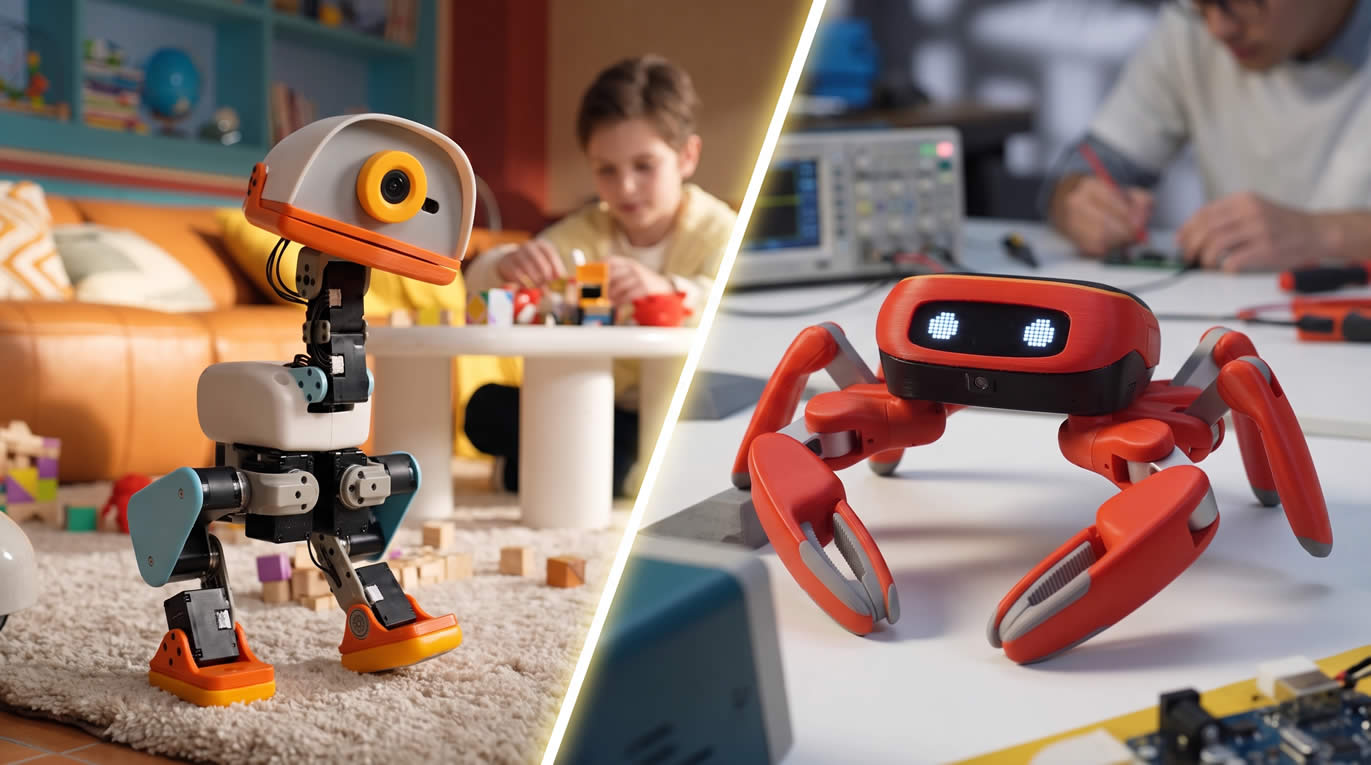
Pollen Robotics’ $399 Microduck drew more than $2.6 million in pre-orders in its first 24 hours, according to Hugging Face co-founder Thomas Wolf. KingKong Tech’s Jumper went viral in China after appearing at WAIC. Neither is anywhere near doing your chores. Both are winning anyway.
KingKong Tech brought a crab to the World AI Conference in Shanghai in July. The company says the six-legged robot drew visitors who stopped to watch, film and photograph it. Elsewhere in the hall, humanoid robots played the piano, folded clothes and made coffee. Jumper danced. It went on to the World Robot Conference in Beijing and to Douyin’s creator conference, and KingKong says one clip has since passed ten million views.
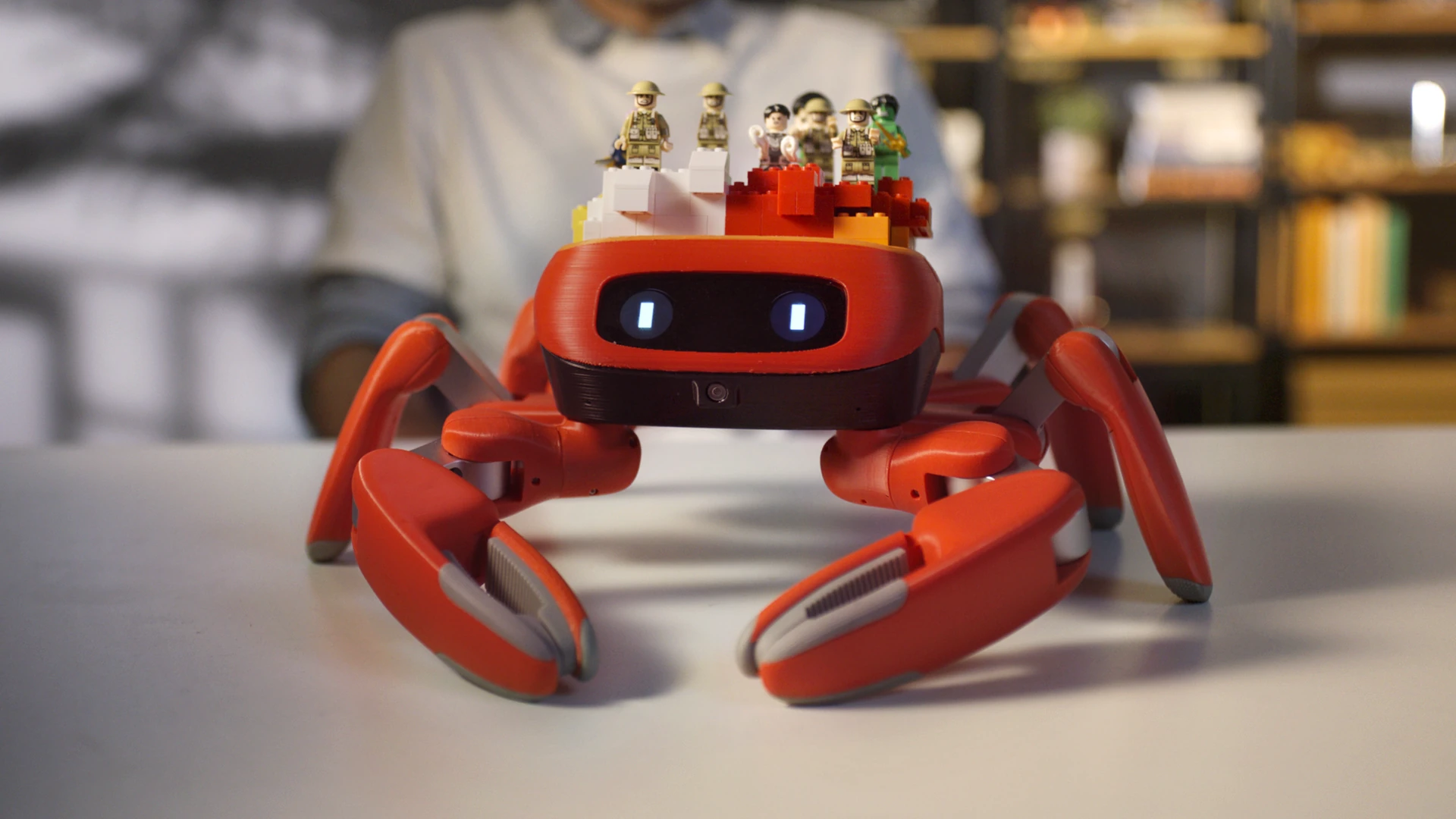
Jumper is red, six-legged, with two claws and a pair of 0.9-inch round colour displays standing in for eyes. KingKong has spent years making encoders and tactile servos for other robot companies, and Jumper is what a parts supplier ships when it decides to build a machine of its own: twenty-two of its own tactile servos, one per joint. The company’s TS20 joint packs a motor, a gearbox and an encoder stack into a 35-gram package. The rest of the hardware list reads like a phone’s: a Rockchip RK3576 with a 6 TOPS NPU, 4 GB of RAM, a 5 MP camera with a 162-degree diagonal view, a dToF depth sensor, a six-axis IMU, four microphones and two speakers. Indoor use only.
The published numbers are respectable rather than astonishing: a top speed of at least 0.5 m/s, a maximum jump height of at least 400 mm, a maximum grasping load of 1 kg, 1.8 kg of robot and a stated battery life of about two hours. On Chinese social media the suggestions for what to do with it are mostly jokes. Strap it to a router and use it as a mobile hotspot. Park it in front of the cat. Send it downstairs for the packages.
Five weeks later, a duck did the same thing to a much bigger audience. On 27 August, Pollen Robotics opened pre-orders for Microduck, a 25 cm biped that waddles, kicks a ball, picks up small objects with its beak and can roller-skate once the optional rollers are fitted. $399 before taxes and shipping. Thomas Wolf, Hugging Face’s co-founder and chief science officer, said on X that the order book passed $1 million in six hours and $2.6 million inside a day, at a peak of roughly one duck every four seconds. Pollen lists first deliveries as targeted before Christmas 2026.
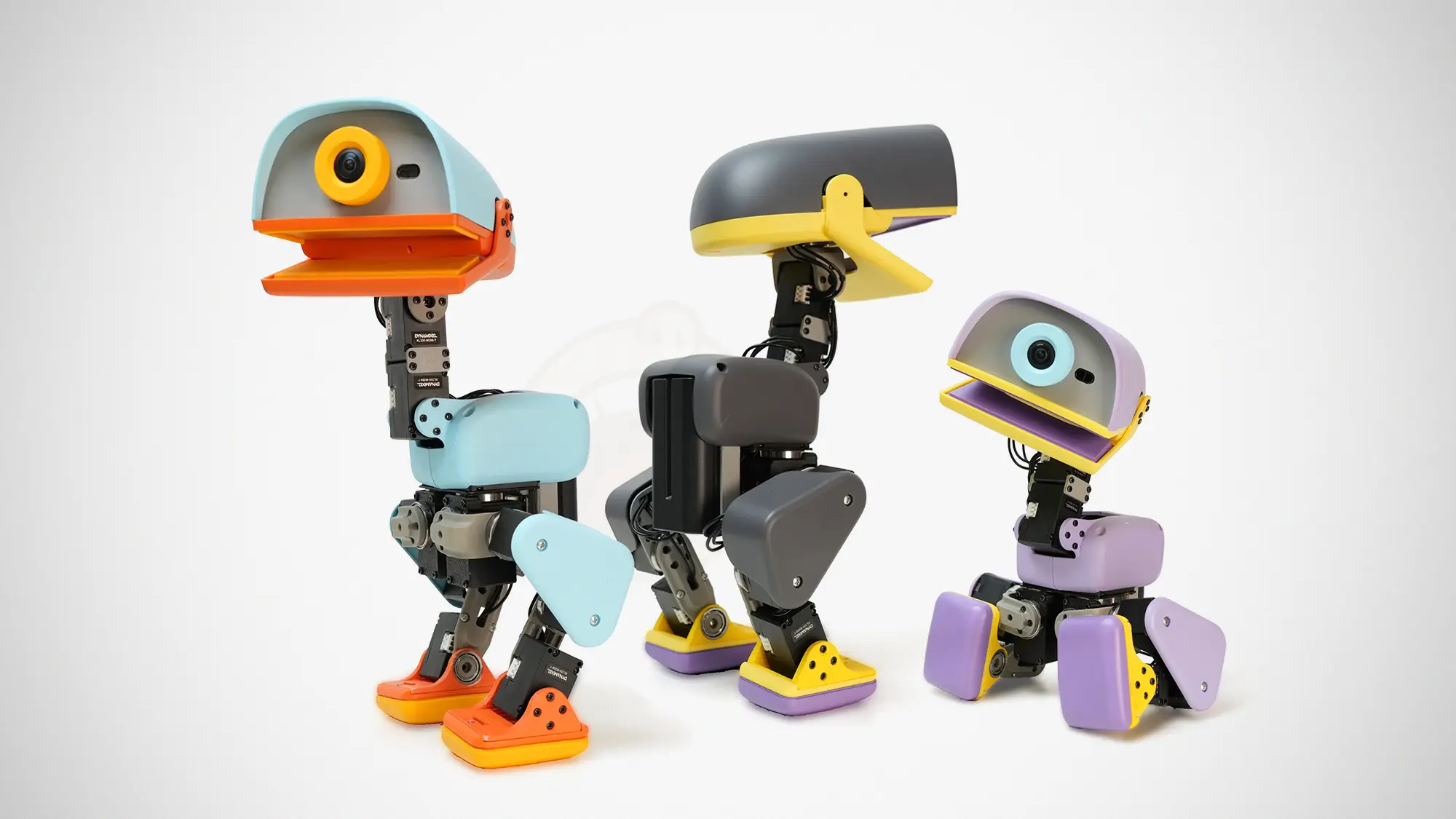
For that $399 you get fifteen motors, a wide-angle camera, a small LiDAR and two IMUs, plus a Rockchip RK3566, the sort of general-purpose AIoT chip that normally turns up in tablets and smart-home gear. Seven behaviours are trained before the thing leaves the box, among them walking, sitting and standing, kicking, grabbing, skating with the optional rollers, and getting back up after a fall. The onboard policy loop runs at 50 Hz. There are four colourways. The SDK, the MuJoCo simulation and the complete reinforcement-learning stack sit on GitHub under Apache-2.0, which is the part that actually matters. What the duck runs is what you can read, fork and retrain.
Set the two spec sheets next to each other and the conclusion is not flattering.
| Spec | Microduck | Jumper |
|---|---|---|
| Maker | Pollen Robotics (Hugging Face) | KingKong Tech |
| Form factor | Biped, 25 cm tall, under 800 g | Hexapod, 400 x 400 x 200 mm, 1.8 kg |
| Actuators | 15 motors | 22 tactile servos |
| Compute | Rockchip RK3566 | Rockchip RK3576, 6 TOPS NPU |
| Sensing | Wide-angle camera, LiDAR, two IMUs | 5 MP camera, dToF depth sensor, 6-axis IMU |
| Performance | Walks, kicks, roller-skates, rights itself | ≥ 0.5 m/s, ≥ 400 mm jump, 1 kg grasp |
| Software | Apache-2.0, MuJoCo, full RL stack | Open simulation and RL stack (MuJoCo, rsl_rl) |
| Price | $399 | Not announced |
Neither machine is going to move a sofa.
So why these two, and not the two-metre bipeds?
Start with the obvious. People like them. A robot 20 cm tall doing a crab dance to a Douyin hit does not set off the reflex that a 1.8-metre humanoid does. Nobody’s first thought is what it will do to their job. It is whether it can be taught to do the worm. There is a long line of these machines, from Tamagotchi to Sony’s Aibo to Anki’s Cozmo, and what sold them was personality rather than capability. KingKong is playing to it directly: an open motion challenge with 100 engineering units as prizes, and marketing built almost entirely around how good the crab looks.
Openness is the other half. Jumper’s repository ships a MuJoCo model, simulation environments, reinforcement-learning tasks and a training pipeline built on MuJoCo Warp, mjlab and rsl_rl with PPO, running on either GPU or CPU. Policies export to ONNX, convert to RKNN, and reach the robot through KingKong’s controller and state machine. Microduck’s stack is broadly the same shape. You can choreograph a routine on a laptop, in simulation, without owning the hardware. That is what turns a product into a hobby, and a hobby into a library of other people’s ideas.
What the clips do is recruit. A duck skating across a kitchen floor, or a crab dancing on a hotel carpet, is a demo that costs the company nothing and reaches an audience that would never read a spec sheet. Some of those viewers buy one. Some of them teach it a new move and post the code. The policies and routines people share back are what compounds. The video is the front door, not the training set.
Then there is the price. Many humanoid robots remain beyond the budget of most households. A duck costs about as much as a decent pair of headphones. KingKong has not announced what the crab will sell for. Microduck’s price has a simpler explanation: it is built in China. Pollen says the robot is manufactured there, with help from Seeed Studio, a Shenzhen company that helps hardware startups reach production. The gap matters because it decides who gets to play. It is the difference between watching a robot on YouTube and having one on your desk, and only one of those produces a second generation of tinkerers.
The unglamorous part is that neither robot does work, and KingKong is careful to say so. Its public repository is an AI toolkit: the MuJoCo model, the simulation meshes and URDF, the reinforcement-learning tasks, the controller and the deployment tooling, with a second repository for skins and scenes. It is not a manufacturing package, and the repository’s own release-preparation notes describe the public tree as a reviewed snapshot of an internal codebase, published without its Git history. The documentation is blunter about the hardware boundary. RKNN inference has not yet been verified on the board, and the 1 kHz controller loop has not yet driven the live motor bus. You can develop new skills for a crab you may never own.
That is a real limit, and it will not be lost on anyone who orders one expecting a pet. Microduck has a version of the same problem. It is a real, working robot, and it still cannot do anything you would call a chore. Pollen’s own demo reel is a duck roller-skating.
Much of the humanoid industry is still working toward the machine that unloads the dishwasher. Microduck and Jumper are nowhere near it. What they offer instead is a way in: train a new gait on a laptop, design a new shell, post the policy, watch someone else improve it, all without waiting for a general-purpose robot that can run a house. The hard part is unfinished. These two give people something to do in the meantime.
For a lot of the people watching, the first question is simpler than the one the industry is trying to answer. Where can I get one?
