


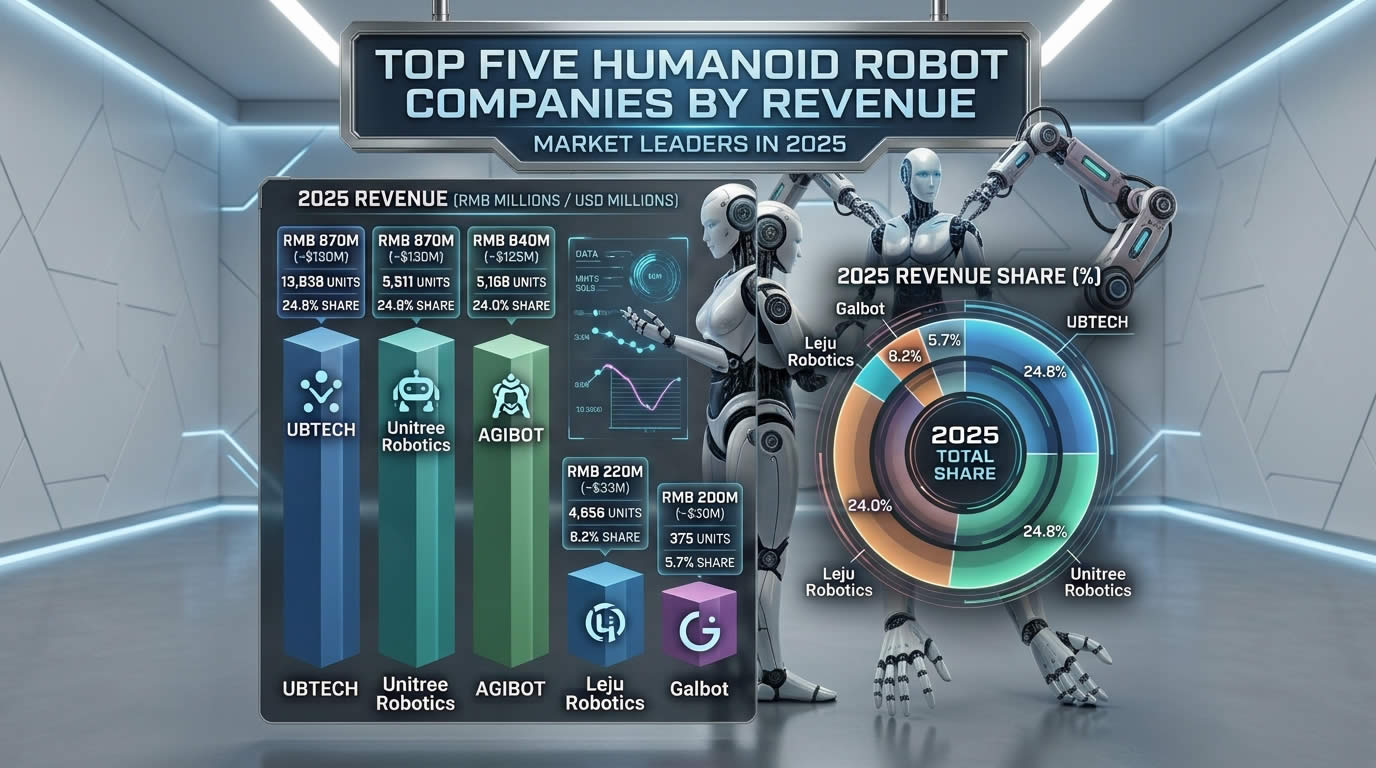
Frost & Sullivan’s latest market research puts UBTECH, AGIBOT, Unitree Robotics, Galbot and Leju Robotics at the top of the global humanoid robot revenue rankings. The bigger question is where that revenue is actually coming from.
China’s position in the humanoid robot industry is no longer a matter of how many companies can build a prototype.
According to Frost & Sullivan’s 2026 Global Humanoid Robot Market Research Report, all five of the world’s leading humanoid robot companies by revenue are Chinese. The ranking includes UBTECH, Unitree Robotics, AGIBOT, Galbot and Leju Robotics.
The revenue figures, however, do not tell the whole story. The market is growing fast, but the robots bringing in that revenue are not doing the same kind of work. Some are research platforms. Some are used for entertainment and demonstrations. Others have been put to work in factories, logistics operations and data-collection facilities.
The difference says a lot about where the humanoid robot business actually stands today.
Five Chinese companies lead the global revenue ranking
Frost & Sullivan estimates that the global humanoid robot market generated $500 million in revenue in 2025, on sales of around 35,000 units. In the first half of 2026 alone, the market brought in another $540 million on sales of around 36,000 units.
Six months of 2026 have already beaten the whole of 2025 on both counts.
The leading companies also swapped places between the two periods.
| Rank | Company | 2025 revenue | 2025 revenue share | 2025 units |
|---|---|---|---|---|
| 1 | UBTECH | RMB 870 million (~$130 million) | 24.8% | 13,838 |
| 2 | Unitree Robotics | RMB 870 million (~$130 million) | 24.8% | 5,511 |
| 3 | AGIBOT | RMB 840 million (~$125 million) | 24.0% | 5,168 |
| 4 | Leju Robotics | RMB 220 million (~$33 million) | 6.2% | 4,656 |
| 5 | Galbot | RMB 200 million (~$30 million) | 5.7% | 375 |
For the first half of 2026, the order was UBTECH, AGIBOT, Unitree Robotics, Galbot and Leju Robotics, with reported revenue shares of 16.5%, 16.1%, 15.3%, 5.5% and 4.0%.
UBTECH stayed on top, reporting RMB 620 million ($92.5 million) in humanoid robot-related revenue in H1 2026. AGIBOT followed at RMB 610 million ($91.0 million), with Unitree at RMB 580 million ($86.6 million), according to the report’s methodology.
Unit figures tell a different story.
UBTECH sold 13,838 humanoid robots in 2025, against 5,511 for Unitree and 5,168 for AGIBOT. Galbot ranked fifth by revenue on just 375 reported units.
That gap is worth a closer look. Dividing reported revenue by reported unit sales does not give you an average selling price; the report’s revenue measure covers a broad set of relevant products and services and follows its own market definitions and estimation methodology. Even so, the numbers show the five companies are monetizing humanoid robots in very different ways.
The market is growing faster than its factory footprint
Headline market figures can give the impression that humanoid robots have already become a mainstream industrial product.
The application data paints a more sober picture.
Frost & Sullivan splits the global humanoid robot market into four application categories: entertainment and performance, research and education, data collection, and production operations.
In the first half of 2026, entertainment and performance accounted for about 21,000 units and $190 million in revenue. Research and education took about 12,000 units and $140 million. Data collection came to roughly 3,000 units and $130 million. Production operations accounted for only about 1,000 units but generated around $80 million.
So production operations are a small slice of unit sales, even as their revenue climbs.
The report puts revenue from production operations at about $50 million in 2025 and $80 million in the first half of 2026, the sharpest increase among the four categories. The work involved includes material handling, loading and unloading, sorting, assembly and delivery across manufacturing, logistics and commercial operations.
This is why the revenue ranking deserves more attention than a simple shipment chart.
A company can sell thousands of cheaper robots for research, education or entertainment without ever proving those machines can run reliably in a factory for long stretches. Industrial deployment asks harder questions: task completion rates, cycle time, safety, uptime, integration with existing equipment and return on investment.
The report identifies production operations as the main path to greater commercial value, while noting that industrial and logistics applications are still working through pilot projects and small-batch deployment.
Full-size embodied AI robots are where the economics change
The Frost & Sullivan report draws another useful distinction between the broader humanoid robot market and full-size embodied AI humanoid robots.
It defines full-size humanoid robots as those at least 160 centimeters tall. Embodied AI humanoid robots, in its definition, are systems that can perceive their environment, understand tasks, plan actions and execute them based on feedback, with some ability to generalize across tasks and environments. Such products typically carry onboard AI computing of more than 200 TOPS.
This segment is much smaller by unit volume.
Frost & Sullivan estimates that full-size embodied AI humanoid robots accounted for around 5,000 units and $260 million in revenue in 2025. In the first half of 2026, the segment reached roughly 6,000 units and $320 million.
In other words, in H1 2026 full-size embodied AI humanoid robots made up only about one-sixth of total unit sales, yet brought in close to three-fifths of the market’s revenue.
The numbers point to a different way of looking at the industry’s growth.
The market is still selling large numbers of robots for research, education, demonstrations, entertainment and data collection. But a smaller pool of more capable, full-size machines is taking home a much bigger share of the money.
UBTECH is especially strong here. The report puts its 2025 revenue share in full-size embodied AI humanoid robots at 45.1%, ahead of AGIBOT at 15.9%, Galbot at 11.0%, ROBOTERA at 4.0% and Leju Robotics at 3.0%. In H1 2026, UBTECH still led at 26.0%, followed by AGIBOT, Galbot, ROBOTERA and Leju Robotics.
That is a different picture from the broader market.
Unitree, No. 2 overall by 2025 revenue, does not appear in the top five of Frost & Sullivan’s full-size embodied AI revenue table.
The distinction matters when looking at the Chinese humanoid robot market. “Top humanoid robot company” can mean very different things depending on whether the measure is revenue, shipments, product size or autonomy.
Why Chinese companies are scaling
Frost & Sullivan’s comparison of China, the United States and other major markets points to manufacturing infrastructure, robotics supply chains, software-hardware integration and application access — not to any single technological edge.
China’s robotics industry is closely tied to a broad manufacturing base that includes automotive, electronics and other industrial sectors. The report points to the availability of suppliers of motors, reducers, sensors, structural components, batteries and manufacturing services, which helps companies iterate on products and move toward volume production.
Development style differs, too.
The report describes Chinese humanoid robot companies as putting more weight on software-hardware coordination, engineering integration and rapid product iteration. The robot body, motion control, sensing systems and intelligent capabilities get developed and adjusted together rather than treated as separate layers.
For a machine that has to walk, perceive objects, handle them and work around people, that integration can matter as much as the underlying AI model.
Access to real environments is the other factor.
Chinese companies are testing humanoid robots across entertainment, research, data collection, manufacturing and logistics. Frost & Sullivan says commercialization is being driven through product iteration, application pilots and joint development with customers, moving gradually from demonstrations toward deployment.
That gives the industry a path from the lab to repeated use in the physical world.
The data loop could end up mattering more than the hardware
One layer of the Chinese market is easy to miss if you only look at robot sales.
Humanoid robots need real-world data to get better at handling unfamiliar objects, environments and tasks. The Frost & Sullivan report treats data collection as a commercial market in its own right, covering teleoperation, human demonstrations, real-robot data, visual and force sensing, training centers and data-production facilities.
It also describes a shift from scattered, project-based collection toward centralized training centers and larger “data factories.”
That sets up a loop:
robot deployment → real-world data → model training → robot update → new deployment
The report argues that production environments contribute another layer of data, because they generate real task outcomes, failures, unusual conditions and long-duration operating records.
For companies building general-purpose humanoid robots, that could prove as valuable as simply selling more hardware.
A robot used for an hour-long demonstration says little about how it behaves after thousands of repetitive cycles. A robot working through real production tasks has to cope with variation, mistakes, interruptions and physical wear — conditions a laboratory cannot fully reproduce.
The hard part is no longer building a robot that can walk
The report’s list of critical success factors goes well beyond robot design, covering robot body and core hardware, embodied AI, production-scene deployment and customer validation, real-robot data accumulation, mass manufacturing and commercial delivery, and safety and compliance.
A commercially viable humanoid robot has to combine actuators, dexterous hands, sensors, batteries, computing and mechanical structures into a reliable system. Then it has to be manufactured consistently, delivered in volume, integrated into customer workflows and supported after deployment. Safety and compliance grow more important as robots share space with people and industrial equipment.
The report is also clear that industrial deployment is a good deal harder than entertainment or research. Production customers care about stability, safety, continuous operation, task success and ROI.
The next phase of the market will be defined by how well companies can meet those requirements.
China’s five companies at the top of Frost & Sullivan’s global revenue table show that Chinese manufacturers have already built a substantial commercial base. But the same report shows most humanoid robots are still sold outside production operations.
The key question now is how many of those thousands of humanoid robots can move from being products that companies buy to machines that they keep running because they make economic sense?
