


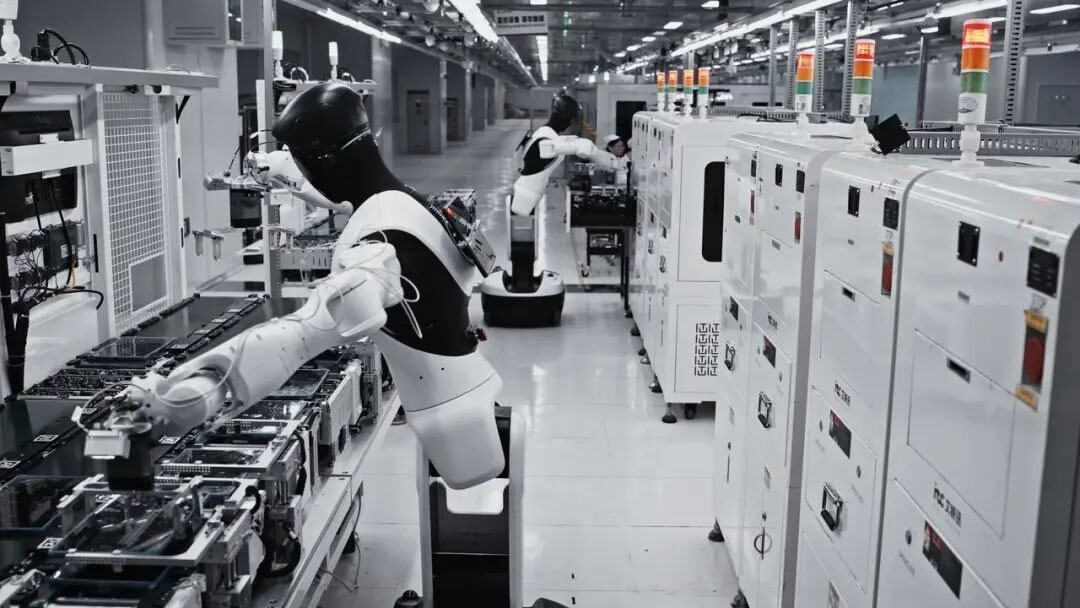
The country is on track to produce over 100,000 humanoid robots in 2026. Industry data suggests that fewer than 5% are currently reaching factory production lines. The gap comes down to a single word: repeatability.
The Numbers Behind the Hype
Visitors at the 2026 World Robot Conference in Beijing could be forgiven for thinking the factory of the future had already arrived. Some 373 exhibitors filled the halls with more than 3,000 robot products. Robots backflipped, sparred, sorted parcels, and simulated surgery. Crowds gathered with phones held high.
Somewhere else, a different set of numbers was circulating. At a Xiaomi electric vehicle plant, a humanoid robot tasked with tightening nuts ran for three consecutive hours. Its success rate: 90.2%. The human worker and the conventional industrial robot at the same station both maintained success rates above 99%. After four months of iteration on that single task, Xiaomi says the rate climbed to 98% — still one percentage point behind the human benchmark, and only for that one task.
That contrast captures the defining tension in China’s humanoid robot industry heading into 2026. Production is booming. Exports are surging. Investor interest is rising. But the machines themselves remain, in engineering terms, not quite ready for the job most people imagine they were built to do.
The Delivery Gap
China’s humanoid robot output exceeded 40,000 units in the first half of 2026, with full-year projections surpassing 100,000. Morgan Stanley raised its 2026 China humanoid shipment forecast twice during the year — first from 14,000 to 28,000 units, then to 50,000 — citing faster-than-expected commercial validation. The bank estimates the Chinese humanoid market at about $2 billion in 2026, rising to $15 billion by 2030.
Exports have followed the same trajectory. In the first quarter of 2026, China’s separately listed robot products reached $1.675 billion in export value, shipped to 148 countries and regions. An ecosystem of new mega-factories has emerged to meet the demand. UBTECH’s facility in Liuzhou, Guangxi, rolled out its first 10,000-unit-capacity humanoid production line in September 2026, claiming one industrial humanoid robot every 10 minutes. Other Chinese manufacturers, including Leju Robotics and ENGINEAI, have announced their own thousand-unit and 10,000-unit production targets.
The prices are dropping, too. Some models now list at around 30,000 yuan ($4,100), putting pressure on manufacturers to drive down component costs and improve production yields.
So where are all these robots going?
An industry estimate covering roughly 23,000 first-half deliveries suggests a very different picture: around 30% went to university research labs, another 30% to trade shows and commercial events, and a similar share to overseas testing programs. The same estimate puts the proportion reaching factories for direct production work at less than 5%.
Globally, the picture is similar. Counterpoint Research data shows entertainment and performance robots accounted for 33.6% of H1 2026 shipments, with data production and research at 27%. Combined, those two categories exceeded 60% of global deliveries. Smart manufacturing accounted for 13% of global shipments, while warehousing and logistics accounted for 5%.
These figures come from different methodologies and sampling frames, but they point in the same direction. Unitree Robotics, one of China’s most prominent humanoid makers, disclosed in its Shanghai STAR Market IPO prospectus that 73.6% of its humanoid revenue in the first three quarters of 2025 came from universities and research institutions. Industrial scenarios contributed less than 10%.
Unitree founder Wang Xingxing put the technical reality bluntly at the World Robot Conference: after thorough training in a fixed scenario, success rates can approach 100%. Introduce minute changes in the environment or the objects being handled, and performance falls off a cliff.
Capability vs. Repeatability
Industry analysts outside China have a clean way of describing this gap. A demo proves capability. A deployment proves repeatability. They are not the same thing, and the distance between them is not a matter of degree — it is a different category of problem entirely.
Consider what a 90-second demo video actually involves: tight framing, careful editing, only the successful grasp shown, a fully charged battery, room-temperature conditions. Now put the same machine on a test stand and let it run. The compute hardware heats up under sustained load. Dozens of motor drivers and sensors interfere with one another inside a sealed cavity. Wire harnesses bend and flex with every gait cycle. As French electronics firm AESTECHNO has noted, the real product is not the robot in the demo — it is the one that has been running for 45 minutes and everything has gotten hot.
Several hard metrics illustrate the gap:
Reliability. Robots that walk smoothly in a lab fail in real environments more than 10% of the time. Humanoid robots still face perception and positioning errors that can be orders of magnitude larger than the tolerances required by many precision industrial processes.
Component durability. A single high-DoF tactile dexterous hand costs over 100,000 yuan and can reach a million yuan in high-end configurations. Under continuous industrial use, wear on high-DoF dexterous hands can become a major maintenance concern, particularly for tactile sensors, actuators and transmission components. Mass production yields for precision tactile sensors remain below 60%, and fewer than five companies globally can meet industrial-grade cycle durability standards.
Training data. Collecting a single category of industrial refrigeration SOP requires thousands of hours of human demonstration. Much of the industry’s training pipeline still relies heavily on simulation and human-generated data, while large-scale real-robot data remains expensive to collect.
Continuous operation. Under high-intensity workloads, humanoid robots typically need recharging after a few hours — not enough to cover a full 8-hour shift. Configuring backup robots for rotation can double initial capital expenditure.
The Line Items That Kill the Deal
The most revealing way to understand why factory adoption lags is to look at what factory procurement managers actually measure. Their KPIs are not about backflips.
Frequency of human intervention. The deployment metrics that matter are cycles completed, uptime, intervention rate, recovery time, throughput, and failure frequency. How long a robot can run between unplanned human interventions determines whether it replaces labor or becomes another job that requires a dedicated operator. In many Chinese factory deployments today, the answer is the latter — a dedicated operator still stands by to troubleshoot.
Continuous operation time. Beyond battery life, there is the thermal problem. Compute and motor drivers in a sealed cavity throttle under sustained load. A robot that has just booted up and one that has run for 45 minutes are, in engineering terms, two different machines. Manufacturers generally publish limited data on mean time between failures.
Fault tolerance and recovery. Demos emphasize successful actions. Deployments must handle failure: Can it detect a dropped object and pick it up? Can it recover from a misaligned grasp? Can it stop safely when a human enters its path? Useful deployment robots do not have to be perfect, but they must be predictable and recoverable. Most current models operate at a low level of autonomy, where any single unexpected step can halt the entire task chain.
Takt time matching. Automotive production lines enforce strict cycle times. Humanoid robots currently assemble slower than humans, with hand dexterity that does not match human capability. Isolated demo “successes” mean little if the robot cannot keep pace with the line’s takt time.
The economics are unforgiving. Manufacturing equipment procurement typically requires a 2-to-3-year payback. Goldman Sachs estimated the 2025 average BOM cost at approximately $27,700, with whole-robot pricing around $41,800, yielding an equivalent labor cost recovery period of about 2.8 years in industrial scenarios. In China, general industrial scenarios show payback periods stretching to 5–8 years when all overhead is included. Guotai Securities estimates that an industrial humanoid would need to cost about 160,000 yuan, including maintenance, to pay for itself within two years against a worker earning 80,000 yuan annually. Current machines cost roughly 300,000 to 500,000 yuan.
Probabilistic capability means you must keep a human on standby. One unplanned shutdown and redeployment can wipe out months of labor savings. As one industry observer put it, probabilistic capability simply cannot be booked in an industrial accounting ledger.
What the Companies That Ship Actually Do
The deployments that have produced the clearest industrial results share one characteristic: they started with narrow, tightly defined tasks rather than trying to make the robot general-purpose from day one.
Figure AI’s Figure 02 completed an 11-month deployment at BMW Group Plant Spartanburg, running 10-hour shifts Monday through Friday. It was measured against a target of more than 99% placement accuracy per shift and an 84-second cycle time, while completing more than 1.2 million robot steps in the production environment. But the tasks were in the body shop — specific, repetitive, and carefully bounded.
Agility Robotics’ Digit has moved over 100,000 totes in live warehouse operations for GXO Logistics at its Flowery Branch, Georgia facility. The milestone matters not because of the number itself, but because it represents long-duration, unscripted operation — not a choreographed short.
In China, AgiBot’s G2 robots completed 2,283 precision loading and unloading tasks at a Longcheer Technology 3C testing station according to AgiBot, with no recorded errors during an eight-hour shift. During a six-day livestream of its tablet production line, the robots processed over 800 products in the first three hours without errors, and surpassed 10 hours of continuous operation with more than 3,000 items sorted without recorded errors. But when the same robots moved from that fixed station to nine categories of unfamiliar scenarios, the gap in their ability to generalize became immediately apparent.
UBTECH’s Walker S2 addresses the shift problem with a three-minute autonomous battery swap for 24-hour continuous multi-process operation, with over 500 units delivered in 2026. Galbot and Baida Precision have announced a cooperation covering more than 1,000 quality-inspection robots across the manufacturing ecosystem.
These robots are not “universal butlers.” They are specialized workers. They get hired because they do not attempt the flashy moves in the demo videos.
Mass Production Is Not Making 10,000 Robots. It Is Making 10,000 Identical Ones.
If there is one variable that determines how this plays out, it is not a single technology breakthrough. It is whether hardware and machine intelligence can be scaled at the same time.
The phrase “mass production year” hides a trap. The hard problem was never building one robot. It is building 10,000 robots that all work reliably. Prototype stages solve technical feasibility. Mass production stages test consistency, reliability, lifespan, and maintainability — thermal management, wire harnesses, joint life, calibration systems, and end-to-end quality control. These are industrial system capabilities, not individual technological breakthroughs.
Bottlenecks run through the entire supply chain. Whole-robot structures iterate every two to three months. Upstream suppliers will not open molds for volumes of a few hundred units. Precision parts are still hand-polished. Single-batch yields remain low, which undermines production consistency, which reduces the quality of data collected in real-world deployments, which stalls model iteration.
The data side tells its own story. Tesla is also building an Optimus production line at Fremont, bringing robot manufacturing closer to the industrial environment in which the company expects to develop and deploy the machines. JD.com announced plans to collect over 10 million hours of human real-scenario data and 1 million hours of real-world robot operation data within two years. That order of magnitude is what laboratory simulation cannot replace.
The Missing Rulebook
One blind spot receives the least discussion: robots entering factories have no “traffic laws.” When an algorithmic error causes material damage or a safety incident, liability can be difficult to assign across manufacturers, system integrators and operators. Specific safety rules for bipedal robots are still under development. The EU’s Machinery Regulation 2023/1230 will apply from January 20, 2027, but certifying dynamically unstable machines such as humanoid robots still raises questions that the industry is only beginning to address. How to certify a machine whose failure mode is falling on a person remains an open question globally.
ISO 25785-1, a new safety standard for dynamically stable industrial mobile robots, is still under development. During the ramp-up to 10,000-unit production, the industry lacks unified performance metrics, functional certification, and quality control standards. Without that regulatory floor, the data flywheel cannot complete its first rotation, because no factory manager will gamble their real production scenario on a probabilistic product.
Apprentice First, Replace Later
Humanoid robots will not suddenly go on duty across all scenarios at some inflection point.
By scenario tier, standardized work scenarios are likely to achieve stable commercial deployment within one to two years. General industrial scenarios will require data volumes to reach critical mass. Home scenarios are further out.
The right approach is not to put a humanoid directly on the line to replace a worker. It is to bring it in as an apprentice — a human engineer backstops at key decision points, and the robot starts with dangerous, dull, dirty, and heavy jobs that humans do not want. The Chinese garment industry offers an early example: Aitu’s robots have achieved a 97% success rate in separating fabric pieces for a single product category and fabric type, with over 98% of resulting sewing work meeting quality standards, and an estimated payback period of 18 months. The general manager of Aitu acknowledges the robots are still in the learning stage and cannot run an entire production flow without human involvement.
The World Robot Conference lights will dim. The backflip videos will be archived. Three years from now, what matters in this industry will not be who performed more synchronized moves on stage. It will be whose robots have quietly been working a station for a full year, accumulating a data advantage that competitors will struggle to match.
