

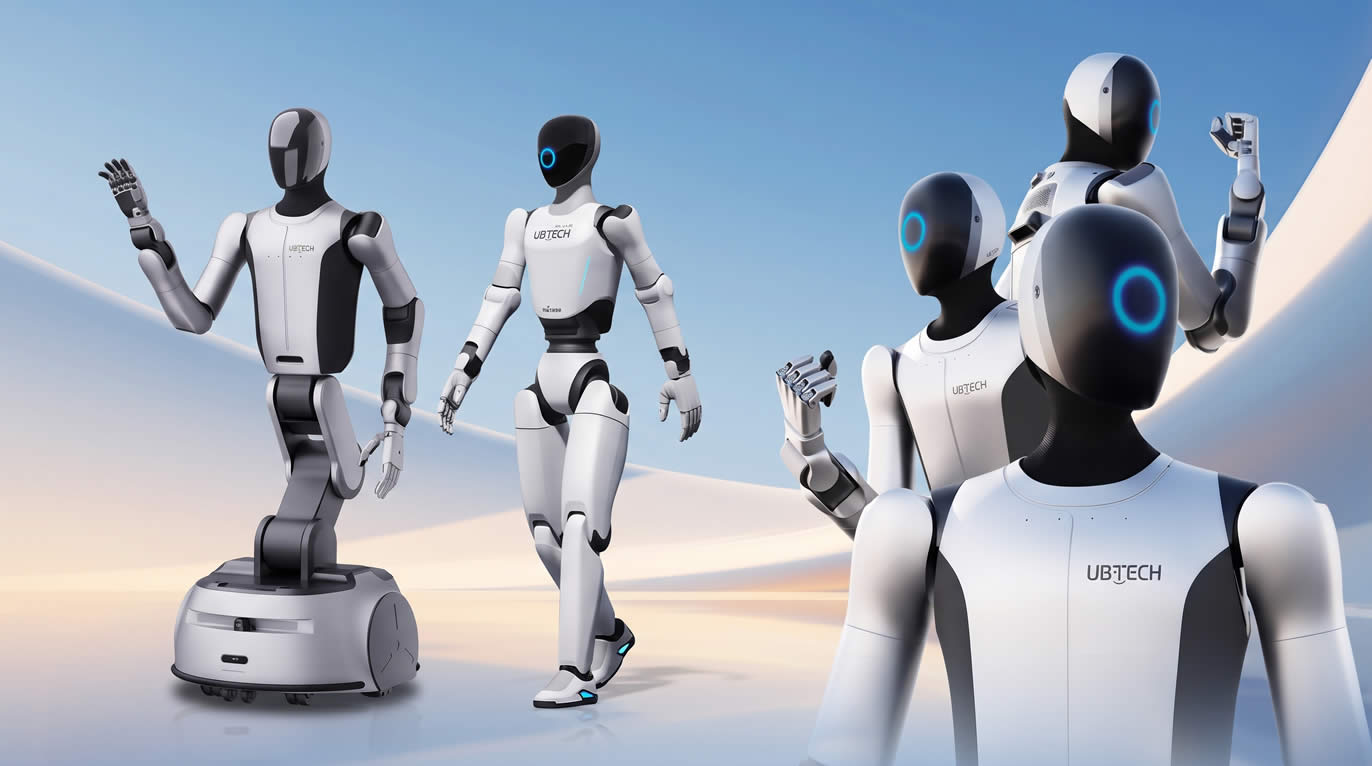
Bitcoin Japan now holds exclusive Japanese rights to six UBTech humanoid and service robots for 36 months — a clock that starts only once Walker C1 is certified. The contract is real; the market, so far, is not.
Of all the companies lining up to sell Chinese humanoid robots in Japan, the one that just won UBTech’s business is a kimono and textile-materials merchant founded in 1861.
Bitcoin Japan Corporation, listed on the Tokyo Stock Exchange’s Standard market under stock code 8105, signed the agreement with UBTECH ROBOTICS LIMITED, a subsidiary of Hong Kong-listed UBTECH ROBOTICS CORP. LTD. (9880), on October 16 and announced it on . It covers six machines — Walker S2, Walker Tienkung, Tienkung Dex, Sky Walker, Walker C1 and Cruzr S2 — plus the upgrades and successors the contract defines as part of the same lines. From signing — and payment of a deposit whose size was not disclosed — UBTech has undertaken that neither it nor its parent group will appoint another distributor for those products in Japan, and that Japanese customers will be supplied only through Bitcoin Japan, with carve-outs for certain existing customers.
That is a striking amount of territory to hand to a company whose Physical AI business began on October 1. But the strangeness of the counterparty is the point: it tells you what a Chinese humanoid maker is now willing to trade away to get a foothold in Japan, and how thin the local infrastructure for these machines still is.
The kimono-to-bitcoin-to-robots pipeline
The company’s history reads like a prank played on a corporate registry. Marusho Hotta spent more than a century and a half in apparel materials before pivoting to a bitcoin treasury strategy in 2025, when crypto infrastructure firm Bakkt took a stake of roughly 30 percent and installed Phillip Lord, then president of Bakkt International, as chief executive. The company adopted its current name in November 2025 and now describes itself as running its legacy business while building “investment and operating businesses” in AI, physical AI included. It filed trademark applications for BJC Robotics and BJC AI Labs in August. Earlier this year it also picked up indirect exposure to Figure AI through a fund managed by a US affiliate.
That Figure position is a passive bet on someone else’s humanoid. The UBTech contract is the operating business — or the intention of one.
Under the terms disclosed on TDnet, the 36-month exclusivity clock does not start ticking at signing. It starts when Walker C1, the commercial-service humanoid UBTech showed off at China’s supply-chain expo this year, clears the Japanese conformity and certification conditions the two sides have specified. Keeping exclusivity beyond that depends on hitting agreed performance targets. The announcement says the financial impact on the fiscal year ending March 2027 is still being assessed.
Until certification lands, Bitcoin Japan can put machines in front of universities, research institutes, public agencies and companies for research, experimentation, data collection and demonstrations — activities permitted under Japanese law. Broad commercial deployment in manufacturing and logistics waits for the paperwork.
Six machines, three revenue lines
The product mix is unusually broad for a single distributor, spanning factory work, service work, research and a wheeled platform:
Walker S2 is the flagship and the reason the deal is interesting to anyone outside Japan. It is an industrial humanoid built around autonomous battery swapping: dual batteries, a coordinated two-arm swap, roughly three minutes to a fresh pack, which is what makes round-the-clock operation plausible. UBTech rates it at 15 kg payload with a working envelope from floor level to 1.8 metres. Walker S robots have been on trial at FAW-Volkswagen’s Qingdao plant since 2024, and the two companies signed a strategic cooperation agreement this month; BYD, Geely and Dongfeng Liuzhou are also reported customers. Japanese groups have already been kicking the tyres — Hitachi entities in China have been evaluating the Walker S2, and Honda Trading’s Chinese arm has been working with UBTech’s UQI Robotics on planned demonstrations. Outside China, UBTech robots are being deployed at a ROSSMANN logistics site in Germany through a European distributor, and the company signed a memorandum with Singtel in August.
Walker C1 is the commercial-service unit that carries the certification burden — 1.64 metres, 55 kg, 53 degrees of freedom, launched at the China International Supply Chain Expo. Its predecessor, Walker C, spent the 2025 Osaka Expo greeting visitors at the China Pavilion, which is the closest thing UBTech has to a Japanese reference.
Cruzr S2 is the wheeled full-size humanoid: 176 cm, 185 kg, 44 degrees of freedom, 2 m/s, aimed at sorting, kitting, pharmacy transport and reception work.
Walker Tienkung and Tienkung Dex belong to UBTech’s research line. Tienkung is the spelling the company uses in English for Tiangong, the platform it developed with the Beijing Humanoid Robot Innovation Center, and the obvious fit for the universities and labs Bitcoin Japan is allowed to supply before certification.
Sky Walker rounds out the six. UBTech has said little about it publicly, and the announcement offers no detail beyond its inclusion.
Bitcoin Japan’s pitch is that it will not simply resell boxes. It has sketched three revenue lines: hardware sales with paid proof-of-concept trials, robot-as-a-service leasing where it keeps ownership and bills for uptime, and data licensing from machines deployed on customer premises.
“AI is moving beyond screens and into the physical world,” Lord said in the announcement. “We are not simply investing in the future of AI. We intend to help put that future to work.” He described the agreement as a step toward a Physical AI operating business in Japan: distribution, deployment services, recurring revenue and real-world data, in one package.
The data leg is the one to watch, because it is where the legal exposure sits. The agreement lets Bitcoin Japan use and commercialise data generated by robots it deploys in Japan, subject to privacy rules, and requires that personal data collected by those machines be processed and stored inside Japan. Commercialisation also needs customer consent. There are narrow carve-outs for overseas collection: deployments for an affiliate’s internal research, and Bitcoin Japan-owned robots sent to overseas sites belonging to Japanese customers.
Why Japan wants humanoid robots now
Japan’s case for humanoids is not subtle. Manufacturing and logistics are short of workers, the driver-hours cap that took effect in 2024 tightened the haulage market further, and Tokyo has decided that physical AI is a domain worth competing in. METI’s GENIAC programme has been funding model development; in June 2026 the ministry flagged industrial-site data as the raw material for physical AI; and in July, METI and NEDO launched FRONTia, a national project to build domestic foundation models for embodied systems. McKinsey has projected the physical-AI robotics market reaching roughly ¥60 trillion by 2040.
What Japan does not have, at least not yet, is a deep bench of embodied-AI vendors. When the country held its first dedicated humanoid exhibition at Tokyo Big Sight in April, around 30 exhibitors turned up — and much of the crowd gathered around Chinese machines, either shown directly or through Japanese agents. Japan’s industrial-robot incumbents still dominate factory automation and have decades of reliability engineering behind them. Where they trail is in the models that make a humanoid useful.
That gap explains why a partner with no robotics track record was acceptable. In a market this early, what is scarce is not a proven distributor but a local entity willing to carry certification, service and customer risk on its own balance sheet. What UBTech brings to the other side of the table is volume. In the first half of 2026, it booked RMB 590.3 million (about $88 million) from full-size humanoids, up 1,445 percent year on year, on 921 units — a 1,947 percent jump in volume. That segment is now 46.5 percent of group revenue. Total revenue more than doubled to RMB 1.269 billion, and group gross margin widened 9.7 points to 44.7 percent. Shipments across all humanoid sizes reached 16,123 units. The Liuzhou plant that opened in September, planned with Siemens Digital Industries Software, is rated at more than 10,000 units a year, with the Walker S and Cruzr lines at its centre.
The hard part is the paperwork
Strip away the revenue-pillar diagram and the contract has a simple structure: UBTech gets a single counterparty carrying Japanese regulatory work, service overhead and customer acquisition; Bitcoin Japan gets exclusive distribution rights to machines it has not yet sold, in a market it has not yet served, on a balance sheet still carrying a loss-making apparel business.
Both sides are exposed to the same bottleneck. Wider commercial deployment — sales and leasing in factories and warehouses — depends on Walker C1 clearing the specified Japanese conformity and certification conditions, and no timeline for that has been published. Until then Bitcoin Japan can run research work, demonstrations and the other pre-certification uses Japanese law allows, but not the business the deal is priced on. The 36-month clock starts at certification rather than at signing, and continued exclusivity depends on performance targets the announcement does not quantify.
The service business is the second test. Robot-as-a-service requires capital for fleets, depots for spares, and technicians who can be at a customer’s loading dock the same day. Bitcoin Japan’s disclosure is candid that fleet investment will depend on demand, operating costs, cash recovery and available funding — a sentence that reads like a hedge, because it is one. It is also candid that no data-licensing customer or revenue has been confirmed.
Then there is competition. UBTech will not be alone in Japanese warehouses. Chinese rivals have been showing up at Japanese trade shows with cheaper hardware and their own local partners, and Japanese distributors are already comfortable carrying Chinese robots. Industrial incumbents will defend the accounts they hold. A distribution agreement, however exclusive, is a claim on a channel, not evidence of demand.
For the industry, though, the structure matters more than the volume. Chinese humanoid exports have mostly been one-off demos, trade-show appearances and single-site pilots. Handing a country’s channel for a whole product line to one partner, bundling leasing and data rights into the package, and making local certification the trigger for everything else is a different playbook — closer to how automotive and medical devices go abroad than to how robots have.
The next real signal will be a TDnet filing naming Walker C1’s certification, or a customer announcing a paid trial with numbers attached. Until then, this is a well-drafted option on a market that has not opened yet.
