

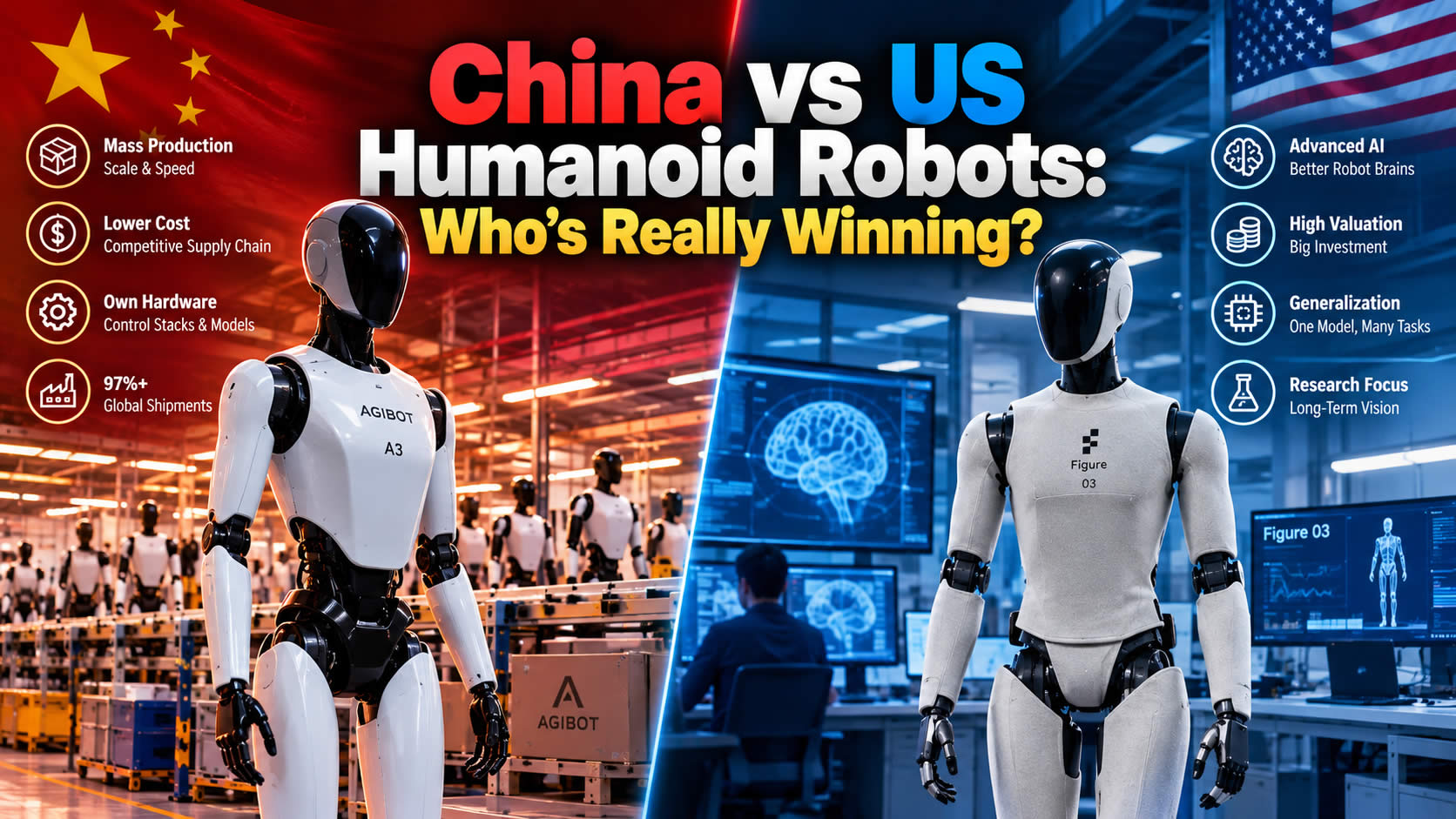
The humanoid industry has quietly split in two. One half sells machines that move; the other is betting billions on machines that think. Neither has proved it can do both.
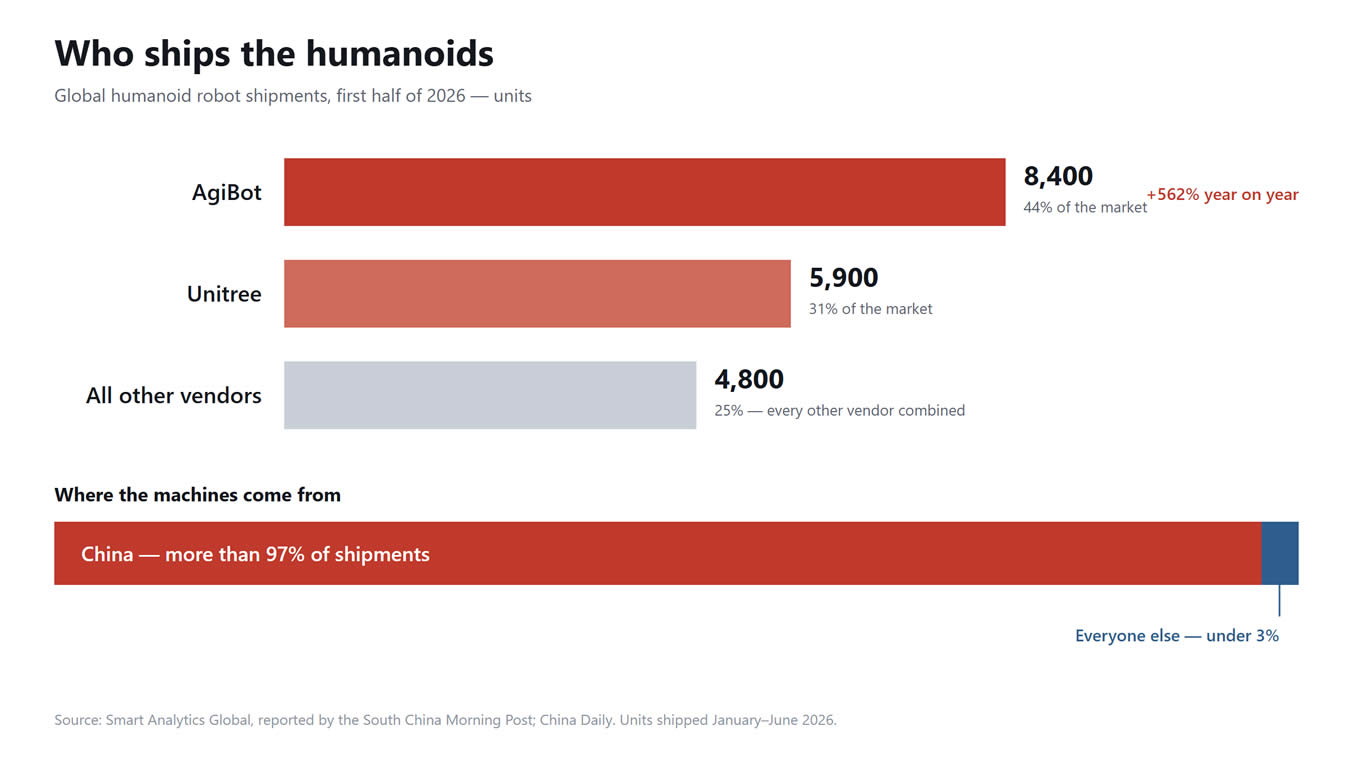
In the first six months of 2026, a Shanghai company that did not exist four years ago shipped roughly 8,400 humanoid robots, more than all American and European vendors combined. AgiBot‘s half-year total was up 562 percent year on year and gave it 44 percent of the world market, according to Smart Analytics Global figures reported by the South China Morning Post. The runner-up, Hangzhou’s Unitree, shipped about 5,900. Between them, two Chinese firms accounted for roughly three-quarters of every humanoid sold anywhere, and Chinese vendors as a group supplied more than 97 percent of them.
The United States shipped a rounding error. Estimates put Figure‘s entire 2025 output in the low hundreds of units. Tesla kept its Optimus fleet behind its own factory gates.
And yet the frontier of robot intelligence still looks American. Figure’s Helix architecture, Google DeepMind’s Gemini Robotics 2, the vision stack Tesla lifted out of its cars: the most capable robot brains are being built on one side of the Pacific, and the bodies that carry them on the other. Chinese leaders build their own control stacks and models as well. What differs is emphasis, and emphasis is what separates the two halves.
Put the two halves side by side and the mismatch is plain. One is a manufacturing business with a supply chain, a price list and a queue of buyers. The other is a research program with a valuation, a demo reel and a hypothesis about the future of work. Both are legitimate. They are simply not the same kind of thing, which is why every attempt to rank them produces a different winner.
This is usually read as a scoreboard, and the reading changes with the reader. China is winning. America is winning. Both miss what is happening. These are not two runners on the same track. They are two halves of an industry that has not been assembled yet, and the phrase both sides now use for it, embodied AI, papers over how differently the two halves are built.
Two answers to one question
Ask how many humanoids shipped in the first half of 2026 and you get three numbers. Smart Analytics Global says 19,100, up 272 percent. IDC says close to 25,000, up 432 percent. For all of last year, Omdia counted about 13,000, while the International Federation of Robotics, which tracks industrial and professional service units only, counted about 7,000, and Unitree by itself claimed more than 5,500 deliveries.
Nobody is lying. They are counting different things. Some totals are units that left a factory; some are units a customer accepted; some cover “pure” bipeds and exclude the wheeled machines that increasingly do the real work. AgiBot’s 15,000th robot off the line, in June, was wheeled.
That gap goes well beyond a rounding error, wide enough in fact to change who looks like the leader. Unitree’s own 2025 delivery figure would have placed it ahead of the number Omdia gave AgiBot for the same year. Both figures are defensible. They describe different product sets.
The disagreement is not a data-quality problem that better research will fix. It is structural. A vendor that counts a wheeled warehouse machine as a humanoid and a research house that counts only bipeds are both answering the question they were asked. Anyone quoting a single number for this market is choosing a definition and hoping nobody asks.
That matters because the sector is now valued almost entirely on projections. Smart Analytics Global expects about 60,000 units this year. JPMorgan has penciled 60,000 as well, on the way to 1.75 million by 2030. Morgan Stanley raised its China forecast for 2026 from 28,000 units to 50,000 and sees 446,000 by 2030. Counterpoint expects more than 50,000, up 210 percent. Between the most cautious and the most aggressive of those out-year numbers sits enough room to hold a different industry.
Every figure in this story, including the ones above, arrives with a definition attached. When a report offers a single clean total and no method, read it as a press release.
The divide is a gripper
The standard explanation for the split is that America builds expensive brains and China builds cheap bodies. True, and beside the point. The deeper difference is a decision about where training data comes from.
Figure makes its own actuators and its own hands. Not for the sake of vertical integration. Teach a robot to pick up an egg and the result depends on the gripper as much as on the model: backlash, torque curves, calibration error all leak into the outcome. If the hand comes from a supplier, the data arrives carrying an unknown. When the model fails, you cannot tell whether the model was wrong or the hardware was. Figure would rather be slow and expensive than carry that ambiguity into its dataset. Tesla made the same call from the opposite direction, reusing the vision stack and silicon it had already built for its cars, keeping body and brain inside one system.
The Chinese leaders went another way. AgiBot and Unitree build their own hardware and their own control stacks, including AgiBot’s Genie Operator-1 foundation model, but they put their weight on the platform, the price and the speed of iteration rather than on owning every variable. Unitree’s G1 starts at $13,500 in its base configuration. Elon Musk has talked about an Optimus price of $20,000 to $30,000, a target rather than a list price. That route puts a machine into a university lab or a municipal pilot within months, at a price those buyers can actually pay. What it does not settle is how well a skill learned on one body transfers to another. Change the hand and yesterday’s training data may no longer describe the machine in front of you.
That cost is real, and it compounds quietly. It is also, so far, the only way to sell thousands of units a year.
Why the halves grew apart
Neither side sat down and chose its route. The options were narrowed before either started.
China makes close to 30 percent of the world’s manufactured goods, and its supplier base runs from castings and gearboxes to the small shops that cut flex circuits. A robot company there can be founded, financed, prototyped and put into production without leaving a single province. Density is not self-sufficiency; the components China cannot yet make well are among the ones it buys most. But density is what makes hardware cheap to iterate on.
The United States has the opposite profile. Its manufacturing base is smaller and its industrial sites are harder to open up to experimental machinery, which makes the quick-commercialization route a hard one to walk. What America does have is the AI layer: the model labs, the accelerators, the simulation tools and the developer habits built up over two decades of work on language and vision. Faced with one route that is slow and another that is largely closed, American firms took the slow one. The valuations are less a vote of confidence in this year than the carrying cost of a road that will not produce revenue for several more years.
The result is a market where the two sides are not competing for the same customer. A Chinese vendor is selling a machine to someone who wants a machine. An American lab is selling a claim about labor to someone who wants a return. Those are different buyers with different patience, and for now both are being served.
What America is actually buying
If China’s advantage is a supply chain, America’s is a market for promises.
Figure’s $39 billion valuation, set in a Series C that raised more than $1 billion in September 2025, is the headline, but the pattern runs across the field. Skild AI raised $1.4 billion in a January 2026 round at a valuation above $14 billion, tripling its worth in seven months, on a thesis about general-purpose robot foundation models rather than a product. Money of that kind buys time and researchers. It does not buy a factory.
The technical bet underneath it is specific. Figure’s Helix splits control in two: a slower vision-language model of about 7 billion parameters running at 7 to 9 hertz, deciding what to do, and a much smaller visuomotor transformer of roughly 80 million parameters running at 200 hertz, executing it. Figure has said the whole system was trained on around 500 hours of teleoperated data, a fraction of what comparable vision-language-action datasets carry, and in January it added a third layer, a 10-million-parameter whole-body controller trained across 200,000 simulated environments. Google DeepMind’s Gemini Robotics 2 attacks the same problem with a single model that controls an entire body rather than a limb.
What both are chasing is generalization: a robot that can be told to do something it was never trained on. That is the difference between a machine and a worker, and it is the whole basis of the labor-market argument that justifies the valuations.
Read the spending correctly and the capital is chasing something larger than robots: the conviction that whoever owns the model owns the industry, much as the operating system came to own the phone. If one general model can drive any body, the body becomes a commodity and the margin migrates to the software layer. That is the prize the American labs are chasing, and it explains why they are content to ship a few hundred units while they chase it.
The gap between the two countries’ leading AI models has narrowed, according to Stanford’s 2026 AI Index. That says less about robots than it might appear. A humanoid’s competence rests on manipulation data, control latency, hardware reliability and whether a skill learned in one setting survives in another, none of which a language benchmark measures. Nvidia’s CUDA ecosystem and the established simulation stacks are real advantages for the teams that use them. They are not proof that American robot models generalize better, and Chinese firms are building their own simulation and control layers alongside them.
Cheap, but not for the reason you think
The reflex explanation for the Chinese cost advantage is subsidy. The cost structure says otherwise.
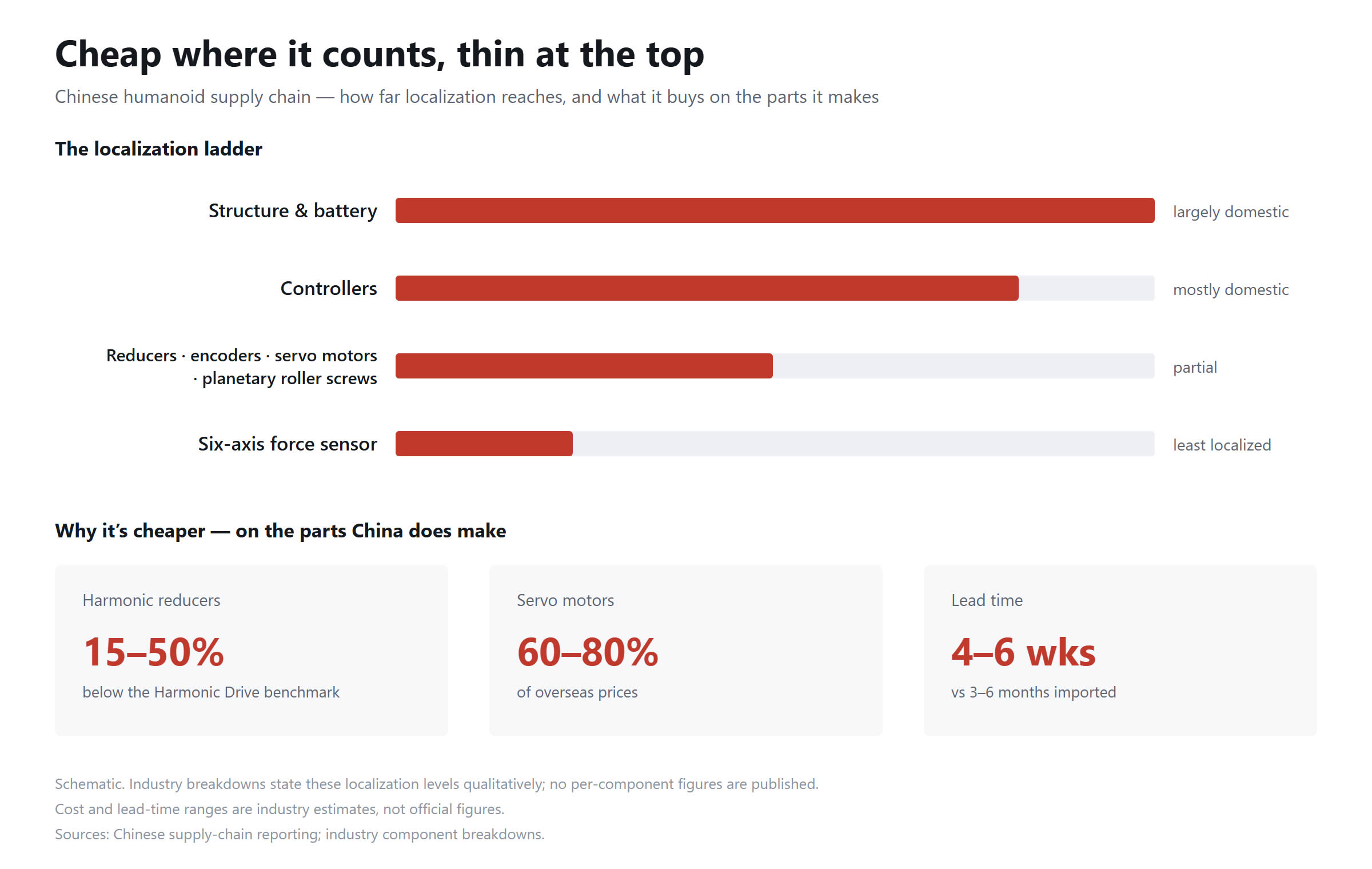
Industry estimates put domestic harmonic reducers, the precision gears at every joint, 15 to 50 percent below the Japanese benchmark set by Harmonic Drive, and domestic servo motors at 60 to 80 percent of overseas prices. Lead times point the same way: a domestic reducer arrives in four to six weeks, against three to six months for the imported equivalent. No state subsidy can buy that kind of speed. It comes from a supply chain packed tightly enough that changing a design does not require changing continents.
That density is not easily transplanted. It took three decades of component manufacturing, a deep bench of process engineers and a home market large enough to absorb early, imperfect parts. A government can subsidize a factory into existence. It cannot subsidize a supplier network into maturity. The cost gap has proved durable for that reason, and the quality gap is proving just as stubborn.
Then comes the part the brochures leave out. “Localization rate” is the most abused number in Chinese robotics. Structure and battery are largely domestic; controllers mostly so. Below that, the ladder falls away. Reducers, encoders, servo motors and planetary roller screws all fall short of full domestic supply, and the six-axis force sensor, the component that governs how gently a robot can handle what it touches, is by the industry’s own breakdowns the least localized of the lot.
Where domestic parts do exist, they are not yet equals. Yields on domestic planetary roller screws trail the imported benchmark, and torque ripple on domestic coreless motors is higher than on the best imports. The cost advantage is real. So is the gap. Anyone who tells you import substitution is finished has not looked at the force sensor.
Shipped is not deployed
Here is the figure that ought to trouble the people shipping all those robots. Smart Analytics Global reports that industrial and commercial applications took more than 70 percent of first-half shipments, up from roughly half a year earlier. That reads like a market arriving.
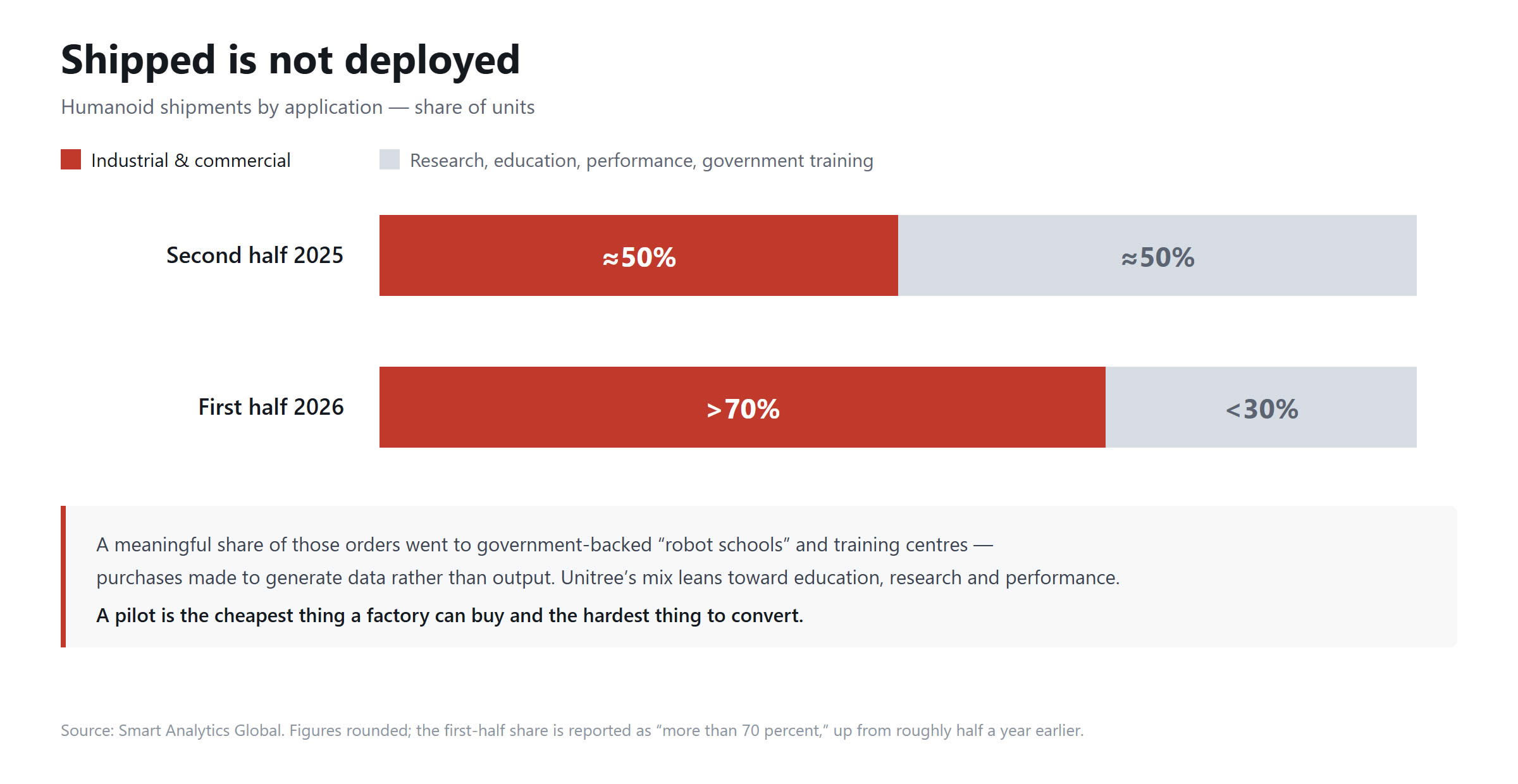
Look at who is paying and it softens. A meaningful share of those orders, analysts note, went to Chinese government-backed “robot schools” and training centers, purchases made to generate data rather than output. Unitree’s mix leans toward education, research and performance. AgiBot’s wheeled machines do go to factories and warehouses, but the customer is frequently running a pilot on a budget that is not their own.
John Koetsier, writing in Forbes, made the case bluntly: unit sales are the wrong scoreboard this early, because a robot that ships is not a robot that earns its keep on a factory floor. A first-half manufacturing sprint is not a deployment wave.
A pilot is the cheapest thing a factory can buy and the hardest thing to convert. It runs on a budget someone else approved, for a period someone else set, with no obligation to renew. Suppliers in this market have learned to count pilots as traction, because the alternative is counting nothing. The question that separates a business from a demonstration is dull and specific: after the pilot, does the same site buy again, with its own money, for work it already knows the machine can do?
That distinction decides whether a customer comes back out of an operating budget or spends a grant. The industry has proved it can build humanoids at volume. It has not yet proved that anyone will buy a second one for the work.
The other side of the ledger
America’s problem is the mirror image, and not obviously the smaller one.
Figure is valued at $39 billion, and that number has to be redeemed in revenue. For now, the revenue comes from BMW’s plant in Spartanburg, South Carolina. Figure says its second-generation robot spent 11 months at the site, loading more than 90,000 sheet-metal parts across more than 1,250 hours and contributing to the production of some 30,000 X3 SUVs. The successor machine now works at the same site in a logistics role, moving material, handling parts and tidying the warehouse, rather than on the line itself.
Read the placement, not the press release. BMW did not hand the robot the work that sets the plant’s rhythm. It handed it the variable work, the jobs whose position and sequence change. The fixed-takt work stayed with conventional automation. That is the most candid verdict on today’s humanoid that any customer has put on the record.
The distance between a vendor’s own floor and a customer’s floor is the hardest one to close. Long-duration trials at a company’s own site run on its own ground, under its own rules, on machines its engineers can reach in minutes. Spartanburg is where a humanoid first had to survive somebody else’s rules, and the job it was given there says how much risk the customer was willing to absorb.
Tesla’s version is tidier and more closed. In April 2026, reports indicated, the company put 50 Optimus Gen 3 units into its Shanghai assembly plant across four tasks: seat installation, interior fitting, parts handling and quality inspection. Seat installation was reported at 47 seconds a unit, using a hand with 22 degrees of freedom, with each robot priced internally at about $49,000. Not one has been sold to an outside customer. Keeping the entire fleet inside its own factories makes Tesla the most complete proof of concept in the industry and the least tested.
Two ways to be stuck
Both halves are now exposed to a version of the same risk.
China’s is path dependency. Shipping thousands of units is working. The money is real, the buyers are paying, and the next order is easier than the last. Against that, building a vision-language-action model that genuinely generalizes is slow, expensive and uncertain, and the returns do not appear in a shipment count. The incentive to keep shipping is overwhelming. Meanwhile “mass-producible” is a seductive phrase precisely because it is almost true. Yield, capacity and cost are where Chinese manufacturing has always been strongest, and the story tells itself. But no customer buys capacity. A customer buys a problem solved. Spend two more years perfecting the capacity narrative while the American labs get past the VLA problem, and China is left holding a great many affordable machines that are not quite clever enough.
America’s risk is arithmetic. A $39 billion valuation on a company shipping robots in the hundreds is a bet that a general-purpose labor market opens within a few years. If it opens, the payoff is enormous. If it does not, capital markets do not extend deadlines out of sentiment. Figure’s own production line has gone from one robot a day to one an hour in under four months, which is a manufacturing achievement and not yet a business.
Both risks have the same shape. Each side has found a way to make money that does not require solving the hard problem, and each is now under pressure to keep doing the easy thing. China can sell bodies without solving generalization. America can raise money without shipping product. Neither habit is fatal on its own. Both become fatal if the other side solves its half first.
So the two halves are not racing. China is turning the robot that moves into something a lab, a school or a factory can afford, at a scale nobody else can match. America is building the robot that decides, on the theory that once the deciding works, the market stops being a market for robots and becomes a market for labor. The first is the ticket to industrialization. The second is the ticket to generality. Neither is much use alone, and the seam between them is where the next decade gets decided.
Whoever holds that seam will set the terms. It will not be a country. It will be a company able to ship hardware this year and fund models this year. Very few such companies exist. There are more than there were a year ago.
The number to watch is smaller and harder to fake than any total above: the second order, from a customer paying with their own operating budget, for a robot that has already done the job once.
