


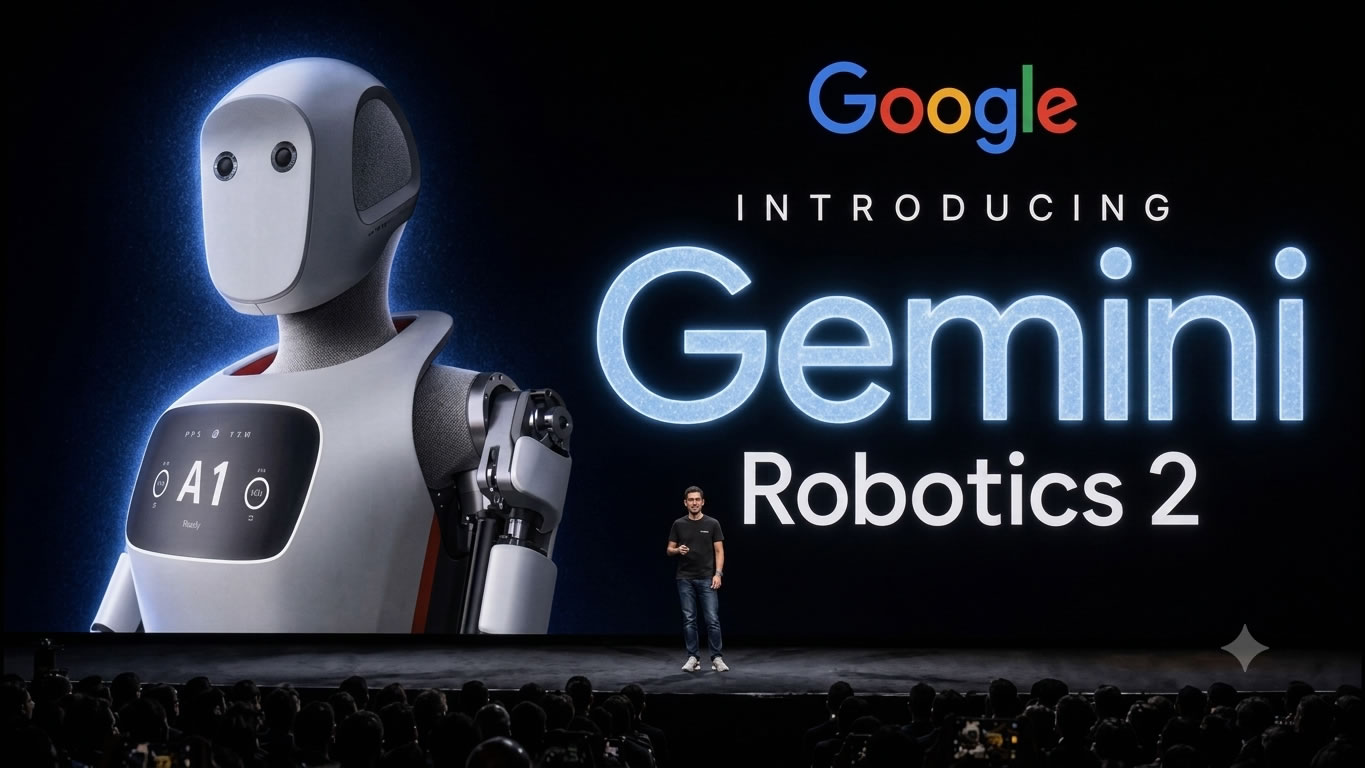
It wasn’t a coincidence that the message landed simultaneously on both sides of the Pacific. On July 20, at the SIGGRAPH conference in Los Angeles, NVIDIA’s Neil Ashton stood on stage as a slide flashed four words: “Physical AI Day.” That same day, Google DeepMind’s Carolina Parada told WIRED something else: “This is a milestone toward physical AGI.”
She was referring to Gemini Robotics 2—a model that can guide a humanoid robot to screw in a lightbulb, tie a trash bag, and restock shelves. NVIDIA’s counterpunch that day was Cosmos 3 Edge, a compact 4-billion-parameter world model designed to run in real time on the Jetson Thor edge chip. Its weights, code, and training recipes are all open source.
Same day, same signal: the AI industry is moving from digital intelligence toward physical intelligence. And this isn’t a story about hype cycles. It’s a structural revaluation that’s only just beginning.
Capital Moves Into Physical AI
Let’s start with the capital flows, because they’re harder to ignore than any editorial. According to CB Insights, in Q1 2026, physical AI and robotics accounted for 11% of all AI deal activity, leading every sub-sector. Industrial humanoid developers and robotics foundation-model companies took the top two spots, with 17 and 15 deals respectively. Humanoid robotics startups are on track to raise a record $10 billion in 2026.
Year-to-date, global public and private funding in physical AI has already hit roughly $7.38 billion—more than double the $3.77 billion raised in all of 2025, and more than triple the $2.24 billion raised in 2024. The median deal size jumped from $61 million last year to $165 million this year, with 72% of all rounds now reaching the nine-figure range.
To put that in perspective: this isn’t venture capital chasing robotics; it’s infrastructure-level capital betting on a new era.
Just look at the names. Uber co-founder Travis Kalanick’s new venture, Atoms, raised $1.7 billion led by a16z. Figure AI is now valued at $39 billion. NEURA Robotics closed a $1.4 billion Series C at a $7 billion valuation. Mind Robotics, founded barely a year ago, secured a $400 million Series B at a $3.4 billion valuation.
China is matching that momentum. DISCOVER Robotics, spun out of Tsinghua University’s Institute for AI Industry Research (AIR), announced a $100 million angel-plus round backed by IDG, Xinglian, Wuyuefeng, and Dachen. Zhengqi Future, which has closed three angel rounds in eight months, raised hundreds of millions of yuan from a mix of top VCs, automotive industry capital (SAIC Hengxu), and luxury consumer investors (Chow Tai Fook).
But the most telling shift isn’t the volume of money—it’s the stage of the companies getting it. In 2025, half of all deals were first-time fundraises, with investors asking, “Can they build it?” In 2026, first-time deals have dropped to just 8%, meaning 92% of the capital is flowing into companies that have already proven their mettle. Rather than a speculative bubble, the market appears to be entering a period of platform selection, where companies with scalable technology and deployment capabilities are likely to separate from the rest.
The Real Bottleneck: Data
Behind the fundraising frenzy, there’s an inconvenient truth that most conversations gloss over: real-world data is the choke point. Applied Intuition CTO Peter Ludwig put it bluntly: “Physical AI is orders of magnitude harder than digital AI.” Digital models can scrape the open web. Physical AI needs data from mines, farms, and ports—none of it publicly available. A failure in physical AI can disrupt operations, damage equipment, or create safety risks.
Ludwig didn’t finish the thought, but the unspoken half is this: capital, engineering talent, and promising applications cannot compensate for the lack of large-scale real-world interaction data.
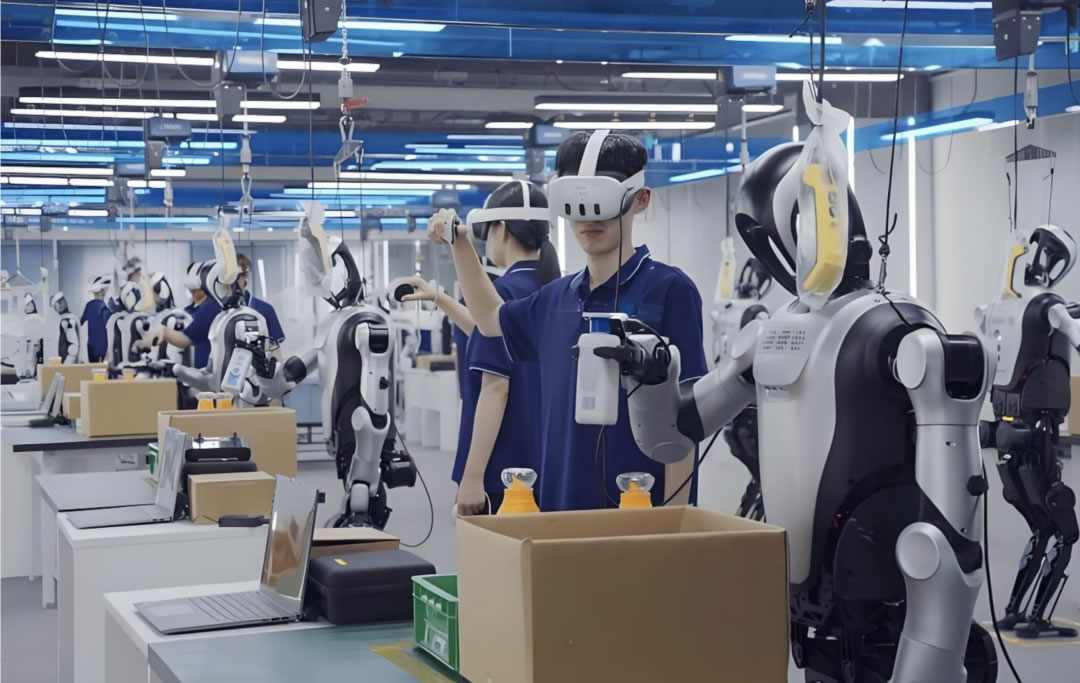
Right now, most companies still rely on “clean data” from professional collectors—engineers arranging objects, tuning lighting, and choreographing movements in a controlled lab. It looks polished, but it misses a critical element: the chaos of the real world.
In the real world, delivery bikes swerve out of blind corners, children run unpredictably, floors get wet, elevator signals drop, and small dogs weave around your feet. That “messy data”—containing failures, environmental noise, and human intent—is the core fuel for building generalizable models.
“Perfect data won’t save a humanoid robot that actually has to work” is fast becoming an industry mantra.
Grid Dynamics’ partnership with South Korea’s Doosan Robotics illustrates the friction. The two are trying to integrate physical AI software into collaborative robots so they can recognize changing object orientations and adapt grasping strategies. But the partnership agreement explicitly highlighted something else: companies must define data ownership, storage locations, and cybersecurity requirements upfront—especially in sensitive industries like automotive, electronics, and pharmaceuticals.
This reluctance comes from the fact that operational data has become one of the most valuable assets in industrial AI. Most factories would rather lock their data in a vault than share it with a robotics startup.
Worse, the cost of acquiring that data is exponential. Training GPT-4 meant ingesting the internet in one go. Training a robot to screw in a bolt requires thousands of real-world repetitions—each one in a physical environment with physical objects, each failure risking equipment damage. The competitive edge, then, isn’t about algorithm elegance. It’s about who can harvest the most real interaction data at the lowest cost. No data flywheel means no product—no matter how good the slide deck looks.
Why Physical AI Is Breaking Through Now
If you only looked at the funding numbers, you might think physical AI is still in the pitch phase. But a cascade of events over the past two weeks is turning that pitch into reality.
Technology: The brain is moving from the data center to the joint. NVIDIA’s Cosmos 3 Edge release at SIGGRAPH wasn’t just another large model. It’s a 4-billion-parameter world model compact enough to run locally on Jetson Thor, delivering 28 frames per second of inference throughput and topping the VANTAGE-Bench visual understanding leaderboard for its size class. More importantly, it’s completely open source—weights, code, and training recipe.
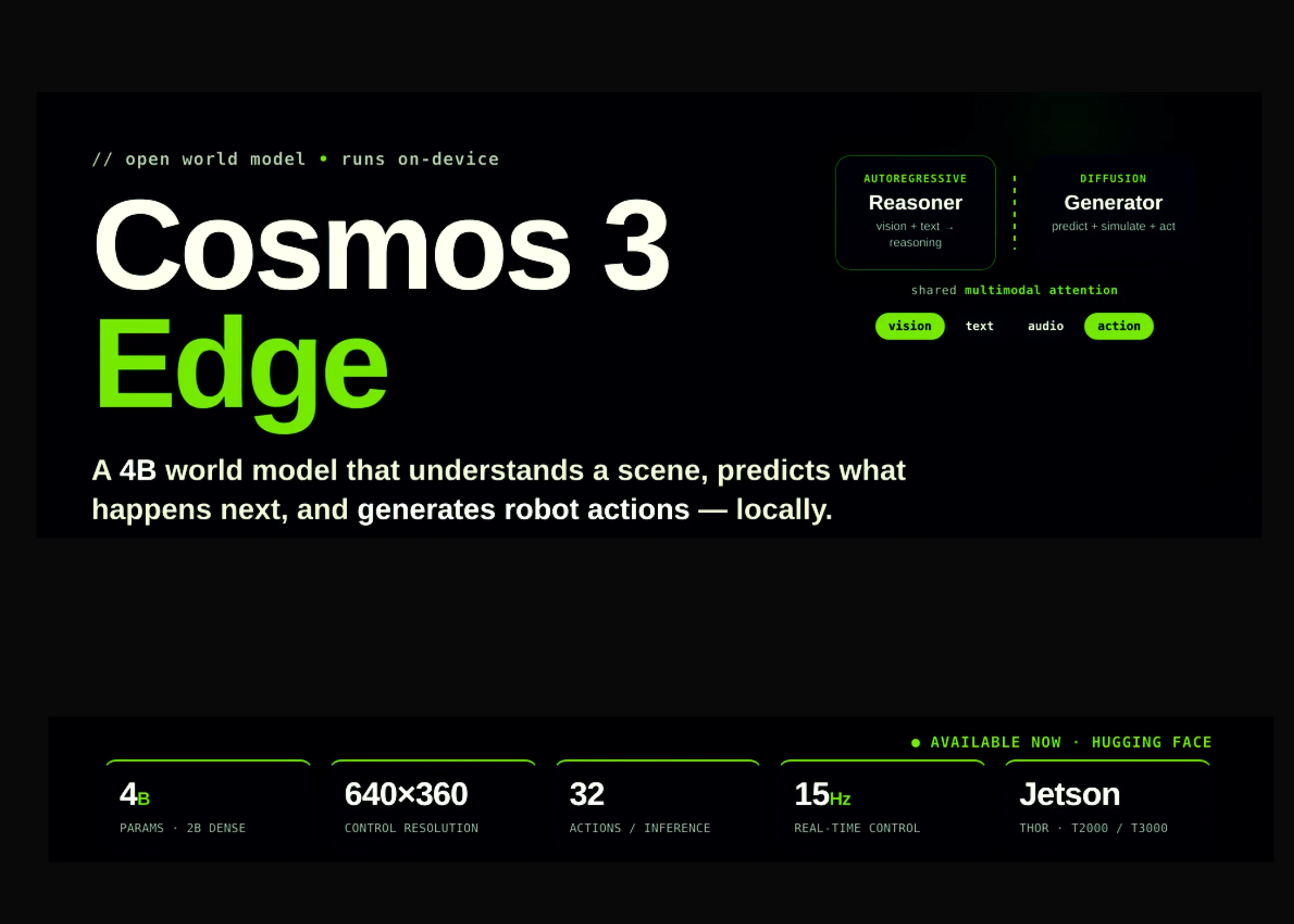
That changes the economics: capabilities that once required large-scale computing infrastructure are increasingly becoming accessible at the edge. Now, a single Jetson dev board can let a robot “think on the fly.”
Same day, Google DeepMind released Gemini Robotics 2. It can control Apptronik’s Apollo 2 robot to unscrew bulbs, tie trash bags, and organize shelves—not via hard-coded routines, but by understanding the scene and planning its own motions. Google’s strategy is clear: build the “Android for robots,” a common intelligence layer that any hardware maker can plug into.
Policy: The geopolitical headwinds are picking up. On July 28, the FCC added “foreign-made humanoid and quadruped robots” to its Covered List, effectively blocking new foreign robots from receiving equipment authorization for the U.S. market. No names were mentioned, but the target is obvious—Chinese humanoid shipments are overwhelming American competitors. China’s Ministry of Industry and Information Technology expects nationwide humanoid production to exceed 100,000 units in 2026, with Q1 exports up 210% year-over-year.
Unitree shipped over 5,500 units in 2025, capturing roughly 32% of the global market. Chinese manufacturers are pushing thousands of humanoids into logistics centers and factories—not primarily for work, but to collect training data. This “volume-for-data” strategy is shifting the Sino-U.S. gap from a technology lag to a data lag. And data, as noted, is the most valuable asset.
Capital: The IPO wave is here. At the end of July, Unitree’s Shanghai STAR Market IPO kicked off, targeting $622 million at a $6.2 billion valuation—making it the world’s first pure-play humanoid robot public company. CEO Wang Xingxing announced plans to ship up to 20,000 units in 2026, roughly four times last year’s volume. Agility Robotics is going public via SPAC at a $2.5 billion valuation, with its Digit robot logging over 65,000 hours of operational data and securing more than $300 million in multi-year orders.
Physical AI companies are moving from “darling of the private markets” to “public-market play.” That’s usually the watershed moment when a technology transitions from concept validation to commercial validation.
AI’s Next Battle Is Moving From Tokens to Actions
Think of AI as an expedition toward AGI. This year, the industry quietly split into two routes.
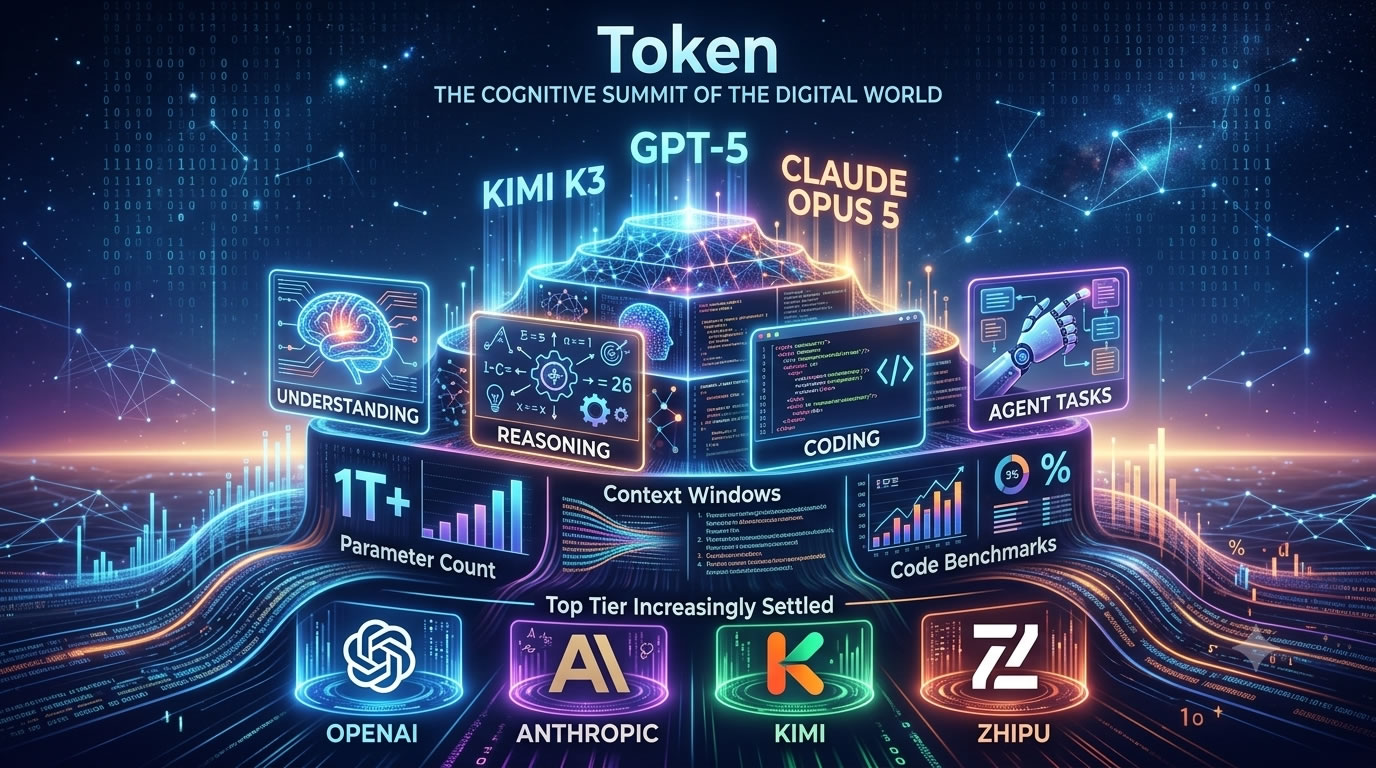
The first is “Token”—the cognitive summit of the digital world. That’s Kimi K3, GPT-5, Claude Opus 5. They solve understanding, reasoning, coding, and agent tasks. Competition is about parameter count, context windows, and code benchmarks. The top tier is increasingly settled: OpenAI, Anthropic, Kimi, and Zhipu have carved out their niches.
The second is “Action”—the physical layer. That’s NVIDIA’s Cosmos 3, Google’s Gemini Robotics, and the VLA (Vision-Language-Action) models from various embodied AI players. They solve how robots perceive the real world, plan continuous motions, and complete tasks amid dynamic changes.
While “Token” represents the cognitive capabilities of AI systems, “Action” determines whether that intelligence can operate reliably in unpredictable physical environments.
But these aren’t parallel tracks—they’re accelerating toward convergence. Gemini Robotics 2 is effectively a VLA model, stitching language understanding to motor execution. Cosmos 3 Edge fuses world modeling with action control, letting robots sense, decide, and adjust in real time. The physical AI of the future won’t be a “ChatGPT that moves.” It will be an AGI with a body—one that understands “put the Coke on the table into the fridge,” decomposes that into “grab → move → open → place → close,” and handles an interruption like “the fridge door is blocked” on the fly.
That’s the real shift from Token to Action.
Who’s Actually Working?
Hold the champagne. Mobileye founder Amnon Shashua, when asked at CES whether humanoid robots are all hype, gave a nuanced answer:
“The internet was hype too. The 2000 crash happened. That doesn’t mean the internet wasn’t real. Hype means companies get overvalued and then collapse. It doesn’t mean the sector isn’t real.”
Physical AI is in that “overvalued” phase right now. Most companies are still selling roadmaps, not products. Tesla’s Q2 earnings left Oppenheimer analyst Colin Rusch unimpressed, noting he hadn’t seen tangible results from Tesla’s pivot to physical AI. Optimus’s production line hadn’t even started by mid-July, and Musk himself admitted early output would be “extremely slow.”
But the companies that are actually building have started generating real data.
Figure 03’s delivery numbers are instructive: from February to April 2026, shipments doubled month over month—60, 120, 240 units. By late April, cumulative deliveries exceeded 350, with production ramping from one per day to one per hour. In May, Figure livestreamed a 200-hour continuous sorting session, processing 12,732 packages in eight hours—losing only narrowly to a human intern. In June, Figure 03 entered BMW’s Spartanburg plant for logistics sorting.
BYD has confirmed its humanoid robot will debut in August, initially for customer reception and product demos at dealerships. XPeng is running small-batch pilot production at its Guangzhou factory, with mass production planned for Q4 2026. Airbus is using UBTECH’s Walker S2 for aerospace manufacturing. BMW has deployed humanoids on German assembly lines. Boston Dynamics’ Atlas will enter Hyundai factories this year.
The distinction matters: some companies are demoing. Others are working. The competition ultimately comes down to data flywheels. Whoever can capture real-world interaction data at greater scale and lower cost will have the advantage.
The Five-Phase Forecast to 2030
Physical AI won’t arrive overnight. It will roll in waves, covering different shores at different speeds. Here’s a five-phase scenario through the end of the decade.
Phase 1 (2026–2027): Single-point breakthroughs in structured industrial settings.
Think factories, warehouses, and hazardous environments. These settings are structured, tasks are well-defined, ROI is calculable, and labor shortages are real. BMW, Airbus, and CATL are already using humanoids for inspection and sorting. Over the next 18 months, we’ll see more pilots turn into standard operations. PwC Strategy& projects the global physical AI market at roughly €430 billion by 2030. SNS Insider’s more conservative estimate puts it at $87.4 billion by 2035, a CAGR of 32.5%. Global industrial humanoid deployments are expected to grow from about 50,000 units in 2026 to 200,000 in 2027. The bottleneck? Reliability. Factories can tolerate slow, but they can’t tolerate a bot crashing a production line. Safety and predictability trump raw intelligence.
Phase 2 (2027–2028): Commercial service scale-up.
Once the industrial flywheel spins, physical AI will bleed into retail, restaurants, hotels, and eldercare. Store restocking, cleaning, and guiding; kitchen prep; luggage handling; assisted care. These are “human-in-the-loop” scenarios—they don’t require 100% autonomy, but they do require a price point that beats labor. By 2028, global commercial service robot deployments could hit 500,000 units. Price is the gatekeeper: Unitree has already dropped its entry-level humanoid to $13,500. Tesla’s target for Optimus is $20,000–$30,000. Once the price falls below $20,000, the total cost of ownership undercuts a human worker in most commercial roles.
Phase 3 (2028–2029): The home breakthrough.
Consumer homes remain the ultimate proving ground for physical AI. 1X Technologies’ NEO has taken about 10,000 pre-orders at $20,000 each (or $499/month rental), with deliveries promised by late 2026. But the home environment is wildly unstructured, safety requirements are punishing, and user tolerance is zero. By 2029, we’ll see the first consumer humanoids capable of handling meaningful household tasks—not glorified robo-vacuums, but devices that can tidy a room, prep a simple meal, or assist with senior mobility. Penetration will be thin: maybe 50,000–100,000 units globally. The real home explosion waits for 2030 and beyond.
Phase 4 (2029–2030): The orchestration layer matures.
By 2030, the biggest change won’t be smarter single robots—it will be multiple robots, devices, and sites coordinated by a single intelligence layer. NVIDIA’s Cosmos and Google’s Gemini Robotics are evolving into the operating system of the physical world. They won’t control one device; they’ll orchestrate factories, AGVs, robotic arms, and sensors across facilities and even across cities. Applied Intuition’s Dana platform and Whale’s AIOS (managing 600,000 edge AI nodes) are early signals of this. The orchestration layer is where the long-term bet lies—AI systems moving from robot control to coordinated fleets and interconnected workflows. By 2030, this physical AI orchestration market could be worth hundreds of billions—more lucrative than robot hardware itself.
Phase 5 (2030): The Mass-Market Convergence.
By 2030, physical AI reaches a point of mass-market convergence—not a single device that changes everything, but four curves crossing their inflection points simultaneously: cost, performance, ecosystem, and social acceptance.
On cost, the bill of materials for a humanoid could drop below $5,000, driven by Chinese supply-chain scale and specialized silicon. On performance, VLA models will approach “one model for all chores.” On ecosystem, Google’s robot Android or NVIDIA’s Cosmos will lock in developer momentum. On acceptance, Gen Z will be the first cohort to grow up alongside robots as coworkers and consumers.
Citi offers a grander vision: by 2035, 13 million humanoids globally, 18 million caregiving bots, 11 million delivery bots—plus autonomous vehicles and cleaning units, pushing total physical AI devices past 1.3 billion. By the end of 2030, total deployed units may hit 5 million, spawning a trillion-dollar new market.
From Digital to Physical
The last decade’s AI narrative was about the cognitive revolution: AlphaGo beating Lee Sedol, GPT-4 passing the bar exam, Kimi K3 topping coding leaderboards. Impressive, but all inside the digital domain.
The next decade’s narrative is about the productivity revolution: robots into factories, warehouses, and homes—doing real jobs, generating real GDP. Humanoid robotics is moving beyond experimentation. Physical AI will be the fastest-growing AI vertical over the next four to five years. The marginal returns on digital AI are diminishing. The marginal returns on physical AI are just beginning.
Looking back from 2030, we may see 2026 as physical AI’s “1995 moment”—the internet bubble was still brewing, but the web had already changed the world. A bubble may come for physical AI too. But the shift itself is already underway.
