

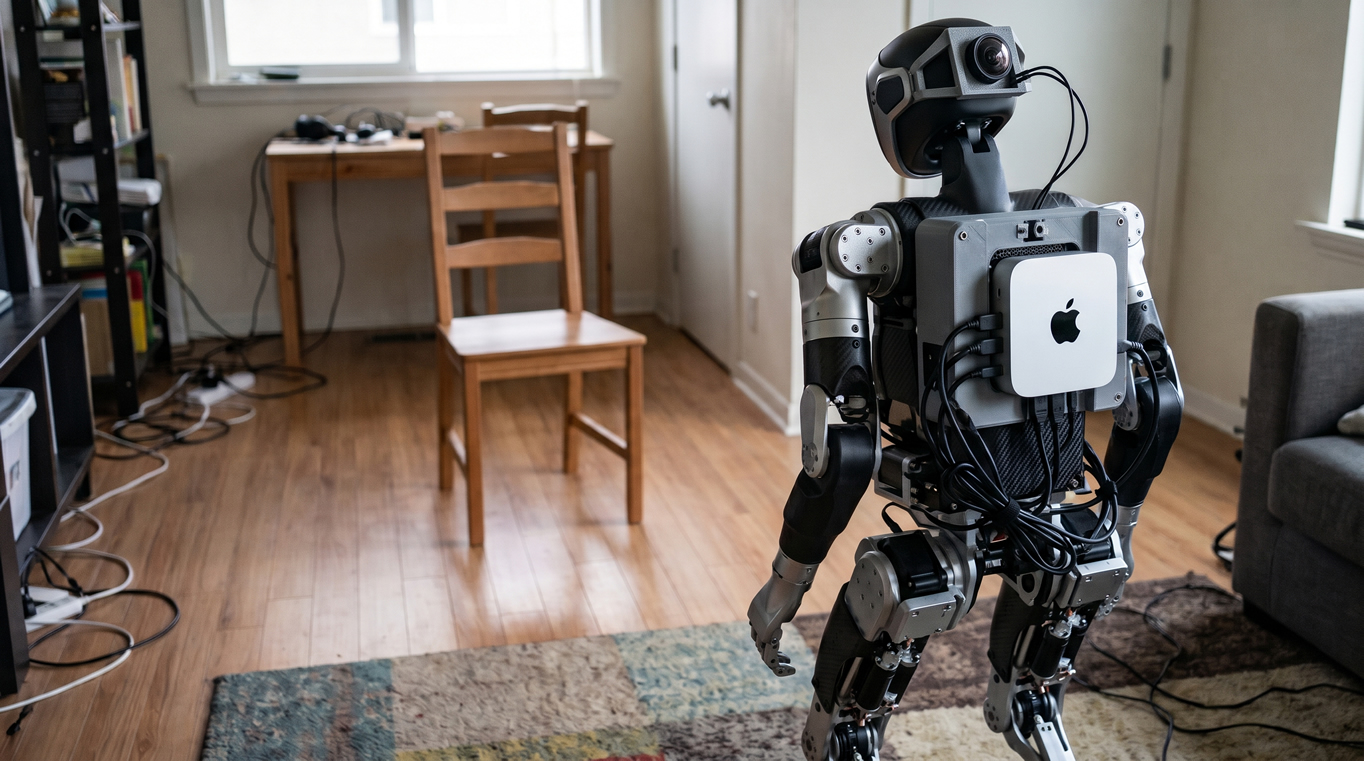
CUPERTINO — Nobody had scanned the room. Nobody had walked the robot through it, driven it by remote control, or taped a marker to the floor. A Unitree G1 stood on a carpet it had no memory of, a Mac mini strapped to its back, a fisheye lens bolted to a custom mount on its head.
Someone said: go sit on the chair.
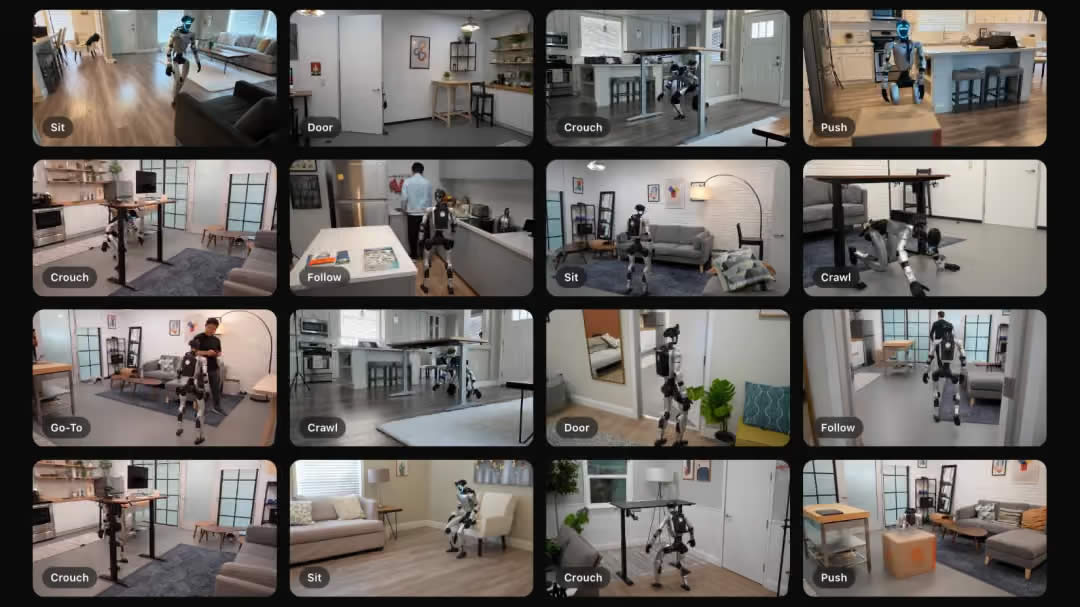
The machine turned, crossed the room and sat down. Apple’s researchers ran that and five other tasks 360 times across six houses and offices the robot had never entered. It worked 91 percent of the time. None of the training data came from a person in a motion-capture suit or a person holding a controller in a real room.
HALO — Humanoid Autonomy, Learned in simulation, running Onboard — is the name Apple gave the system in that paper, Perceptive Humanoid Motion from Simulation. Eight authors, all at Apple. Siyuan Hu is first, Vladlen Koltun last, and Koltun spent years running Intel’s Intelligent Systems Lab before Intel wound it down. It is the most convincing piece of embodied AI Apple has shown in public, and it is not a product.
Two documents landed this month, 48 hours apart, pointing in opposite directions. On November 4, Apple’s machine learning research group posted the paper behind that demo. On November 2, The Information reported that the robot Apple actually intends to sell — a $1,000 tabletop device codenamed J595 — had slipped from 2027 to as late as 2028, held up not by hardware but by software.
What HALO actually solved
Every lab working on humanoid robots hits the same wall, and it is not motors or batteries. It is supervision. Getting a machine to turn a camera image and a sentence into joint commands requires paired examples of what to do, and nobody has a corpus of that at scale. The two ways to build one are teleoperation and wearable capture, both of which the paper dispatches in its abstract: they “require at least an hour of human time to produce an hour of data.”
That ratio is why humanoid progress has been slow and expensive, and it is the thing HALO attacks.
The pipeline starts with Kimodo, the kinematic motion diffusion model NVIDIA Research released in March, trained on 700 hours of optical motion capture. Given text descriptions, waypoints and a few keyframes, Kimodo produces whole-body movement. Those movements get dropped into rooms generated by Infinigen, the procedural scene tool from Princeton’s vision lab: 1,000 of them, 45 percent living rooms, 30 percent offices, 25 percent bedrooms. Each room is rendered in NVIDIA’s Isaac Sim with ray tracing, from a viewpoint matched to the robot’s own fisheye camera, then degraded on purpose with random blur, noise, exposure and color shifts to close the gap between simulation and a real living room at four in the afternoon.
The output was 162,698 episodes, or 296 hours of training data at 30 frames per second, covering six skills. Apple’s summary of what that means is one sentence: the corpus “scales with compute rather than human labor.”
That is a claim about economics as much as robotics. Apple is saying the scarce input in humanoid development can be bought from a cloud provider instead of hired.
Three models, three clocks
HALO is not one model. There are three, running at wildly different speeds, and the split is the design.
An orchestrator takes the request — “go sit on the chair” — and breaks it into subtasks, deciding when to move on and when to retry. The model is off the shelf: Apple’s default is a 35-billion-parameter one from Alibaba’s Qwen family, quantized to 4-bit so it fits. It runs about once every two seconds, roughly as fast as a model that size can go on a backpack.
A motion generator runs roughly three times a second. It pairs a frozen Qwen vision encoder with a 49-million-parameter diffusion transformer, reads the current camera frame and the current subtask, and plans five seconds of whole-body motion.
A tracker runs at 50 Hz. Trained with reinforcement learning in Isaac Lab, it consumes depth images, proprioception and the robot’s IMU, and outputs position targets for 29 joints.
The compute split matters. The models run on the robot, but not on anything Unitree put there. Apple bolted a Mac mini with an M4 Pro and 64 GB of memory into an enclosure on the G1’s back; that machine runs the orchestrator and the generator. The tracker runs on the G1’s own Jetson Orin NX. The robot is untethered, which is impressive, and it is also carrying a desktop computer.
What the 91 percent doesn’t cover
Individually the six skills hold up. Crouching under a table worked 95 percent of the time in simulation and 100 percent in the real world; stepping sideways through a half-open door, 91 and 93; walking to a named object, 98 and 92. Sitting on a chair is the weakest of them, at 84 and 85, and the six-skill averages come out at 91 percent in both.
Chaining them is where it falls apart. Go through a door and then to an object: 10 for 10. Crouch under a table and then sit: 60 percent. Crouch, walk to a box, push it: 50 percent. Those tests used a single real environment, and the authors are honest that the drop is steeper than the single-task rates would predict.
The gaps run deeper. None of the six skills involves grasping anything with the hands. The robot has no sense of touch. The tracker, as the paper puts it, “follows the kinematic plan without knowing what the plan is for” — it will execute a plan that has already gone wrong. And adding a seventh skill is not a matter of more compute: a person still has to write the prompts and author the keyframes, so “the repertoire grows only as fast as a person can specify additional tasks.”
Nor is the data as human-free as the headline suggests. The tracker’s first training stage uses LAFAN1, a public motion-capture dataset, retargeted onto the G1. The keyframes for crouching and crawling were taken from phone video of a person going under a table and lifted into 3D. The box-pushing set includes a mocap recording. What HALO eliminated is the hour-for-an-hour teleoperation tax, not human input.
The ablations are where the useful lessons are. Train the generator on one room instead of 1,000 and the sitting task drops to 43 percent in held-out simulated rooms. Swap the diffusion decoder for plain regression: 19 percent. Remove depth from the tracker: 74 percent. Apple published the data pipeline, the training code and deployment code for both MuJoCo and the real G1 on GitHub, though not the trained weights or the 296-hour dataset. It ran no head-to-head comparison against other published systems under matched conditions, which is the one thing a skeptical reader would most want.
Apple’s contribution is the assembly, not the parts
Look at what is actually inside this result. A Chinese body, an NVIDIA motion model, an NVIDIA simulator, an Alibaba orchestrator, a scene generator from a university lab in New Jersey, a commodity camera in a 3D-printed mount.
Apple’s contribution is the pipeline that connects them, the decision to freeze the vision encoder and train only the small parts, the quantization that squeezed a 35-billion-parameter model onto a battery-powered backpack, and the taste to pick a robot you can order online instead of building one. That last choice is not laziness. Using a stock G1 removes the hardware as an experimental variable, which is exactly what you do when the question you are asking is about software.
Something has changed, though. For twenty years Apple’s advantage in any category was that it owned the defining part: the chip, the operating system, the industrial design, the retail channel. Here it owns none of them. It owns the integration, and it did the integration well enough to produce a state-of-the-art result. That is a different company from the one that built the iPhone, and one that can produce a brilliant paper and a late product in the same two weeks.
Why J595 slipped to 2028: the hardware was done two years ago
The product is a nine-inch display on a rotating arm. It turns to follow whoever is speaking, does FaceTime, and switches on the lights when someone walks into the room. Target price around $1,000.
It has been coming for a long time. A prototype existed by 2018. Tim Cook saw a demo in 2019 and let the team keep going. The project was formally approved in 2022. When Apple killed its car in February 2024, the robotics group moved out of the AI organization and under John Ternus, the company’s senior vice president of hardware engineering, and only then did it become a strategic priority rather than a side project.
The hardware has been frozen for roughly two years. What has not been frozen is the software, and according to The Information’s reporting the internal argument is not about whether the robot can work but about what the first version should be allowed to do. The hardware team wanted to ship. The software team kept narrowing the scope, retreating to FaceTime and basic home control, because the deeper Siri integration never arrived. Apple’s AI gap, discussed for three years in general terms, has a concrete cost here: it is the reason a machine that was supposed to be on sale next year may now arrive in 2028.
A slipped date is nothing new at Apple. A product whose feature list was written by its own AI team’s limitations is.
The $299 product that does everything but move
On Friday, Apple starts selling HomeView. The hardware is a seven-inch screen on a speaker base, $299, tabletop or wall-mounted, and the one thing it cannot do is turn toward you.
So here is the commercial question nobody at Apple has answered in public: why would a household pay three times as much for a HomeView that swivels?
The company’s internal answer, as reported, is that J595 is a data-collection terminal first and a product second. A screen that moves produces pairings no stationary display can. It learns where a person sits relative to where it is pointing. It learns which physical motion follows which spoken request, and which change in a room should provoke it into acting unasked. Those pairs are the raw material for whatever Apple builds after this, and you cannot generate them in a simulator, because the whole point of the last two years of research is that simulated humans are not real ones.
A coherent argument, and also the one every company makes when its product is late. It will be tested by whether anyone buys the thing. A thousand dollars is a strange price for a data-collection device that also has to be a good FaceTime machine in a kitchen where a $299 one already is.
Ten years of robotics, each attempt smaller than the last
Apple has been at this longer than most of the companies now shipping humanoids. Project Titan started in 2014 with a target of full autonomy, ran for a decade, and ended in February 2024 without a vehicle. What survived was not a product but a set of capabilities: computer vision, autonomous navigation, motion control, sensor fusion. The engineers who held them mostly went into robotics.
A year later Apple published ELEGNT, a framework for what its authors called expressive and functional movement design for non-anthropomorphic robots. The demo was a desk lamp on an arm behaving like the Pixar lamp: leaning in when curious, tilting back when asked something hard, nudging toward a person to suggest they drink some water. It was easy to file away as a design study. It was not. ELEGNT and J595 ask the same question: whether a robot’s first job is to look human or to do what a screen cannot. Apple has answered it the same way twice.
The pattern is consistent: research first, product late. Titan banked capabilities and ELEGNT banked an interaction language. HALO banks a training method. J595 is the first attempt to spend any of it, and the spending is cautious — a low price, and a form factor that cannot fall over.
The room, again
The G1 is still standing in that living room, waiting for its next instruction. Its body came from Hangzhou. Its motion model came from Santa Clara. Its orchestrator came from Hangzhou too, shrunk to 4-bit by Apple’s engineers so it would fit on a backpack. Its training rooms came from New Jersey. Its code came from Cupertino, and is now on GitHub for anyone to download.
What Apple contributed is the judgment about how to put those pieces together, and on the evidence of the paper, that judgment is very good.
Apple can make a robot intelligent. It proved that in 360 trials. Whether it can get one into a box and onto a shelf before the companies that already sell the body, the motors and the joints work out the rest is a different problem. For $13,500, Unitree will sell you the same body Apple’s researchers used. Apple’s own robot, a screen on a swiveling arm, will cost a thousand dollars and is not expected before 2028.
The gap between those two facts is not a technology problem. It is a shipping problem, and Apple used to be the best in the world at shipping.
