


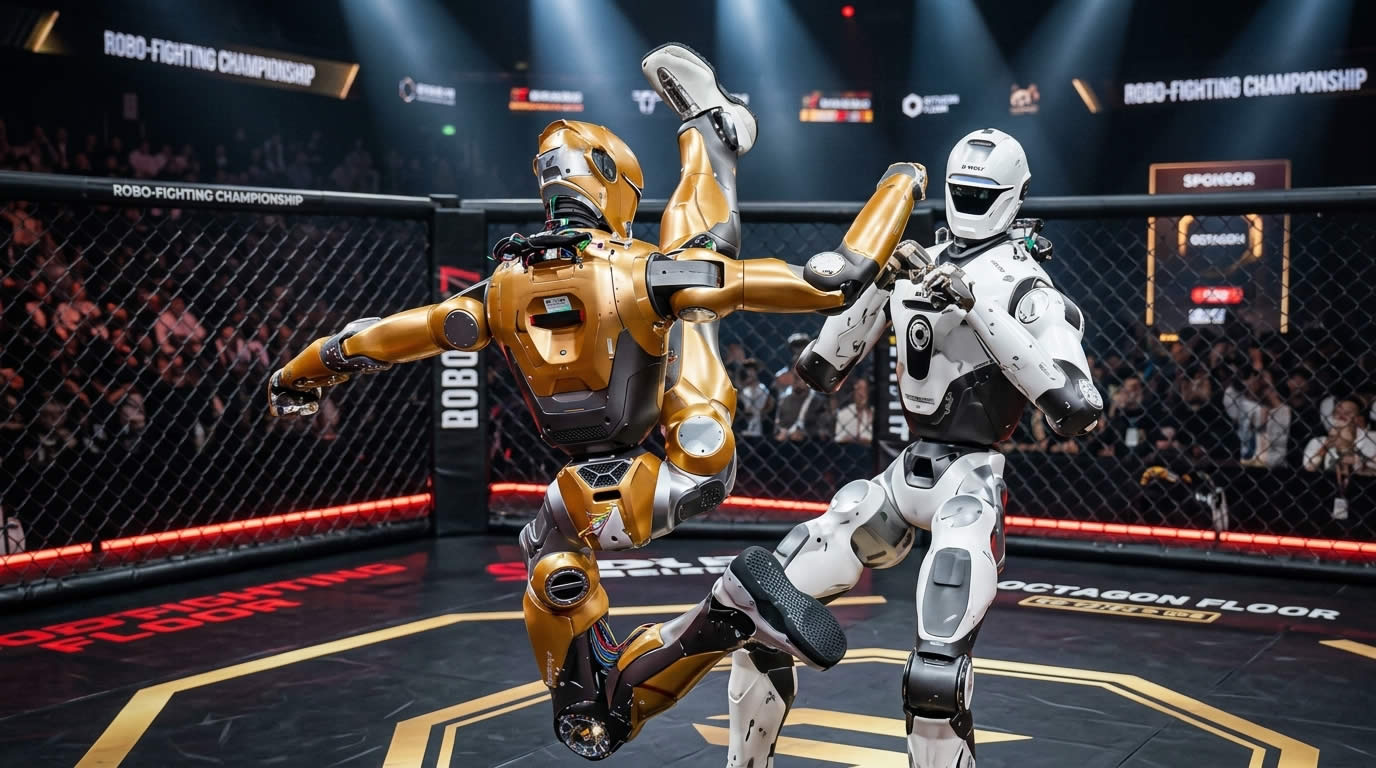
A humanoid robot hit the floor of a boxing cage in Shanghai on Sept. 19 as a referee counted down the seconds. Then it got back up.
An EngineAI T800 nicknamed “White Eagle” pulled off a kip-up, using its hands and feet to push itself back onto its feet almost immediately. It then went back into the fight.
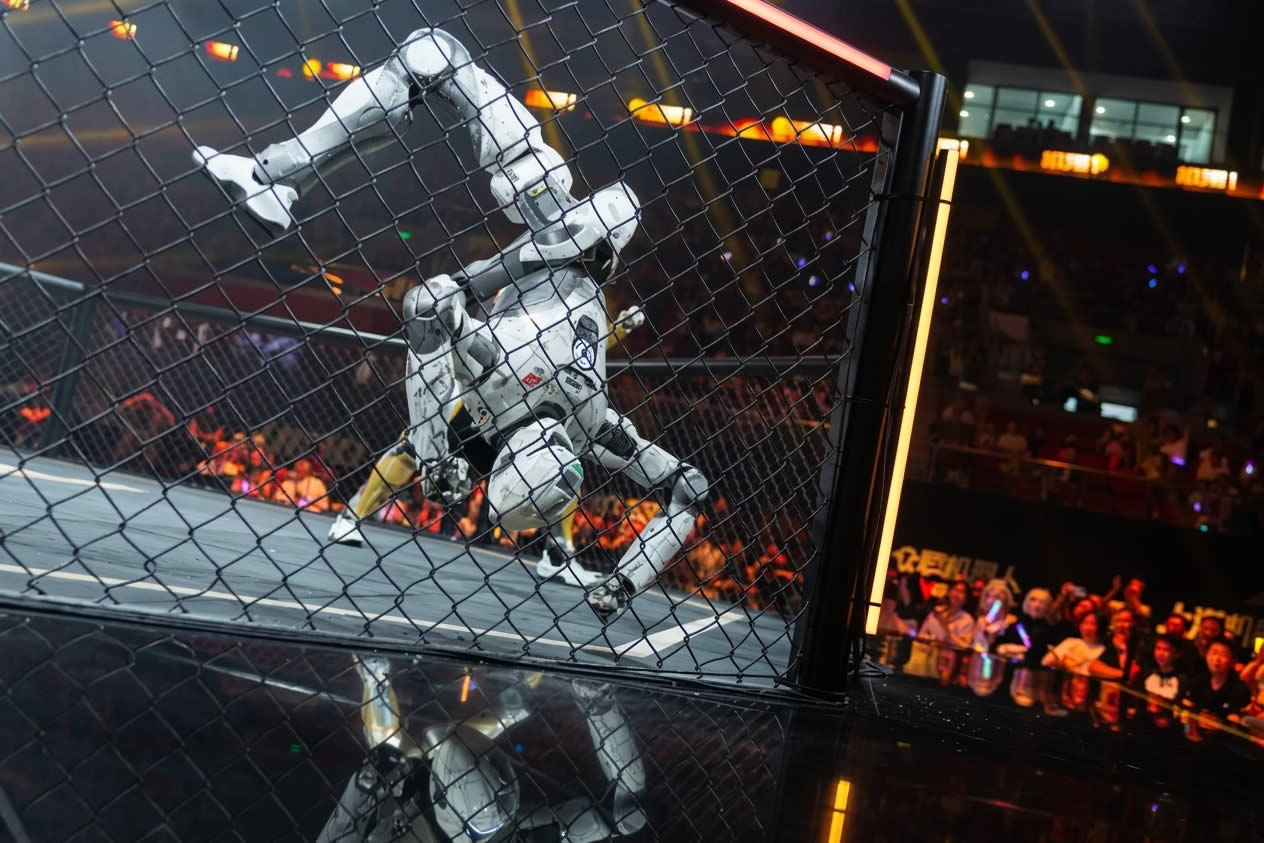
The move was one of several new demonstrations at the Shanghai stop of the URKL City Tour Challenge, a humanoid robot combat event launched by EngineAI. The company is using the competition to showcase what its robots can do under physical stress, but the more interesting question is what happens when a humanoid has to perceive an opponent, make decisions and recover from a fall while the fight is still going on.
That makes robot combat a useful test case for a broader problem facing humanoid robot makers: how to keep a machine stable and responsive when the environment stops cooperating.
A T800 That Gets Back on Its Feet
EngineAI held the Shanghai event at Baoshan Sports Arena on Sept. 19, roughly two months after URKL’s opening match in Shenzhen on July 16.
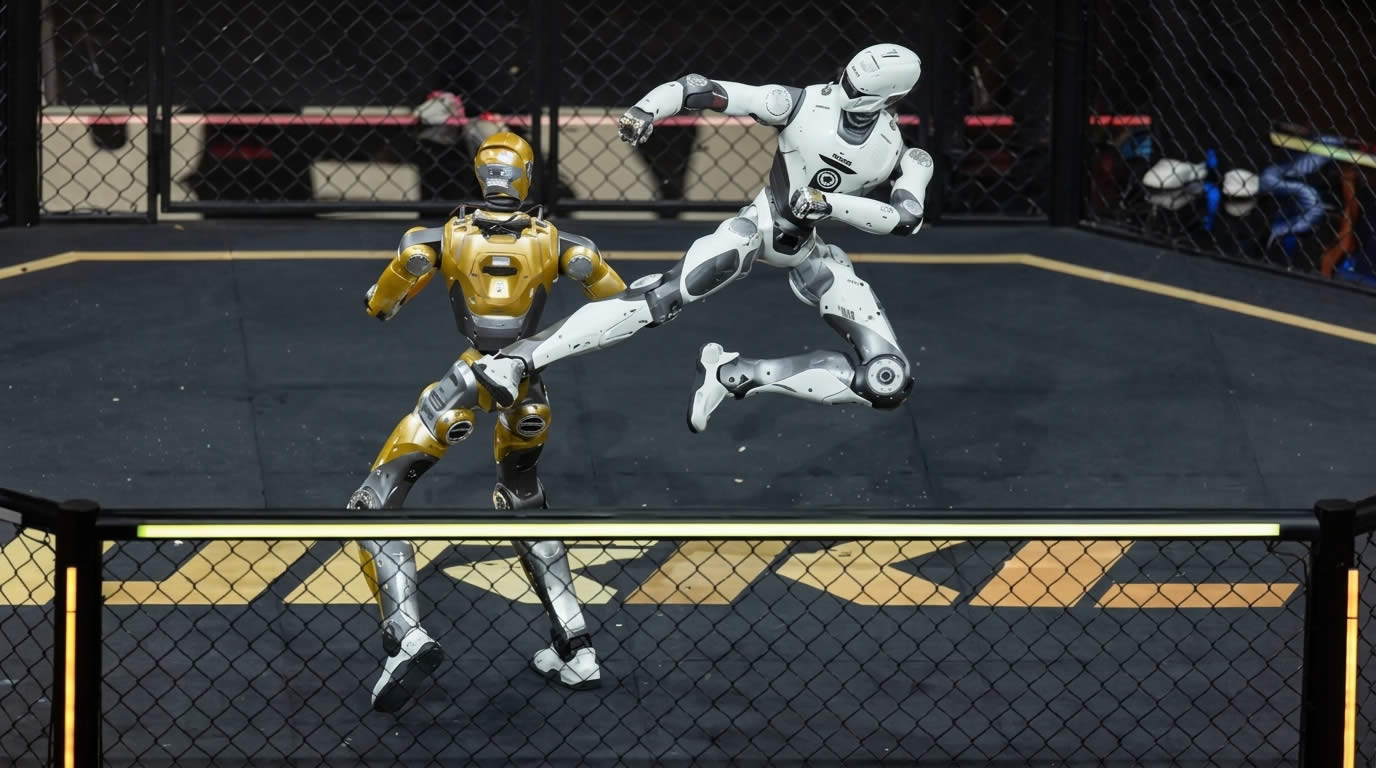
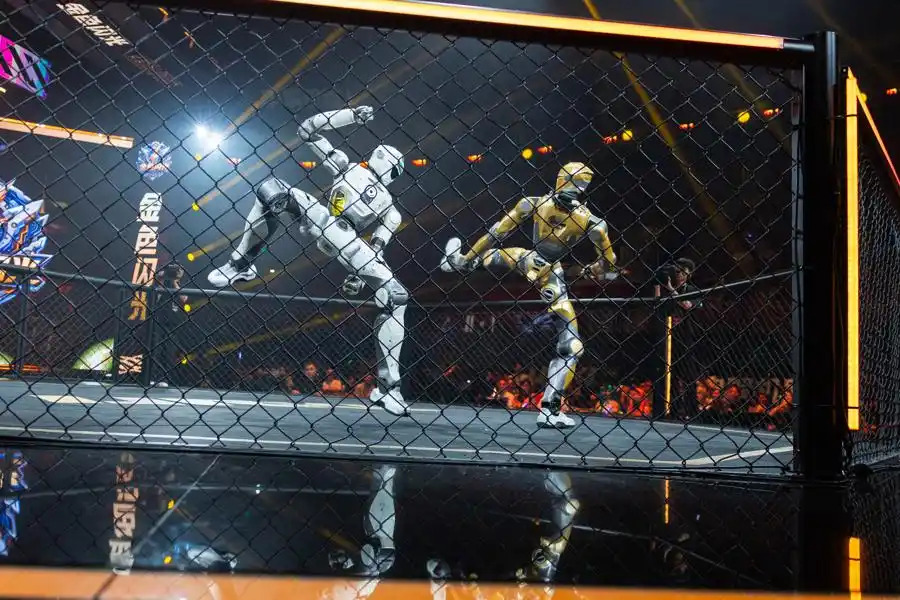
Two T800 humanoids traded punches, kicks and evasive movements inside the octagonal cage. The Shanghai event also introduced three new moves: the kip-up, a rapid evasive maneuver around an opponent, and a jumping knee strike.
The movements look like fight choreography on the surface, but they put very different demands on a humanoid robot.
A kip-up requires the robot to move from a fallen posture back to standing in a single sequence, combining upper-body support, leg movement, joint torque and balance control. A rapid change in posture leaves little room for error. A delayed control response or a poor balance correction can turn a recovery attempt into another fall.
The other movements test different parts of the system. Footwork requires the robot to track where the opponent is and move quickly without losing balance. A jumping knee strike requires a controlled launch, a rapid change in body posture and a stable landing.
That means the demonstration was not only about the movement itself. It also put joint actuation, motion planning, control loops and balance compensation under pressure at the same time.
For humanoid robots, that combination matters. A robot that can perform a movement in a controlled demonstration faces a very different challenge when another machine is moving unpredictably in front of it.
From Semi-Autonomous to Autonomous Combat
According to Yao Qiyuan, EngineAI’s co-founder and head of marketing and services, the T800 used a semi-autonomous mode during the July Shenzhen opening event. By the Shanghai stop, the company said the robot had moved to an autonomous mode for parts of the competition.
That includes navigation, opponent tracking and strike selection, according to Yao.
EngineAI described the Shanghai event as a demonstration of an autonomous perception-to-action loop operating in a live arena. The robot navigates into the cage, tracks the opponent’s body position and movement, and selects actions as the situation changes.
The underlying system combines perception, situational assessment, decision-making, motion planning and execution. EngineAI also said the T800 can continue tracking the opponent and adjust its strategy as the fight develops.
Those claims are important, but they should be read in context. A public robot combat demonstration is not the same as proving that a humanoid can operate autonomously across the much wider range of situations it may encounter in factories or homes.
What the arena does provide is a highly constrained but physically demanding environment where failures are obvious. The robot has to stay upright, respond quickly and deal with impacts rather than simply repeat a pre-programmed sequence.
At the control level, EngineAI points to high-torque joint actuation, low-latency control loops, external-force estimation and balance compensation as part of the system supporting the robot.
That is where the fighting becomes more interesting from an engineering perspective.
Three Robots Turn the Fight Into a Coordination Test
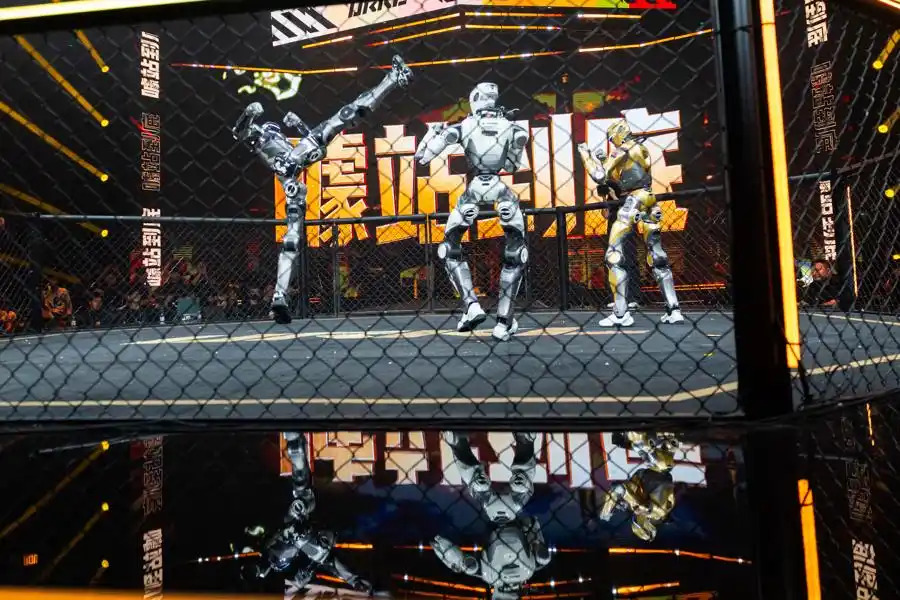
The Shanghai event went beyond one-on-one fighting.
In the final “Last Robot Standing” matchup, the Shenzhen competitor “Matador” returned as the challenger while “White Eagle” and “Golden Flash” fought as a team.
EngineAI said the multi-robot system uses distributed multi-robot perception, combining observations from two robots to reduce individual blind spots. The system can track an opponent’s 3D pose, movement trajectory and behavioral state while also keeping track of the relative positions of the three T800s.
The robots can then be assigned different roles, including containment and distraction, while another robot takes advantage of an opening, according to the company.
Coordinating three full-size humanoids adds another layer of difficulty. Each robot has to account for the opponent, its teammates and its own position at the same time. The system must also prevent the robots from colliding with one another while maintaining enough space for them to maneuver.
In other words, the problem is no longer simply “Can the robot punch?”
It becomes: Can multiple robots maintain situational awareness and coordinate physical movement in a rapidly changing space?
That is a more relevant robotics question than the spectacle of the fight itself.
Beyond Raw Torque, Reliability Becomes the Real Test
The strongest case for robot combat may not be the fighting.
It may be the falling.
EngineAI says the T800 has a maximum joint torque of up to 450 N·m. In a physical fight, repeated impacts place stress on the robot’s joints, structure and control system. A humanoid that loses balance has to recover quickly or the encounter is effectively over.
Yao said the team pays more attention to the robot’s ability to recover than to its raw fighting power.
In a real industrial setting, a humanoid that gets knocked off balance by an unexpected impact, loses its footing or falls will need to recover without damaging itself or disrupting the task it was performing.
“The ability to quickly adjust posture, regain balance and return to work” is part of the capability EngineAI wants to improve, Yao said.
In that sense, the cage becomes a kind of physical stress test.
Combat data can expose weak points that may not appear during controlled demonstrations. EngineAI said data collected from the fights can be used to identify vulnerable components and guide hardware improvements aimed at extending service life and improving reliability and durability.
The point is not that a robot needs to fight in a factory. It is that a robot designed to work alongside people will eventually have to deal with physical disturbances that cannot be scripted in advance.
A fall is a much more useful engineering signal than a perfect demo.
A New Business Around Robot Combat
EngineAI is also trying to build a business around the events themselves.
At the Shanghai event, Yao outlined plans for an Embodied Intelligence Enablement Center and a humanoid robot combat club in Baoshan. The proposed center would combine real-world training environments with demonstration space and services including robot sales, smart hardware, repair, warranty support and equipment rental.
That is closer to a service and experience center than a conventional exhibition hall.
The company is also planning a dedicated robot combat club aimed at a consumer audience. Finding a suitable location is not straightforward. A venue needs enough space and ceiling height for the cage and audience, while also benefiting from public transport and surrounding foot traffic.
The planned site is in an older factory building inside Wisdom Bay Science and Technology Park, near a metro station and existing commercial activity.
For EngineAI and its partners, the venue could support more than ticket sales, with training, equipment rental, technical services and robot demonstrations built around the same site.
The Shanghai Robot Industrial Park is also developing shared infrastructure that can support robotics companies with testing and validation. The park says it is building co-creation space, pilot testing facilities and data infrastructure that could reduce the need for individual companies to build every testing environment themselves.
In June, Gucun Industrial Company and EngineAI established Shenqing Robotics Technology (Shanghai) Co., Ltd., which is intended to support EngineAI’s local operations and industry partnerships in Shanghai. Its business scope includes embodied robot scenario training, technical services, equipment sales and rental, public demonstrations, educational programs and vocational training.
The URKL events could therefore serve a second purpose beyond competition: giving EngineAI a public-facing venue for training, demonstrations and other robotics services.
From Shanghai to Riyadh
The Shanghai event is part of a broader push by EngineAI to take humanoid robot combat beyond a single showcase.
On Sept. 9, Hero Esports’ CyberHero event in Riyadh featured 10 T800 robots in a seven-round team combat format inside an octagonal cage. The event lasted nearly two hours.
The international expansion matters because robot combat is still a niche format. For now, the value of these events is less about establishing a mature sports industry than about creating public venues where humanoid robots can be demonstrated under conditions that are harder to control than a trade-show floor.
URKL’s city tour is one way of doing that.
Shanghai provides one environment. Riyadh provides another. The underlying robot may be the same, but the audience, venue and operating conditions change.
That creates a question for EngineAI that is more difficult than putting on a successful fight night: Can the company turn robot combat into a repeatable testing, training and commercial platform?
The answer will depend on what the robots can learn from those events and how much of that learning translates into improvements outside the cage.
The more important test, however, will happen after the applause dies down.
Can a humanoid robot fall, recover, avoid another robot, adapt to a changing situation and keep working?
That may ultimately matter more than how hard it can punch.
