


The 2026 World Robot Conference runs August 19–23 at the Etrong International Exhibition & Convention Center in Beijing Economic-Technological Development Area, better known as E-Town. This year’s theme is “Coexistence of Human and Machine, Integration of Industry and Demand.” The exhibition floor covers about 55,000 square meters, with more than 300 companies and over 2,000 exhibits. Organizers say more than 150 products will make their public debut, and more than 60 side events are scheduled.
But for most attendees, the bigger change isn’t volume. It’s that the show has shifted further toward complete robot systems, embodied AI, core components, and real deployment scenarios. For industry buyers, developers, and integrators, that means the old “walk every aisle” approach is less useful. Pick your targets by hall and by theme day.
Which Day You Attend Matters
WRC 2026 isn’t following a single schedule for all visitors. It has four theme days.
August 19: Launch Day. Major announcements, product unveilings, and partnership initiatives. Not all 150 debuts will land on day one, but if you want an early read on where leading companies are heading, this is likely to be the busiest day for launches and announcements.
August 20: Procurement Day. Built for industry attendees. Expect matchmaking sessions and supply chain events. If you’re sourcing robots, looking for component suppliers, or evaluating projects, this is the day to be there.
August 21: Developer Day. Aimed at engineers and developers. Technical sessions and demo walkthroughs. Good for people working on software, control systems, algorithms, and embodied AI.
August 22–23: Public Open Days. Open to all ages. Families, students, and hobbyists tend to pack Hall D and Robot Consumer Street during these two days.
Age policy: August 19–20 is restricted to attendees 18 and older. August 21–23 is open to all ages. Visitors under 18 and over 60 can register for free exhibition access. One adult can bring up to three minors per day. Visitors should bring their original ID for entry. General exhibition entry is 100 yuan per day. Main forum sessions run from the afternoon of August 19 through August 22.
Hall C Should Be Your First Stop
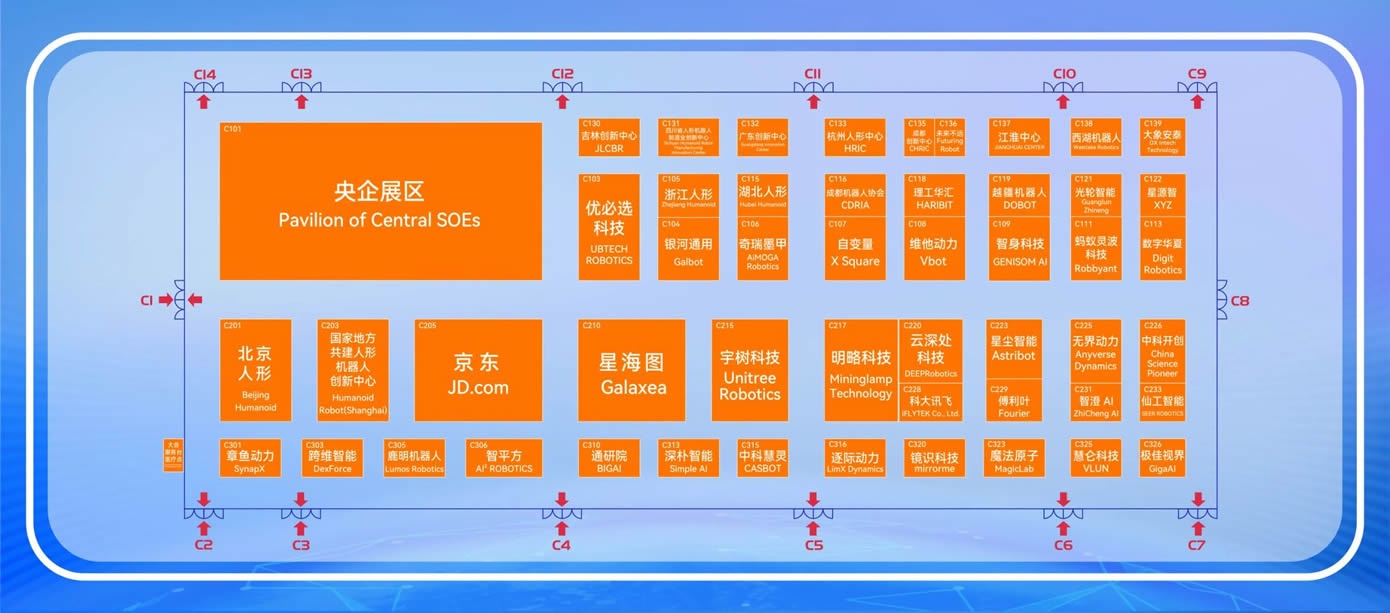
Hall C — Smart Innovation Pavilion — is the main destination for humanoid robots and embodied AI. It’s the new 20,000-square-meter hall focused on complete robot systems, embodied AI, and humanoids.
Exhibitors include Unitree Robotics, Galbot, UBTECH Robotics, Galaxea AI, X Square Robot, Mininglamp Technology, Vita Dynamics, GENISOM AI, DEEP Robotics, Booster Robotics, Fourier Intelligence, DOBOT, SEER, and CASBOT. Humanoid robotics innovation centers from Beijing, Shanghai, Zhejiang, Hubei, Guangdong, Sichuan, and Jilin will also be represented here.
Three things to watch in Hall C:
- Different approaches to humanoid hardware. Companies are making different bets on degrees of freedom, motion control, dexterous hands, actuators, and overall design. In one hall, you can compare them side by side.
- Embodied AI moving beyond demos. The real question is whether these robots can work outside a scripted demo — and whether the companies are delivering robots to customers, not just showing lab prototypes.
- How central SOEs and local innovation centers are applying robots. The central state-owned enterprise zone is in Hall C, and JD.com is building a large scenario area here. So this hall isn’t just about humanoids. It’s where you see how big industrial players define robot demand.
If you only have one hall to visit, there isn’t much debate.
Hall B: Components and International Suppliers
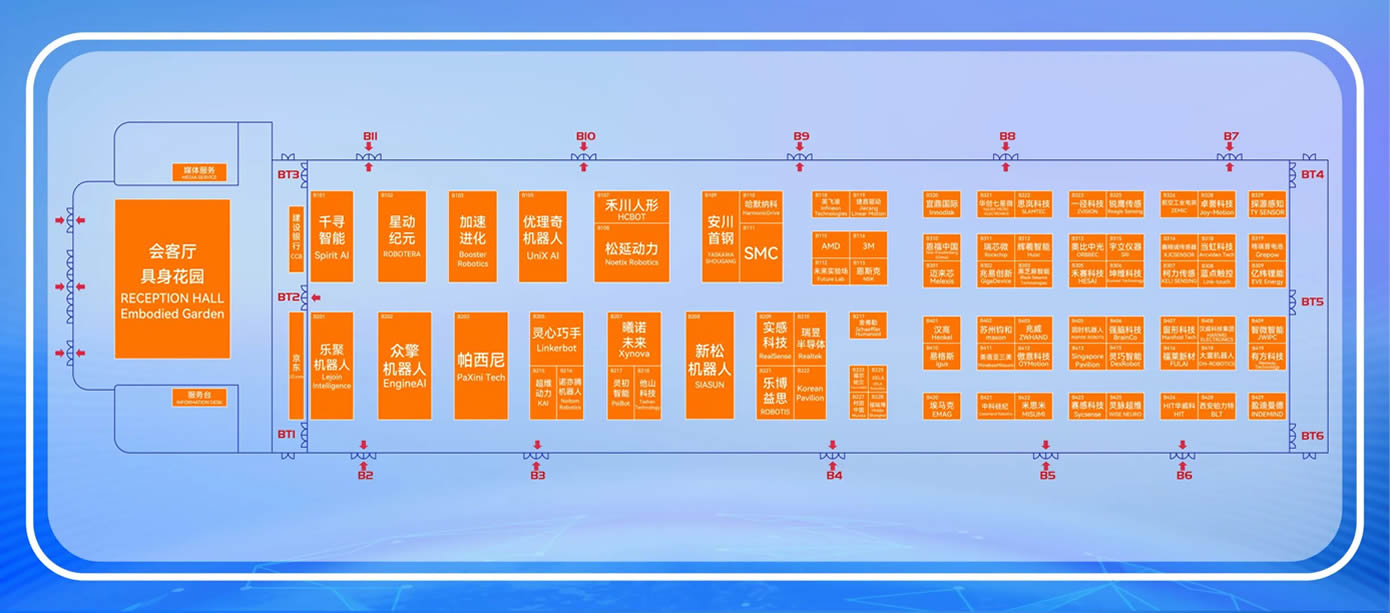
Hall B — Smart Integration Pavilion — focuses on core components and international suppliers.
Chinese exhibitors include EngineAI, Robotera, SIASUN Robot & Automation, Leju Robotics, NOETIX Robotics, LinkerBot, and Tashan Technology. International names include AMD, SMC Corporation, Infineon Technologies, Intel RealSense, Realtek Semiconductor, ROBOTIS, NSK Ltd., Schaeffler Group, and Harmonic Drive Systems.
For engineers and procurement people, this hall matters because it puts domestic and international suppliers side by side. The industry is paying more attention to actuators, reducers, motors, vision systems, and sensors. What matters isn’t a robot’s appearance. It’s whether the component stack is mature, whether supply is stable, and where the trade-offs are between performance, cost, and lead time.
If you’re here to map the supply chain, don’t skip Hall B.
Hall A Shows Whether Robots Work
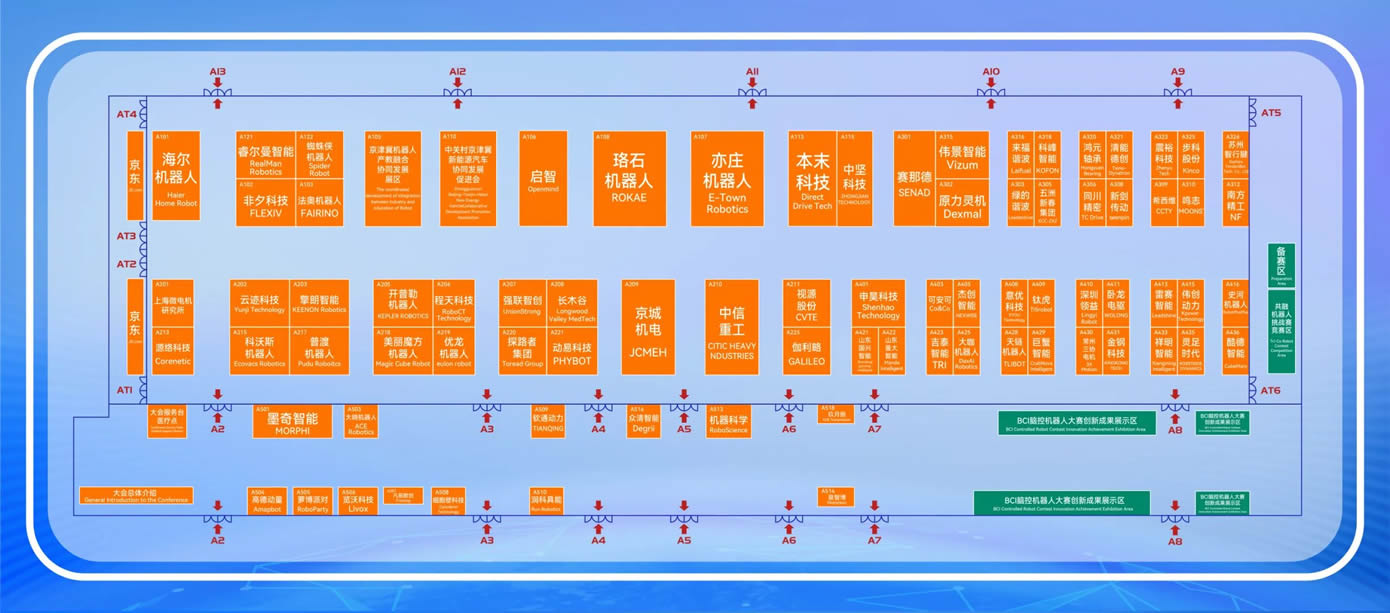
Hall A — Smart Manufacturing Pavilion — focuses on industrial robots, core components, and industrial applications.
Companies include Beijing Jingcheng Machinery Electric, ROKAE, CITIC Heavy Industries, Haier, Flexiv, RealMan Robotics, Yunji Technology, Keenon Robotics, and Pudu Robotics. Component makers include Leaderdrive, Wolong Electric Drive, TC-Drive, Seenpin, XCC Group, and MOONS’.
If Hall C shows where robots are heading, Hall A shows whether they can actually be used now.
Manufacturing visitors should ask specific questions at demos: How long does deployment take? How much production line modification is needed? How stable is the robot in continuous operation? Where are the boundaries for human-robot collaboration? How long until the investment pays back?
Those answers tend to be more useful than a three-minute demo.
Hall D: The Consumer Side of Robotics
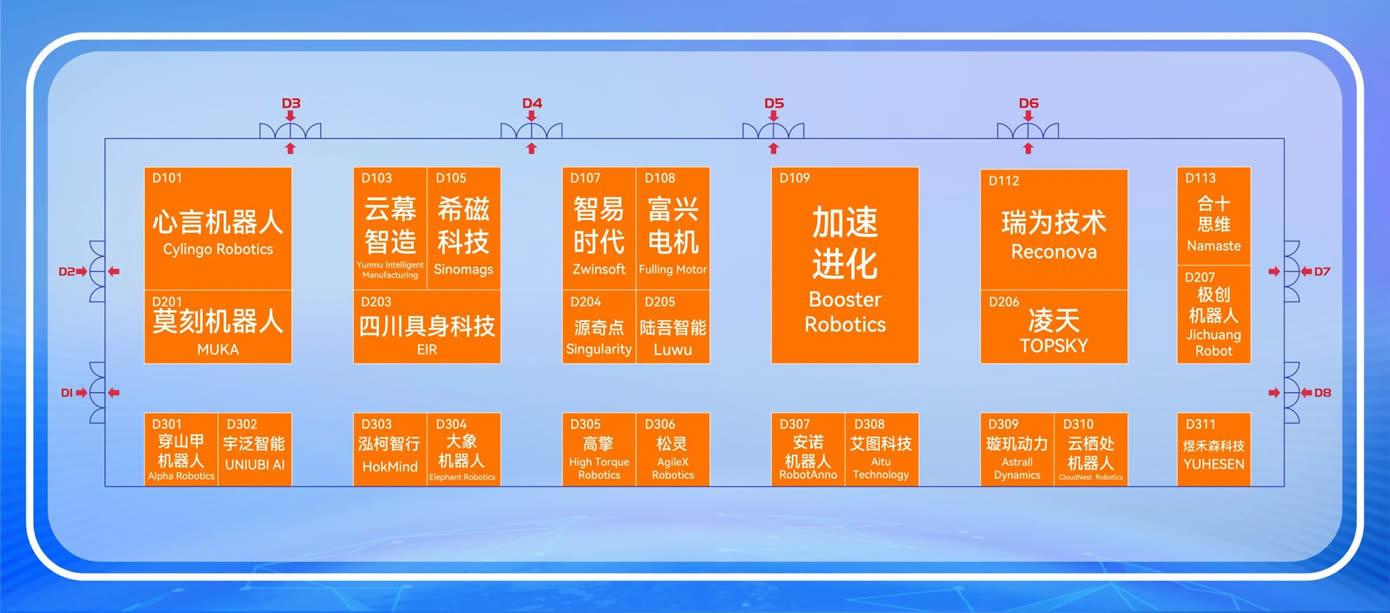
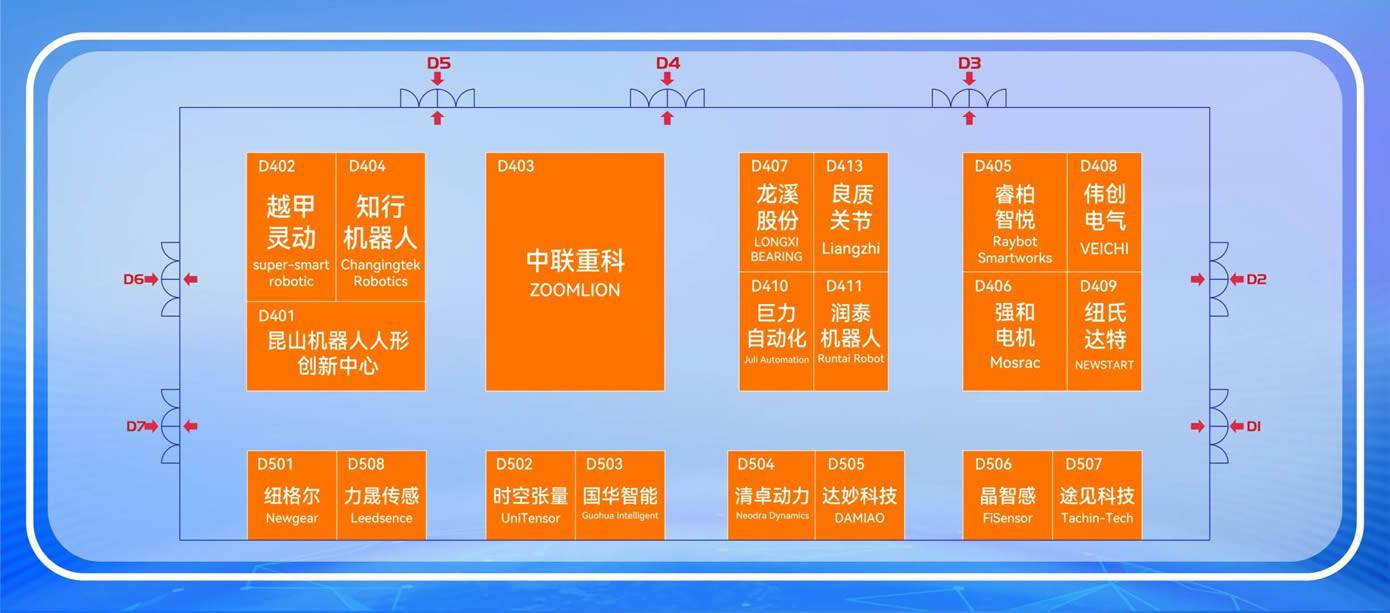
Hall D — Smart Fun Pavilion — consists of two temporary halls and focuses on interactive and entertainment robots. Exhibitors include Booster Robotics, Moke Robotics, and Hongke Zhixing.
One thing to note: Robot Consumer Street is not inside Hall D. It’s split between the glass corridor connecting Hall A and Hall C, and the outdoor area between Hall B and Hall C.
For general visitors, Hall D works best when you combine it with Robot Consumer Street.
If this is your first time at a robot show, Hall D offers a quick look at how robots are being adapted for consumer-facing applications.
Two New Areas Worth Seeing
The central SOE zone and Robot Consumer Street are new this year.
The central SOE zone is in Hall C, with 49 central state-owned enterprises showing 12 application scenarios: manufacturing, warehousing and logistics, food service and retail, healthcare and eldercare, workplace safety, and emergency response.
The value here isn’t the number of companies. It’s how large enterprises define robot demand. If you build robot solutions or do system integration, pay attention to what types of robots these scenarios actually require — and what problems robots need to solve before they fit into a large enterprise workflow.
Robot Consumer Street is part of the second E-TOWN Robot Consumer Festival and is inside WRC for the first time. The indoor section runs along the north-south glass corridor between Hall A and Hall C. The outdoor section sits between Hall B and Hall C.
Expect a Robot-Mall 4S store, direct sales of consumer products, interactive challenges, robot chefs, official merchandise, robot shop assistants, brand exhibits, food stalls, and stage events. More than 90 outdoor vendors are signed up.
The conference will also use robots for reception, security, guidance, and disinfection. For ordinary visitors, that’s a good chance to watch service robots operate in a crowded, real-world environment.
Four Questions That Cut Through the Demo
Don’t judge a robot by a single successful demo. Ask these four questions.
1. How many times can that demo run without failing?
Watch for repeatability. Can the robot complete the same task multiple times in a row? Does it need staff intervention between attempts? Can it recover if something goes wrong?
One good run means it can do the task. Multiple clean runs suggest it can do the task reliably.
2. When can I actually buy it?
Don’t just ask if a product exists. Ask what stage the product has reached: R&D prototype, engineering prototype, small-batch production, or a fully commercial product? What’s the expected lead time? What does it need in terms of power, network, floor space, and environment?
That tells you whether the company is still demonstrating technology or has built a product it can actually deliver.
3. Can the claimed value be measured?
If a company says its robot is already in a factory, warehouse, or commercial site, push for numbers. How much faster? How much cheaper? What does maintenance cost? How many hours per day does it need to run? Under what conditions do those gains hold?
Companies that can state the assumptions and the range are easier to evaluate than companies showing a concept video.
4. Is this a sample, a pilot, or a real deployment?
This is where the language around deployment can become unclear. Terms such as “order” or “deployment” can refer to very different stages of a project — from a sample purchase or pilot to a letter of intent or an already delivered system.
So when you hear that a contract has been signed or a robot has been “deployed,” ask what stage the project is at. WRC includes both application demonstrations and staged performances. A demo doesn’t prove volume production. A pilot doesn’t equal large-scale commercial rollout.
How to Plan Your Route
Industry and procurement visitors: Hall C → Hall A → Hall B. Begin with humanoid robots and embodied AI before moving on to real-world applications and core components, then finish with international suppliers and key technology vendors.
Developers and engineers: Hall B → Hall C → Hall A. Start with components, platforms, and tooling, then move to complete robots and embodied AI before looking at how those technologies are being applied.
General visitors, families, and enthusiasts: Hall D + Robot Consumer Street + Hall C. You get robot performances and consumer products, plus a look at the major humanoid and embodied AI companies.
What WRC 2026 Actually Tells Us
Beijing’s robotics industry has grown fast. Revenue went from about 15 billion yuan in 2023 to 51.8 billion yuan in 2025, with an average annual growth rate above 85 percent. E-Town alone has more than 300 robotics and intelligent manufacturing companies and a robotics supply chain worth over 10 billion yuan.
In that context, WRC 2026 is less a celebration and more a status check.
The central SOE zone with 49 companies and 12 scenarios, the 150-plus product debuts, and the concentration of humanoid robots, embodied AI, component, and consumer robot exhibitors all make the show useful. But the show itself doesn’t prove the industry has crossed a milestone.
What’s worth recording is simpler: which products can actually be purchased, which companies have stable delivery capability, which robots have entered real working environments, and which use cases are backed by real economic data.
You don’t need to see every booth. Pick a few directions that matter to you, watch for repeatable demos, ask about delivery timelines, application costs, and actual orders, and compare companies against the same criteria. That will tell you more about where the industry actually stands than any keynote.
If you’re heading to E-Town, the most useful thing to bring isn’t a list of companies. It’s a list of questions.
Because the robots will perform. The real information usually comes after the demo ends — when you start asking.
