


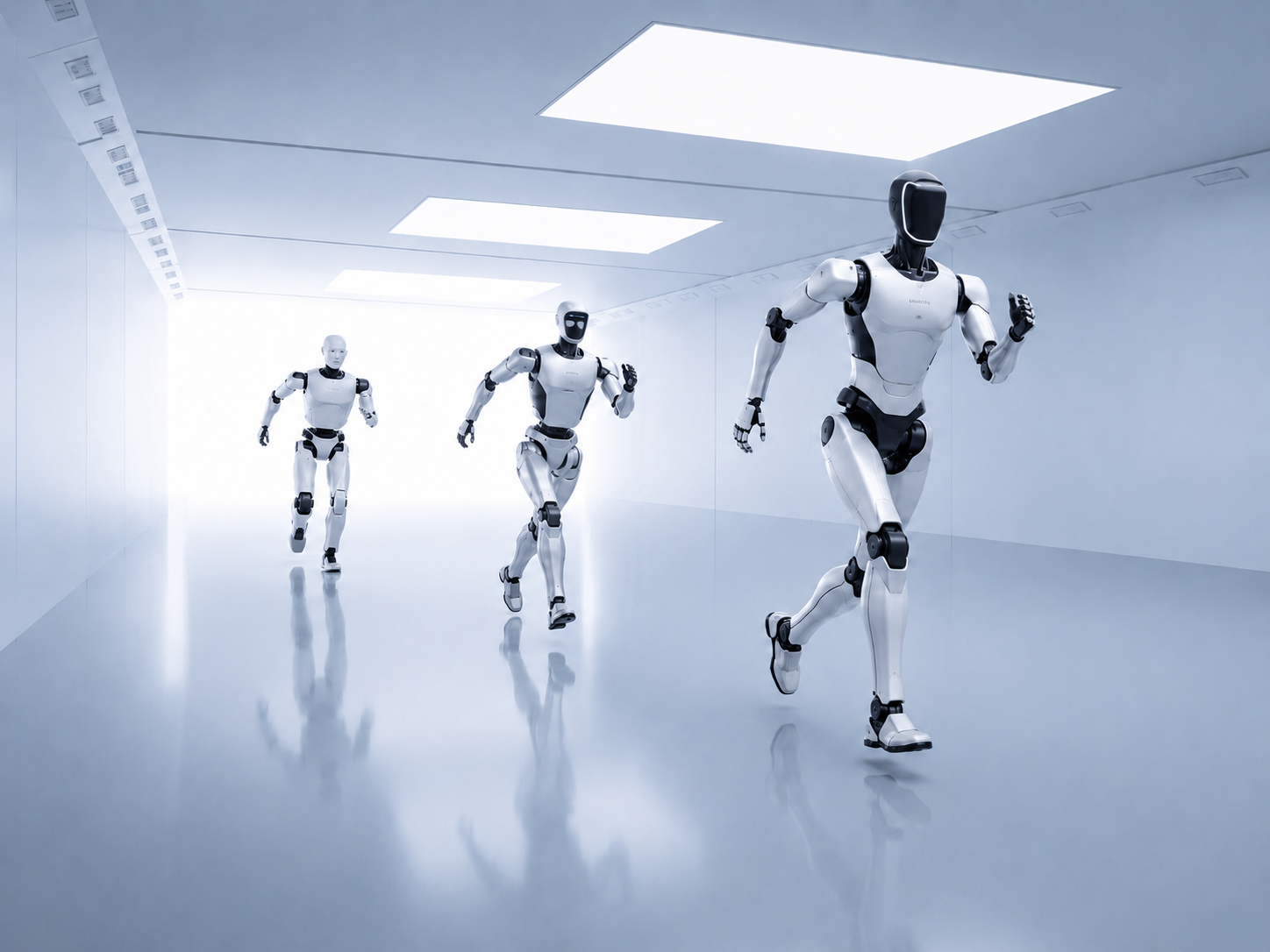
Humanoid Robots and the Rise of Physical AI
In its latest thematic report on humanoid robots, Barclays says AI is moving from “digital intelligence” into “Physical AI.”
For the past few years, most of what AI could do was still stuck inside the digital world. Large language models could write. AI agents could help manage calendars. Coding assistants could finish lines of code. They were mainly solving problems around writing, programming, data analysis, and software workflows.
Now AI is beginning to enter real spaces. It needs to read the environment, understand the task, move a body, use tools, and turn a decision into an actual action.
This is why humanoid robots are being pushed back to center stage. They are no longer just systems that can talk; they are physical machines capable of getting things done in the real world.
Barclays believes that as robot brains, mechanical bodies, and battery systems improve at the same time, humanoid robots could become a $200 billion industry by around 2035, while helping push the broader Physical AI ecosystem toward a trillion-dollar scale.
The Arrival of Automation 3.0
According to Barclays, humanoid robots are “Automation 3.0.”
Automation 1.0 is the era of industrial robots. The first industrial robot, Unimate, was developed by General Motors back in 1961. This marked the beginning of manufacturing automation. At that point, robots mostly worked in factories performing repetitive actions such as welding, material handling, painting, and assembling.
Automation 2.0 is the era of digital AI. AI bots such as ChatGPT and large language models started performing their functions in offices, data processing, and software development. As a result, they have become more efficient at cognitive work, writing code, summarizing documents, generating content, retrieving information, analyzing data, and doing some tasks within software.
Automation 3.0 is where AI goes into the physical world.
Barclays points out that the real shift behind humanoid robots is that machines are beginning to adapt to the human world. Factories, buildings, stairs, doors, shelves, handles, and tools are all designed around the human body and human movement. There are about 8 million factories and 2.8 billion buildings worldwide. Rebuilding all of these spaces for robots would be far too expensive.
If they can move like people, they can pass through the same spaces, handle the same tools, and take on the same kinds of tasks.
The Bigger Market Is in Services
Traditional industrial robots succeeded because manufacturing environments are highly structured. Factory tasks can be broken down into clear motions. Materials are usually placed in fixed positions. Routes are controlled. Workflows are stable. The environment changes within a limited range. These conditions are well-suited to robotic arms, AGVs, AMRs, and automated production lines.
Service environments are much messier.
There will always be something new in the hotel room at the time of check-out, such as towels on the floor, personal belongings on the table, or bags left partly open. A robot must be programmed to know what to pick up, what not to pick up, and how to navigate the room seamlessly. The elderly care environment becomes even more complex, with a robot having to offer an elderly person a glass of water, help them up, or be prepared for an unexpected situation.
Robots in these spaces need to perform tasks while sharing space with people.
This is where humanoid robots show their potential. They can move through human spaces, use arms and hands to complete physical tasks, and adjust their actions when the environment changes. Their commercial value comes from the possibility that one platform could support many different tasks.
Barclays also notes that over the next five years, humanoid robot deployment will still be concentrated mainly in manufacturing, logistics, and warehousing. The larger market may begin to open after 2030.
The reason is simple: services account for 60% to 80% of GDP in major economies such as the United States, the United Kingdom, and Japan. Once humanoid robots can reliably enter service industries, the addressable market will be much larger than factory automation alone.
Three Trends Are Driving Demand
Underlying the increasing demand for humanoid robots is the shift in the global labor market structure.
- Aging population: UN data projects that the global population aged 65 and over will grow from around 900 million today to 1.6 billion by 2050, increasing their share of the total population from 10% to 16%.
- Urbanization: It is projected that in 2050, 70% of the population will be urban dwellers. Many labor-intensive sectors, such as manufacturing, logistics, and agriculture, operate in suburban and rural areas.
- Preferences of young workers: According to Barclays, only 14% of Gen Z employees are willing to take industrial jobs. Young people generally prefer to engage in flexible and less physical jobs.
Agriculture has become one of the industries heavily affected by an aging population. Over the period between 2010 and 2024, the number of people working in agriculture declined by 37% in Europe, 23% in Japan, and 17% in the US.
In this situation, humanoid robots are likely to become an additional source of labor.
China Is Taking the Lead
China already holds the lead in the humanoid robot industry.
China was responsible for deploying 85% of all global humanoid robots in 2025. AgiBot and Unitree accounted for more than 70% of all global deployments.
China’s lead comes from four main advantages.
A Complete Supply Chain
China has a full supply system covering rare earths, motors, batteries, and component manufacturing. Its vertical integration capability is much stronger than that of Europe and the United States.
Cost Advantage
Barclays estimates that the average cost of a Chinese humanoid robot is about $50,000, roughly half the cost of comparable Western models.
Rich Manufacturing Scenarios
As the world’s largest manufacturing base, China offers a wide range of industrial environments for the first stage of humanoid robot deployment.
Policy Support
Local governments and national-level policies are both actively supporting the development of the robotics industry.
Humanoid Robots in 2026
Barclays estimates that the global humanoid robot market is currently worth about $2 billion to $3 billion. By 2030, that figure could grow to $10 billion to $25 billion.
On , CSC Financial also said in a research note that 2026 could become a breakout year for vertical applications of humanoid robots. As robots become better at generalizing across tasks, more deployments are expected to appear in industrial and commercial settings.
