

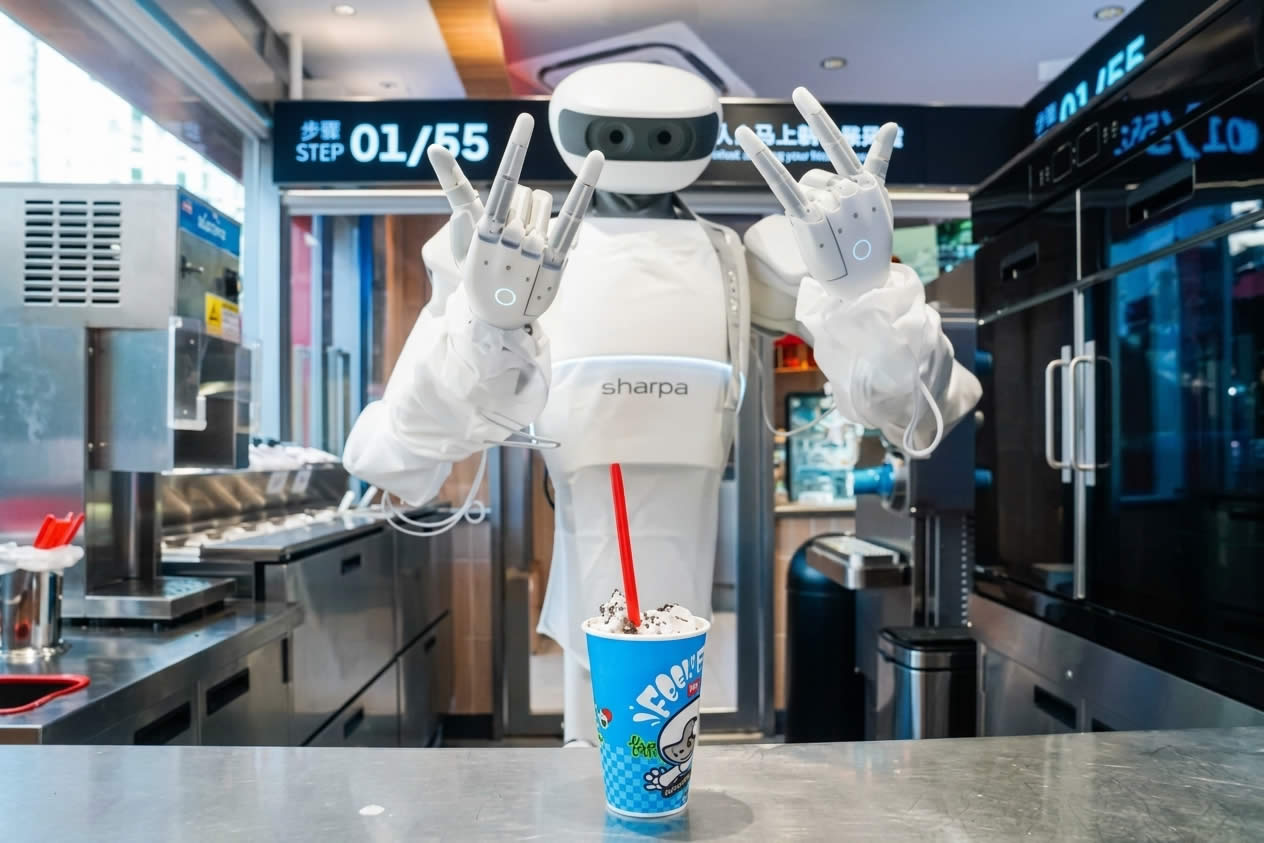
On August 29, inside a Dairy Queen on Wujiang Road in Shanghai, a silver-white dual-arm robot stood behind the counter. After a customer placed an order, it opened cabinet doors, fitted a cup ring, dispensed soft serve, added Oreo crumbs, ran the spindle mixer, and handed over a completed Blizzard.
From order to handoff, the robot went through 55 consecutive steps — separating a paper cup from a sanitized tray, aligning a cup ring with sub-millimeter precision, dispensing the ice cream, adding toppings, running the high-speed mixing spindle, and finally inverting the cup for the signature Blizzard flip.
That “flip without spilling” moment is the final test. It is also where the robot proves whether it can actually do the job.
Sharpa says this is the world’s first “zero-modification, fully autonomous” robot deployment in a restaurant. The robot runs during normal store hours, from 10:00 a.m. to 10:00 p.m., without a human operator standing by. Dairy Queen’s store equipment, ingredients, and workflow were left untouched. The robot uses the same tools designed for human hands.
One day earlier, on August 28, Sharpa disclosed for the first time that it had raised more than 4.5 billion yuan (roughly $620 million) in cumulative funding, with a post-money valuation exceeding 22 billion yuan. Investors include Alibaba, Meituan, Tencent, JD.com, Transsion, Sequoia China, and Qiming Venture Partners.
Twenty-four hours after the funding announcement, the robot started its shift at DQ. The industry’s benchmark, Sharpa argues, has shifted from “Can the robot complete a task?” to “Can the robot deliver real, deployable productivity?”
Why “zero modification” is the harder path
The more common way to put a robot in a store is to modify the environment — build custom workstations, alter equipment, redesign the workflow around the machine. Sharpa co-founder Li Yifan rejected that approach outright.
“If we had started by modifying the environment, customizing equipment, or opening our own store, the first thing you’d hear from a store operator is: ‘So you’re going to replace everything in my shop?’” Li said. “Who would say yes to that?”
In his view, that kind of deployment has no real commercial value and cannot scale.
So Sharpa chose the harder route: leave the store exactly as it is. Same equipment, same ingredients, same procedures. The robot has to work with tools designed for human hands.
Paper cups deform. The metal cup ring needs to be held in place throughout the process. The mixing spindle creates complex, shifting forces. These are all challenges a human hand handles without thinking, but they are significant problems for a robotic gripper. That choice made the task dramatically more difficult — and, Sharpa argues, dramatically more meaningful.
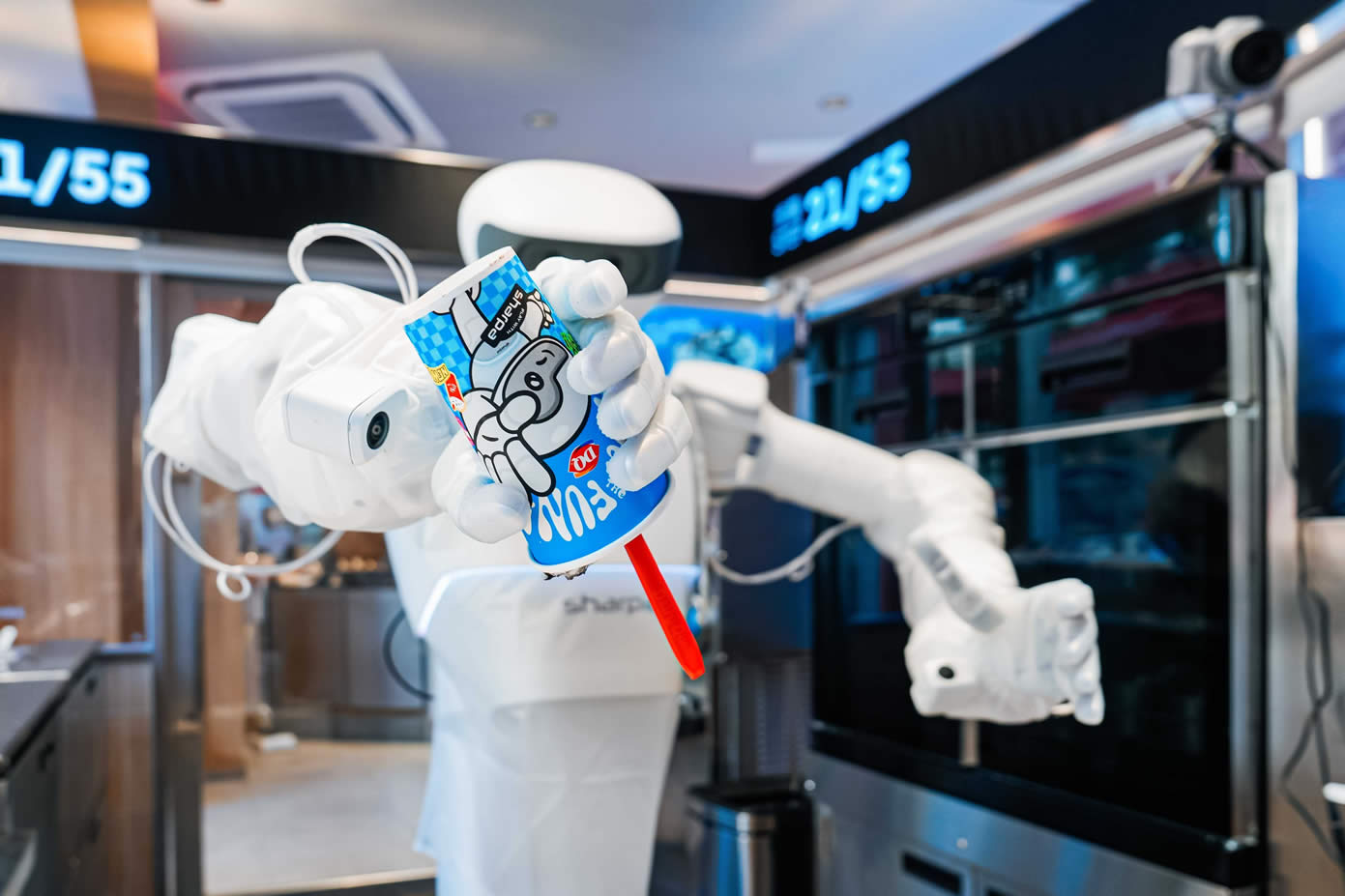
Dairy Queen has a global standard for the Blizzard: every cup must be flipped upside down before it is handed to the customer. Sharpa and DQ broke the entire process down frame by frame into 55 steps. Any deviation anywhere in the sequence shows up in that final inversion.
Li Yifan describes the minimum threshold for moving from a demo to commercial deployment as a “kill line.” A demo can be 70, 80, or 90 percent complete and still demonstrate technical progress. But once you enter a real commercial environment, the standard changes. The system has to be reliable and efficient enough that a customer is willing to keep using it. If you haven’t crossed that line, no amount of impressive individual capabilities will let you replicate or scale.
“If you complete 54 of the 55 steps and still need a human for the last one, the person can’t actually be removed from that station,” Li said. “The value of the deployment collapses.”
Sharpa isn’t trying to make a cup of ice cream. It’s trying to prove that the employee can walk away and the robot can keep working the same way the employee did.
Touch, not vision, is what makes the 55 steps possible
Executing 55 continuous autonomous steps requires more than vision. Touch plays a critical role.
Sharpa’s in-house end-to-end hierarchical VTLA (Vision-Tactile-Language-Action) model, CraftNet, incorporates tactile input as a core modality. Combined with the multi-finger dexterity of the Sharpa Wave hand, the system adjusts finger movements and grip force in real time based on tactile and force feedback.
Tactile sensing is directly involved in 98% of the 55 steps. Pulling a paper cup from a stack requires sensing friction and resistance. High-speed mixing requires adjusting grip as the cup slides, vibrates, and shifts under load. The upside-down handoff requires continuously correcting the grasp as the cup’s orientation and center of gravity change.
The Sharpa Wave hand has 22 active degrees of freedom and more than 1,000 tactile pixels per fingertip, providing high-resolution feedback for fine manipulation. CraftNet is a multimodal manipulation model that combines reasoning, vision, and tactile input, targeting what the company calls the “last millimeter” of precision interaction.
Vision lets a robot see the world. Touch lets a robot feel it.
Sharpa’s founding team came from HESAI Tech, the Chinese lidar maker — CEO Li Yifan, CTO Xiang Shaoqing, and chief scientist Sun Kai. They are now applying lessons from autonomous driving to a different field. Li’s stated goal: make the dexterous hand as central to robotics as lidar was to self-driving cars.
At CES 2026, Sharpa’s hand demonstrated card dealing and windmill assembly. In June 2026, NVIDIA unveiled a humanoid robot reference design built around a Unitree H2 Plus and Sharpa Wave tactile hands.
The strategy is straightforward: build manipulation around touch, then take that capability into real commercial environments.
The robot is slower than a human. That’s not the point.
Right now, the Sharpa robot takes about six minutes to make a Blizzard. A trained employee typically needs two to three minutes. The robot operates at roughly half the speed of a human worker.
Sharpa is candid about the economics. The first-generation robot is not yet profitable. Sharpa acknowledges that positive ROI is unlikely in the short term for the industry’s first wave of commercial deployments.
But Sharpa is looking at three longer-term variables: the certainty that operating speed will reach human levels, equipment amortization cycles modeled on the automotive industry (which can run 10 years or more), and the cost curve of mass production. Using automotive manufacturing methodology, Li says, production at the million-unit scale could bring costs down to the 100,000-yuan range (roughly $14,000).
Li’s framing is blunt: “The most important thing is to go deep in one scenario. If you haven’t gone deep enough, the scenario can’t be replicated and can’t reach scale.”
The significance of the DQ deployment extends beyond ice cream. What looks like a narrow task is actually a relatively complex fast-food workflow: 50-plus steps, multiple pieces of kitchen equipment, grasping spoons and ingredients by hand. Once this process is validated, Li argues, individual steps can be recombined and extended to new categories. “If we’re doing burgers or pizza, and you break it down into 10 steps, we probably already have seven or eight of them.”
CFB Group CEO Hsu Wei-lun, whose company operates DQ in China, put it plainly: “Technological progress is not something we can refuse. DQ is about to open its 2,000th store in China by the end of September. Taking one store and putting it at the forefront of technology development — I think that’s necessary and meaningful.”
One store is not about replacing workers. It’s about proving that a robot can work in a real store the way a person does.
The robot at DQ is slower than a human. But the point isn’t speed. The point is that it can do the job at all.
It has demonstrated that a robot can enter a commercial space designed for humans — without modifying the environment, without custom equipment, without remote human control — and complete a full, standardized task from start to finish.
2026 has increasingly been described in China as a turning point for humanoid robot mass production and early service-sector deployment. At industry events from WAIC to WRC, the robots on display are shifting from performance to labor.
Sharpa’s cup of ice cream is not a destination. It’s a starting point. While much of the industry still debates whether robots can actually work, Sharpa has one standing at a DQ counter — six minutes per Blizzard, 55 steps without interruption, no days off.
