

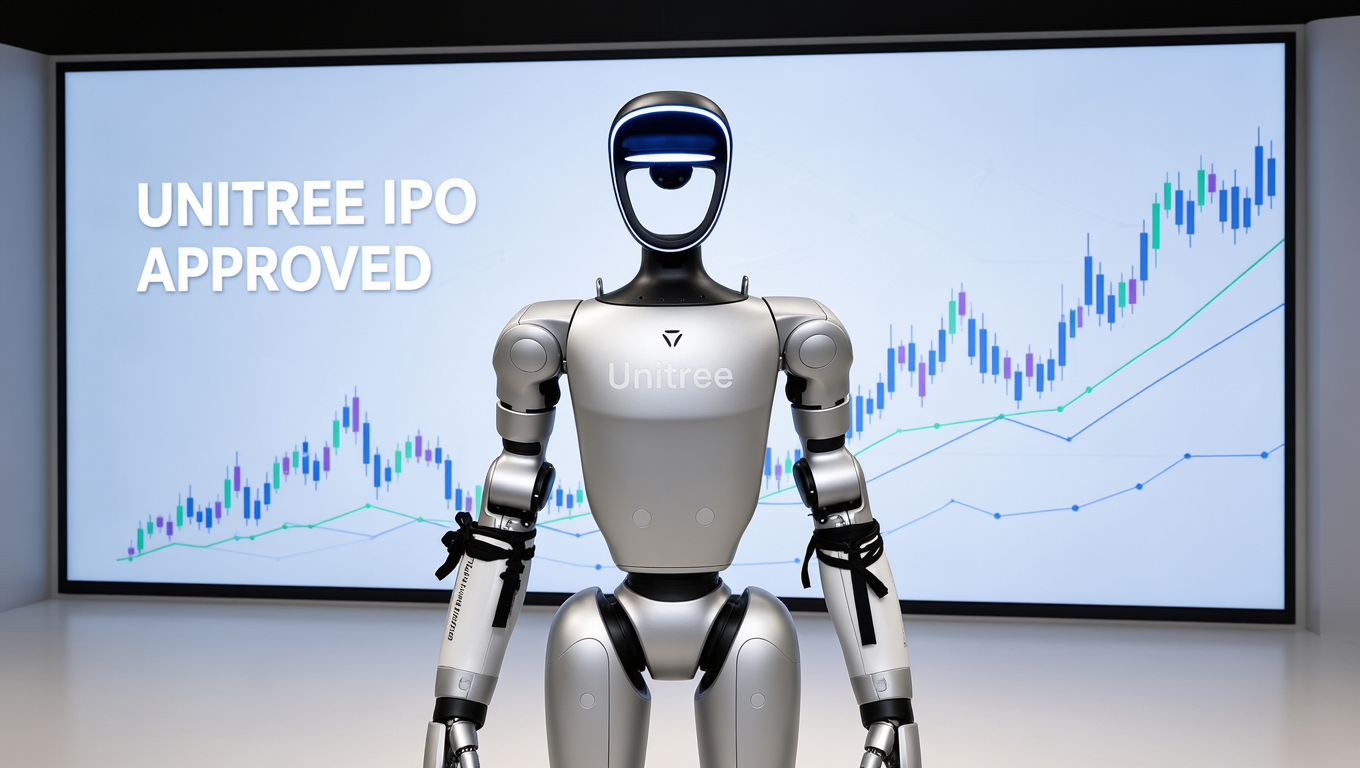
On June 1, 2026, Unitree Robotics passed the IPO review for Shanghai’s STAR Market. Unitree plans to raise about RMB 4.2 billion, roughly $580 million. The proceeds will be used for AI model development, robot hardware R&D, new product commercialization, and production expansion. The IPO application was accepted on March 20, 2026, and cleared review just 73 days later.
China’s A-share market is giving hard-tech companies much more attention. In China’s capital market, humanoid robots are starting to sit next to semiconductors, AI, aerospace, and advanced manufacturing as another hard-tech bet.
Unitree Has Numbers That Most Robot Startups Still Don’t
In the humanoid robot space, many companies have yet to move beyond demos and prototype-stage products.
According to third-party data disclosed in its prospectus, Unitree shipped more than 5,500 pure humanoid robots in 2025. That number doesn’t include wheeled dual-arm robots. By shipment volume, that put Unitree at the top globally.
The company’s financials strengthen the case for the IPO. Revenue rose from RMB 159 million in 2023 to RMB 1.699 billion in 2025. Net profit went from a loss of RMB 11 million to a profit of RMB 278 million.
These numbers still need context. Shipments do not mean the market is mature, and early profitability does not mean humanoid robots have already found mass adoption. But compared with companies still trying to prove their machines can “leave the lab,” Unitree has already shown something more concrete: it can build robots, sell robots, and turn early demand into real revenue.
Why Unitree Moved Faster Than Many Competitors
Unitree didn’t start with humanoid robots. Its early strength came from quadruped robots, the four-legged kind. That gave the company years of real-world experience in motion control, robot hardware, cost control, and mass production.
A humanoid robot is easy to show off in a short video. It’s much harder to build over and over at a stable cost. In a humanoid robot, one weak link, whether it is a motor, joint, battery, or control system, can limit the performance of the entire machine.
Unitree had already learned many of these lessons before humanoid robots became the center of the current tech cycle.
It also took a smart approach to pricing. By making robots more affordable and easier for developers to access, Unitree expanded its customer base. Universities, labs, developer teams, and tech companies could purchase and build on the platform. That helped Unitree ship faster while many competitors were still focused on high-end demos.
Humanoid robots now sit at the crossroads of several big trends. AI companies are looking for physical platforms, factories want more flexible automation, and investors are searching for the next major hardware category after EVs and smartphones.
Unitree and AgiBot Show Two Different Paths
Unitree’s IPO progress and Nvidia partnership also make it easier to see how China’s humanoid robot market is splitting into different strategies.
Unitree is following a product-driven path. Its strength comes from hardware accessibility, motion control, cost control, and developer adoption. AgiBot is taking a broader ecosystem approach. Instead of focusing only on the robot body, it is pushing product lines and use cases across reception, entertainment, industrial work, logistics, security patrol, cleaning, data collection, and research.
Both companies are trying to answer different parts of the same question. Unitree is showing that humanoid robots can be built, shipped, and used as development platforms. AgiBot is trying to show that humanoid robots can be connected to data, scenarios, and enterprise deployment.
They show that China’s humanoid robot race is not moving along one single route.
The IPO Doesn’t Mean Mass Adoption Has Arrived
According to 21st Century Business Herald, demand for Unitree’s humanoid robots mostly comes from universities, research institutions, and tech development platforms. R&D and education account for more than 70% of its humanoid robot revenue.
It proves Unitree’s robots are useful as development platforms. Researchers and developers need reliable hardware platforms, while AI companies need physical machines to test and improve embodied intelligence models.
Demand from research labs is not the same as broad commercial adoption.
Real-world use is much harder than a demo. In factories, floors can be uneven, lighting changes, people move around, and safety rules are strict. Malls, hotels, exhibition halls, and warehouses bring crowds, noise, and daily wear. Homes are even tougher. Consumers won’t be patient with a robot that constantly needs help, updates, or a human babysitter.
So Unitree has answered one big question: can humanoid robots be built and sold at a meaningful scale?
The next one is much harder: can they deliver enough value in real operating environments?
Commercialization Is the Test Public Investors Will Care About
Public investors will care about customers, margins, repeat orders, repair costs, delivery, and real-world adoption.
Humanoid robotics has no shortage of imagination. But at some point, the market will ask a simple question: who is paying, and why would they pay again?
If Unitree’s robots stay mostly in research and education, the company can still grow, but the ceiling may be limited. If it can move deeper into factories, industrial inspection, logistics, commercial services, or other daily-use scenarios, the situation changes.
That is why Unitree’s IPO matters beyond one company. The company is no longer just competing for attention. It has to prove that customers will not only buy these robots once, but continue to deploy, maintain, and reorder them.
The Supply Chain Story Behind Unitree’s IPO
A humanoid robot depends on a tightly connected supply chain, from motors and reducers to sensors, batteries, computing modules, perception systems, dexterous hands, and AI models.
China’s advantage lies in its manufacturing depth, fast supplier response, and ability to improve hardware through repeated production cycles.
That’s why Unitree’s fundraising plan deserves attention. The money is going into models and software, but also into robot hardware development, new products, and production capacity. Put simply, Unitree is not only trying to improve the robot itself. It is trying to strengthen the full stack behind it, from hardware to AI.
H2 Plus Shows Where Humanoid Robotics Is Heading
The same day, Unitree also announced H2 Plus, an NVIDIA Isaac GR00T reference humanoid robot platform for academic research. The project brings together Unitree’s humanoid body, Sharpa’s tactile hands, NVIDIA Jetson Thor computing, and the Isaac GR00T software stack.
This setup also shows where humanoid robotics is heading. The industry is moving away from closed, single-company demos and toward shared platforms where robot bodies, hands, chips, models, and simulation tools can work together.
That is important for an industry still trying to lower development costs. It lowers the cost of experimentation. It also gives more teams a way to build on top of existing hardware instead of starting from zero.
Why This IPO Is Worth Watching
Unlike many robotics startups, Unitree has already shipped products, kept costs relatively low, built a recognizable brand, and turned early demand into profit.
Still, humanoid robots are young. Research and education demand can carry Unitree through an early growth phase. The bigger market will open only when factories, service providers, and eventually households see humanoid robots as practical tools rather than experimental machines.
I think that’s the most important part of this IPO.
Unitree has pushed humanoid robots closer to the market. Now the market will respond with stricter standards. Investors and customers will pay less attention to stage demos and more attention to daily reliability, cost savings, and performance in real workplaces.
That’s why this listing isn’t just a fundraising event. It will test whether embodied AI can move beyond research labs and viral demos into products that customers buy, deploy, maintain, and order again.
