

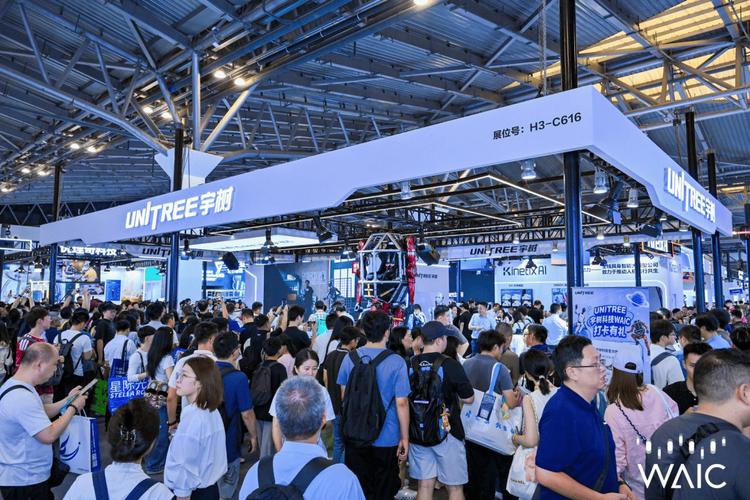
Walking through the robotics halls at WAIC this year, the shift in tone was immediate. For years, the main event at these shows was a robot’s walking smoothness or its ability to dance. In 2026, the only thing that seemed to matter was whether those machines could actually perform useful work.
The scale of the exhibition showed how far the industry has moved. The organizers counted 208 embodied AI systems and more than 300 physical robots on display, and Chinese manufacturers filled nearly every corner of the hall. They brought mass-production plans, commercial contracts, and field-ready solutions. Between them, they showcased a domestic supply chain that now stretches from foundational software to core actuators, all the way up to factory-floor humanoids and service bots.
The Hidden Infrastructure Behind China’s Robot Push
The strongest business opportunities on the show floor were not always where the biggest machines stood. Instead, they were often found in the underlying software and hardware that make those machines possible.
EFORT, for instance, introduced Openmind OS, a universal software platform for robotics. The goal is straightforward: allow developers to reuse software across different robot platforms and models, rather than building from scratch for each one. Working with Tsinghua University, the company says its cloud platform can compress a robot’s training cycle from months down to days. For smaller startups, this type of infrastructure lowers the barrier to entry by skipping the costly foundational R&D that usually stalls early-stage teams.

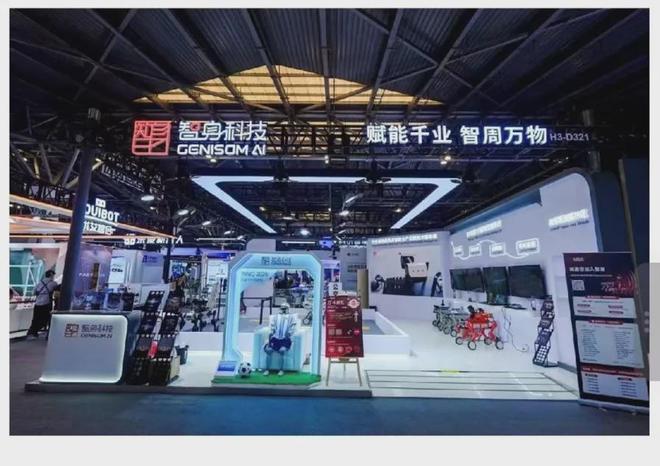
Genisom AI is following a similar full-stack strategy. The company claims to have mass-produced more than 15,000 quadruped robots and is using that experience to build its humanoid, the Genisom Yinyi NE01. Its MATRiX 2.0 simulation platform lets robots practice dangerous or hard-to-replicate tasks virtually before being deployed in the real world—a process that dramatically improves training efficiency.
Heavy-Duty Humanoids Hit the Factory Floor
The push into industrial applications was the most pronounced change at this year’s show. Several companies arrived with machines already validated on real production lines, and they were eager to talk about delivery timelines and customer orders.
JAKA Robotics put its K1-25 heavy-duty dual-arm robot to work, demonstrating its handling capability in a live test. The machine weighs less than 30 kilograms per arm but can lift a synchronized 50-kilogram load. Built with self-developed joint modules, it reduces reliance on imported components. The robot is designed for heavy-transfer tasks, large-part precision assembly, and high-precision data collection for R&D.
Leju Robotics built a mock production line right in the middle of the hall. Its humanoid autonomously handled cardboard and plastic crate depalletizing, as well as small-part feeding. Even when boxes were tilted, the robot recalibrated on its own, without human intervention. It runs entirely on homegrown technology, covering data, motion control, and hardware.
AgiBot brought the Lingxi G2 Max, targeting industrial heavy lifting. It offers an 18-kilogram single-arm load, a 38-kilogram dual-arm load, and a 50-kilogram peak payload. The 7-DOF force-controlled arms achieve sub-millimeter positioning accuracy, and the torso structure is reinforced for 24/7 operation.
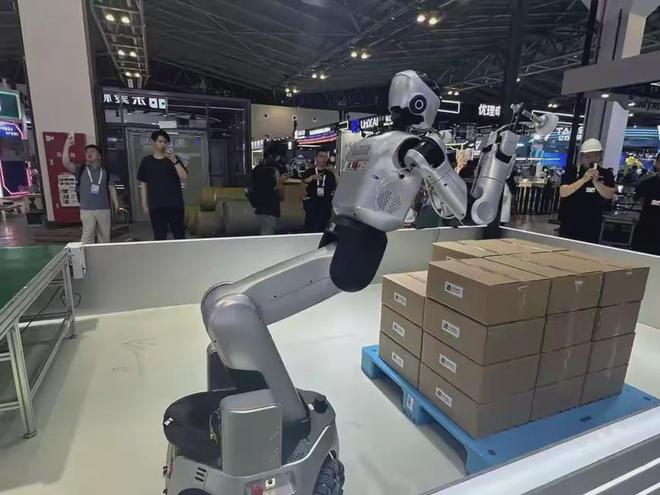
PIA Automation also staged a full chip-processing line, where robots executed a long-sequence workflow including loading, boxing, and pallet transfer. The task required dynamic fault tolerance and multi-step planning—and the robots pulled it off autonomously.
Legged and Wheeled Robots Carve Out New Niches
Beyond the factory floor, two distinct robot forms are gaining traction. Legged robots are already essential for power-grid inspections, firefighting, and security because they can handle rough terrain. Wheeled dual-arm robots, by contrast, excel in tight spaces like hospital corridors and warehouses.
ASTRALL brought two wheeled quadruped models to booth H4-041. The Hypertron-T01 is aimed at heavy logistics and emergency response, while the smaller Hypertron-SW01 is built for patrol, distribution, and industrial inspection. Both use self-developed high-torque joint modules, and the chassis supports quick-change top equipment, letting users switch between different roles with one base unit.
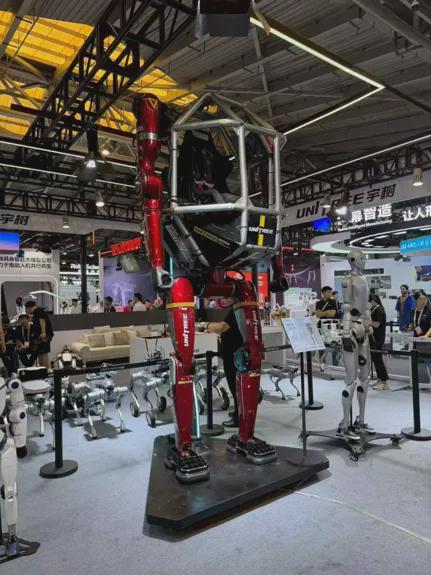
Unitree drew a crowd with the GD01, a manned robotic platform capable of shifting between humanoid and quadruped configurations. The transformation is visually striking and opens up possibilities for entertainment, tourism, and outdoor exploration. It was one of the more talked-about innovations on the floor.
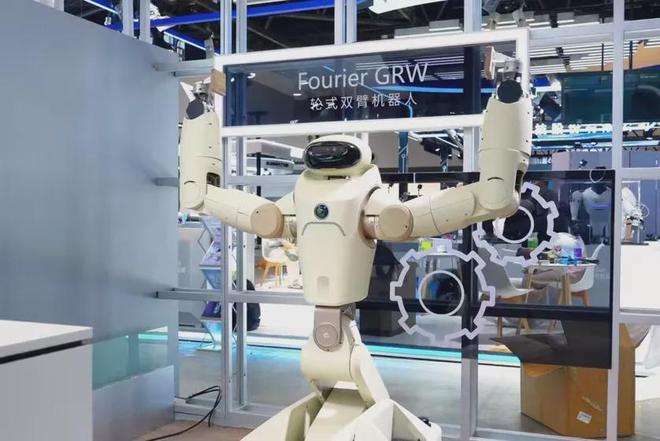
On the wheeled dual-arm side, Fourier introduced the GRW, a compact robot that is only 585 millimeters wide. It is designed for high-load human-robot collaboration, with a 16-kilogram stable payload, up to four hours of operation with hot-swappable batteries, and emergency braking and anti-tip protection. The robot is designed with redundant architecture to maintain operation even if one subsystem fails.
UniX AI showed two wheeled dual-arm models: Wanda, which can handle fine manipulation tasks like making pizzas or painting, and Panther, built for home services like tidying up and cleaning floors. The company even set up a robot band on site, with units playing piano and drums in sync—a vivid demonstration of fast, continuous arm stability.
Humanoids Start to Earn Their Keep
Perhaps the biggest surprise for attendees was how far humanoid robots have moved beyond being simple photo props. Several companies are now offering them as standardized products with rental or purchase models for entertainment, business interaction, and live shows.
LimX Dynamics launched the Luna, a 160-centimeter female-form interactive humanoid that has attracted early orders from domestic and overseas customers following its May release. It balances high-dynamic motion with multi-modal interaction and is marketed for commercial performances and public engagement. The company also demonstrated the Oli, a full-size general-purpose humanoid, and the TRON 2, a multi-form robot, covering scientific research, commercial use, and inspection.
Moving Past the Hype
After three days on the floor, one pattern stood out: companies weren’t trying to prove robots could move. They were trying to prove they could work. Hardware specs and stage performances have taken a back seat to production volume, real purchase orders, and supply-chain independence.
Infrastructure suppliers are beginning to build sustainable businesses around robotics. Industrial humanoids are moving onto manufacturing floors. Specialized legged and wheeled robots are finding roles in high-risk industrial sites and daily household tasks. And general-purpose humanoids are starting to generate revenue in tourism, public spaces, and commercial settings. China’s robotics supply chain has closed many of the gaps that existed just a few years ago.
WAIC 2026 sent a clear signal: the robot industry is no longer about hype and lab prototypes. From factory lines to hospital wards to outdoor inspections, machines are finally starting to take on real-world work.
