

What Is a Robot Cerebellum, and How Is It Different From a Robot Brain?
Galbot breaks robot intelligence into three layers.
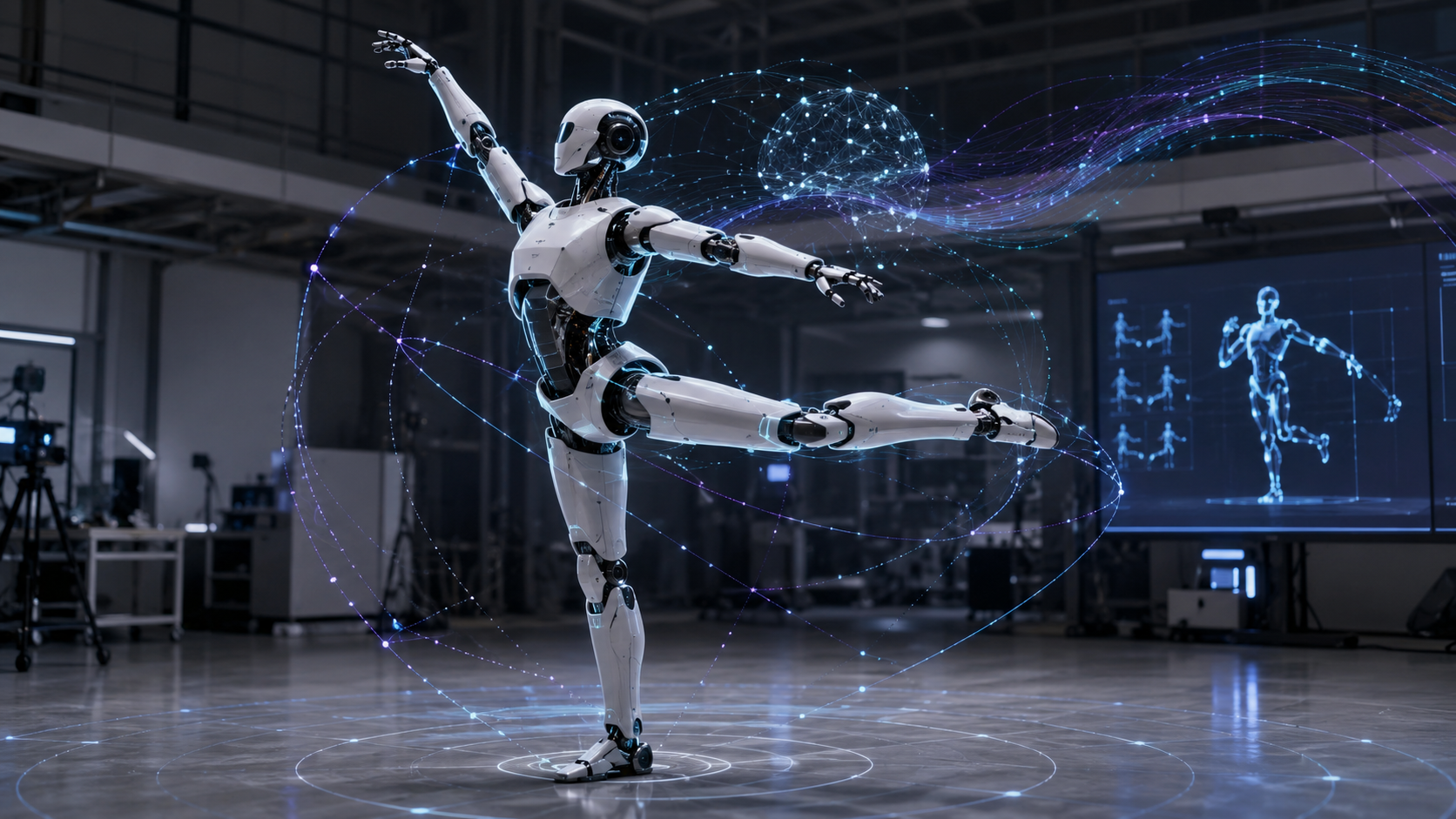
The brain handles perception and task planning. It knows there is a box in front of it, and that the box needs to be moved to Area B. Neural control handles fine manipulation at the end effector, such as how the fingers should pinch a screw. Between the two sits the cerebellum, which handles whole-body control. Where is the center of gravity? Which leg moves first? How should the arms and torso coordinate? How fast should the body move?
The perception side of the robot brain has been improving quickly with vision-language models. Dexterous hands are also becoming more precise. The difficult part is the layer in between: getting a bipedal humanoid robot to stand, walk, and perform a target motion stably from almost any posture. There has never been a general solution for that.
The old approach was to train a separate controller for each movement. To teach a robot to walk, engineers would collect walking motion-capture data, label joint angles, and train a policy with reinforcement learning. To teach it to run, they would train another one.
That means one controller for every type of movement. Each controller can also fail when the scene changes. A robot may learn a polished walking policy, then struggle once it moves onto a slope.
AstraBrain-WBC 0.5 takes a different route. It asks whether one model can handle all movements, in the same way a GPT model can handle many kinds of language tasks.
Galbot’s team pulled together nearly all public datasets in human motion capture, including AMASS, LAFAN1, Motion-X++, PHUMA, and MotionMillion. It also added more than 1,000 hours of self-recorded motion data. After merging, filtering, and augmenting the data, the team produced 2 billion frames of motion data retargeted into the Unitree G1 joint space.
Before this, the largest training sets in similar research were roughly at the 100-million-frame level. Nvidia’s SONIC reached about 100 million frames. Galbot’s dataset is about 200 times larger.
A Transformer Controller Takes On What MLP Could Not Handle
For humanoid robot motion control, the mainstream architecture used to be MLP. MLP has a built-in weakness in motion control: at each step, it can only “see” one slice of the current state.
The relationship between gait and center of gravity can stretch across a dozen frames, or even dozens of frames. MLP does not naturally model this kind of long-range dependency. Engineers usually have to patch around it by stacking historical data into the input vector.
When MLP is trained on multimodal, highly dynamic motion data, its returns start to flatten after a certain scale. A Transformer works differently because of self-attention.
At each position in a sequence, the model can look back across any length of previous frames and capture the relationship between the current movement and a posture from, say, 32 frames earlier.
For a humanoid robot, this cross-frame continuity directly affects whether walking feels human, and whether dancing suddenly stiffens or breaks.
Galbot’s team ran a clean ablation study.
With the same 2 billion frames of training data, MLP hit a plateau after roughly 50K steps. The Transformer was still improving after 200K steps. The Transformer eventually stabilized at about 0.06 loss, while MLP stopped at around 0.08. That 0.02 gap shows up on the real robot as the difference between a gait that has human texture and one that still feels mechanical.
During training, MLP can only process one time step at a time. To cover a long sequence, it has to loop through N steps. The Transformer can process all positions in the sequence in a single forward pass. At the scale of 2 billion frames, that creates an order-of-magnitude gap in training throughput.
If the team had stayed with MLP, the same 2 billion frames would have required several times more compute and training time to complete one pass.
On the deployment side, the team used TensorRT compilation and a C++ pipeline optimization. Inference latency reached 0.39 milliseconds, with a 50Hz control loop. Compared with the TWIST system’s 2.79 milliseconds, it is about five times faster. The larger model runs faster because of specialized kernel optimization for causal attention and fused MLP operators.
More Than 300 Motion Experts Distilled Into One Model
Training a single Transformer directly on 2 billion frames of raw data end to end is unrealistic. The team first used PPO reinforcement learning to train 384 “motion experts” across roughly 300 motion clusters.
Each expert only handles its own style of movement. A walking expert does not handle dancing. A dancing expert does not handle sprinting. Each expert can preserve its own style with high fidelity.
Then the team used the DAgger distillation framework to make one unified Transformer generalist learn from all 384 experts at the same time.
The knowledge from 384 experts was distilled into one model with 80.4 million parameters. After distillation, deployment only requires this one large model.
The ablation study in the paper shows that the number of clusters cannot be too small or too large.
With 128 clusters, each expert has to handle too much variation, so the quality of each expert drops and the distilled generalist becomes weaker. With 1,024 clusters, the supervision signals from neighboring experts start to interfere with each other, and the student model has trouble deciding which expert to follow. Around 384 clusters appears to be the current best tradeoff among diversity, quality, and cost at this data scale.
The full training process took about 15,000 GPU hours. Expert training accounted for 75% of that and ran on RTX 4090 GPUs. Transformer distillation accounted for 25% and ran on H100 GPUs. For an academic paper, that cost is reasonable. For commercial deployment, it is not especially expensive either.
Conclusion
AstraBrain-WBC 0.5 does not make a humanoid robot fully autonomous. It does not give the robot vision, task understanding, or the ability to decide what to do next.
Its value sits lower in the stack. It shows that humanoid robot motion control can be scaled with data and a Transformer controller, instead of training a separate controller for every movement.
That is why the robot cerebellum idea matters. It turns whole-body control from a handcrafted skill problem into something closer to an engineering problem. Once that happens, humanoid robots become easier to train, easier to update, and easier to scale.
