

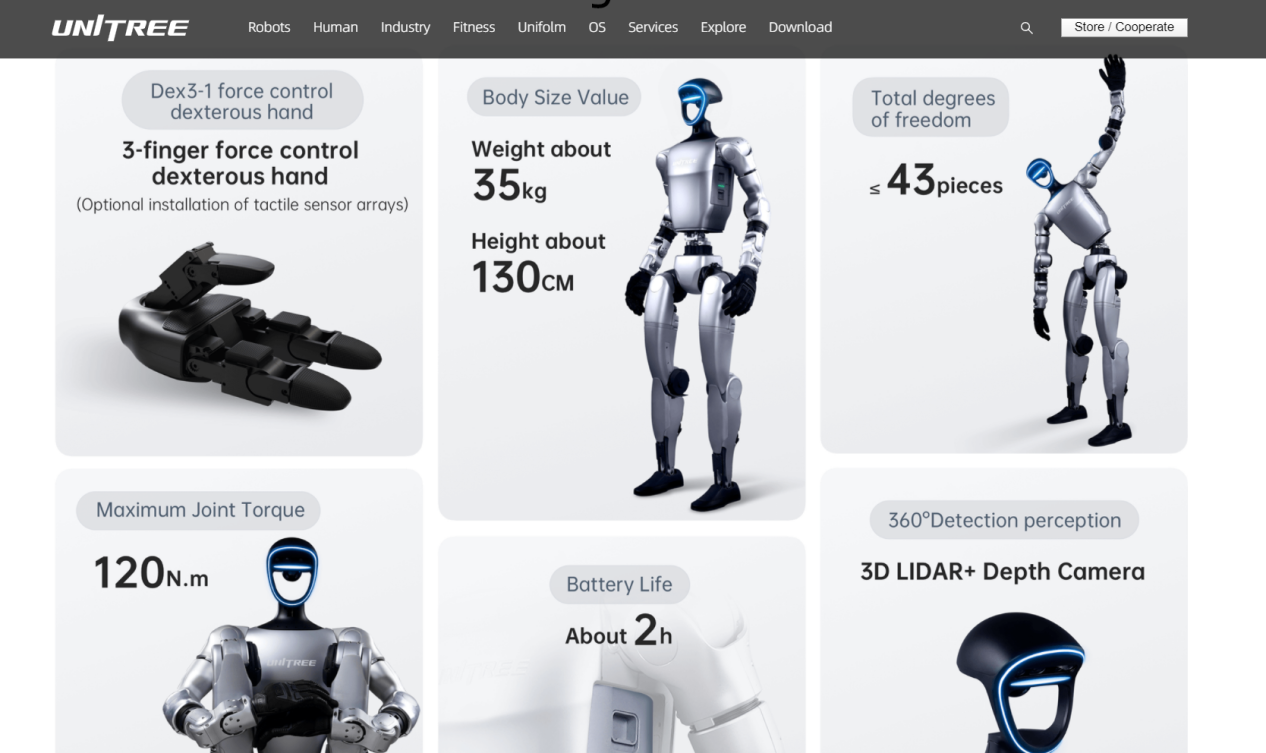
There is only so much space inside the body, and the battery pack usually has to stay within five or six kilos. Too heavy and the robot loses useful working capacity. If it is too light, it cannot run long. It does more than power the battery. It determines if the robot is able to stand up, run fast, and work for hours.
In this article we will look at what makes humanoid robot batteries so difficult, how they are chosen by engineers, and what you need to know to understand it.
Why NMC Still Dominates Humanoid Robot Battery Packs
Open up most humanoid robots today and the battery pack is still likely to be NMC. The cells may be cylindrical or pouch format, but the basic reason is the same: NMC gives engineers a workable mix of energy density and power output.
Typical packs sit around 250 to 300 Wh/kg, with 3C to 5C discharge in normal use and short bursts that can climb to 10C or 20C. For a liquid-electrolyte battery, it also holds up reasonably well when temperatures drop.
The problem begins when this pack is installed inside the chest of the robot. This is a very tight space with very poor air circulation and a lot of electronic components surrounding it. When the robot is drawing high currents from this battery pack, the heating is not uniform within it. Certain cells will be hotter compared to other cells.
With an NMC pack, a humanoid robot can usually run for about two to three hours in normal use. Push it harder, and that window shrinks.
LFP Works, Just Not for Robots That Need to Move Fast
Lithium iron phosphate, or LFP, has one weakness that is hard to get around: low energy density. Mainstream cells are usually around 160 to 200 Wh/kg. To store the same amount of energy, the battery pack has to be heavier. For a robot that needs to run, jump, carry loads, and keep changing posture, that extra weight is hard to ignore.
The case for LFP starts with safety. It has a higher thermal runaway threshold, can pass nail-penetration tests without catching fire, holds up well in abuse testing, and can easily go beyond 3,000 cycles. The cells also cost less. For a robot expected to work every day for several years, those are real advantages.
So LFP’s place is not in speed.It is a matter of stability. Guide robots for hospitals, nurse robots at bedsides, and indoor companion robots that slowly make their way down hospital corridors are the best places for LFP technology. They do not require bursts of energy. Instead, they require batteries that cannot burst into flames, will not balloon in size, and will last a long time without needing replacement.
Semi-Solid-State Is the Bridge, All-Solid-State Is the Longer Bet
Semi-solid-state batteries are the compromise. They can be produced now, so the industry does not have to wait, while performance still moves a step beyond conventional liquid-electrolyte batteries. Once part of the electrolyte is replaced with solid material, cell energy density can reach 350 to 400 Wh/kg. Runtime can move from two or three hours to six or eight hours. Samples are already being tested by several leading robotics companies, and small-batch trial production has started.
All-solid-state batteries go further. The liquid electrolyte is removed completely, which takes leakage, swelling, and thermal spread out of the cell design at the root. Energy density is expected to reach 400 to 520 Wh/kg. The operating temperature range can extend from -40°C to 80°C, and resistance to vibration and impact also improves.
In electric vehicles, all-solid-state batteries are still waiting for costs to come down. Humanoid robots may not have to wait in the same way. This industry is more willing to pay for a performance jump than to obsess over cost per kilowatt-hour. If the performance is strong enough, all-solid-state batteries may scale faster in robots than in EVs. Early tests on prototype platforms are already sending that signal: weight is down, stored energy is up, and puncture tests have been passed. First, make semi-solid-state work reliably. Then, once the upstream supply chain runs smoothly, shift to all-solid-state production.
How Engineers Choose Batteries for Humanoid Robots
Choosing batteries for robots that walk and run takes a different yardstick than consumer electronics or EVs. The criteria that work for a phone or a car just don’t cover what these machines need.
- Weight and packaging. The full pack has to stay inside five or six kilograms. More than that, and it won’t fit. The torso cavity isn’t a neat rectangular box — it’s an irregular space where cylindrical, prismatic, and pouch cells all fight for room. The structure has to be tough, too. The robot will get dropped, knocked around, and shaken for hours on end. Internal connections can’t break.
- Power response. The instant the robot jumps, lands, or shifts posture under load, power demand can spike to several kilowatts. Voltage droop happens in milliseconds. If it drops too far, joint torque falls off and the gait breaks. A lot of cells that look fine on a steady-state discharge curve fall apart the moment you test them inside that millisecond-scale window.
- Temperature adaptability. Forty to fifty degrees Celsius on a factory floor, minus ten or worse on a winter patrol route — the battery doesn’t get to pick the weather. Liquid-electrolyte solutions struggle at both extremes. Solid-state designs would be a lot more comfortable, but right now you can’t buy them in volume, money or not.
- Safety redundancy. The cells sit right next to wiring harnesses, joint motors, and the main control board. There’s no separate cooling channel. Nail penetration, crush, thermal shock, vibration, overcharge, short circuit — the pack has to pass all of them. A single cell failure can’t cascade and take the whole pack down. That constraint bites from the very first cell selection and reaches all the way into how you fuse the module.
- Cell consistency. Hundreds of cells are strung together in series and parallel. As soon as voltage and internal resistance gaps widen past a narrow band, the BMS throttles the entire pack — Gait timing and task continuity pay the price.
What Comes Next for Humanoid Robot Batteries
Most of the humanoid robots sold in the next few years will continue to use liquid lithium packs. The supply chain is in place, production is known and the weak points are better understood. The improvements will come through changes to BMS tuning, faster heat transfer and tighter pack layout inside the torso.
Semi-solid-state packs will debut in high-end robots, where the higher cost can be justified by the longer run-time. They will eventually replace some of today’s NMC and LFP usage. All solid-state cells will take longer. First small validation batches, then robot grade packs when cells can survive heat, vibration, impact, cell matching, fusing and repeated production.
The commercial threshold is about seven to eight hours of continuous high-load work without constant throttling or battery swaps. At that point, buyers can start treating humanoid robots as usable equipment. As cells above 400 Wh/kg become easier to source and all-solid-state costs fall, longer operation will become a standard requirement.
The challenge is turning better cells into reliable packs. A lab cell can perform well once. A robot battery pack has to perform the same way across production batches, safety tests, and real operating conditions.
A humanoid robot battery is closer to a powertrain than a plug-in part. Cells, housing, thermal control, monitoring electronics, and safety logic have to work together. That system decides how long the robot can run, how often it has to slow down, and whether it can be trusted beyond a demo.
