


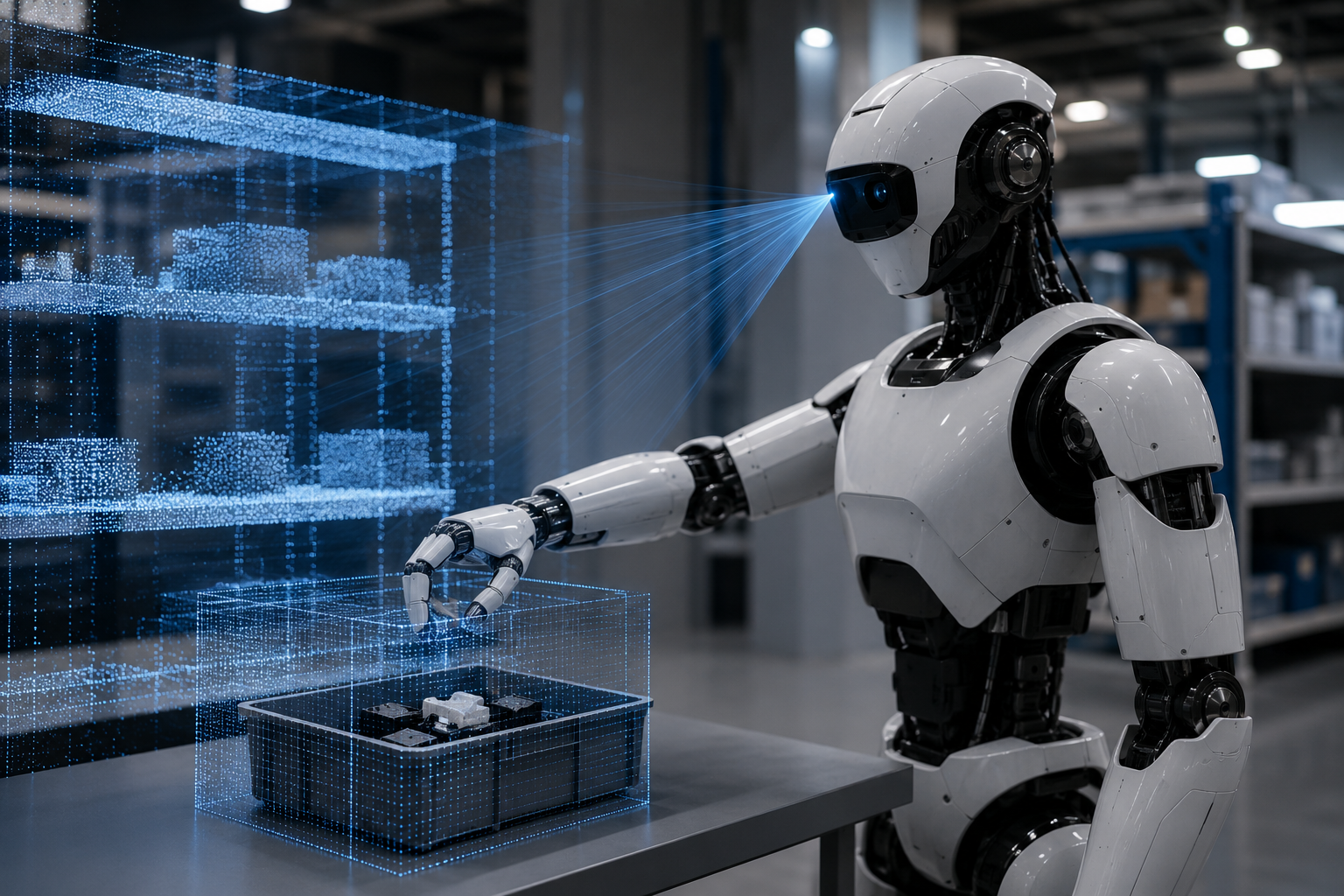
A simple way to understand humanoid robot 3D vision is to compare it with a regular 2D robot vision camera. A 2D camera can show color, texture, and surface details. The image may look sharp, but it is still flat. The robot can see that something is there. It just cannot reliably tell how far away it is, or how much space it takes up.
That is where a 3D vision system comes in. It gives the robot depth, so robot vision becomes more than taking pictures. The robot can begin to judge distance and size in the real world.
Two Main Vision Routes for Humanoid Robots
3D Depth Cameras Combined With LiDAR
A 3D depth camera does not need to rely fully on ambient lighting. It can emit infrared light on its own, capture color images, and measure distance at the same time. For example, Orbbec’s Astra series can support 3D body scanning, short-range perception, and other related functions.
Most Chinese humanoid robot manufacturers use this kind of robot vision system. Unitree’s G1, for example, combines 3D LiDAR with a depth camera. AgiBot’s Expedition A2 uses a combination of 360-degree LiDAR, an RGB-D camera, and a fisheye camera, giving the robot an all-around environmental perception capability with no blind spots.
The main advantage of this approach is adaptability. The robot can still judge its surroundings when the lighting is poor, when objects block part of the view, or when the ground surface changes. Since much of the sensing work is handled by the hardware, the system puts less pressure on onboard computing. Similar sensor setups have also been used for years in robot vacuums and industrial robots, so the deployment path is already fairly familiar.
The cost problem is hard to avoid. LiDAR and multiple camera modules push up the bill of materials, and they add weight to the robot body. That makes lightweight design harder and takes a toll on battery life.
Many Chinese humanoid robot companies still choose this route for one reason: stability. Before they can bring costs down in a serious way, the robot vision system has to prove that it can work in real environments.
Standard Cameras Plus Algorithms
The other route strips the robot vision system down to standard cameras and software. The robot carries ordinary cameras, with no dedicated distance-measuring hardware, and uses algorithms and computing power to build a sense of 3D space. Tesla Optimus follows this approach.
Compared with the hardware-heavy approach used by many Chinese manufacturers, the biggest advantage is lower cost. A standard industrial 2D robot vision camera may cost only a few dozen RMB. A consumer-grade RGB-D 3D depth camera can cost several thousand RMB. Fewer hardware modules also mean less weight on the body, which helps battery life.
The weakness is that pure vision depends heavily on lighting conditions. A pure camera-based robot vision system can struggle in backlit scenes, low light, or with objects that have little surface texture. In those cases, depth estimation can drift.
Factories leave little room for visual mistakes. A humanoid robot vision system has to recognize parts accurately and place them with steady precision. One wrong pick can hold up a production line. In that kind of setting, a robot vision system built around depth cameras and LiDAR is a sensible choice. The extra sensor cost is small compared with the loss from a production stoppage.
Homes are a different market. Price matters much more, and consumer robots have to meet a demanding standard before people will accept them. When expensive hardware stays in the design, humanoid robots remain hard to bring into ordinary households. A machine priced above RMB 100,000 is still too expensive for most buyers.
The two robot vision routes need to be judged by where the robot will work. Depth cameras and LiDAR fit environments that put stability first. A standard robot vision camera with algorithms fits scenarios where cost, weight, and battery life carry more weight. There is no single route that works best for every use case.
The Robot Vision Sensor Market
When comparing overseas and Chinese companies in vision hardware, overseas firms such as Keyence, Basler, and onsemi have spent decades working on image chips. They have long held leading positions in the high-end industrial camera market, and their supporting software ecosystems are also mature.
Chinese companies are mainly focusing on customized 3D vision hardware and software for humanoid robots, which gives them a specific industrial advantage. Orbbec is mainly working on consumer-side 3D vision sensors that can be adapted to service robots. Angstrong focuses more on wide-angle LiDAR, expanding the robot’s field of view. Hikrobot can provide industrial cameras, smart code readers, stereo cameras, and other products.
China’s advantage comes from the complete robot supply chain. Domestic 3D vision hardware can move quickly into the dedicated humanoid robot market and build differentiation there. This is also a local advantage unique to China’s robotics industry chain.
Future Technology Trends
As the humanoid robot industry develops quickly, robot vision will mainly upgrade in three directions.
First, deeper algorithms will gradually reduce dependence on hardware. This is directly tied to deployment cost.
Second, multi-sensor fusion will continue. Depth cameras will become standard, while LiDAR will be added depending on the use case. Multiple technical routes will coexist for a long time.
Third, vision will move away from aimless full-scene scanning. Robots will be able to choose the objects they need to grasp or interact with, reducing wasted computing power and making movements smoother. This is where robotics vision and control become closely connected.
Overall, 3D vision is more than the eyes of a humanoid robot. It is the foundation for a complete process, from environmental perception and deeper reasoning to physical action. Today, technical routes are developing in many directions, competition between domestic and overseas companies is becoming more intense, and the market continues to grow. Companies that can build compact, low-power 3D vision products with complete supporting algorithms will be well positioned to benefit from the growth of embodied AI and the humanoid robot industry.
