


On the afternoon of August 19 in Beijing, a Unitree G1 humanoid robot stood on one side of a table tennis table at the company’s booth at the 2026 World Robot Conference (WRC 2026). As the ball came over the net, the robot stepped sideways and returned it with a backhand.
A Unitree staff member said the G1 tracks the incoming ball’s position and movement in real time, then chooses a forehand, backhand or a shot after stepping into position. It adjusts its posture and striking motion as the ball’s position and trajectory change.
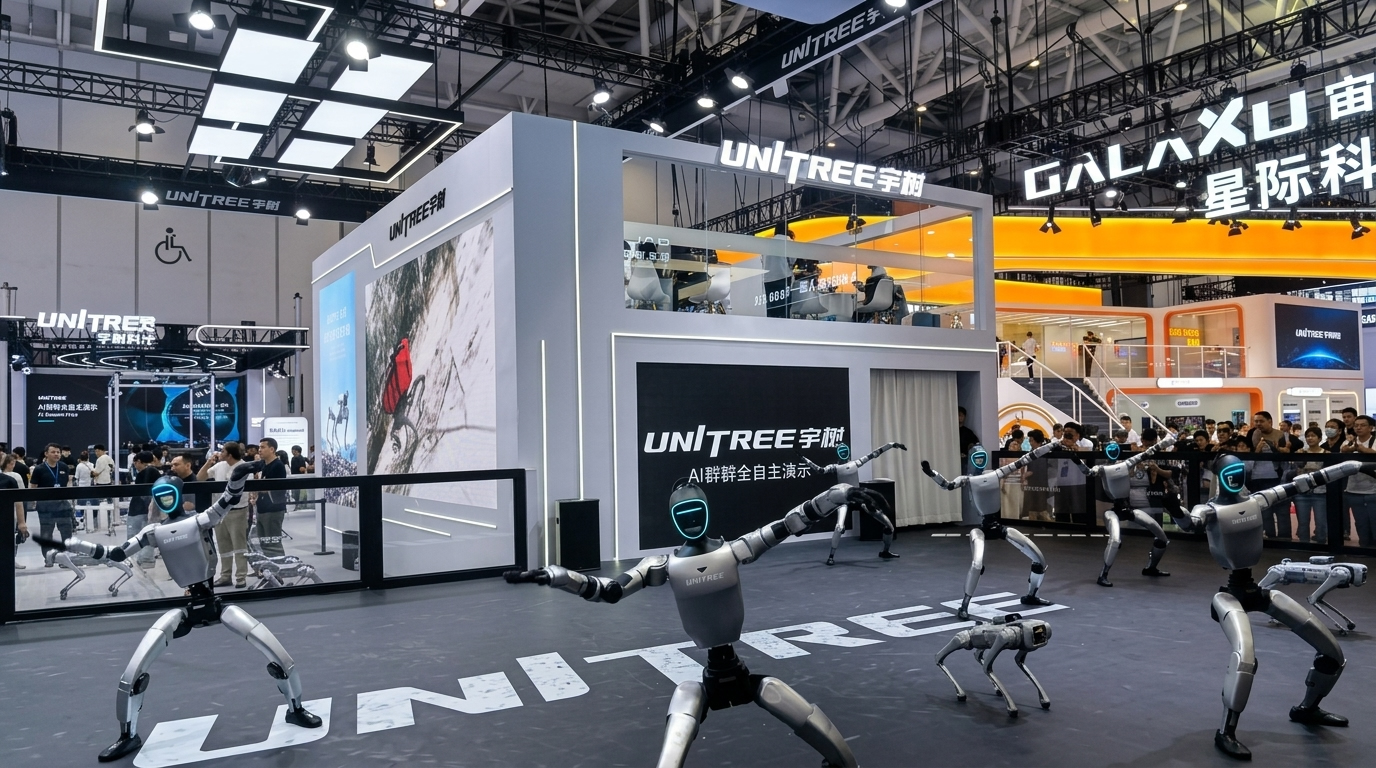
Elsewhere at the booth, multiple G1 humanoids moved alongside Unitree’s As2, As2-W, A2 and A2-W quadruped and wheeled-legged robots in a synchronized group performance.
Unitree said the demonstration was coordinated by its in-house AI swarm control system. Staff said the focus was on coordinating different types of robots rather than demonstrating a single machine. The robots followed the same set of commands despite differences in their forms and sizes, giving visitors a look at how different robot platforms could operate as a single fleet.
The G1 and Unitree’s new full-size humanoid, the H2 humanoid robot, also performed fighting movements at the show. Such movements demand dynamic balance, whole-body coordination and fast motion control.
A Unitree representative said the G1 has gone through multiple upgrades since its launch, with home applications among the areas the company is watching. The representative said Unitree may eventually see the robot serving a wider range of household tasks.
GD01 brings a different kind of robot to the show
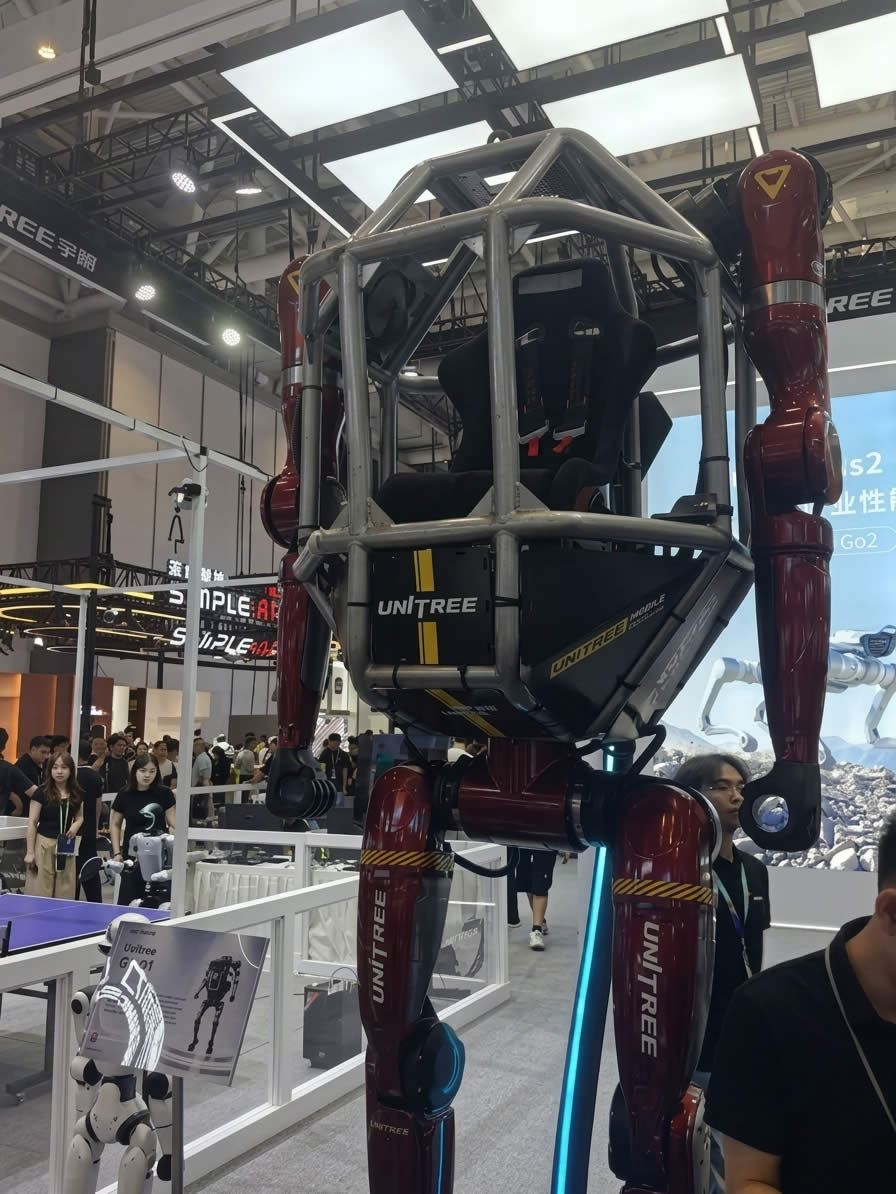
The company also brought its GD01 manned transforming mecha to WRC for the first time, drawing a steady crowd around the display.
The machine stands about 3 meters tall in its upright configuration and weighs roughly 500 kilograms with a person on board. Unitree says the GD01 uses its own servo drive system and control algorithms to switch between bipedal and quadrupedal configurations.
Unitree has highlighted cultural tourism and other specialized applications as potential use cases. The machine shown at WRC was the production-ready GD01 that Unitree unveiled earlier this year.
Unitree makes its stock-market debut as the show opens
The WRC appearance came on the same day Unitree officially listed on Shanghai’s STAR Market, the science and technology-focused board of the Shanghai Stock Exchange.
The company’s IPO price was 150.80 yuan ($22.40) per share. Unitree opened at 1,100 yuan ($163.50), up 629.44% from the IPO price, putting its market capitalization at about 444.9 billion yuan ($66.1 billion) at the open.
The IPO raised about 6.1 billion yuan ($904 million), giving Unitree additional capital as it expands beyond its original quadruped business. The company now has products spanning quadruped robots, wheeled-legged robots, humanoids and the GD01 manned machine. Unitree has said that more than 90% of its core components are developed and produced in-house.
From single robots to coordinated fleets
The most notable part of Unitree’s WRC presentation was the combination of swarm control with different types of robots.
Coordinating bipedal, quadrupedal and wheeled-legged machines under one control system points toward multi-robot applications in areas such as logistics, inspection and entertainment. The exhibition demonstration did not show whether such systems are ready for routine use in less controlled environments, but it showed the direction Unitree is pursuing.
The table tennis demonstration highlighted a different technical challenge. A robot reacting to a moving ball has to combine perception with rapid changes in posture and motion, moving beyond a fixed sequence toward more real-time physical interaction.
At the exhibition, visitors lined up to play table tennis with the G1 humanoid robot while the H2 stood nearby in a fighting stance.
For Unitree, however, the demonstrations were only part of a much bigger day. Its debut on Shanghai’s STAR Market brought a sharp rise in its valuation, while the WRC booth offered a public look at how the company is expanding from individual robot platforms toward a broader lineup of connected machines.
