


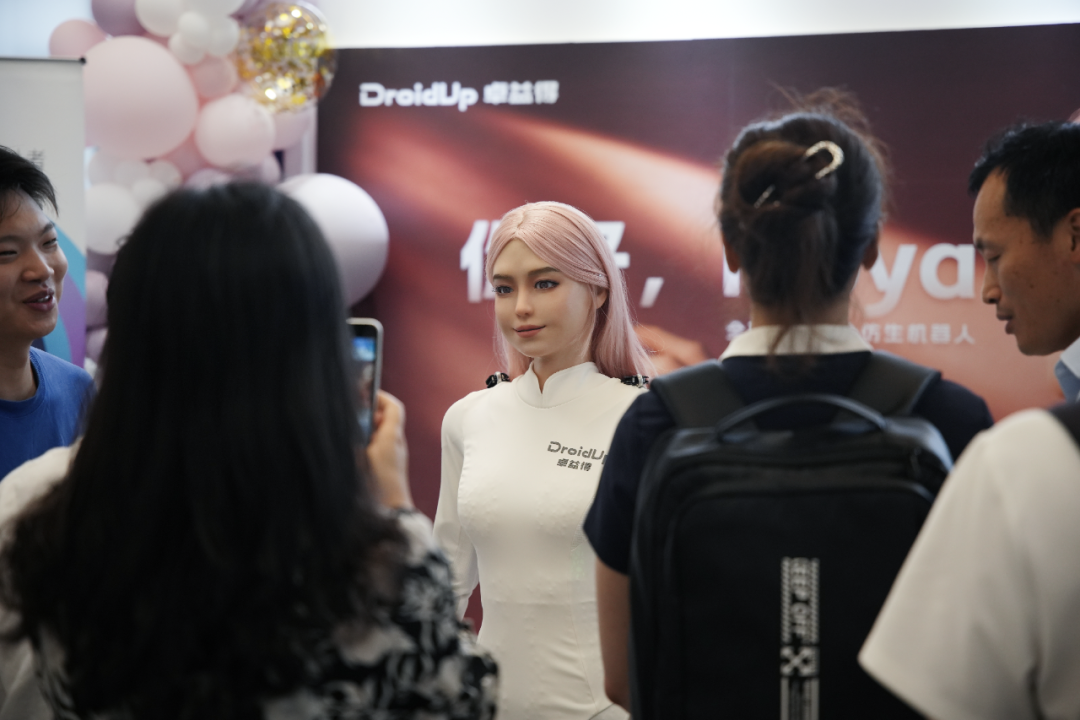
When the performance ends, it turns toward the audience. It speaks without delay. Facial expressions change within seconds, shifting through multiple emotional states. The skin shows subtle muscle-like movements, creating a lifelike expression that feels reflective.
This is Moya, a Chinese humanoid robot developed by DroidUp. The robot first gained attention online as a “silicon girl”. Now it returns with a new version that pushes toward a fully biomimetic humanoid robot.
In 2026, human-like robot designs are no longer rare. The focus has shifted to presence. Moya weighs around 30 kilograms, significantly lighter than many humanoid robots. Its structure includes more than 100 degrees of freedom, allowing coordinated movement across face, voice, and body.
What stands out is the interaction behaviour. Moya notices people moving closer, turns toward them, slows speech when they hesitate, and responds with small shifts in expression.
From Human-like Robot to Emotional Presence
Across the field of Chinese humanoid robotics, most systems focus on appearance or movement accuracy. Some aim to improve mechanical performance. Others focus on embodied AI systems that enhance decision-making.
User feedback points to another problem. Many reactions describe discomfort. The uncanny valley effect remains visible when movement or expression feels slightly off. Even advanced human-like robot systems still struggle with long-term comfort in shared environments.
The core issue is no longer imitation. It is coexistence. A humanoid robot companion is expected to operate in close proximity to people, not only to complete tasks.
What matters is whether a robot feels natural to live with, not only whether it looks human.
Defining a Fully Biomimetic Robot System
DroidUp describes Moya as a fully biomimetic robot built on three connected systems.
The robot weighs around 30 kilograms. Its structure uses 3D-printed lattice soft materials. High-performance PEEK replaces rigid steel parts. There are no sharp edges, reducing risk in close human interaction.
Movement relies on a tendon-driven architecture. Motors are concentrated in the hips. Force is transmitted through tendon-like structures across the body. Multiple motor groups work together like muscle systems, improving smoothness and efficiency.
The perception and expression system connects the head, eyes, hands, and skin. It supports more than 60 micro-expressions. Facial movement is produced by muscle-like actuators that simulate human expression. A flexible robotic hand and silicone skin kept at 32–36°C create a more natural presence in close contact.
On top of this sits DroidSoul, a full-body interaction engine. It processes vision, voice, touch, and posture together. An emotion-aware mechanism reads human behavior in real time.
Engineering Behind a Chinese Humanoid Robot Platform
The core architecture of this Chinese humanoid robot is based on a tendon-driven system. Instead of placing motors at every joint, actuation is centralized in the torso. Movement is transmitted through tendon-like structures.
This design reduces limb weight and improves motion smoothness. Contact with objects or people produces softer force feedback compared to traditional rigid servo systems.
The robot also integrates biomimetic facial architecture. More than 60 micro-expressions are supported. Facial movement is driven by multiple muscle-like actuators that simulate human expression patterns.
A full-body interaction system processes visual, voice, touch, and posture data. This embodied AI system interprets human behavior signals and generates real-time responses.
The goal shifts beyond appearance. It asks whether a robot can feel safe, responsive, and natural to be around.
Applications of Companion Robot Systems
A companion robot designed with full biomimetic capabilities opens multiple use cases.
In hospitality, it supports reception and guided interaction. Consistent behavior and emotional responsiveness create a stable service experience.
In elderly care, the system provides daily interaction and reduces isolation. The human-like robot behavior is designed to maintain calm and predictable communication.
In education, the robot acts as an interactive assistant. It responds without pressure, helping create a low-stress learning environment.
In entertainment and IP systems, AI character-based applications expand into physical interaction. Digital characters gain a physical presence that can engage directly with audiences.
These applications reflect a broader shift in humanoid robotics in China, moving from industrial tools to social systems.
Toward a New Stage of Human-Robot Coexistence
The advancement of next-generation humanoid robot systems suggests a clear shift. Mechanical capability is no longer the final test. A robot may walk, respond, and move with precision, but daily acceptance depends on something quieter: whether people feel steady and comfortable around it.
Moya shows this shift clearly. A fully biomimetic robot brings together embodied intelligence, mechanical design, and emotional response, then turns them into a body that can move safely in human spaces.
Chinese humanoid robots are moving into a new stage. Large AI models improve cognitive ability. New materials reshape the outer body. Through full biomimicry, DroidUp is pushing humanoid robots from exhibition systems toward real environments where people live, work, and interact.
