


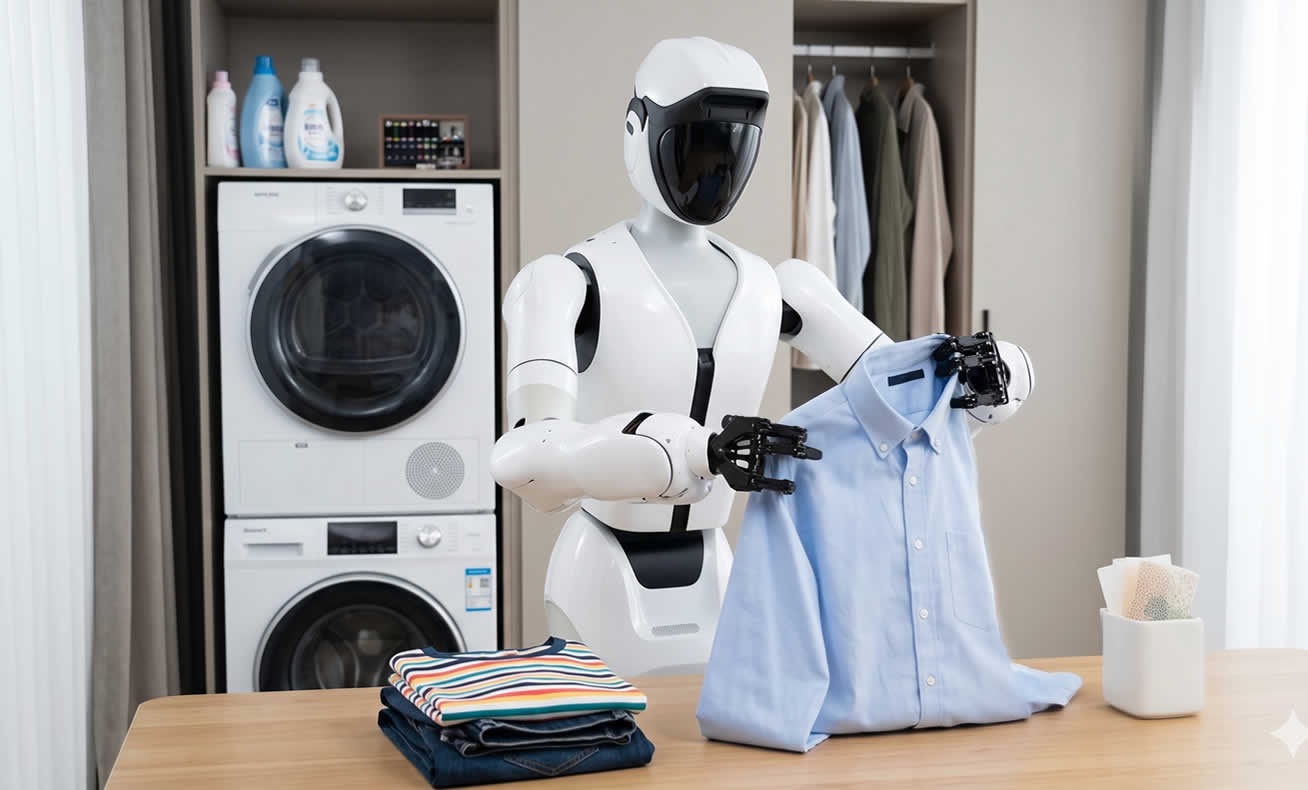
On , in Wuhan’s Optics Valley, a humanoid robot called Seelight S1 folded a piece of clothing. The demo was simple, but the setting made it stand out – this was a simulated home, not a factory or a trade show booth.
GigaWorld, the company behind Seelight S1, describes it as China’s first general-purpose home humanoid robot. In a year when humanoid robots are finally supposed to move from prototypes into mass production, that “for the home” label may be more interesting than the hardware itself.
Why home is different
Over the past two years, Chinese humanoid robot companies have been racing to get their machines out of the lab. UBTech’s Walker series landed in factories. Agibot’s Expedition A1 started tightening bolts on auto assembly lines. Unitree’s H1 keeps showing off backflips and parkour. Almost all of these early commercial moves target industrial and business environments. The logic is solid: factories are structured, tasks repeat on a schedule, and business customers can absorb a price tag that households never could. A robotic arm costing a few hundred thousand yuan can replace two workers and pay for itself in two years.
The home is messier. GigaWorld CEO Zhu Zheng put it plainly at the launch event: “The biggest challenge of the home setting is that the environment, tasks, even the habits of family members are never fixed.”
What that means in practice is that a home robot has to actually understand what it’s doing. In a factory, the part that needs picking up is always in the same place, same size, same weight. At home, a T-shirt one day is a button-up shirt the next, sometimes left on the bed, sometimes draped over a chair. An industrial robot gets confused when things change; a home robot has to read the situation, figure out the task, and plan its own motions. That capability – what researchers call embodied intelligence – is one of the hardest problems in AI right now. Seelight S1’s main claim is that it runs on GigaWorld’s own embodied intelligence large model.
The technology underneath
GigaWorld isn’t a name most people recognize, but in AI circles and among venture investors, it’s been gaining momentum fast. This April, the company raised close to 2.5 billion yuan within a single month, hitting a valuation above 10 billion yuan and becoming China’s first world model unicorn. Two things drive that number: its world model, also called GigaWorld, ranked first globally in the WorldArena benchmark, and GigaBrain, the embodied intelligence model built on top of it, has kept up error-free performance for hours in complex task tests.
A world model is basically an AI that tries to understand how the physical world behaves – push a cup and it might tip, water spills and spreads, fabric wrinkles when you grip it. Traditional AI, the kind that just recognizes objects in an image, doesn’t need to know any of that. A robot acting in a real room does.
Ye Yun, GigaWorld’s R&D vice president, said Seelight S1 “does not rely on pre-set programs” but uses its model to understand the goal and plan its own movement. The robot also has compliant control that stops it immediately when it touches a person or a pet. That safety feature matters a lot – on a factory floor, robots and people are kept separate; at home, they have to share the same space.
Another detail: the robot can pick up a new skill after watching a person do it once or twice. No programming required. The user just shows it what to do.
All of this is still in the testing phase. GigaWorld’s published roadmap says GigaBrain 1 will launch in , aiming for better data understanding, task generalization, and movement precision in home settings. This week’s demo was a beginning, not a finished product.
Wuhan’s bet
Seelight S1’s launch is also a window into what the city of Wuhan, and Hubei province, are trying to build. Hubei has set up a 10 billion yuan humanoid robot industry investment fund. Wuhan’s Optics Valley now hosts one of the country’s largest humanoid robot innovation hubs, with over 30 companies along the supply chain. At the event, Zhu Qinmiao, secretary-general of the Hubei Humanoid Robot Industry Alliance, said plainly that the province believes it has a first-mover edge in commercializing home robots and is “confident we can complete the whole chain – from technology to products, from products to homes.”
One part of that push is getting real-world data. Home robots can’t improve just in a lab; they need to spend time in actual homes. So GigaWorld plans to give 100 Seelight S1 units, free of charge, to households in Wuhan this Q3. They are targeting homes with complex dynamics – places with seniors, children, or pets. Another 100 units, ordered by Hubei Science and Technology Investment Group, will be placed in the Future Apartments of Optics Valley’s Zhiyu complex.
Zhu Zheng also mentioned a longer-term goal: working with local partners to build what could become the world’s first massive dataset of real home scenarios. If that dataset reaches a critical scale, it could give whoever owns it an advantage similar to what ImageNet once did for image recognition – the kind of advantage that’s hard for latecomers to close. Right now, though, it’s still a plan. A hundred trial robots and a hundred-unit order are modest compared with the talk of a trillion-yuan home service market. But the direction makes sense.
The price tag
All the home-robot visions eventually run into the same question: how much? Zhu Zheng acknowledged that Seelight S1 currently costs about 200,000 yuan to produce. The target, by moving to in-house manufacturing, is to get that below 100,000 yuan.
Two hundred thousand yuan is far too expensive for a typical family – it’s roughly the price of a mid-range sedan. But within the humanoid robot industry, it’s actually an aggressive number. Most humanoid robots on the market today sell for around 300,000 yuan, and some aren’t even sold outright, only leased. GigaWorld likely brought the price down by using its own core components and algorithms.
The 100,000-yuan mark is an interesting psychological barrier. In China, that’s what a budget car costs, and it’s the range where a middle-class family might think about an expensive durable good that makes daily life easier. If a humanoid robot can actually hit that price and deliver reliable service, the market math changes. But that’s still a big “if.” Home robots still have to get better at understanding what’s going on, handling objects with precision, and adapting to new places. Safety, data, and just proving they are worth it – all of those remain open questions.
A closer look
So what to make of Seelight S1 right now? It’s a breakthrough in one sense: it’s the first humanoid robot to clearly label itself “general-purpose home” and lay out a concrete plan to get into real homes. The 100 free trials and the apartment deployment show that someone is putting money behind the idea.
But it’s also a probe. The home is far less predictable than a factory. The demos showed the robot folding clothes, helping in the kitchen, keeping an elderly person company. How many of those tasks work outside a tightly controlled demo? How often does it fail when something unexpected happens? How much human help does it still need? The only way to find out is to put the robot into those 100 homes and watch what happens over weeks and months.
2026 may be the year humanoid robots start being produced at scale, but scale isn’t the same as maturity. Seelight S1 is an early stone thrown into the water. The real test starts when it lands.
