

What Is H2 Plus?
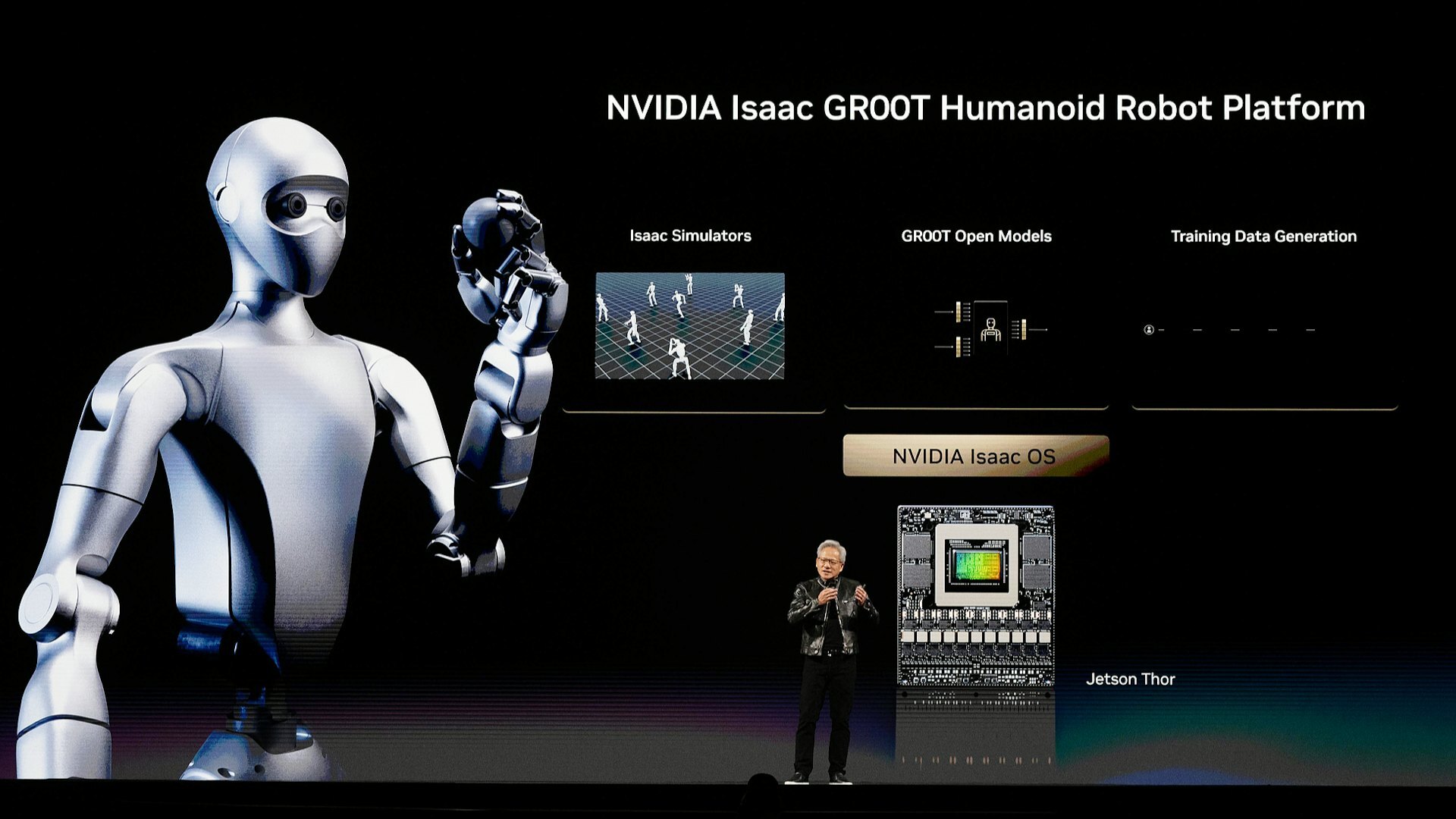
H2 Plus integrates three core pieces: an AI “brain” for perception and planning, a motion control system (“little brain”) for balance and joint coordination, and the physical body, including limbs, actuators, hands, and frame. Unitree supplies the body, Sharpa, a Singapore-based robotics company, provides tactile five-finger hands, and Nvidia contributes the onboard compute via Jetson Thor and Isaac GR00T.
Unitree provides the H2 Plus humanoid body. Sharpa provides tactile five-finger robotic hands. Nvidia supplies the onboard computing system and software workflow through Jetson Thor and Isaac GR00T.
According to Nvidia’s announcement, the H2 Plus system uses a Unitree humanoid body that stands about 1.8 meters tall and weighs around 68 kilograms. The robot body has 31 degrees of freedom, while each five-finger robotic hand has 25 degrees of freedom, bringing the full system to 75 degrees of freedom. Nvidia’s computing layer is based on the Jetson AGX Thor T5000 platform, using Blackwell GPU architecture, 128GB of memory, and up to 2,070 FP4 TFLOPS of AI computing performance.
Higher degrees of freedom allow more natural movement but also make control much harder. The extra computing power helps with perception, inference, and model execution, though without robust motion management and sufficient training data, the robot won’t perform useful tasks outside a lab.
What Does H2 Plus Actually Change?
The real shift isn’t a single flashy capability. It’s that researchers no longer have to build the entire humanoid robot stack from scratch before testing ideas. Nvidia is leveraging H2 Plus to push its AI computing advantage deeper into humanoid robotics.
As Jensen Huang noted, building a complete humanoid robot test platform independently is “too difficult” for many teams. Nvidia packages the software stack, data-generation system, simulation environment, and runtime tools into a platform that researchers can use more directly. Instead of assembling the robot body, onboard compute, sensors, simulation tools, and development workflow piece by piece, labs can start from an integrated system.
That doesn’t mean H2 Plus makes humanoid robotics easy. The field still demands serious funding, skilled engineering, and integration capabilities. What changes is the starting point. Instead of spending a year just getting a prototype to stand still and reach, a lab can use H2 Plus to jump straight into harder questions: training manipulation policies, making locomotion robust on uneven ground, or testing real-world failure cases. That won’t turn every research group into Boston Dynamics, but it does mean more teams can afford to try, fail, and iterate.
What This Means for Humanoid Robotics
H2 Plus is interesting because it goes after three problems that have slowed humanoid robot research for years: integration, cost, and time.
1. Less Time Spent Stitching Hardware Together
For many labs, building a humanoid test platform is a project before the real research even begins. Teams have to connect the robot body, hands, sensors, compute, and software stack, then spend months getting everything to work together.
H2 Plus shortens that path. The body, hands, Nvidia compute, and software environment come as one system, so researchers can get to testing models and robot skills faster.
2. Better Balance Between Strength and Dexterity
Humanoid robots often struggle to combine fine hand control with enough physical strength. H2 Plus is built to cover both sides. Its arms are rated for 7 kg loads, with a 15 kg peak load, while the five-finger hands are meant for more detailed manipulation.
Useful humanoid robots will need to do both: handle small parts, cables, and tools, but also move heavier objects when needed.
3. Vision and Compute Working Together
The humanoid robot requires good vision, real-time image processing, and the ability to turn that data into steady movements across its limbs and body.
For its eyes, the H2 Plus features a 5MP human-looking binocular camera system with a 140-degree horizontal viewing angle and a 102-degree vertical viewing angle. The camera supports global shutter imaging and a viewing range from 0.4 meters to infinity, helping the robot perceive its surroundings more clearly with less motion blur. The H2 Plus also has an optional pair of 3MP wide-angle wrist cameras with global shutters.
So the robot ends up with clearer vision, quicker reactions, and more reliable hands.
Conclusion
H2 Plus humanoid robot is not just another humanoid robot announcement. H2 Plus lowers the barrier to serious humanoid research. When teams no longer have to build every layer of the system on their own, they can spend more time testing real skills, improving control, and finding useful applications.
That matters for the whole humanoid robot industry. As the barrier to development comes down, more labs, startups, and engineering teams can enter the field. This could speed up the shift from demonstrations to real-world applications in actual workplaces, such as factories, research labs, logistics sites, and service environments.
