


Chinese Humanoid Robots in Elderly Care Start With Repetitive Work
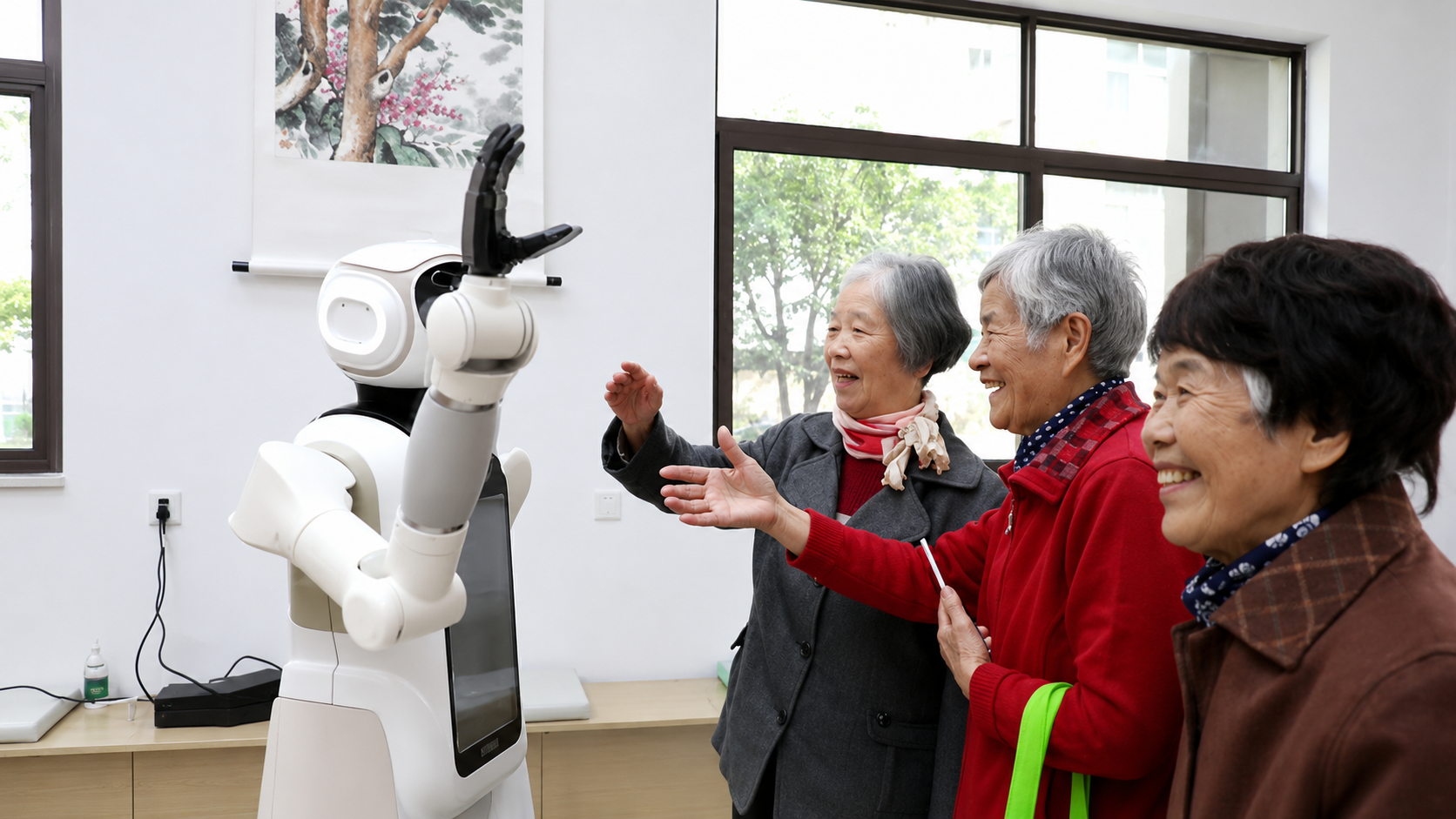
Guanggu Dongzhi showcased its“1+1+N” smart elderly care service system at the event. The platform uses the Photon series of embodied intelligence robots as its hardware base, supported by an AI system specifically developed for smart elderly care. It is aimed at nursing homes, care facilities, and senior living communities, offering human-robot collaboration in safety patrols, emotional support, health monitoring, and other care scenarios. The three robots shown on-site each handled a different part of that work.
U1 can move on its own to a designated room, remind an elder resident to adjust the air conditioner to a suitable temperature and take medicines. The U1 robot is also able to patrol all day long. If a senior falls down either in the hallways or in the rooms, the nursing home robot will be able to identify the hazard.
HL1 handles the transport of meals, supplies, medication, and daily-use items. These jobs repeat every day in nursing homes. In the past, caregivers often had to walk back and forth to handle them. Once a robot enters this workflow, part of that repetitive transport can be taken over.
S1 serves another kind of need. As one of the companion robots for seniors, it can chat with older adults and lead them through exercises. Many older residents have a limited activity radius during the day. For them, being willing to speak and willing to move along with an activity matters.
Chen Weiran, brand director at Guanggu Dongzhi, said at the event, “At the moment, one robot model cannot do everything, but we can let different types of robots each do their own job.”
That line avoids the fantasy of an all-purpose machine. It is also closer to how care work is divided inside a nursing home. As robots in elderly care become more visible, the useful question is less whether one machine can do everything and more whether each caregiver robot can take on a job that staff already need done.
For Robots to Reach Seniors, They First Have to Understand Them
In a nursing home, older adults do not always speak in neat, complete sentences. Some pause halfway through a thought. Some speak in dialect. Others speak slowly.
At the Chain Expo, Chen Weiran said U1 runs on a dedicated AI model for smart elderly care. It can answer eldercare questions and has been tuned for dialect recognition, including Wuhan dialect and other local dialects spoken across Hubei. The robot also uses facial recognition to tell residents apart. Each interaction is sent to a back-end management platform, giving medical staff more context for follow-up care.
At Xialing Interactive Smart Senior Care Home in Xihu District, Hangzhou, nursing supervisor Cheng Juan told CCTV that the “Rouqing” robot leads residents through finger exercises and fitness routines every morning. The seniors find it novel and are willing to join in. The home has 13 residents, with an average age of 86. Most have cognitive impairment, and residents with disabilities make up 70% of the home. Even with one caregiver for every five residents, one-on-one care is still difficult.
Cheng said turning an older adult over in bed takes real strength. If the resident is heavy and only one caregiver is working the night shift, the task becomes especially hard. Since Rouqing arrived, it has joined caregivers on their rounds. Cheng called it “a very capable helper” and said it has improved care efficiency.
From Seniors to Children, Robots Are Entering More Everyday Settings
Outside nursing homes, robots are also appearing in classrooms, rehabilitation rooms, and community service stations.
In the same Chain Expo exhibition area, Hubei Guanggu Shengchuang Technology displayed the NAO series of smart robots. They are designed for intelligent companionship for young children and early developmental screening. They can also provide structured rehabilitation training for children with autism. For these children, training often requires repeated practice, while teachers need an auxiliary tool with stable responses and controllable pacing.
NAO is also being opened up to universities through programming interfaces, so students and researchers can build on the platform themselves. Some use it for choreographed dance. Others program it to play instruments, write calligraphy, or carry out other staged movements.
In Beijing, Ronghua Subdistrict has put a different kind of robot scene closer to daily life. Its smart eldercare robot service station covers about 1,100 square meters and already has more than 40 robots on site. Seniors can have food cooked by a stir-fry robot, pick up a jianbing made by a robot in three minutes, or try machines that play chess, make tea, give massages, and perform moxibustion.
Mr. Zhuang, who lives nearby, said after trying the robots that a robot could also keep someone company. A short chat, he said, was enough to ease the boredom. Wang, 74, tried an exoskeleton. When she climbed the stairs, she felt as if her legs were supported, with much less pressure on her knees.
The Places Where Robots Get Closest to Life Are Often Ordinary
Robots in people’s lives can start from small and simple things. These include conducting a routine inspection in the corridor of a nursing home, delivering drugs during lunchtime, or conducting exercises in the activities area. This can also occur within the classroom of a rehabilitation center where an AI companion robot assists the child in conducting repeated practice, or at community service stations where robots in healthcare assist the elderly patient to conduct therapy and health checks.
From all these examples, it is clear that Chinese robots in nursing homes, community centers, and classes are beginning with everyday tasks. It also shows us what the humanoid robots used for elderly care in China look like. The most useful machines may be the ones that quietly take over a real task inside an ordinary day.
