

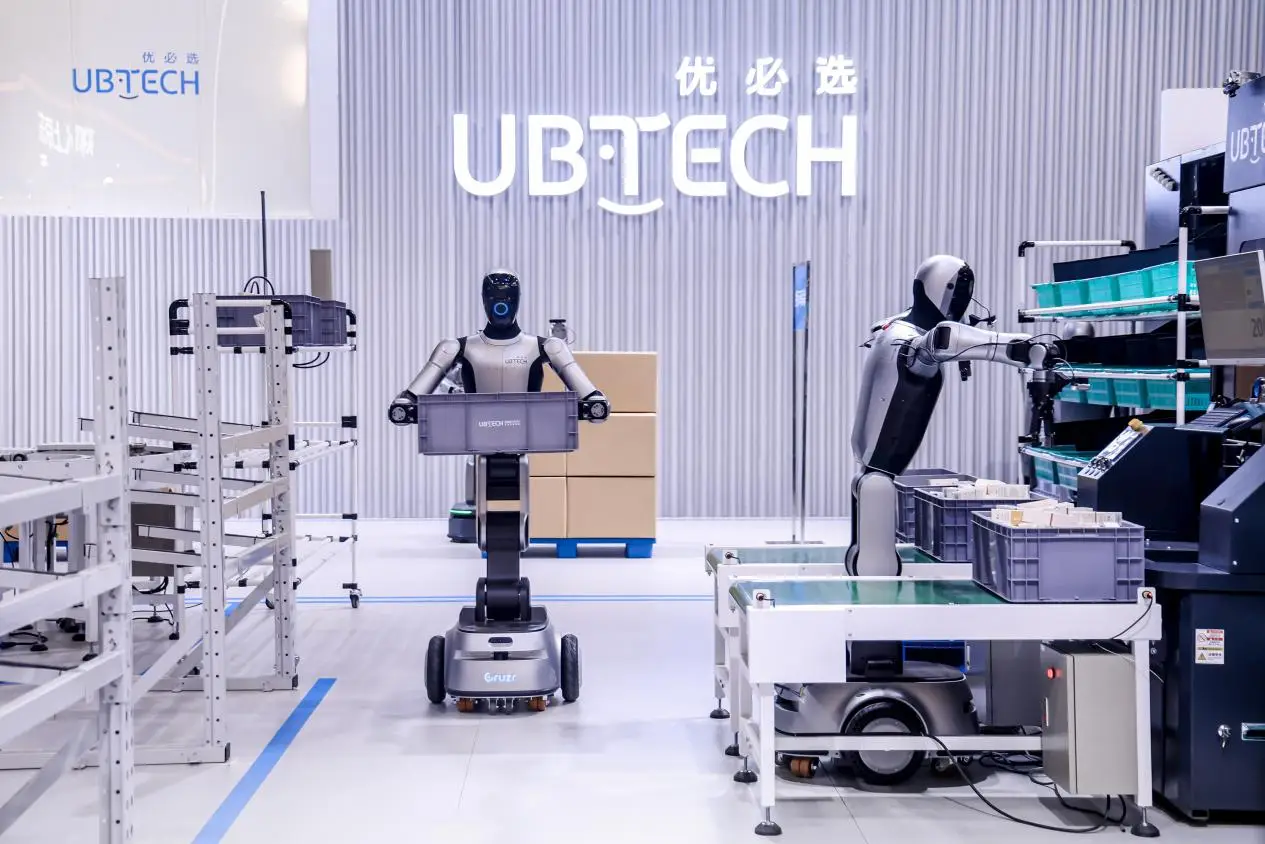
In January 2026, Airbus bought a Chinese humanoid. The machine is UBTECH’s Walker S2: 5 feet 9 inches tall, 154 pounds, 52 degrees of freedom, rated to carry 33 pounds anywhere between the floor and about six feet. It walks at up to 4.5 mph. When its battery runs low, it pulls the pack, seats a fresh one, and is back at work in about three minutes.
Airbus has not said how many machines it ordered or which plant will run them, and it describes the work as early-stage concept validation. None of that changes what the order is for. Airbus is not buying legs. A gantry crane doesn’t need to walk, and neither does most of what happens on an assembly line. What it is buying is a pair of arms with enough control authority to place a part within specified tolerances, mounted on a body narrow enough to reach the places where aircraft get built. That capability lives in the joints — and the joints are the reason this particular company exists.
The Joint Business
UBTECH was founded in Shenzhen in March 2012 by Zhou Jian, who uses James Zhou in English. It did not start out building humanoids. It started out building servo actuators: the motor, gear train, encoder and drive electronics sealed into a single housing and bolted into a robot’s limb.
The product that made its name was Alpha, a toy-sized humanoid sold to consumers. The version that traveled, the Alpha 1S, took five years and — by the company’s own accounting at the time — about 50 million yuan to get right, most of it spent on the servos. In 2016, 540 of them danced behind a pop singer at the CCTV Spring Festival Gala, one of the most-watched annual television broadcasts in the world. In China, that performance is remembered as the moment UBTECH became a household name. The more useful reading is that the company then spent a decade scaling up the one part it had already learned to make.
That part is harder than it looks. A humanoid joint has to deliver high torque from a package small enough to fit inside a forearm, hold position without backlash, shed heat in a sealed housing, and survive being dropped. Get it wrong and the machine lurches; get it expensive and the machine never sells. Many humanoid developers buy at least some of their actuators from outside suppliers, trading the difficulty of building them for the lead times and margins of someone else’s factory.
UBTECH’s range now runs from 0.2 newton-meters, small enough for a desktop toy, to 200 newton-meters, which is industrial territory. Three joint architectures are built in-house: harmonic rotary, planetary rotary and planetary linear. The company says more than 90 percent of its core components are domestically sourced and that it machines and assembles the actuators itself.
Why that matters is arithmetic. Actuators are, by most industry estimates, the largest single line in a humanoid’s bill of materials, which makes their cost and their supply the two things that decide whether a machine can be built by the thousand. A company that makes its own is not paying a supplier’s margin on the component it uses hundreds of, and it can change a gear ratio or a winding without renegotiating a contract. That is how a joint designed for a desk toy becomes a joint designed for a factory machine without a new supply chain behind it.
Above the hardware sits ROSA, UBTECH’s in-house operating framework, where motion control, vision and large language models get wired together. On the industrial side that has become a two-layer system the company calls BrainNet 2.0 plus Co-Agent: a fleet layer that assigns work across machines, and a per-robot agent that plans and executes. The pitch is coordinated behavior — a row of robots handing parts down a line instead of each one running its own program. It is the kind of claim that is easy to stage at a trade show and hard to verify from outside a customer’s plant.
Three Machines, Three Kinds of Buyer
The humanoid lineup is best understood as three machines aimed at three buyers who share almost nothing.
Walker S2 is the factory machine, launched in July 2025 and in volume delivery since November of that year. Beyond the numbers above, the interesting design choice is the battery. Two packs share the load, so the robot can run on one while the other is exchanged; the swap is done with both arms, without a shutdown, and the robot decides for itself whether to swap or charge based on what it has been asked to do next. That turns a two-hour runtime into an uptime claim, which is the number a plant manager actually budgets against.
Walker C1 is the commercial machine, shown in June 2026 at a supply chain expo in Beijing: 5 feet 5 inches, 53 degrees of freedom, and enough on-board compute to run models locally instead of round-tripping to a server. The body uses printed lattice structures in place of solid panels to soften the silhouette, the goal being a machine that reads as a colleague in a lobby rather than as hardware. It does reception, wayfinding and scripted hosting, and in the demo the company likes to run, a waltz.
Then there is the U1, sold under a consumer brand called UWORLD, launched June 30, 2026. It is the strangest product in the lineup, and the one that has caused the most argument. Eighty-eight degrees of freedom, a two-pivot neck, silicone skin, and — by the company’s own figures — lip sync at about 20 milliseconds and an emotion model that reads more than 20 states at better than 90 percent accuracy. Three versions run from 119,800 yuan, about $17,000, to 990,000 yuan, about $139,000. Male and female body types, two to four hours of battery, sold to adults only.
Underneath all of it sits the business that paid the bills for the first decade: education kits, the wheeled Cruzr service platforms, logistics and commercial cleaning machines. A range that runs from a classroom kit to an Airbus supplier inside one company is unusual, and it explains a lot of what follows.
The Numbers, and What They Hide
UBTECH closed 2025 with revenue above 2 billion yuan, up 53 percent. Full-size humanoids contributed 820 million of that. The company reported selling 1,079 of them alongside 12,759 smaller humanoid units, and a group gross margin of 37.7 percent, up from 28.7 percent a year earlier. It says both unit counts were the highest in the world. That is its own claim, and worth reading as one.
The first half of 2026 is where the shape of the business changed. Revenue came in at 1.269 billion yuan, about $179 million, up 104 percent. Full-size humanoids accounted for 590 million of it — a fifteenfold increase — and went from a rounding error to nearly half the top line. Unit sales were 921. Revenue per full-size unit, dividing that segment’s sales by units sold, fell from roughly 760,000 yuan in 2025 to about 641,000. The figure includes service revenue, so it is not a hardware price, and the drop could reflect larger orders, a changed product mix, or harder bargaining as customers move past the pilot stage.
Research spending ran above 300 million yuan in the half, with 1,103 people in R&D and a full-year budget guided to 700 million. As of June 30, 2026 the company held 3,112 granted patents, 1,857 of them invention patents and 530 granted overseas, and it has been involved in drafting Chinese national standards for robot operation, navigation and human-robot interaction. It also lost about 340 million yuan in the half, and reports more than 5.6 billion yuan in cumulative net losses since 2020. R&D at roughly a quarter of revenue is the profile of a company buying position, not collecting it.
The order book is where the story has actually moved. UBTECH reported more than 1 billion yuan in new orders in the half, three of them above 100 million, and long-term supply agreements with BYD, Geely, Audi FAW and NIO worth more than 500 million. The Airbus deal sits inside that push. Those names make a delivery schedule credible, even if none of them will say publicly how many machines are on their floors or what those machines do all day.
Capacity is a separate question from demand. The Liuzhou manufacturing base in Guangxi was formally commissioned on September 12, 2026, with lines designed to turn out one robot every ten minutes and planned annual capacity above 10,000 units. The site had already reached an earlier milestone: the 1,000th Walker S2 came off a Liuzhou line on December 26, 2025. Rated capacity and actual output are different things, and only the second one shows up in revenue.
Which sets up the market’s reaction. UBTECH listed in Hong Kong in December 2023, the first humanoid robotics company to do so, and it has been a volatile proxy for the whole sector ever since. On November 20, 2026 the stock fell more than 13 percent in a single session, part of a brutal month for Chinese robotics names. On December 7 it becomes a constituent of the Hang Seng Tech Index, a change that brokerage estimates say could pull in more than HK$2 billion of passive money. Both things are true at once. Index funds will buy the shares regardless of what the company earns, and active investors are asking with increasing impatience when it will earn anything.
The Second Company
Here is the part that gets left out of the industrial story.
The firm that sells assembly arms to Airbus also sells a $139,000 humanoid with a face, to be kept in a house. UWORLD’s launch material talks about companionship, cites 90 million Chinese adults living alone and 118 million empty-nest seniors, and announces a 2026 plan to donate 100 customized units — machines built with 3D facial reconstruction and voiceprint cloning, so that a robot can reproduce a specific person.
That product carries a different risk profile from a factory arm, and the company knows it. UWORLD describes a three-layer privacy architecture: processing on the device first, minimal cloud dependence, and hardware controls the owner holds. That is the company’s account of its own design, not the finding of an outside audit, and it does not answer the question a buyer will eventually ask, which is what happens to a dead relative’s voice.
Online discussion in China took a different turn. Through the fall the U1 was treated mostly as a novelty, and often through a sexualized lens — “robot wife” was the phrase that traveled, and it was never UBTECH’s. The company’s own framing is emotional support, and it sells to adults only. But a bionic humanoid with customizable features, sold into homes, raises questions a warehouse robot does not: how a likeness gets made and whether the person it belongs to consented, what the device records, where that data lives, what happens when an owner wants it erased.
Then there is the mundane problem of two hours. The U1 runs two to four hours per charge, fine for a companion and useless for a shift. The Walker S2 answers that with a battery swap. The U1 has no such answer, because the constraint isn’t the pack. It’s the weight of a machine that has to look like a person while carrying enough battery to be useful.
The harder sell abroad has been credibility, and it started before the U1 existed. When UBTECH posted footage in November 2025 of hundreds of Walker S2s filing into shipping containers to mark the start of mass delivery, Figure AI’s chief executive Brett Adcock called the robots fake. UBTECH denied it flatly and published a single-take version of the same scene. The argument was never really settled, because the video proved that hundreds of machines can be filmed walking into containers, not that they were doing anything worth paying for. A year of reported sales figures has done more for the company’s case than the video ever did.
None of this suggests the machines aren’t real, and it would be a mistake to read the consumer line as a retreat from industry. It is the same company doing what it has done since 2012: build the joint, build whatever the joint makes possible, then find out who will pay for it. The joint took five years and 50 million yuan to get right. The market for everything it enables is still being priced.
The Liuzhou plant is designed for more than 10,000 robots a year. UBTECH sold 921 full-size humanoids across its whole business in the first half of 2026. Those numbers measure different things, one a factory’s ceiling and the other a company’s sales, but the distance between them is the size of the bet. The factory is ready for a market that UBTECH still has to build.
