

Before anyone steps onto a chip test floor, they put on a coverall, a hood, a mask, booties, and gloves, and usually pass through an air shower while jets blast loose whatever the garments missed. Some sites ask for a second pair of gloves on top. The ritual exists because of a number that sounds wrong the first time you hear it. A person standing still sheds something like a hundred thousand particles a minute. Skin, hair, lint, whatever is riding on the fabric. Walk, and the count climbs.
Cleanroom design literature puts the human share of airborne particle generation at 80 to 90 percent in a typical cleanroom. In a room engineered to keep airborne particles below a fixed budget, the largest single source of particles is the thing that was hired to work inside it.
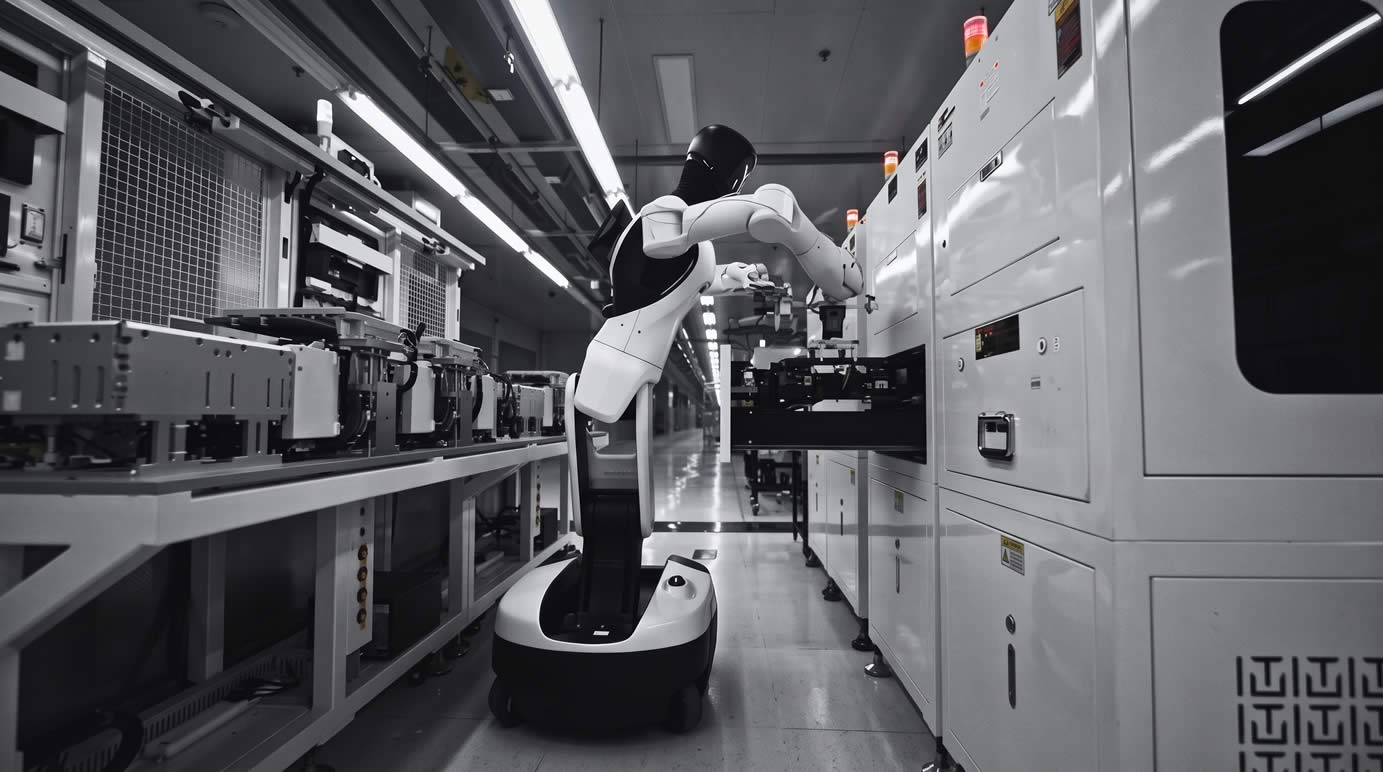
That is the argument behind what happened at JCET’s plant in Lingang, on the southeastern edge of Shanghai, in late November. AgiBot, the Shanghai humanoid manufacturer, put its first batch of G2 robots onto a live test line in the site’s automotive electronics plant. The machines load trays of untested devices, unload them once they are through, and send failures down a separate path. AgiBot says the robots run the station without an operator touching the trays.
A robot that moves a tray is not news. Industrial arms have done that since the 1970s, faster and more repeatably than anything that has to move itself to the work. What makes this one worth a second look is the address. Of all the places in a semiconductor supply chain where a general-purpose humanoid could be sent, AgiBot picked the one with the thinnest margins, the most frequent changeovers, and the highest turnover. Nobody involved is calling it a first. It appears to be the first time a humanoid has been given a production station inside a Chinese outsourced semiconductor assembly and test (OSAT) plant.
The last manual mile
Wafer fabs have spent decades automating the front end, down to wafer transport and material handling, and a modern line runs inside sealed tools. OSAT plants have automated plenty of individual steps too: die attach, molding, the test handlers themselves. What resisted automation is the seam between those steps, where material moves from one machine to the next, trays get loaded and unloaded, and the line is reconfigured because the product changed. Assembly, test, and packing is a business of short runs, odd package shapes, and constant changeover. JCET shipped more than 57 billion chips and devices in 2025. Nobody builds a bespoke cell around a part that sells for pennies.
The seams stayed with people. They gown up, stand at a station for a shift, lift a tray out of a cart, slot it into a handler, watch a screen, pull the tray, sort it, and start again. The trays arrive at chest height because the line was designed around a person’s reach. The cart has a handle because a person pushes it.
AgiBot’s case rests on the factory as it stands, and on the fact that nobody is going to rebuild it. A gantry needs steel bolted to the ceiling. A SCARA arm needs the tray presented at a fixed point in a fixed orientation. A machine the size of a person, with arms on it, can roll to the cart, bend at the waist, and use the interface that is already there. AgiBot did not give the G2 legs, which is a fair indication of how much walking the job involves.
What it has instead is an omnidirectional wheeled base, and a five-joint torso that does the bending and the twisting and can raise the machine from about 1.2 meters to just under 1.8. Each arm carries seven joints. A pair of batteries provides about four hours of runtime and can be hot-swapped, so a spent pack comes out without shutting the machine down. It also returns to a charging dock on its own when it needs to. AgiBot says the components are automotive-grade and the enclosure is rated IP42.
The detail buried in the Chinese coverage says more about the job than the spec sheet does. Chip packages are fragile, and a tray picked up with a little too much vibration lets devices shift in their pockets. A device sitting crooked jams the handler downstream, the line stops, and somebody walks over to clear it. Every one of those jams is unscheduled downtime, and unscheduled downtime on a test line is the expensive kind. Tray handling is the part of the back end that stayed manual longest for exactly this reason.
Four percent
JCET booked RMB 38.87 billion in revenue in 2025, about $5.4 billion, and RMB 1.57 billion in net profit attributable to shareholders. Four cents on the dollar, in a business where advanced packaging capacity is expensive to build and more expensive to keep current.
At that margin, what matters is cost per unit of work, measured against an operator who earns a few thousand renminbi a month. Uptime counts for more than speed here, and so does a changeover that doesn’t need an engineer.
AgiBot has been rehearsing that pitch in public for a while. In April it announced a deployment at Longcheer Technology’s tablet plant in Nanchang, and the figures it published then read like a manufacturing spec sheet rather than a demo reel: a cycle time of 19 to 20 seconds per operation, up to 310 units an hour across the robots installed, better than 99.9 percent success in continuous operation, roughly 3,000 units a shift, and downtime under 4 percent. Fitting the robots into the running line took 36 hours. Li Long, who runs Longcheer’s robotics division, put the wider project at four months in the announcement, saying the G2 was “integrated into Longcheer’s mass production line” and had met “all key targets” in that time. That is a customer speaking in a press release, and press releases are not interviews.
At the bottom of that same release, AgiBot listed automotive, semiconductors, and energy as what came next.
Semiconductors were on that list. Seven months later the robots are in a chip plant. Whatever you make of the timing, the roadmap was not a secret.
JCET’s annual report, published in April, contains a line that reads like advance notice too. The company says it “completed production line readiness at JCET Shanghai Automotive Co., Ltd., supporting automotive-grade and robotics applications.” The Lingang site was being fitted out for robotics customers before anyone announced a robot.
A node in the MES
The technical claim that matters least in the press release and most to anyone who runs a line is that the robots are wired into the plant’s manufacturing execution system (MES) and equipment automation program (EAP). MES and EAP are the layers that tell a tool what to run, in what order, and with which test program.
Connecting a humanoid to them changes the robot’s status. The important change is that the robot now reads the schedule and reports results, which is what makes it part of the line rather than something parked beside it. AgiBot’s framing — no changes to the existing line, one body across multiple lines — only holds up if the robot is scheduled like equipment, and the company says that is what it built.
Being a station also means inheriting a station’s obligations: takt time, yield reporting, traceability, and a qualification file. Automotive-grade parts make that file longer. A chip that ends up in a brake controller carries a paper trail, and the robot now has to be documented in it.
What the spec sheet leaves out
Nobody has published the measurement that would settle the argument the marketing makes.
IP42 describes what the enclosure keeps out — solid objects down to a millimeter, water dripping at an angle. It says nothing about what the machine puts into the air. Then look at the machine itself: 185 kilograms on wheels, cable bundles flexing at every elbow, a torso that telescopes and turns. A person in a bunny suit is a particle source, and so is a machine. Wheels can grind particles off a coated floor, gearboxes can throw lubricant as they warm, and a wrist moving at speed can lift whatever has settled on it. Those are risks that would have to be measured in place, not assumed away.
There is a standard for this. ISO 14644-14:2026 sets out how to assess whether a piece of equipment suits a cleanroom, measured by the particles it puts into the air, and it was written for exactly the things people want to wheel into a controlled environment: robot arms, automated guided vehicles, grippers, linear slides. The Lingang site holds around 50,000 square meters of cleanroom in its first phase, and neither company has said what class the test area runs at. AgiBot’s published specifications for the G2 give a weight, a battery life, an ingress rating, and a compute module. They publish no particle emission profile, and no result showing the machine suits a specified cleanroom environment under 14644-14. No ESD qualification results have been disclosed either, which matters when the machine is handling discharge-sensitive parts in JEDEC trays.
None of that makes the deployment fake. AgiBot calls it a trial, which is the right word. The company has not said how many units are running on that line, and it is one line. Qualification cycles for automotive semiconductor equipment run in months.
The claim that survives is narrower than the one being implied. AgiBot has put a wheeled humanoid through a trial on a live chip test line, which is further than most. Whether it holds takt time, keeps its handling accuracy, and stays inside the site’s particle limits across a real production run has not been disclosed. The company behind it is no longer a prototype shop. AgiBot was founded in February 2023, and Omdia estimated it shipped about 5,200 humanoid robots in 2025. It announced its 10,000th unit this March. Whether the machine belongs in the room, in the sense a contamination engineer means, is still open, and the standard that would settle it has no data behind it yet.
Everyone else went to the car plant
The obvious comparison is with the American programs, and it is instructive mostly for how different the targets are.
Boston Dynamics and GlobalFoundries said on November 17 that they are widening an existing arrangement. Spot, which has been doing inspection rounds in GF’s fabs for several years, is going into sites in Malta, New York; Burlington, Vermont; Dresden; and Singapore. Atlas goes on site at the start of 2027, when the two companies begin testing it and training it for specific tasks, the first time a customer outside the auto industry has taken the biped that far. Hyundai, which has bought out SoftBank’s remaining stake and now owns Boston Dynamics outright, has said Atlas starts on parts sequencing at Metaplant America in Georgia in 2028, moves to assembly in 2030, and that the group wants 25,000 of them across Hyundai and Kia plants. Apptronik’s Apollo 2 has been picking and organizing car parts at Mercedes-Benz, at a 96 percent success rate, using Google DeepMind’s Gemini Robotics 2.5.
Every one of those is a car company, or a chipmaker being asked a car company’s question: can this thing do useful work in a plant we control, staffed by people we employ, on a line we are free to modify? A foundry owns its process. It can move a fixture, re-sequence a station, and draw on an automation group that has been reworking its own lines for years.
JCET can do none of that. It is a contract manufacturer, the third-largest outsourced assembler in the world by market share, and its factory is a shared resource for customers who each want their own tray, their own test program, and their own changeover. The problem is harder than a car plant’s, and the case for a humanoid is stronger. The car plant has already been automated to the point where the jobs left are the awkward ones. The test floor has never been automated end to end, because the economics never closed.
They may be closing now, for reasons the brochure does not mention. The contamination argument is the elegant one: a worker who doesn’t shed skin, doesn’t sneeze, doesn’t lean over the tray. The deciding argument is duller. Back-end labor costs in China are getting more expensive and harder to hold onto, and a plant running two shifts cannot staff itself from a shrinking pool of people willing to gown up for eight hours and lift trays. HT-Tech, one of China’s three largest assemblers, ended 2025 with 33,887 employees on its books. Not all of them touch trays, but that payroll is the scale automation is now aimed at.
The tray comes off the handler and a machine that does not breathe picks it up. Behind a door somewhere, a contamination engineer is waiting on a particle counter and a qualification report, and neither of those will end up in a press release. The robot will get the job. Whether it earned the cleanroom is a question of paperwork, and the paperwork is not in yet.
