

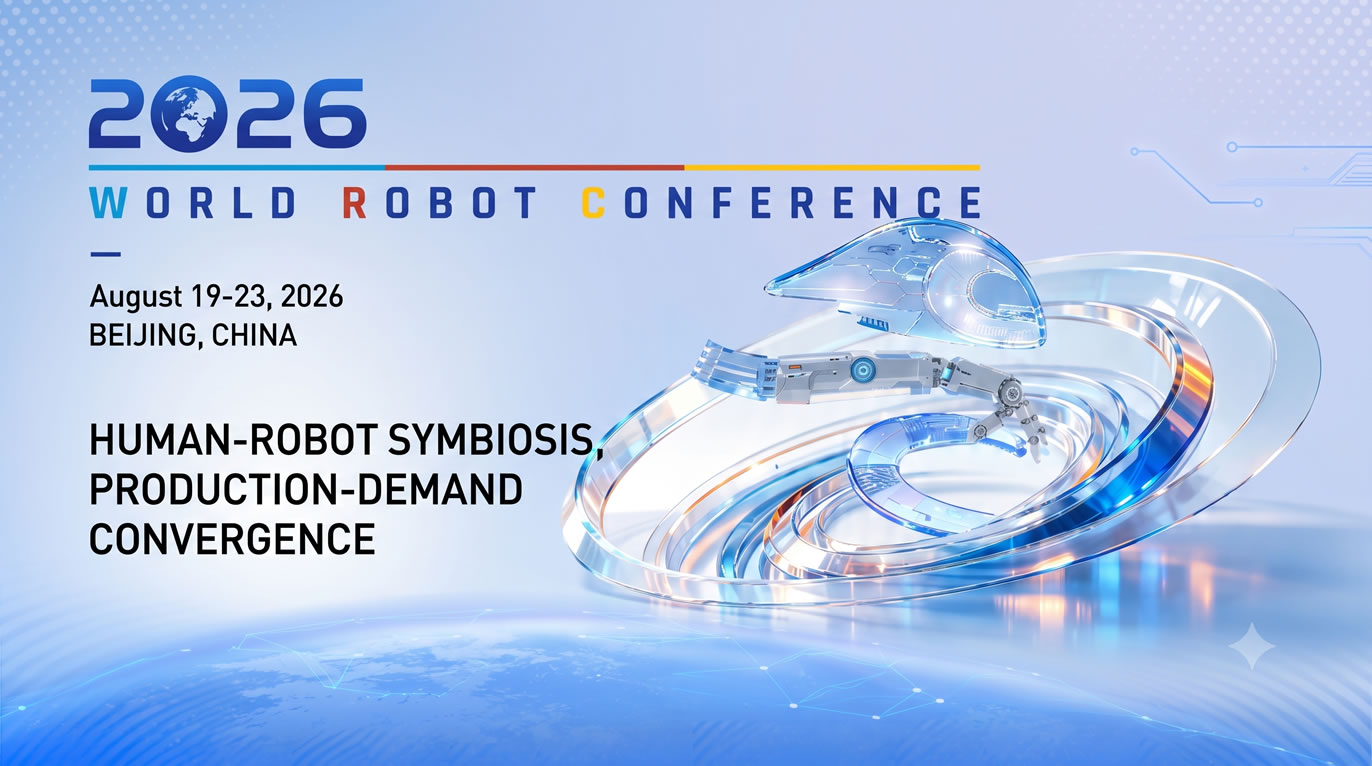

The 2026 World Robot Conference (WRC) is scheduled for at the Beiren Etrong International Exhibition & Convention Center in Beijing’s Economic-Technological Development Area (BDA). Now in its 11th year, the event is co-hosted by the Chinese Institute of Electronics (CIE) and the World Robot Cooperation Organization. This year’s theme focuses on human-robot symbiosis and stronger links between robotics innovation and real-world demand.
More than 300 companies are exhibiting, up 36 percent from 2025, with over 2,000 products on display and more than 150 making their public debut. Nearly 30 international organizations are supporting the conference, including the UN Industrial Development Organization, the International Federation of Robotics, the World Federation of Engineering Organizations, and the IEEE Robotics and Automation Society. International speakers account for 30 percent of the main forum lineup, and the number of concurrent sessions has doubled from last year’s level to more than 60.
The scale of this year’s event reflects how quickly China’s robotics sector has expanded. According to CIE chairwoman Xu Xiaolan, China has been the world’s largest industrial robot market for 13 consecutive years, with domestic brands now holding more than half of the local market share. Revenue for major robotics enterprises exceeded 90 billion yuan ($13.26 billion) in the first five months of 2026, up 26.9 percent year-on-year, with average annual growth above 20 percent over the past five years.
In humanoid robotics, the country has developed a broad and increasingly integrated supply chain covering materials, core components, system integration, commercial deployment, and data services. Industry estimates suggest that Chinese manufacturers accounted for a significant share of global humanoid robot shipments in 2025. Beijing’s own robotics sector grew from 15 billion yuan in 2023 to 51.8 billion yuan in 2025—an annual compound growth rate above 85 percent.
Looking back at the conference’s first edition in 2015, it had fewer than 100 exhibitors, depended heavily on imported core components, and drew about 50,000 in-person attendees. Last year’s event attracted 220 companies, 1,569 exhibits, and 271,000 in-person visitors, with online participation reaching 52 million.
Beyond Robot Demonstrations: WRC Targets Real-World Deployment
For the first time, the conference is organized around four thematic days: as Launch Day, as Procurement Day, as Developer Day, and as Public Open Days. The idea is to provide different stakeholders with tailored access to the event.
The expo floor is split into four halls: Innovation, Integration, Manufacturing, and Lifestyle. The Innovation Hall is new this year, covering 20,000 square meters, and will house most of the humanoid robot manufacturers. Confirmed exhibitors and key industry players include Unitree Robotics, UBTECH Robotics, Galaxea AI, Galbot, X Square, Vbot, SmartBody Technology, Deep Robotics, Fourier Intelligence, DOBOT, SEER, CASBOT, Booster Robotics, EngineAI, Robot Era, SIASUN, Leju Robotics, Noetix Robotics, Spirit AI, PaXini, HCFA, LinkerBot, Tashan Technology, LimX Dynamics, MagicLab, Kepler, Beijing Humanoid Robot Innovation Center, and AI² Robotics.
Unitree is expected to draw significant attention. The company’s GD01 bipedal-quadruped robot—which debuted at WAIC 2026 in Shanghai in July—may appear again, though the company could bring something newer given the 150-plus product launches expected across the conference. Unitree recently deployed its industrial-grade embodied AI model UnifoLM-X1-0 for precision motor assembly at its manufacturing facility. Galaxy General, which has reportedly reached a valuation of around 20 billion yuan, focuses on wheeled dual-arm robots for retail, warehouse, and factory environments. Its Galbot G1 demonstrated long-horizon breakfast preparation tasks under disturbance at WAIC, handling interrupted actions such as removing bread and responding to unexpected object movements.
Two structural additions stand out. For the first time, a dedicated delegation of central state-owned enterprises (SOEs) will exhibit—49 SOEs across 12 application scenarios, showcasing robotics deployment in state-owned industrial operations. The State-owned Assets Supervision and Administration Commission (SASAC) will also announce the formation of the Central Enterprise Robot Innovation Consortium at the conference.
Perhaps the most unusual initiative this year is the Global Robot Application Exploration Program, which provides commercially available robotic products—humanoid robots, quadruped robots, dexterous hands—to outstanding global innovation teams for trial use at no cost. The program is designed to connect supply with early-stage R&D teams that might not otherwise have access to production-grade hardware.
Away from the main exhibition halls, the conference is introducing a robot-themed consumer street for the first time—a space where visitors can interact with robotic chefs, servers, and other service robots in a “technology + food + culture” setting. Robotic chefs will prepare WRC-branded meals on-site. Organizers have also deployed robots across greeting, reception, security screening, wayfinding, and disinfection throughout the venue. A humanoid robot full-lifecycle management platform will track robot behavior across the event.
The main forum runs from the afternoon of through . Topics are organized around four pillars: frontier technology leadership, application-driven development, ecosystem co-building, and inclusive public benefits.
The 60-plus concurrent sessions cover more specific ground. One session, hosted by the Beijing Academy of Artificial Intelligence, focuses on brain-inspired computing, AI chips, and neuromorphic interaction—areas the academy describes as fundamental technical bottlenecks for robotics development. Another, organized by the International Society of Bionic Engineering, will debut the Yuequan Bionics bionic tension-compression Y-Hand and humanoid robot series. A third session, hosted by the Ministry of Industry and Information Technology’s SME Development Center, targets commercialization pathways across industrial manufacturing, commercial services, and home care—framing 2026 as the year humanoid robots move from technical verification to mass production.
The 2026 World Robot Competition Grand Final will run alongside the conference, bringing together more than 10,000 competitors from over 20 countries, representing more than 6,000 teams.
WRC 2026 arrives at a critical stage for the robotics industry. After years of rapid technical progress, the sector now faces a harder question: which applications will generate sustainable revenue and at what cost. The participation of 49 central SOEs suggests that state-owned industrial capacity could serve as an early deployment environment, while the application exploration program signals a bet on early-stage innovators and smaller R&D teams. WRC 2026 will likely be judged less by the number of robots on display than by the number of companies willing to put them into real operating environments. For international robotics companies and investors, the key question is no longer whether these machines can demonstrate impressive capabilities, but whether they can deliver enough value to support large-scale adoption. The exhibition floor opens in three weeks.
For a detailed breakdown of the four exhibition halls, key exhibitors and visitor routes, see our [WRC 2026 Visitor Guide].
