


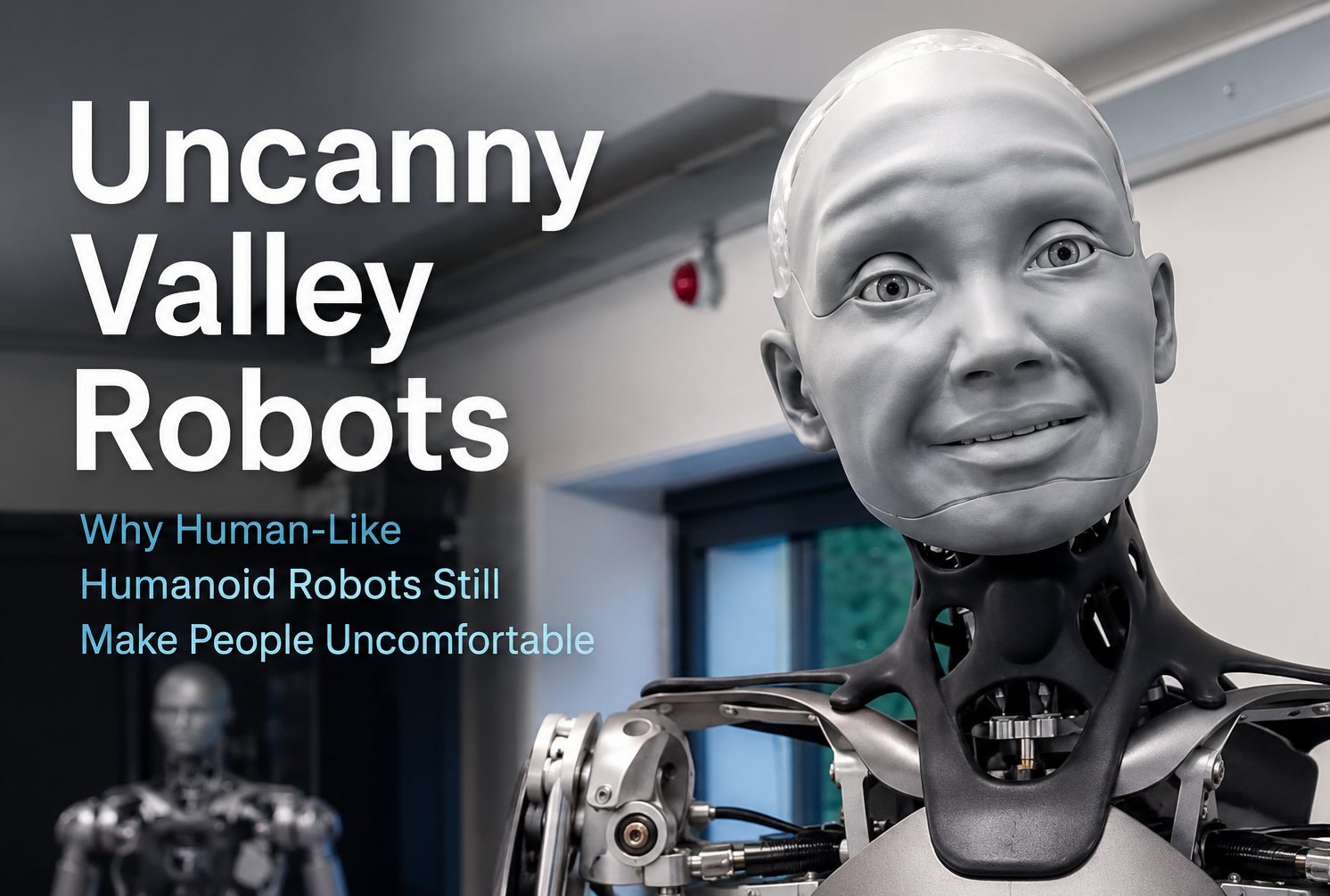
That impression does not last once the robot becomes too human. A human face, skin, eyes, or natural-looking movement changes how every detail is perceived.
A slightly stiff smile, an off-timed blink, an empty stare, or a walk that is almost human but not quite will suddenly stand out. The closer a robot gets to human appearance, the less forgiving people become toward its imperfections. This shift in perception is known as the uncanny valley.
The term was introduced by Japanese roboticist Masahiro Mori in 1970. It describes a pattern where human-like figures become more acceptable as they grow closer to human form, until they reach a point where they are almost human but still noticeably artificial. At that stage, comfort drops sharply.
A face that is 80 percent human may feel easier to accept than one that is 98 percent human with dead eyes.
Why Some Humanoid Robots Feel Uncanny
Facial features that look slightly off
The smallest inconsistency in a smile or a delay in blinking can shift perception immediately. As human-likeness increases, people become more sensitive to tiny deviations in facial behavior.
Mechanical movement patterns
A robot may appear natural at first glance, but motion often reveals the gap. Overly precise walking, rigid hand movement, or delayed head turns can expose the underlying mechanics of the system.
Mismatched non-verbal signals
Human communication relies heavily on alignment between expression, tone, and timing. When a robot maintains eye contact too long or smiles without emotional timing, the interaction feels inconsistent.
Lack of emotional grounding
A simple robot smile can feel friendly. A human-like face without emotional depth feels different. When appearance becomes highly realistic, people expect intent, awareness, and emotional presence behind every expression.
Moya and the Edge of the Uncanny Valley
Moya, developed by Shanghai-based DroidUp, is described as a fully biomimetic embodied intelligent robot. It features a humanoid face, eye contact, blinking behavior, facial expressions, and micro-expressions. The robot stands at around 5.5 feet tall and weighs approximately 70 pounds.
Its artificial skin is reported to maintain a temperature between 32–36°C, close to human body warmth. According to developer claims, Moya can also achieve walking accuracy of around 92% in human-like motion patterns.
These design choices aim to reduce psychological distance. A warmer surface, softer facial behavior, and familiar proportions are intended to make interaction smoother and more intuitive.
Public reactions, however, remain divided. Some users describe the robot as highly advanced and realistic. Others react with discomfort, comparing it to characters from dystopian fiction. One comment even referred to it as a “walking ghost.”
Extreme reactions aside, the underlying response is consistent: when a robot enters human-like space without fully achieving natural presence, emotional tension increases. It becomes harder for people to categorize what they are seeing.
Will the Uncanny Valley Disappear?
The uncanny valley may soften over time, but it is unlikely to disappear entirely.
Technical improvements can reduce friction. Better blinking timing, smoother speech synchronization, and more adaptive facial movement will make robots feel less rigid and more responsive.
Still, simulation has limits. A robot can reproduce emotional signals without experiencing them. It can mimic attention without awareness. As realism improves, the gap between appearance and inner state becomes more noticeable rather than less.
This is why some designs move in a different direction. Instead of fully human-like appearance, robots with clearly artificial faces or mechanical structures reduce expectation mismatch and avoid emotional over-interpretation.
Over time, familiarity will also reshape perception. As robots appear in stores, factories, hospitals, and public spaces, their presence becomes routine. Repetition reduces surprise, and function replaces curiosity.
However, in intimate settings such as homes or eldercare environments, the challenge remains more complex. Proximity, privacy, and emotional context intensify human sensitivity to appearance and behavior.
The uncanny valley will likely be managed rather than eliminated. Improvements in motion design, interaction logic, and visual identity will gradually narrow the gap between human expectation and machine behavior, without fully removing it.
