



Global humanoid robot shipments reached roughly 19,100 units in the first half of 2026, more than triple the figure from a year earlier, according to Smart Analytics Global (SAG). Chinese manufacturers accounted for more than 97% of global shipments.
The figures point to a market moving beyond lab demonstrations and trade-show prototypes toward commercial deployments. In 2026, the focus has shifted toward mass production and real-world use.
AgiBot and Unitree Lead Global Shipment Rankings
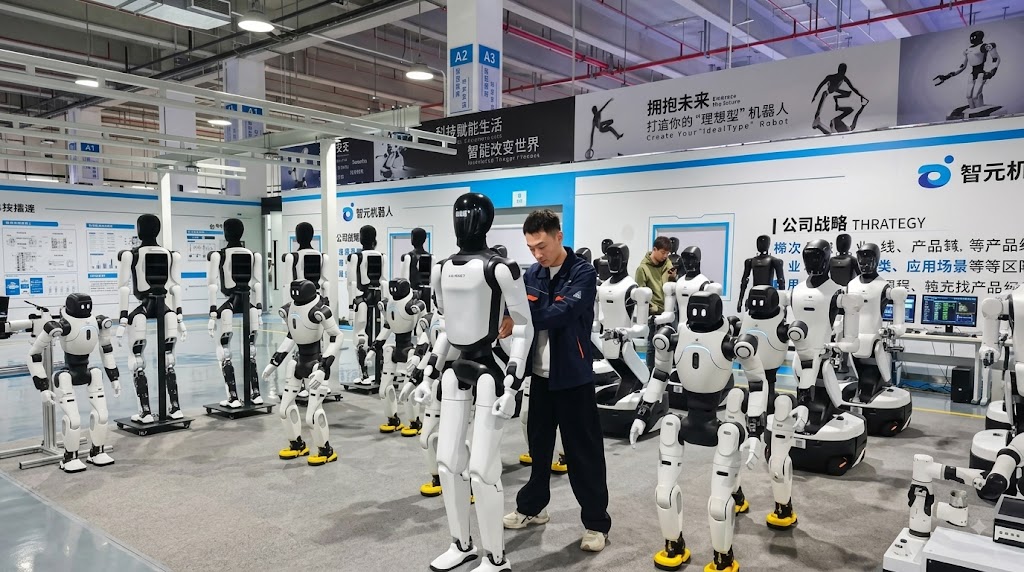
Chinese manufacturers hold a clear lead. Shanghai-based AgiBot shipped about 8,400 units in the first half, accounting for roughly 44% of global shipments. Hangzhou’s Unitree followed with about 5,900 units. Together, the two companies accounted for about three-quarters of all humanoid robots shipped worldwide during the period.
By comparison, U.S. humanoid robot makers such as Tesla, Figure AI and Agility Robotics remain at earlier stages of commercial deployment. Their publicly reported shipment volumes remain far behind those of their Chinese competitors.
This gap did not appear overnight. In the full year 2025, Chinese humanoid robot shipments totaled about 14,400 units, or 84.7% of global shipments, with the top six vendors all based in China. By the first half of 2026, China’s share of global shipments had climbed above 97%.
Over 70% of Shipments Now Headed to Industrial and Commercial Use
Humanoid robots are now moving into more real-world settings. More than 70% of humanoid robot shipments in the first half of 2026 went to industrial and commercial applications, up from about 50% a year earlier, according to SAG. Demand is shifting from R&D pilots to actual work on factory floors, in logistics and in business services. In China, AgiBot has begun exploring manufacturing applications, while Unitree’s humanoid robots are used in scientific research, education, inspection and other fields.
Why China’s Supply Chain Matters
A big piece of the story is the supply chain. Humanoid robots are not a pure software product. Commercial success depends just as much on hardware manufacturing, supply chain management and the ability to scale. Over the past several years, China’s expansion in electric vehicles, industrial robotics and smart manufacturing has given humanoid robot makers access to an established supplier base. Many component makers already have experience with mass production, which helps robot makers iterate designs faster while keeping costs down. China’s Ministry of Industry and Information Technology (MIIT) says more than 400 humanoid robot products have been developed in China, accounting for more than half of the global total.
U.S. Companies Push Toward Commercial Deployment
U.S. companies remain active in robot software, AI models and advanced robotics research. Large-scale manufacturing and commercial delivery, however, are at an earlier stage. Tesla, Figure AI and Agility Robotics are also working toward commercial deployment, but their reported shipment volumes remain well below those of the leading Chinese companies.
The Market’s Next Phase
The market is still in its early days. SAG forecasts that full-year 2026 global humanoid robot shipments could reach about 60,000 units, growing to 500,000 units by 2030. As the market expands, the basis of competition is likely to move beyond unit numbers and toward reliability, software quality, AI capability and measurable returns.
The industry also faces regulatory and geopolitical pressure. The SAG report notes that regulatory uncertainty and geopolitical factors could reshape the market. Recently, the U.S. Federal Communications Commission proposed new rules targeting certain foreign-made advanced robotic devices, raising questions about future market access across borders.
The shipment data points to a change in what matters most. Technical demonstrations still attract attention, but production capacity, deployment and operating performance are becoming harder to ignore. China’s manufacturers have taken the lead through manufacturing scale, a well-developed supplier base and rapid commercialization. But with continued investment from the U.S., Europe and Japan, the race is far from settled. For the whole sector, long-term winners will not simply be the ones with the highest shipment figures today, but those that can turn humanoid robots from test devices into everyday production tools.
*Data sources: Smart Analytics Global (SAG), H1 2026 Global Humanoid Robot Market Tracker; China Ministry of Industry and Information Technology.
