

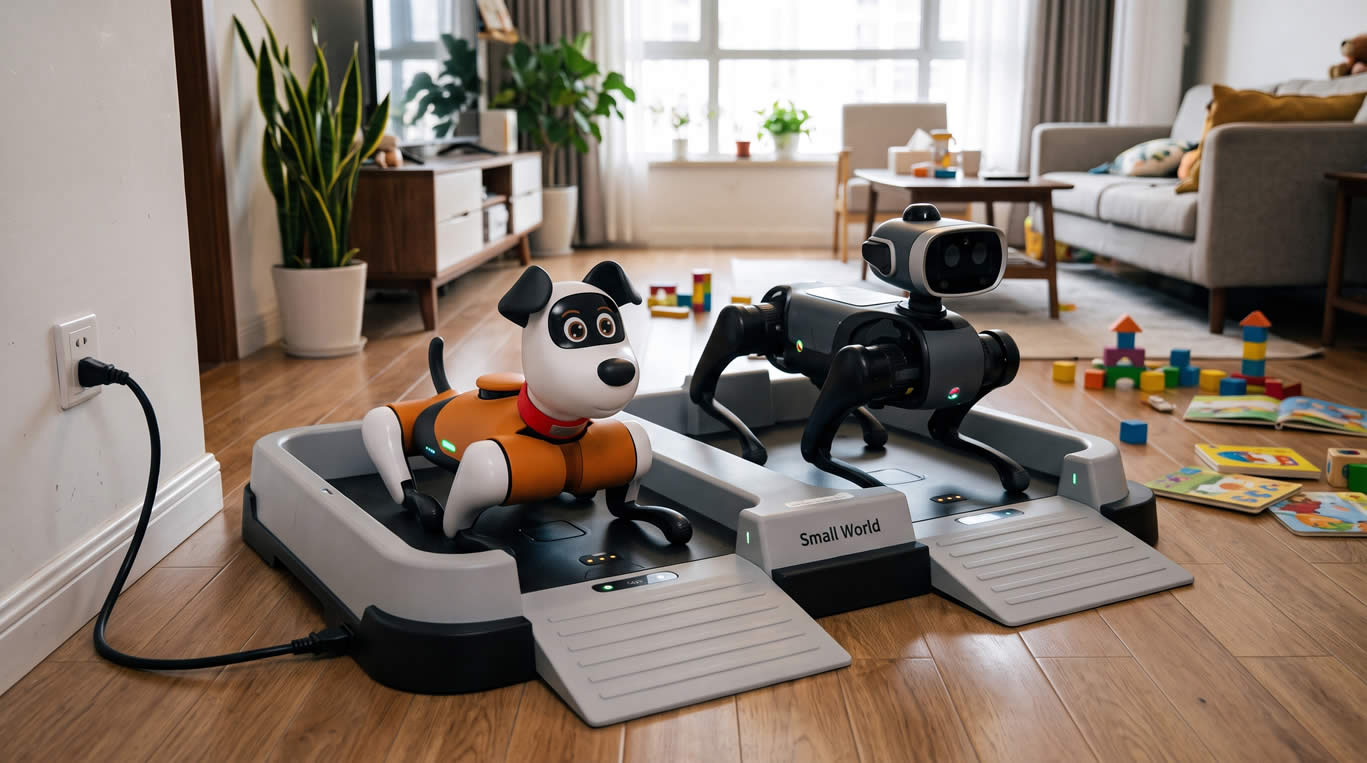
The dock is the part that rarely makes the promotional video. Weilan sells an enclosure called “Small World” as an accessory, a resting space and charging station for the BabyAlpha that covers about 11 square feet of floor. The dog plays inside it. It charges inside it. It never needs anyone to hunt for a cable. It is also an admission, written into the accessory list: this animal cannot be left to its own devices for very long.
Weilan says it has sold more than 25,000 BabyAlpha units across 295 Chinese cities, with roughly nine in ten going to households rather than labs, schools or showrooms. That last figure is the one worth sitting with. For much of the past two decades the robot dog’s public image was that of a demonstration — a hydraulic pack mule climbing a snowy slope on DARPA’s dime, a fifteen-second clip of a backflip that circulated on every tech site for a week. Sometime in the past three years it turned into an appliance that parents buy for their children and then review, at length, on e-commerce platforms.
The machine most Western readers picture when they hear “robot dog” is still the other kind. Unitree’s Go2, launched in July 2023 from 9,997 yuan (about $1,400), is a four-legged sensor platform with a 4D lidar sensor, a remote range of about 100 feet in line of sight and a repertoire of tricks. It is a wonderful thing to own if you like robots. It is not a thing you buy instead of a dog. Chinese companies have spent the same three years building the version you buy instead of a dog, and they have been unusually literal about it.
What made that possible was not a breakthrough in legged locomotion. Boston Dynamics had already shown how capable a legged machine could be. DARPA funded the BigDog program from 2005, and the machine went on to trot at 4 mph, climb a 35-degree slope and carry 340 pounds, all of it driven by a two-stroke engine and a hydraulic system. It was also loud, heavy and expensive to build. Hydraulics are costly to machine and costly to seal, and they do not scale. The economics moved as electric actuators displaced hydraulic ones across a growing range of quadruped designs, and as motors, gearboxes, sensors and batteries improved alongside a deeper Chinese component supply chain. No single invention did it. Every product in this article sits downstream of that long, unglamorous cost curve.
The industrial buyers noticed first, and for a dull reason: the math changed. Once the hardware got cheap enough to risk, utilities, fire departments and security contractors could justify buying them in fleets rather than renting one for a demo. That volume pays for the tooling, and the tooling is what makes the consumer version cheap.
Ten voices and a schedule
The BabyAlpha line launched in December 2023 at a price the company likened to buying a phone, and it has been iterating on the pet metaphor ever since. Weilan advertises ten voice options, six preset personalities with their own hobbies, and a face that can produce close to a hundred expressions. The body has an actual tail. The head is shaped, unapologetically, like a dog’s.
The more interesting design decision sits underneath the cosmetics. A BabyAlpha runs its own day. It wakes up on a schedule, mimes brushing its teeth, eats, reads, plays a game, and puts itself to bed. Nobody commands it to do any of this. That is a strange thing to build into a consumer product, and it is the clearest signal of what these companies think they are selling.
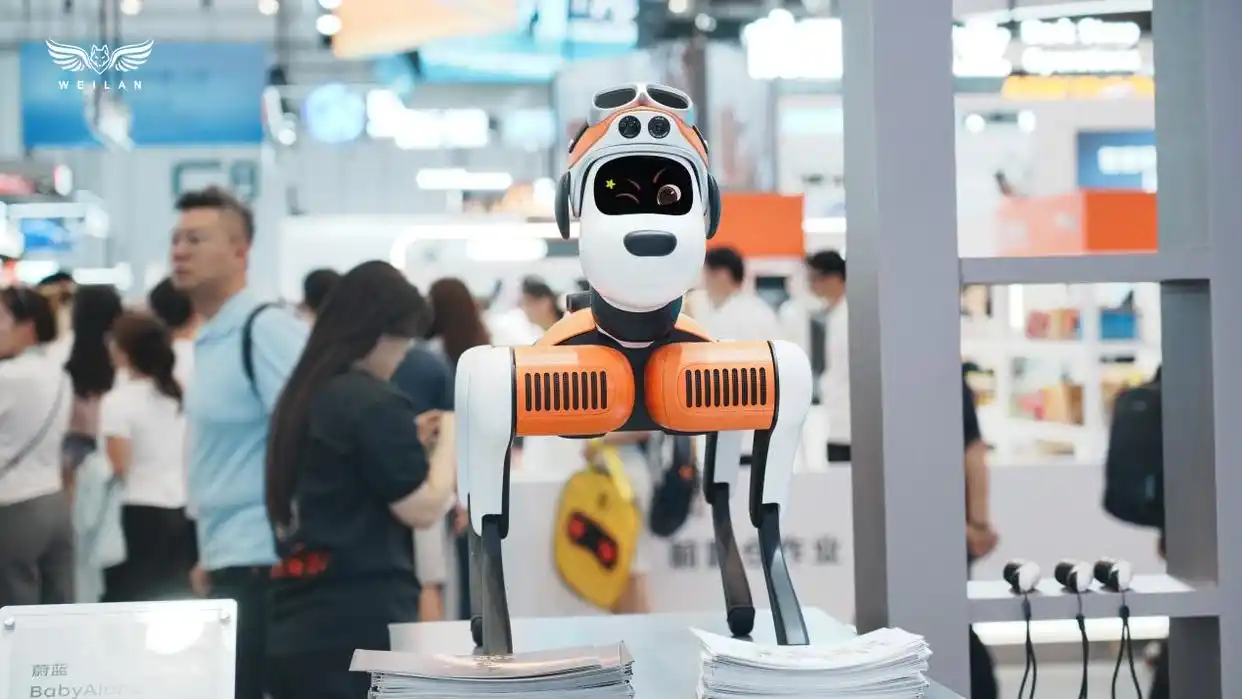
The BabyAlpha A3, unveiled in May 2026, pushes the same idea further into the silicon. Weilan says it runs a seven-billion-parameter multimodal model locally, on a mixed cluster of six Chinese-made chips. Local inference matters more here than it does on a phone. Core interactions should survive a dropped Wi-Fi connection, which reduces the pet’s dependence on a server the company has to keep paying for. How much of the full feature set still needs a connection is unclear.
Vbot, a Beijing startup founded in late 2024 by former executives of Horizon Robotics and Li Auto, took a blunter route. Its first consumer product, Datou BoBo, went on sale last December at 12,988 yuan (about $1,800), discounted to 9,988 (about $1,400), and its headline claim was the absence of a controller. No remote. The dog decides where to go. Vbot’s published figures put its top speed at 8.3 mph, a respectable clip for something with four legs and no leash, with a maximum payload of about 26 pounds and a quoted towing capacity of 220 pounds — enough for a small camping trailer, which is exactly the use case the company demonstrated.
Vbot says its initial presale generated 6,540 orders, and that 86 percent of buyers were still using the robot two weeks later. Two-week retention is not a metric that hardware companies used to publish. It is a metric that app companies publish, and its appearance here tells you where the business logic has moved. A novelty robot gets unboxed, filmed, and shelved. A pet gets used on a Tuesday.
Four hours, if you’re lucky
The reason that dock exists is the same reason the pet framing has not fully landed: the power budget.
Runtime is the constraint nobody has engineered around. The first generation of sub-10,000-yuan machines ran for one to two hours. Figures for current models are all over the map — manufacturers quote anything from about an hour to four or more, depending on the model and how hard the dog is working — and every one of those numbers comes from the company selling it. Weilan’s answer is to make charging part of the fiction: the dog returns to its pen the way a real one returns to its bed.
The economics around repair may prove harder than the battery. Warranty terms vary by manufacturer and model, and the cover is short. After it lapses, service runs through the original vendor, and public information on third-party parts and independent repair is thin. A child’s pet with a failed knee joint can become a very expensive ornament.
This is the part where the industry’s own marketing has worked against it. The gap between a robot that runs a few hours and needs a dedicated charging pen and the animal it is modeled on is the thing a buyer notices in month two, not month twelve. Companies that manage that expectation honestly, and say plainly that this is a companion that runs a few hours a day and sleeps in a box, will keep their customers. Companies that let the advertising imply otherwise will keep getting one-star reviews from people who feel misled, and the category will inherit a reputation it does not deserve.
A camera on legs
There is a second cost to putting a camera and a microphone on something that lives in a child’s bedroom, and the industry has already had its warning.
In September 2025, security researchers disclosed a set of flaws in the Bluetooth Low Energy Wi-Fi provisioning interface used across several Unitree models — the Go2 and B2 quadrupeds and the G1 and H1 humanoids. The bugs included hardcoded encryption keys, an authentication bypass and a command injection path, and together they allowed an attacker within radio range to take root-level control of the machine. The technique was nicknamed UniPwn. Unitree said in a statement on September 29 that it had “completed the majority of the fixes” and that the updates would roll out shortly, but the episode established something the marketing departments would rather not discuss: a robot dog is a networked computer with legs, a camera, and a microphone, and it is sitting on the floor of a home.
Sony ran this experiment once already. The original AIBO arrived in 1999 at $2,500 and sold out its first production run. Sony stopped making it in 2006, which raised the question that still hangs over the category: what happens to owners who have bonded with a machine that can lose access to parts and support? The 2018 revival cost $2,899 and came bundled with a cloud plan, which means the pet’s personality and learned behaviors depend on a subscription and a server farm that Sony has not promised to run forever. Aibo owners have watched a product they loved get orphaned once. The pet framing turns a hardware purchase into a long-term relationship, and relationships have obligations on both sides.
The Chinese entrants have an advantage Sony did not: they can run the model on the device. Weilan’s local-inference bet may be an attempt to make the pet outlive the subscription. It is also a hedge against the possibility that nobody in this category has figured out the recurring-revenue model yet.
Two buyers, one chassis
The odd thing about this market is that the same machine is being sold twice, to two people who want opposite things from it.
One buyer wants a companion: something that responds, has moods, and makes a seven-year-old shriek when it walks into the room. The other wants a pack animal with a battery: something that follows you on a trail, carries the water, and can be programmed to run a patrol route around the house. Both are legitimate, and both are served by the same four legs and the same lidar. Several of the machines now ship with block-based and text-based programming modes pitched at children, which quietly turns the pet into a robotics curriculum. Parents who bought it for the companionship end up using it for the coding lessons; buyers who wanted a mule discover their kids have adopted it.
The ambiguity sells machines and complicates support. It widens the addressable market and muddies every review, because the person writing one may have wanted a pet and been sold a tool, or the other way around.
China first
Here is the awkward part for anyone reading this in Ohio or Manchester. China is the strongest early market for robot dogs built around companionship, but the category is no longer confined to Chinese households. Vbot has started building an overseas distribution network; how deep its local service, spare-parts and repair coverage goes is a separate question.
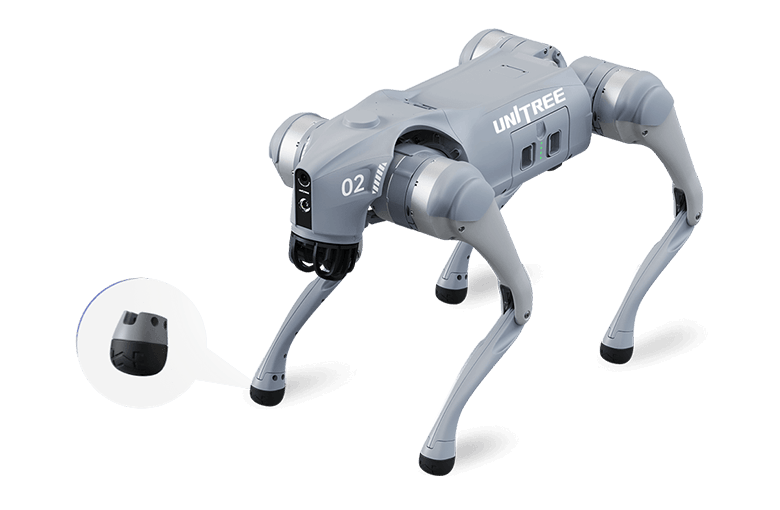
Unitree’s Go2 is available internationally and remains the default recommendation for Western buyers, which is a little like recommending a Jeep to someone shopping for a Labrador. Dobot, the Shenzhen maker best known for collaborative arms, launched a home quadruped of its own, the Rover X1, in November 2025, and it appeared at CES in January 2026, though the company’s business is still built on industrial automation. Vbot showed Datou BoBo at the same show and made its European debut at IFA in September. There it said it had signed purchase agreements with 16 international partners covering more than 5,000 units, and that cumulative global sales had passed 13,000 across 15 countries and regions. Those are the company’s own figures, and signed agreements are not delivered robots. It is still unclear whether a controller-free dog translates to a market where few consumers have encountered one on a sidewalk.
The clearest pitch to Western buyers comes from the newest and smallest company in the group. Lumisition Robotics, founded in Shenzhen in February, raised roughly 50 million yuan in angel funding in July on a thesis that reads like it was written for a suburban driveway: a four-legged all-terrain platform for owners of detached houses, outdoor athletes, and older people who need a hand carrying things up a slope. The company has said it plans to show product at CES 2027, which is now only weeks away. Whether anything ships after the show is another matter. The graveyard of CES promises is crowded, but the targeting is instructive. Lumisition’s bet is that at least part of the American market wants a machine that earns its keep before it wants one that nuzzles.
Which may be the most honest read of where the category actually stands. The pet model is still China-led, built on dense apartment living, a supply chain that has pushed component costs down fast, and a retail culture that puts a robot dog next to the washing machines. JD.com signed Weilan in 2024, and the company now runs a store in a Nanjing mall.
The machine in the corner of the room is doing something remarkable. It has a face, a routine, a voice, and a bed it returns to on its own. It also has a battery that lasts a few hours at best, a warranty that runs out in a year, and a camera and microphone attached to a system that researchers once took over remotely. The distance between those two descriptions is where this market will be decided, and no one has shipped the product that closes it.
