

The shareholder register of Xixuan Chuangzhi Technology reads like a compromise, and that is roughly what it is. MetaX, the Shanghai GPU designer, holds 35.01 percent. UBTech, the Shenzhen humanoid maker, holds 35.01 percent. A third, Fenglong, holds 4.7 percent; three vehicles hold the rest.
Fenglong makes parts for lawnmowers. UBTech agreed in December 2025 to buy 43 percent of it for 1.665 billion yuan, and the shares that gave founder James Zhou control changed hands in March.
So the symmetry is decorative. The two parents are equals on the cap table. In practice the UBTech side controls 39.71 percent, a fact that appears in no press release and does some work later in this story.
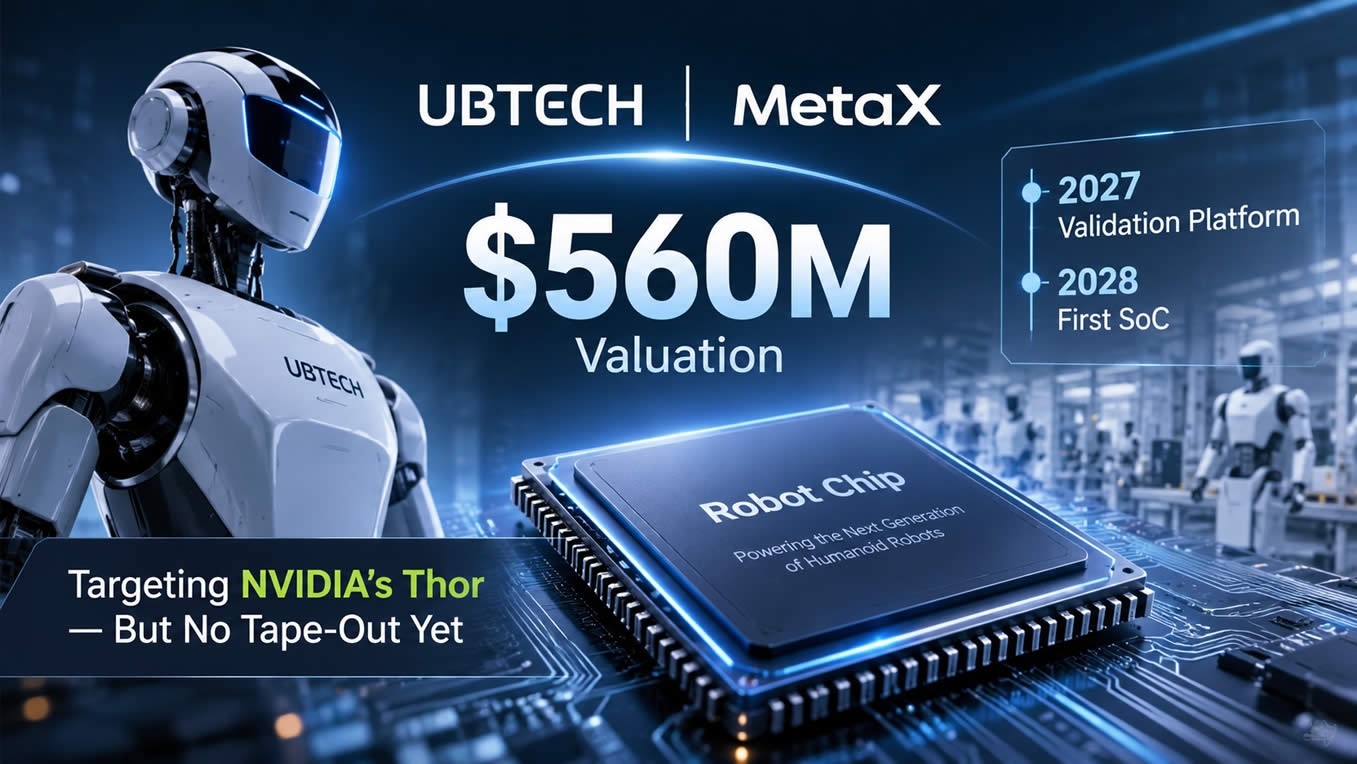
On November 12, Xixuan Chuangzhi said it had closed a 500 million yuan angel round, about $70 million, at a post-money valuation of 4 billion yuan. Call it $560 million, which means the new money bought 12.5 percent of the company. Xixuan was incorporated in May. It has no product, no revenue and, according to Chinese tech press reports this week, no completed tape-out — the step that sends a finished design to a foundry.
It does have a target. Its stated research goal is to beat NVIDIA’s Thor across the board.
The round, and what it is meant to buy
Jiyuan Capital, the RMB fund that split from GGV in 2024, and Matrix Partners China co-led the round, with eight more firms following, among them SAIC’s Hengxu Capital. Xixuan says the proceeds go to chip and platform development, a software toolchain, hiring and joint validation work with robot makers.
The schedule calls for a validation platform for industry partners in 2027, and the first SoC, with a complete embodied-intelligence solution around it, in 2028.
The roster is not what an angel round usually buys. MetaX’s founder, Chen Weiliang, is chairman; Zhou is vice chairman. The chief executive is Yang Xianbo, until recently a senior vice president at H3C, the enterprise networking and server vendor. The CTO is Li Zhaoshi, who holds a doctorate in integrated circuits from Tsinghua and came out of MetaX’s research arm. The hardware vice president has taken several general-purpose GPU designs through tape-out.
The group knows how to build silicon. Nobody in it has shipped a chip into a robot at volume, and the distance between those two facts is most of the next two years.
One chip for the thinking and the flinching
The phrase Xixuan uses for its first part is “brain and cerebellum in one” — a single SoC that runs both the slow loop and the fast one. The slow loop is perception, planning and a vision-language-action model, ticking at something like ten hertz. The fast loop is joint control, running a thousand times a second or more, where a late answer is a fall.
NVIDIA’s Thor does the first job and, by convention, leaves the second to a microcontroller sitting next to it. The T5000 module, generally available since August 2025, carries 2,070 sparse FP4 teraflops, 128 gigabytes of LPDDR5X and a 40-to-130-watt power envelope, and NVIDIA lists it at $4,999 in thousand-unit quantities. AgiBot’s G2, a 408-pound wheeled industrial humanoid launched in October 2025, runs one.
Collapsing both loops onto one die is an old idea with a new economic case. Fewer parts, one power budget, one thermal design, no round trip across a bus between the part that decides and the part that moves. It is also why the claim needs care: a language model and a control loop that must never miss a deadline make hostile roommates on one die. The model wants memory bandwidth and does not care when it gets it. The control loop cares about nothing else. Deterministic latency, lockstep cores and functional safety are the hard part here, not peak throughput, and Xixuan has published numbers for none of them.
Nor is the idea unique to this company. D-Robotics, the Horizon Robotics subsidiary, sells an RDK S100 developer kit that it markets as putting planning and motion control on a single SoC. At least one humanoid program has gone the opposite way, splitting high-level planning and real-time control across two separate processors on purpose.
What Xixuan has not published is a single number, or any indication of which Thor variant it means: no teraflops, no process node, no power target, no benchmark. That goal is a line in a research plan. It is not a specification, and the gap between the two is where this story actually lives.
Why a robot maker stops buying its brain
UBTech’s own purchasing history explains the decision better than any strategy deck. Its Walker X used two Intel i7-8665U processors and a GeForce GT 1030. Its Walker Tienkung, the research humanoid it sells to universities, has shipped with Jetson AGX Orin modules rated at 275 TOPS in the 64-gigabyte version. For a decade the company bought general-purpose compute and built a robot around whatever tradeoffs came with it.
Those tradeoffs have started to hurt. A humanoid has a fixed battery and a fixed surface area for heat, and both are smaller than a car’s. High compute at sustained load runs into a thermal wall; pushing the same work to the cloud runs into a latency wall. A module designed for a dozen customers cannot be optimized for one robot’s sensor set, and its roadmap belongs to somebody else.
Zhou’s version of the argument is narrow and credible: bring the requirements from robot development and deployment into chip design earlier, then validate against real tasks rather than benchmarks. Chen’s is about the cloud-edge split — training and simulation in the data center, inference on the body, one software stack across both.
The commercial bet underneath is not really about silicon. Xixuan says its compute core is a general-purpose GPU, with a CUDA-like programming model and a toolchain built so that models already written for NVIDIA hardware can move over without a rewrite. That is a software promise, and software promises are where Chinese GPU companies have historically lost customers. If porting is cheap, the chip has a market. If it is not, a cheaper module with a familiar stack wins regardless of what the die can do.
The 2028 problem
NVIDIA shipped Xavier in 2018, Orin in 2022 and Thor in 2025. Roughly a three-year cadence, each generation resetting what a robot’s brain costs per teraflop.
A chip that reaches customers in 2028 will not be competing with the Thor on sale today. It will be competing with whatever NVIDIA is shipping then, designed on a newer node, with two more years of software behind it. None of that makes the plan wrong. It makes the comparison wrong. A 2025 spec sheet is not the yardstick, and “surpass Thor” is doing less work than it appears to.
The fab is the constraint nobody in the announcement mentions. Under current export controls, a Chinese robot SoC at an advanced node will almost certainly be built at a domestic foundry, and China’s leading-edge capacity trails TSMC by roughly two generations. A design team can close a logical gap with architecture. It cannot close a process gap by trying harder, and a chip that spends its power budget compensating for an older node has less left over for the thing it was built to do.
The schedule itself is tight. When the venture was announced in June, the plan was tape-out in the second half of 2027 and volume production in 2028. Bring-up, qualification and a production ramp typically take 18 months to two years, and that assumes the first silicon works, which is not the usual outcome. The plan leaves very little room for a respin — and a respin is the most ordinary event in this industry.
A second constraint gets less attention. Qualification can take a year or more, because changing the compute under a robot means re-validating every model, every sensor path and every safety case. UBTech is the obvious first customer, which guarantees the part a home and little else. A valuation of 4 billion yuan needs outside buyers, and outside buyers are exactly the ones with the least appetite for re-qualification.
Forty times the registered capital, and no gain to book
Here is where the 4.7 percent matters.
UBTech holds 35.01 percent of Xixuan directly and controls another 4.7 percent through Fenglong. The group’s stake is 39.71 percent. The portion attributable to UBTech’s own shareholders is 37.03 percent, because most of Fenglong’s slice belongs to Fenglong’s minority investors. At the round’s price, that interest is worth about 1.48 billion yuan, or $208 million, against roughly 37 million yuan of registered capital behind it. Forty times, on a company that has not taped out.
It will not appear in UBTech’s income statement as a gain. If Xixuan is treated as an associate — the likely reading, since MetaX’s founder chairs it and neither parent controls the board — the stake sits under the equity method, carried at cost plus UBTech’s share of profits. A rising valuation is a fact about the market, not about the income statement, until there is an exit or an impairment test. If the chip slips two years, the same accounting rule points the other way.
The valuation itself deserves a caveat. It was disclosed by UBTech and reported widely in the Chinese financial press on November 12. No announcement of the round appeared in Hong Kong exchange records that we could locate, and the 4 billion figure has not been reconciled against a filing from either listed parent. The register is public, and more complete than most coverage suggests: business-registry data from June lists six holders, the two parents at 35.01 percent each, Fenglong at 4.7, and the remaining 25.28 percent split between two vehicles carrying the company’s name and TradeGo Markets. What no one has published is the cap table after the round. Treat 4 billion as a number the company is willing to state, not a number an exchange has blessed.
Fenglong’s side of the register carries its own oddity. As part of the takeover deal, Fenglong committed to cumulative net profit of at least 45 million yuan across 2026, 2027 and 2028. A company that has promised 45 million yuan of profit over three years now holds a slice of a chip venture valued at 4 billion. Both facts are true and they do not sit comfortably together.
Two parents, neither of them a cash machine
MetaX listed in Shanghai in December 2025 and closed its first session up 693 percent. By the standards of Chinese chipmakers, it is a commercial success: revenue of 2.82 billion yuan in the first nine months of 2026, up 128 percent, and net profit of 639 million yuan against a loss a year earlier. Strip out non-recurring items and the profit is 259 million. Operating cash flow for the same period was negative 1.34 billion yuan. In June the company’s board approved a Hong Kong listing of up to 5 percent of its enlarged share capital.
UBTech is growing fast too, and still losing money. Revenue of 2 billion yuan in 2025, up 53 percent, with 1,079 full-size humanoids delivered. In the first half of 2026 revenue reached 1.27 billion yuan, up 104 percent, gross margin hit 44.7 percent, and it still lost 339 million yuan.
Neither parent is going to fund the whole program on its own. That is what the outside round is for, and it is also why the valuation has to be high enough to be worth the dilution: a chip program costs billions of yuan before it produces anything.
The part that already exists
One piece of this does not depend on 2028.
Xixuan is based in Wuxi, and part of its plan there is a data collection center, with hundreds of UBTech industrial robots to be deployed on real production lines, feeding task data back into model training, operator tuning and system evaluation. It is the only part of the plan that could produce something before the chip does: a corpus of what Chinese factory work actually looks like, gathered on hardware UBTech already sells.
It also explains the logic of the pairing better than the chip does. MetaX brings the ability to design silicon. UBTech brings bodies, tasks and the customer relationships to place them. Whether or not the SoC ever beats a Thor module, the data keeps accumulating, and data is the input nobody can buy from TSMC.
Sometime in 2027, a validation board will arrive at a customer’s factory. The engineer who opens the box will not run a benchmark first. They will try to keep an already-running line from stopping, on a chip that has never done it, built by a company that will be barely a year old and has never shipped anything. If the line keeps running, 2028 is a date. If it does not, the date moves, and 4 billion yuan has to be explained to somebody who paid for it.
