

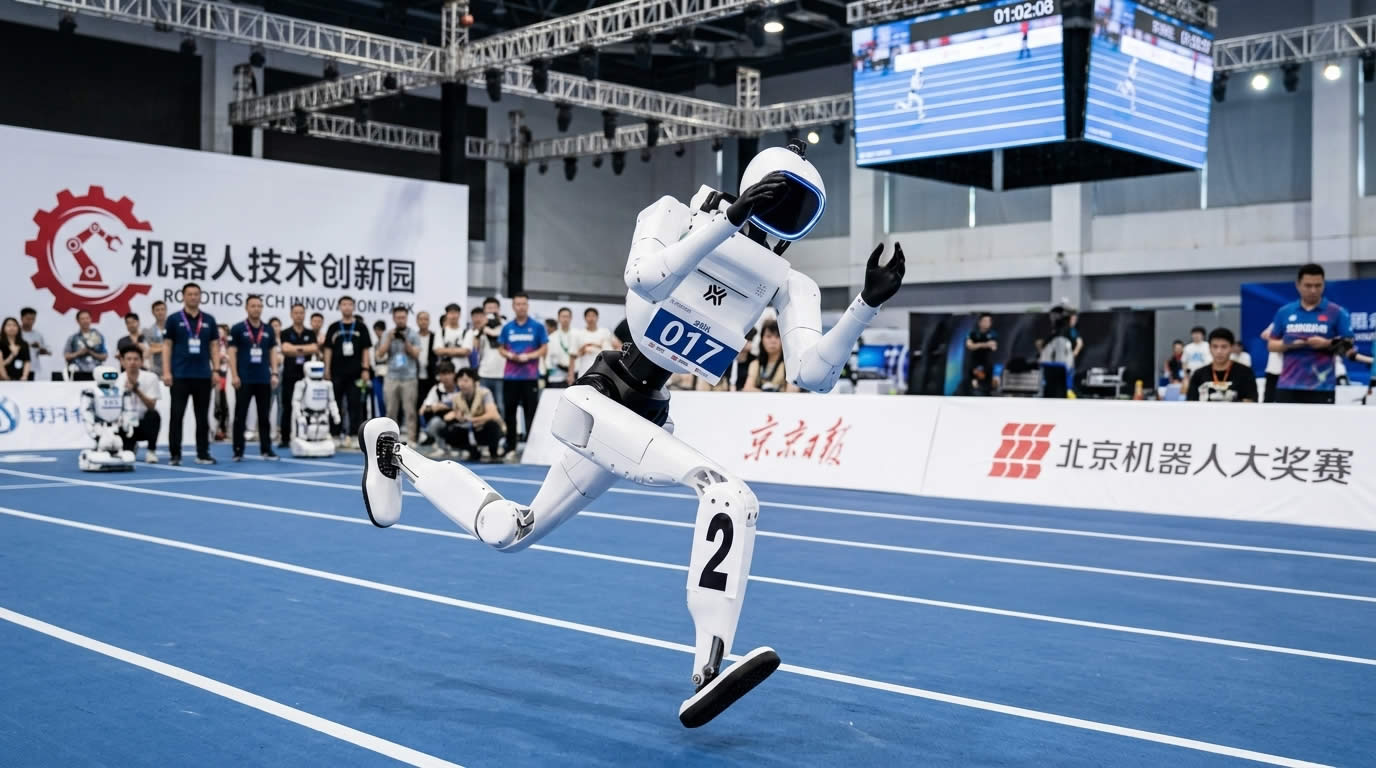
At the 2nd World Humanoid Robot Games (WHRG 2026), Tiangong Omni crossed the finish line of the 400-meter small-group final in 45.66 seconds, leaning forward with both hands held near its face and barely swinging its arms.
The unusual gait quickly became a talking point online. Chinese viewers dubbed it the “coy” run, or the “face-palm” sprint.
But the running style points to a change in how humanoid robots are being trained.
Han Gang, a motion-control algorithm expert at the Beijing Humanoid Robot Innovation Center, told reporters after the race that the team had initially designed a more conventional running motion with a human-like arm swing. The final gait emerged through repeated iterations in simulation training.
In other words, engineers set the objectives and constraints. The robot’s movement policy was shaped through training.
The Robot Was Not Trying to Run Like a Human
Human runners swing their arms for reasons related to balance and coordination. A humanoid robot does not necessarily need to.
Its motors, joints, weight distribution, thermal limits and body structure are different from those of a human athlete. A movement that works well for a person may not be the best solution for a machine.
This is where reinforcement learning can change the way robot locomotion is developed.
Instead of manually programming every movement, engineers can define a target and a set of constraints. In Tiangong Omni’s case, the training process considered factors such as speed and joint temperature. Faster movement could increase the reward, while excessive joint heating could incur a penalty.
The robot then tried different movements in a simulation environment and adjusted its policy based on the reward function.
Over many iterations, the system can converge on a movement strategy that meets the training objectives—even if that movement looks nothing like what an engineer initially expected.
That helps explain the “coy” run. Rather than being a deliberately designed pose, it was the result of a locomotion policy developed through reinforcement learning.
The movement may look awkward to a human observer. For the robot, however, it was simply one solution to an optimization problem.
The Rules Are Changing, Too
One of the clearest changes at WHRG 2026 was the greater emphasis on autonomous operation compared with the previous edition.
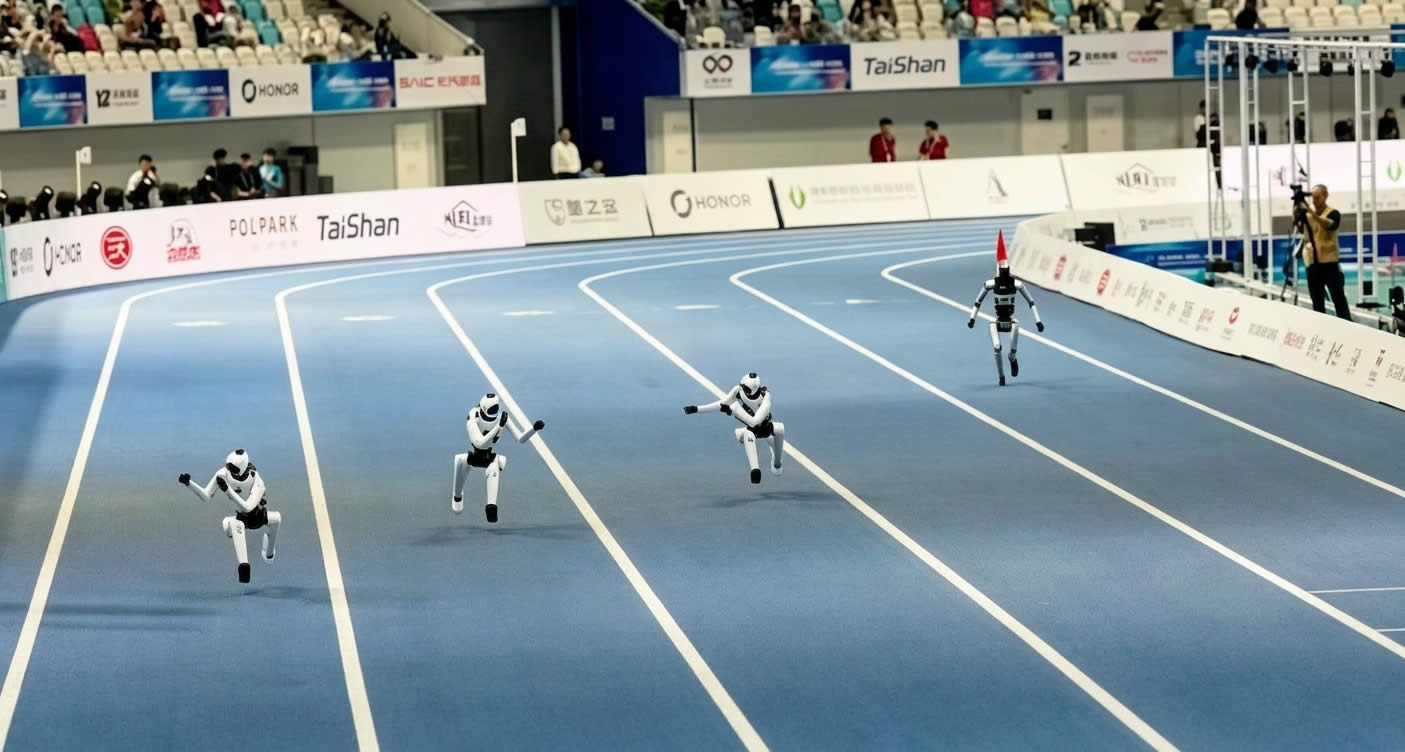
In running events, for example, robots have moved beyond relying solely on visual recognition of track markings. Some systems used LiDAR positioning and pre-built 3D maps to navigate the course.
The human operator still had a role at the start. After giving the command to begin, however, the operator was no longer allowed to continue controlling the robot with a remote controller.
A robot completing a task does not necessarily mean that the robot is operating autonomously.
A remotely operated humanoid can walk, carry objects, recover from a fall or perform complex movements. But if a human is continuously deciding what the robot should do next, much of the decision-making still sits outside the machine.
The harder question is what happens when that human input is removed. Can the robot determine what to do next on its own?
That is one of the central problems facing embodied AI.
From Programming Movements to Learning How to Move
Robot motion control has long relied on dynamics models, trajectory planning and carefully designed controllers.
Those methods remain important. But high-dynamic movements such as running, jumping and hitting a ball create a problem: there are too many possible combinations of movements to manually specify every situation.
Reinforcement learning offers another approach.
Engineers define the objectives and constraints, while the learning system searches for a policy that can satisfy them. Faster movement can increase the reward, while excessive joint heating can be penalized. The training system then allows the robot to explore the available action space and learn a policy through trial and error.
The result is not necessarily a movement that looks natural to a human. It is a movement that works for the machine.
According to the development team, the training process for Tiangong Omni also had to account for the thermal load on its joints. For a 400-meter race, peak speed is only part of the problem. The robot must maintain its performance over the entire distance without pushing its motors and joints beyond their operating limits.
That creates a trade-off between speed, stability and heat.
The final running style is therefore not simply about running faster. It reflects a policy balancing several objectives at once.
This is one of the important differences between conventional motion programming and learning-based control: engineers can define what the robot should optimize without necessarily specifying what the final movement should look like.
Tennis Turns Movement Into a Real-Time Decision Problem
Running mainly tests whether a robot can control its own body.
Tennis introduces a different challenge: the environment keeps changing.
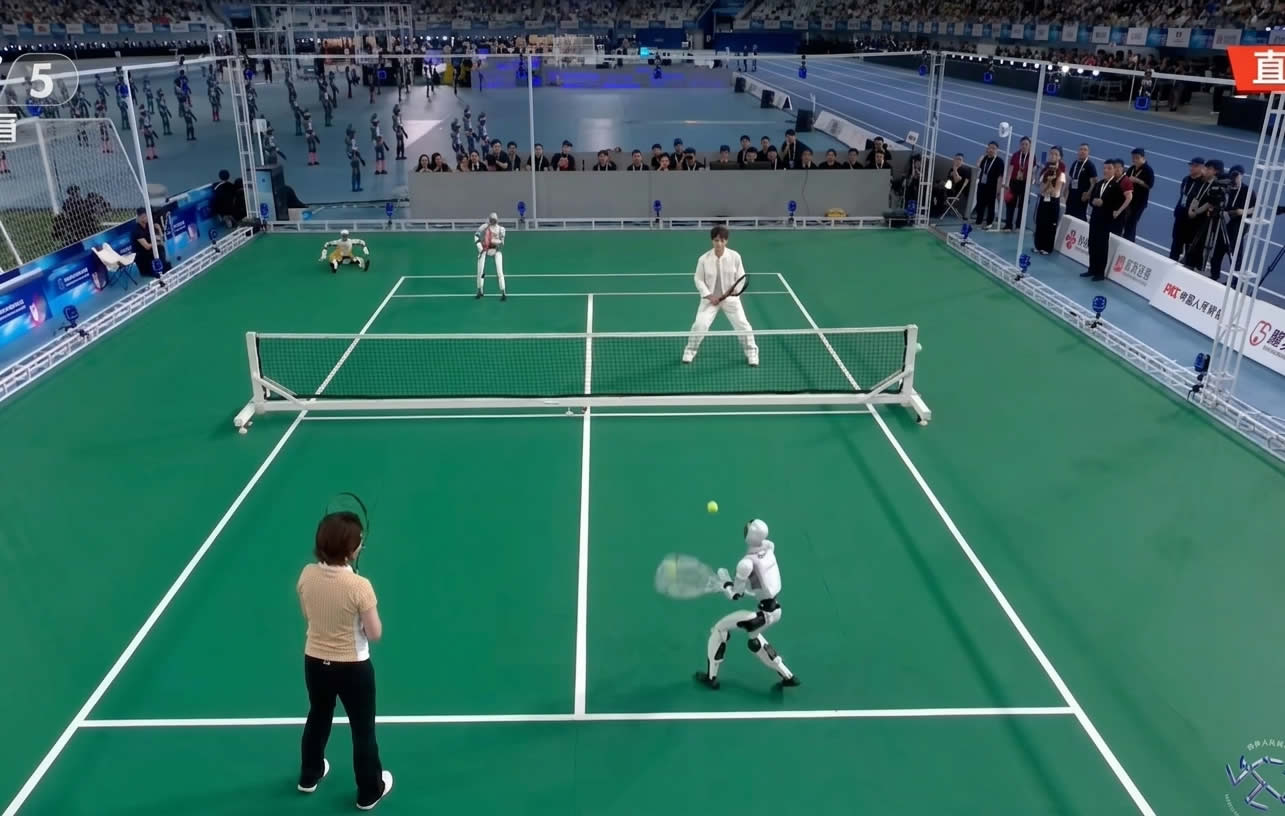
During WHRG 2026, Galbot demonstrated a humanoid robot playing tennis against former Chinese tennis player Zheng Jie. The robot had to track the incoming ball, move into position, adjust its body and execute a return. During the demonstration, the robot fell while being moved around the court, then got back up and continued playing.
The difference from a pre-programmed demonstration is significant. A tennis ball does not arrive at exactly the same speed, angle or position every time.
The robot has to estimate the ball’s trajectory, decide where to move, adjust its balance and select a way to return the shot—all within a very short time.
And hitting the ball is only part of the problem. The robot also needs to consider the opponent’s position and the state of the rally when choosing where to send the ball.
That turns tennis into a continuous decision-making problem.
For an embodied AI system, the task involves perception, prediction, decision-making, locomotion, whole-body coordination and action execution.
All of those components have to work together in a real-time closed loop.
What AstraBrain Is Trying to Connect
Galbot has developed AstraBrain as its embodied AI foundation model system.
Traditional robotic systems often separate high-level task decision-making from low-level motion control.
The basic idea is familiar: the high-level system decides what should happen, while the lower-level controller works out how the robot’s body should move.
That separation becomes harder to maintain in a fast-moving environment such as a tennis court. A robot may know that it needs to reach a particular position, but it also needs to know where its body is, how quickly it can get there and whether its current posture will allow it to hit the ball.
Galbot’s AstraBrain architecture is designed to connect high-level decision-making with whole-body movement more closely.
Galbot says AstraBrain-WBC 0.5 has 80.4 million parameters and can achieve model inference latency as low as 0.39 milliseconds under its test conditions.
That figure refers to model inference latency, not the end-to-end response time of the robot. In a complete robotic system, additional latency comes from cameras and other sensors, perception, state estimation, planning, communication, controllers and actuators.
The engineering challenge is to make all of these components work together quickly enough to maintain a stable real-time control loop.
Robots Need a Different Way to Learn
There is another problem with teaching robots physical skills: robots do not have access to the equivalent of the enormous text datasets used to train large language models.
A robot needs physical experience.
Training a real robot thousands or millions of times takes time and puts wear on hardware. Falls can damage components, while repeated high-load movements can shorten the life of motors and actuators.
Tennis makes the problem even harder. There is plenty of human tennis data, but a human body is not a humanoid robot.
Humans have different proportions, joint structures, degrees of freedom and ways of generating force. Simply copying a human movement does not produce an optimal robotic motion.
This is where motion priors and simulation become useful.
Project LATENT, developed by Galbot and researchers including teams from Tsinghua University, is one example of this approach.
Public materials for the project describe a system that uses human tennis motion data as a prior and combines motion tracking, high-level policy learning and simulation-based training to develop tennis skills for a humanoid robot. Rather than relying on complete demonstrations, LATENT uses imperfect human motion fragments as priors and learns how to combine and execute those skills on the robot.
The project was deployed on a Unitree G1 humanoid robot for sustained tennis exchanges.
Human data can provide useful information about how a task works, but the robot still needs to learn how to execute that task with its own body. Human data provides a prior. Reinforcement learning searches for a policy that works on the robot.
That distinction is becoming increasingly important as humanoid robotics moves from demonstrations toward autonomous operation.
Football Makes It a Team Problem
Tennis is a one-on-one interaction.
Football adds another layer: multi-agent coordination.
At WHRG 2026, autonomous 7-on-7 football matches required robots to assess passing routes, adjust their positioning and participate in attacking and defensive play. The robots had to estimate the positions of teammates and opponents, adjust their positioning and select actions during play.
A robot that can move autonomously is only the starting point. It also needs to know where its teammates are, where opponents are moving and when it should pass, carry the ball or change position.
The same problem appears outside sports. In factories, warehouses and logistics facilities, similar problems arise when several machines must coordinate material handling, share space or adjust their routes in response to changing conditions.
Football simply puts those problems into an environment where the decisions are easy to see.
The Important Change Is Not That Robots Are Becoming Athletes
Humanoid robot competitions have often been treated as showcases of physical performance. Which robot runs faster? Which one jumps higher? Which one can perform more difficult movements?
This year’s competition points to a different question. Can the robot do those things without a human continuously telling it what to do?
Tiangong Omni’s running style emerged from training rather than being fully specified in advance. The tennis demonstration required the robot to respond to the incoming ball rather than follow a fixed sequence. Football added the problem of coordinating multiple agents in a changing environment.
The common thread is the gradual removal of the human operator from the action loop.
That does not mean these robots “think” in the human sense. A more precise description is that they are gaining greater autonomy in perception, decision-making and motion control.
The Real Test Is Outside the Stadium
A robot that can run a 400-meter race or return a tennis ball is interesting.
A robot that can reliably perform useful work in an unpredictable environment is much harder.
Factories and warehouses do not have marked running lanes. Objects are misplaced. People move through workspaces. Lighting changes. Tasks are interrupted. The environment rarely behaves exactly like the training data.
A useful humanoid robot therefore needs more than a library of movements. It needs to perceive what is happening, decide what to do next and execute the action without waiting for a human operator to intervene every few seconds.
That is why the “coy” run is more than an amusing moment from a robot competition. The interesting part is not that Tiangong Omni runs differently from a human. It is that the training process produced a movement suited to the robot’s body and control objectives.
For years, one of the questions in humanoid robotics was whether machines could learn to imitate people. The more interesting question now may be different: Can a robot find its own way to get the job done?
