


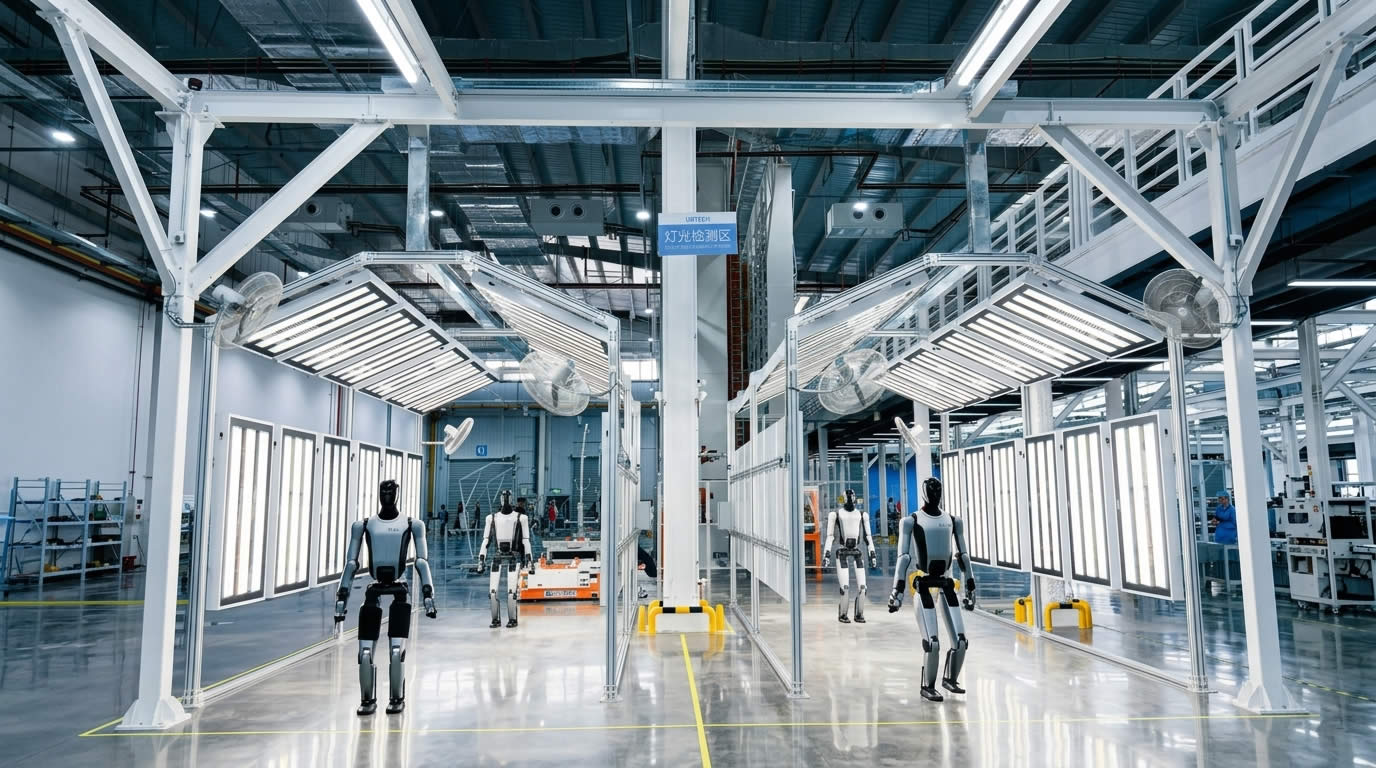
LIUZHOU, China — UBTECH Robotics has started production at a factory in Liuzhou that it describes as the world’s first industrial humanoid robot plant designed for annual output of more than 10,000 units. The plant, in Liuzhou’s Northern Ecological New Area, began operation on Sept. 12. The factory covers 14,000 square meters (150,700 square feet) and is 13.8 meters (45 feet) tall. The production line has a planned takt time of 10 minutes per robot, with annual capacity of more than 10,000 units.
That target matters because humanoid robot manufacturing has been stuck at small volumes. For much of the industry, reaching 1,000 units is still a major production milestone, while many humanoid robot makers remain at pilot or small-batch volumes. UBTECH is trying to move the conversation from demo videos to production schedules.
The factory produces Walker S series and Cruzr series industrial humanoid robots. Each robot undergoes more than four hours of full-machine testing. Assembly uses more than 2,000 screws in over 50 specifications, with different torque requirements at different points. Using the wrong screw, missing a fastener or applying insufficient torque can affect a robot’s motion performance and service life. UBTECH has deployed its in-house intelligent tightening system at stations on both the sub-assembly and final assembly lines. The company says the system can prevent incorrect fasteners, missed fastening, insufficient torque and dropped screws, while recording and archiving the tightening data for every fastener.
UBTECH developed the factory’s digital manufacturing system with Siemens. Siemens Plant Simulation is used to create a 1:1 digital replica of the shop floor, with virtual models of stations, racks and AGVs. Raw material inbound, work-in-progress transfer and finished goods outbound are simulated on a computer first. The goal is to cut on-site commissioning costs and make later expansions and new models faster to adapt. The two companies also built the Yanshee MOM system, which covers work order scheduling, material delivery, equipment scheduling and warehouse monitoring. Each robot gets a unique serial number, making parts origin, production batch, assembly parameters and inspection data traceable over the full lifecycle.
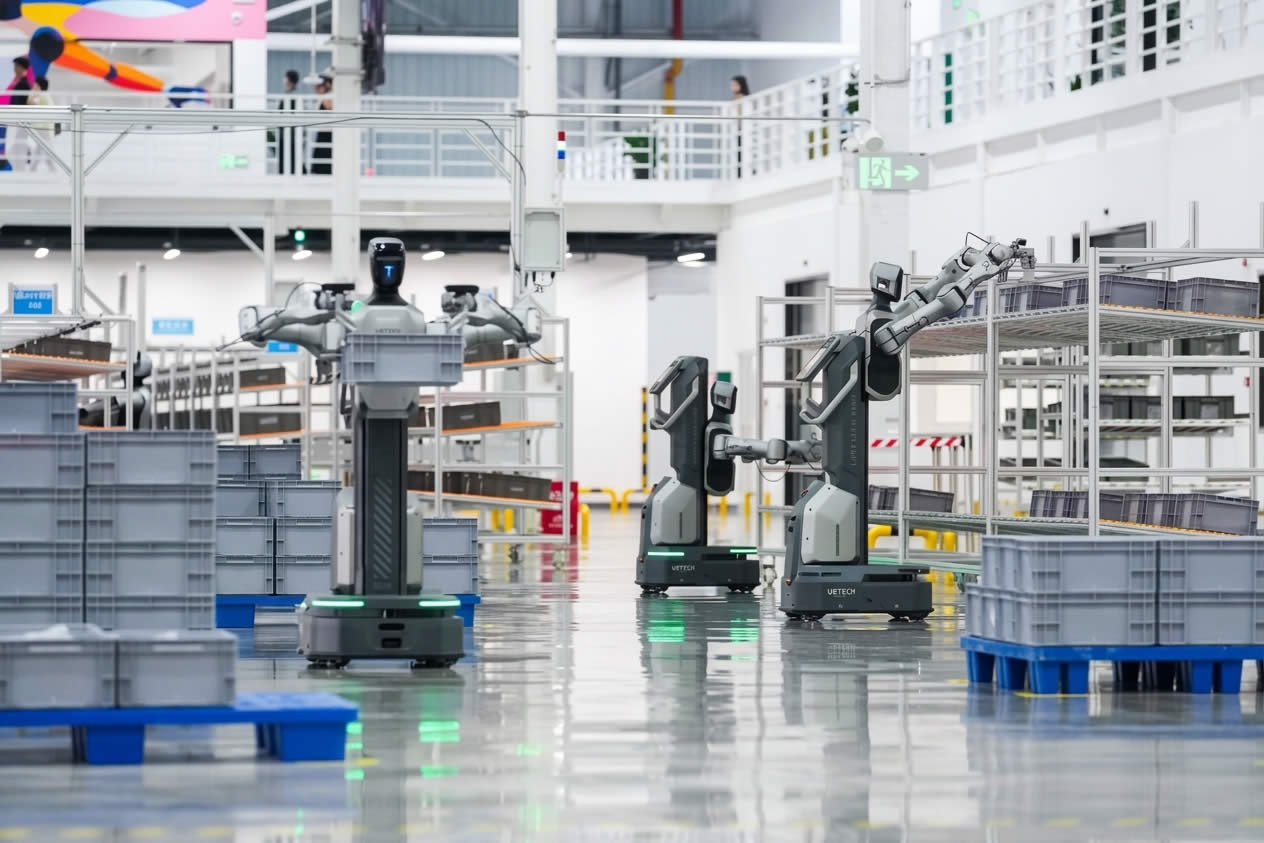
Then there is the factory’s most eye-catching idea: robots building robots. Cruzr Y1 and Cruzr S2 industrial embodied AI humanoid robots work on the line, handling depalletizing, palletizing, loading and transport alongside human workers. They use 3D vision and embodied AI to deal with box offsets and changing pallet patterns. Final assembly does not use a traditional fixed line. Instead, UBTECH combines collaborative robot arms, assistive manipulators, unmanned logistics vehicles and 360-degree rotating workstations. The setup supports mixed-model production of Walker, Cruzr and other robots.
Logistics is also largely automated. A 65-square-meter (about 700-square-foot) automated high-bay warehouse can hold 112 humanoid robots, and UBTECH says space utilization is more than 50% higher than before. AGVs, autonomous forklifts and unmanned logistics vehicles form a plant-wide logistics matrix. In this factory, robots are not only the products on the line but also part of the production workforce. UBTECH is using its own embodied AI systems for factory-wide material handling and logistics.
UBTECH now has products spanning industrial, commercial and consumer applications. In its latest first-half results, the company reported revenue of RMB 1.27 billion, up 104.2% year on year. UBTECH reported sales of 16,123 humanoid robots, up 268.3% year on year. Revenue from full-size embodied AI humanoid robots was RMB 590 million, up 1,445%, with sales of 921 units, up 1,946.7%.
Liuzhou has its own ambitions in robotics and AI. The city is pushing an “AI + manufacturing” program and a development path it sums up as “R&D in Beijing, Shanghai and Guangzhou; integration in Guangxi; application in ASEAN.” The city says it has 46 industrial enterprises above designated size in AI terminals and robotics. Output value rose 39.5% in 2025 and 98.1% year on year in the first eight months of 2026. It has formed a robot product system with six series and more than 50 specifications. Cluster and scale effects are starting to appear.
Local manufacturers are already using automation. LiuGong Group has built a smart loader factory with fully unmanned production and cut its manufacturing cycle by 50%. Liuzhou Steel Group released Guangxi’s first steel-industry large model, the Xuantie Steel Model, and raised production efficiency by 8.5%. SAIC-GM-Wuling’s lean smart manufacturing plant was selected for China’s first batch of “Lighthouse-level smart factory” pilot projects, with AI used in 75% of typical scenarios.
The risks are not small. It is still unclear whether demand can absorb 10,000 humanoid robots a year, or whether industrial, commercial and consumer markets can grow at the same time. But UBTECH has done one thing: while others debate whether humanoid robots can be mass-produced, it has built the infrastructure to do it. It is like building a highway before traffic fills it.
Mass-production standards for humanoid robots will not come from a lab or a slide deck. They will be worked out on lines like this one, one robot every 10 minutes. Where that road leads is still an open question. The takt time in Liuzhou is more honest than any forecast.
