


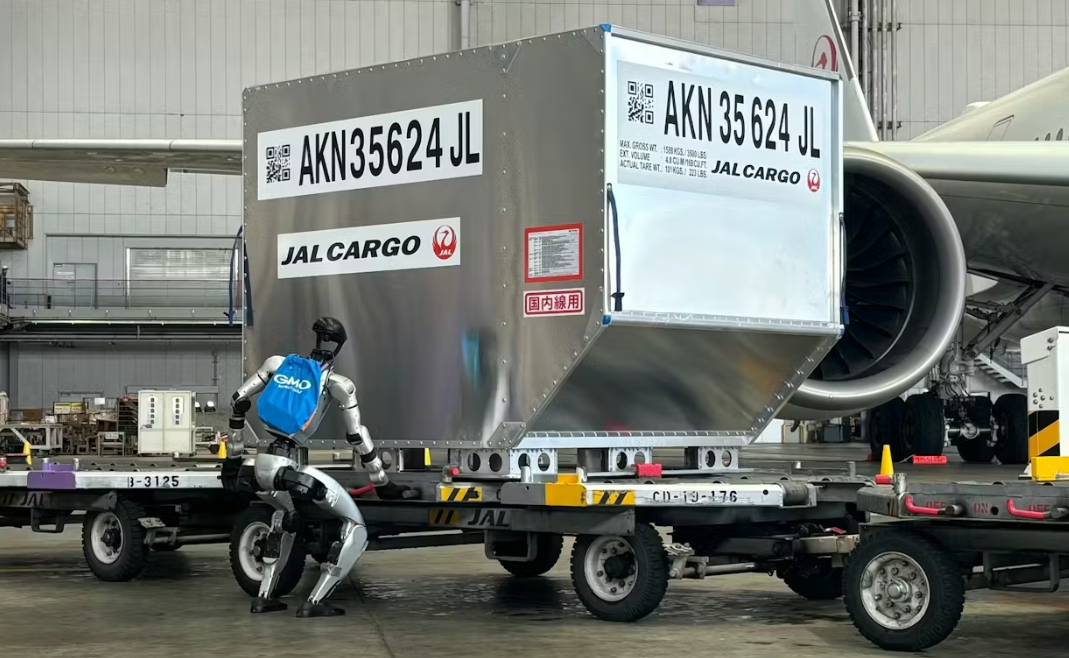
Global Expansion of Chinese Humanoid Robots
Chinese humanoid robots are beginning to appear outside domestic markets, including airport trials in Japan and early-stage industrial deployments across Southeast Asia and Europe. In 2025, Chinese manufacturers accounted for 84.7% of global humanoid robot shipments, reflecting a dominant position in the supply chain.
Among leading companies, Unitree alone shipped approximately 5,500 units, while six of the top ten global shipment positions were held by Chinese robotics firms. This scale highlights the rapid acceleration of China’s humanoid robotics industry.
However, the central challenge remains the same: converting early overseas interest into long-term commercial adoption and sustainable revenue models.
Why Chinese Robots Are Expanding Overseas
Many global markets face structural labor shortages in physically demanding, repetitive, or low-margin roles. Industries such as aviation, healthcare, hospitality, and construction are increasingly seeking automation solutions to reduce operational pressure.
This creates a strong demand foundation for humanoid robots in logistics and service industries. Chinese robotics companies are responding by exporting not only hardware, but also integrated ecosystems that include software platforms, deployment support, maintenance services, and local operational frameworks.
At Tokyo Haneda Airport, Chinese humanoid robots have already been tested in real operational scenarios. Companies such as Unitree collaborated with Japan Airlines and GMO AI & Robotics, while UBTECH Walker E was deployed for ground operations such as aircraft towing and cargo handling.
Japan’s aging population and labor shortages further accelerate adoption of automation technologies capable of handling repetitive physical tasks in controlled environments.
Beyond Humanoids: Service Robots Going Global
Chinese robotics expansion is not limited to humanoid systems. Companies such as Yunji Technology, known for hotel delivery robots, have expanded into hospitals and industrial environments across Southeast Asia.
In Bangkok hospitals, delivery robots operate continuously, transporting medicines and laboratory samples along predefined routes. This demonstrates how robotics is moving from pilot programs to operational infrastructure.
Yunji Technology is also transitioning from one-time hardware sales to a hybrid model combining hardware and software subscriptions. In 2025, its AI digital systems revenue grew by 57.3%, contributing nearly 30% of total revenue.
Trust, Compliance, and Local Execution
International expansion depends heavily on regulatory approval, local trust, and operational adaptation. The challenges are often less technical and more institutional.
For example, Qibot, a Chinese cleaning robotics company, faced months of administrative delays in Japan, including extended timelines for corporate registration and banking approval. The process began in February and was only completed in September.
To enter the market, the company also conducted more than 100 field trials, reduced operational noise, and aligned performance standards with Japan’s strict cleaning requirements.
Today, around 90% of Qibot’s revenue comes from overseas markets, with Japan contributing nearly half of total sales.
This reflects a key reality: overseas customers evaluate not only product capability but also reliability, safety assurance, and long-term service support.
The U.S. Market Opportunity and Barriers
The United States remains a strategic target for Chinese humanoid robotics companies, driven by labor shortages across manufacturing, logistics, construction, and service sectors.
At the same time, the market presents complex barriers, including tariffs, regulatory scrutiny, data security concerns, and geopolitical pressure.
Domestic competitors such as Tesla, Boston Dynamics, and Agility Robotics are also advancing rapidly, shaping a competitive environment where compliance and ecosystem integration matter as much as performance.
Success in the U.S. market requires more than cost advantage. It depends on local partnerships, long-term service networks, and regulatory alignment.
China’s Structural Advantage in Robotics
China benefits from a dense manufacturing ecosystem, rapid prototyping cycles, and strong supply chain integration across motors, sensors, batteries, controllers, and precision components.
This infrastructure enables faster transitions from prototype to mass production, giving Chinese companies a practical advantage in scaling humanoid robot production.
According to the International Federation of Robotics, China’s robot density has reached 470 units per 10,000 manufacturing workers, surpassing both the United States and Germany.
This level of industrial deployment creates continuous feedback loops between real-world applications and product iteration, accelerating technological refinement.
From Exporting Robots to Building Trust
The next phase of global expansion is defined less by hardware exports and more by long-term operational trust. Local partnerships, maintenance infrastructure, and compliance systems become central to success.
Humanoid robots must demonstrate reliability in real environments, operating safely alongside humans while maintaining consistent performance over extended periods.
For Chinese robotics companies, international growth is no longer just about entering new markets. It is about sustaining presence through service, trust, and continuous adaptation to local conditions.
