


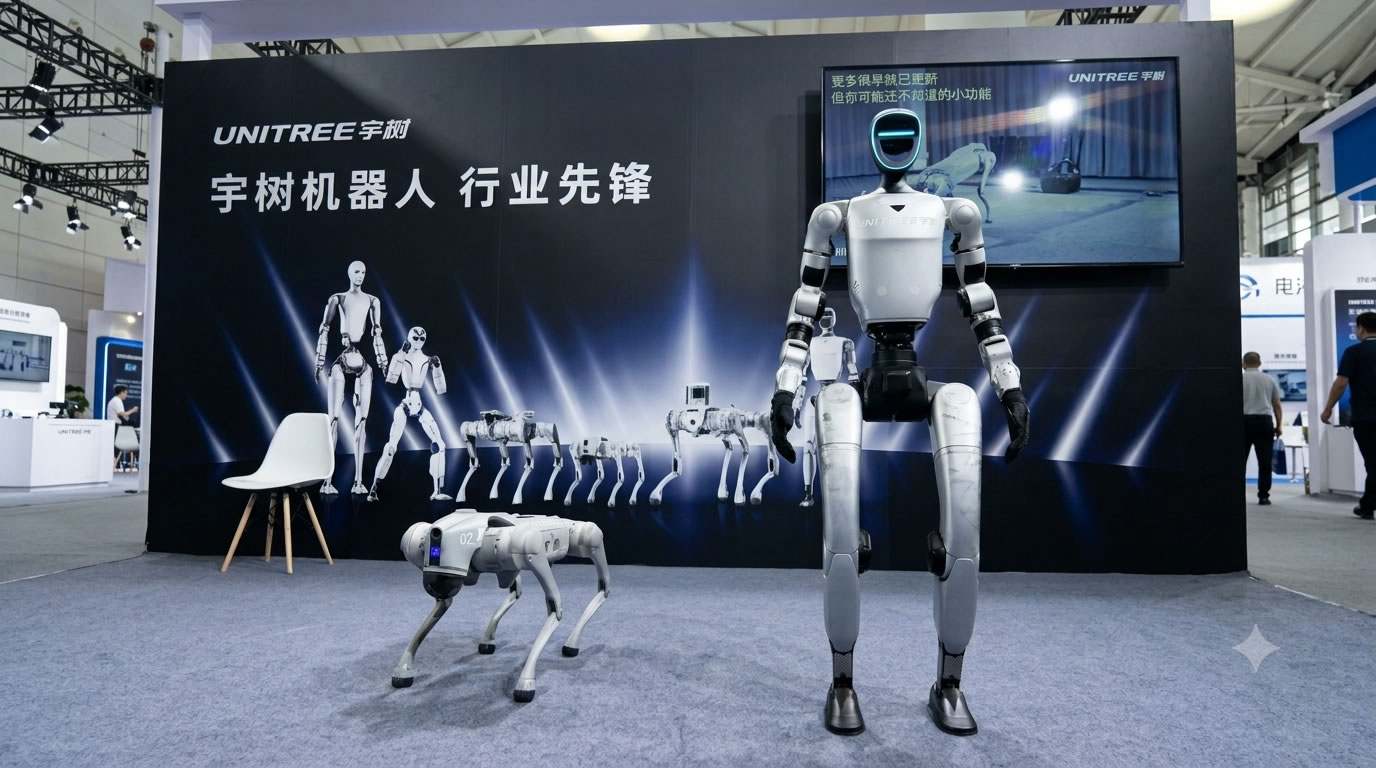
Roughly eight out of every ten humanoid and quadruped robots sold around the world are now produced in China, according to China’s National Development and Reform Commission (NDRC), the country’s top economic planning agency — a figure that shows how Chinese manufacturers are moving beyond lab prototypes and into large-scale manufacturing.
Jiang Yi, an NDRC spokesperson, disclosed the statistic recently, describing it as evidence of growing Chinese competitiveness across the robotics supply chain, from components to complete systems.
At a separate briefing on July 20 covering industrial performance in the first half of 2026, Wang Weiming, chief engineer at the Ministry of Industry and Information Technology, said industrial robot output jumped 28 percent from a year earlier, while production of service robots rose 11.9 percent.
China’s Robotics Advantage Comes From a Complete Industrial Ecosystem
The two sets of data highlight a broader shift in China’s robotics industry: China’s competitiveness is increasingly coming from the ecosystem behind the robots — a combination of research capabilities, manufacturing capacity, supply chains and real-world deployment experience.
For more than a decade, China has been the world’s largest market for industrial robots, driven by strong automation demand in automotive manufacturing, electric vehicles, battery production and electronics. That foundation is now extending into newer categories of robots.
Humanoid robots require far more complex integration than traditional industrial arms. They pull together high-performance actuators, precision reducers, motors and drive systems, force and vision sensors, battery and energy management systems, and robot control software — all areas where China’s existing manufacturing base is deeply embedded.
For robot makers, the ability to source parts quickly, test prototypes and move to volume production is what turns a technology demonstration into a commercial product. It also explains why a wave of Chinese companies has been able to introduce humanoid robots in quick succession and start exploring applications in factories, logistics and commercial services.
The production figures reflect a rapidly expanding robotics supply chain. The 28 percent increase in industrial robot production was fueled by sustained automation demand in sectors such as new energy vehicles, semiconductors and electronics. The 11.9 percent growth in service robots covered categories including delivery, medical assistance, education, inspection and home robots.
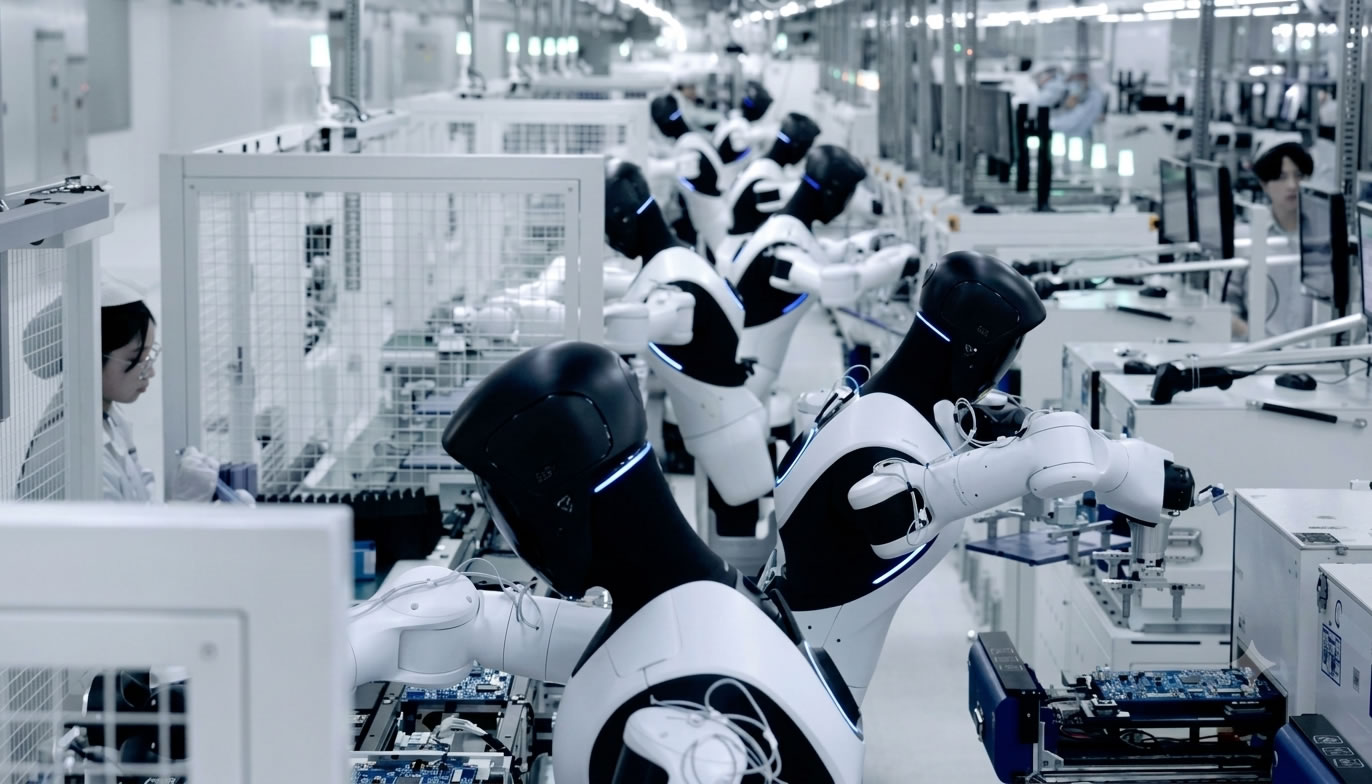
Humanoid Robots Move From Demonstrations to Real-World Deployment
Humanoid robots are emerging as the next growth vector. Unlike conventional machines that work inside structured factory environments, humanoids are meant for open, human-centric settings. That demands stronger capabilities in environmental perception, motion control and autonomous decision-making.
In recent years, humanoid robot competition centered on attention-grabbing demos — walking, running, jumping. The focus is now shifting to more practical questions: Can the robot work reliably? Can costs come down? Can it function in a real production environment? Can it keep improving through data and training?
Several Chinese robot makers are already testing humanoid machines on factory floors. In automotive plants, for instance, companies are trialing them for material handling, parts transport and simple assembly tasks. Factories provide clearer performance benchmarks than lab environments and offer a direct path toward commercialization.
Artificial Intelligence Will Decide the Next Robotics Race
The next contest, however, will not be decided by who builds the most robots. It will hinge on artificial intelligence. Embodied AI — the ability of a machine to perceive, reason and act in the physical world — will determine which systems become useful and which remain mechanical shells.
That involves multimodal large models, robot foundation models, vision-language models, reinforcement learning and the huge datasets required to train robots for real-world behavior. A robot needs a body, but it also needs a brain that can make sense of its surroundings.
China’s advantages come from manufacturing scale, a mature supply chain and a growing pool of real-world deployment opportunities. Yet in parts of foundational AI, high-end chips and advanced robot algorithms, the global race remains wide open.
The next phase of competition will be defined less by production volume and more by whether robots can reliably complete useful tasks. China has already become an undeniable manufacturing force. The challenge ahead is whether these machines can move from controlled demonstrations to reliable workers in the real world.
