


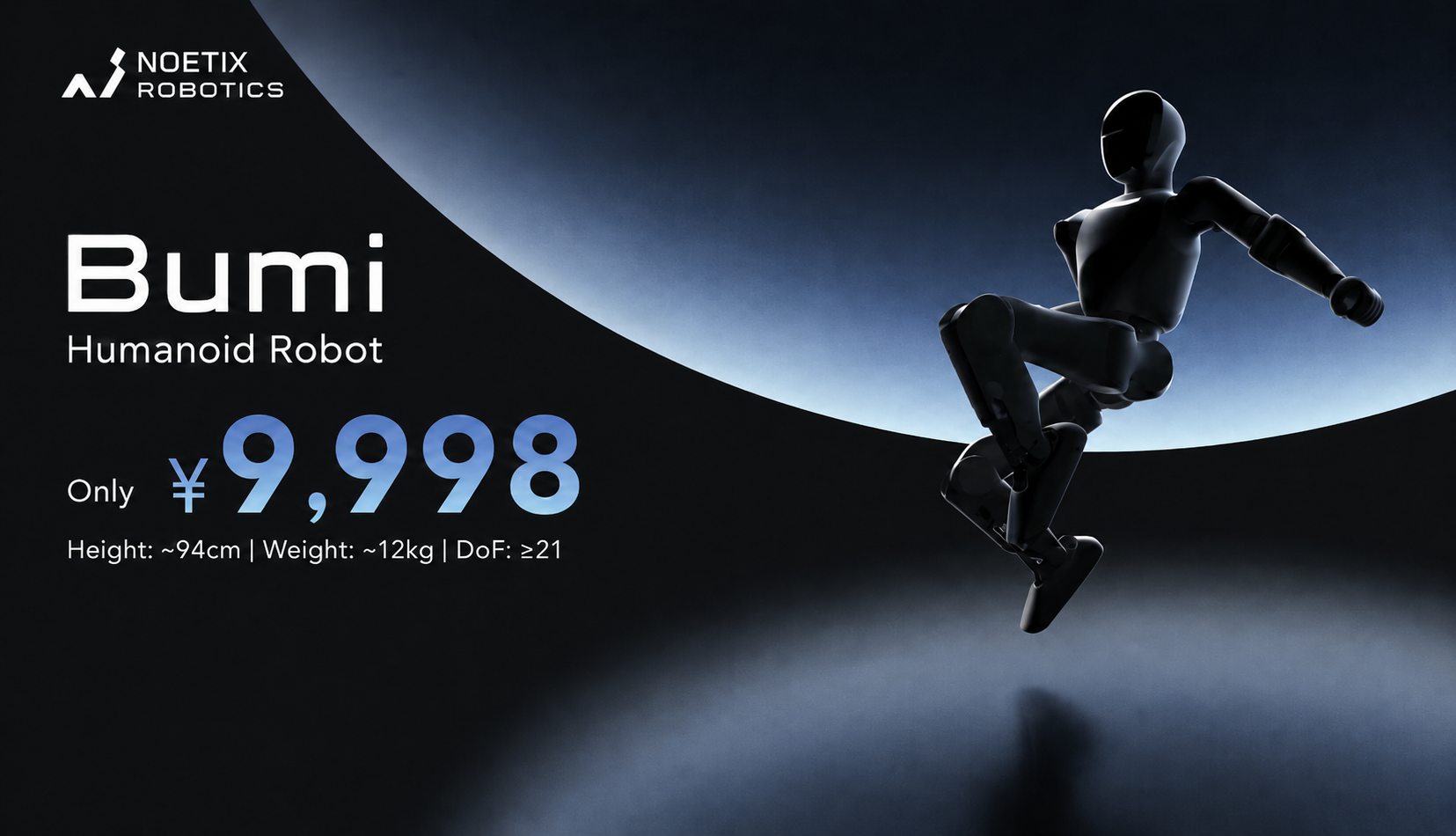
A humanoid robot cheaper than an iPhone. In China, it is already happening.
Recently, China’s humanoid robot market has seen a sharp turn from “luxury tech” to surprisingly low-cost machines. Noetix Robotics has priced its small humanoid robot Bumi at RMB 9,998, roughly $1,380. Unitree’s R1 Air starts at RMB 29,900, about $4,100, while its better-known Unitree G1 starts at RMB 85,000, around $11,700.
Not long ago, most humanoid robots were still research machines, not products ordinary buyers would even consider. Many prototypes and engineering units cost hundreds of thousands of yuan. Now, entry-level models are starting to fall into a price range people can actually understand: phones, laptops, and other consumer gadgets.
The Second-Hand and Rental Markets Are Cooling Too
Used humanoid robot prices are falling too. Many of the second-hand units now circulating online are barely used machines bought earlier this year by tech bloggers, review teams, or early adopters who wanted to try them out. Some are now being sold at about 60% to 70% of their original price.
Unitree’s R1 Air, for example, starts at about $4,400 new, while second-hand units have appeared in the $2,700 to $3,400 range.
Rentals are getting cheaper as well. In 2025, renting a humanoid robot for a day could cost as much as $1,500. By May 2026, that price had fallen to around $120 to $220 a day, as more rental units became available on the market.
On Chinese social platforms, some users are already talking about buying one, while others are wondering when robots might help with housework or elderly care. The conversation around humanoid robots is changing fast. People are not just asking how cheap these robots can get. They are asking who would buy one, and what it can actually do.
Why Are Humanoid Robot Prices Falling So Fast in China?
There was no single magic breakthrough behind the price drop. The bigger reason is more practical: China’s robot supply chain has become much stronger.
While the body of a humanoid robot is not necessarily the most expensive part, its components are. The cost includes everything needed to make a humanoid robot move and react properly, from motors and batteries to sensors, cameras, controllers, and other key parts.
China already has a strong supply chain in electric cars, consumer electronics, drones, batteries, sensors, motors, and precision manufacturing. Many parts that used to be expensive to import, manufacture, or design from scratch can now be sourced domestically at a much lower cost.
For humanoid robot makers, that changes the economics. Components that once had to be custom-built for lab prototypes can now be obtained from local suppliers. Design changes become faster, production gets easier, and larger demand helps bring unit costs down.
This is one of the main reasons Chinese humanoid robots are becoming cheaper so quickly.
Unitree Robotics is a good example. Its reported average humanoid robot selling price dropped from RMB 593,400 in 2023 to RMB 260,700 in 2024, and then to RMB 167,600 in the first three quarters of 2025.
What Can Cheaper Humanoid Robots Actually Do?
After its launch, Bumi’s first batch reportedly sold out quickly, and Noetix Robotics later said the model had received thousands of online and offline orders. Once people can afford a humanoid robot, what are they actually buying?
Bumi is one example. The robot is about 94 cm tall and weighs around 12 kg. It is built for tech hobbyists, youth programming classes, and light home companionship. It can walk, run, dance, interact with users, and support programming education.
Booster Robotics’ K1 points to a similar market. The robot is aimed more clearly at education, robotics competitions, and entry-level embodied AI development.
At its launch event, Booster Robotics announced its “Hundred Cities, Ten Thousand Schools” plan, saying it aims to work with more than 1,000 universities, 2,000 vocational schools, and 7,000 primary and secondary schools over the next three years.
For now, the first real buyers are probably not families looking for a robot maid. They are schools, developers, showrooms, event organizers, and companies that can use a robot for teaching, testing, demos, or audience interaction.
That may not be the home robot people imagine, but it is already a real market.
Does Lower Cost Mean Humanoid Robots Are Ready for Homes?
Lower humanoid robot cost is good for the industry. Noetix Robotics founder Jiang Zheyuan has said that as more companies bring prices down, humanoid robots will become easier to popularize, and the market will eventually move toward more reasonable prices and profit margins.
Cheaper does not mean home-ready. A robot that can walk, dance, take voice commands, or run a programming lesson is still far removed from one that can handle daily housework.
Homes are messy and unpredictable. Stairs, pets, furniture, cables, wet floors, and fragile objects all create real problems. Household tasks also rarely repeat in exactly the same way.
The next fight will be harder than cutting prices. Companies will have to prove that these robots are useful for consumers.
If humanoid robots for home do enter ordinary households, they will probably start as interactive companions, not full-time housekeepers.
