

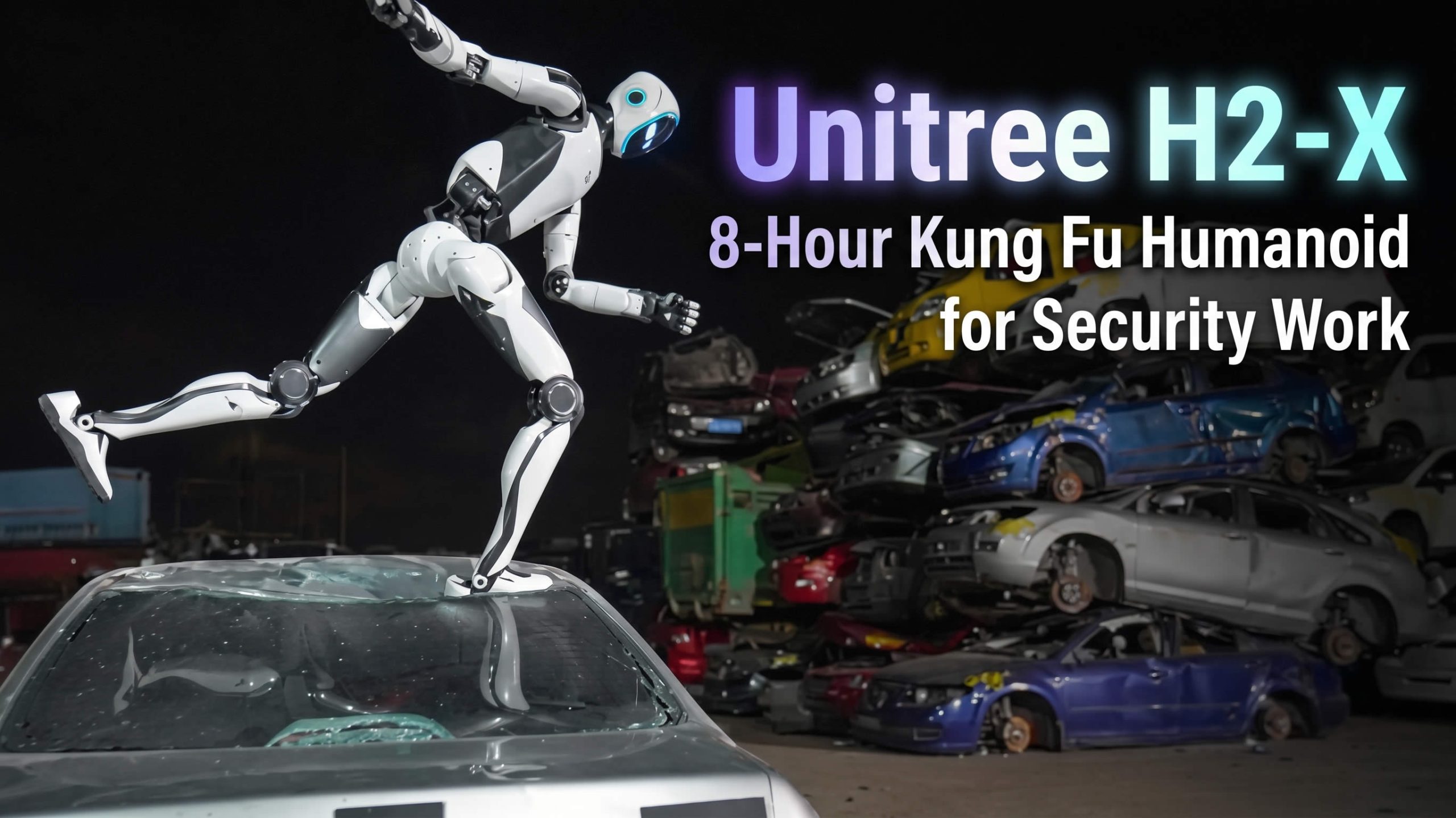
Unitree says its new machine can work most of a shift. It hasn’t said whether anything in the launch video was autonomous.
In the clip Unitree posted on Wednesday, a humanoid walks up to a parked car and kicks the door hard enough to leave a dent. The same clip shows it driving an elbow into the hood, climbing onto the roof of a car, and swinging down to land on its feet.
The machine is the Unitree H2-X. In China, Unitree is marketing it under the name “Kung Fu Legend: Guardian.” The launch post keeps things short: strong performance, a promise to serve and protect, up to about eight hours of runtime, and a request that customers use the robot safely and kindly.
No price. No full spec sheet. No ship date.
Eight hours, no test conditions
The number worth arguing about isn’t the kung fu. It’s the battery life. The H2-X is built on the H2 platform, which Unitree rates for roughly three hours on a 0.972 kWh pack. The new machine claims eight. Unitree hasn’t said what changed, and it hasn’t published the conditions behind the figure — ambient temperature, payload, how much of the time the robot is actually moving.
That gap matters commercially more than any kick. Three hours is a lab session. Eight hours is a shift. Security contractors, plant safety managers and civil defense units buy equipment by the shift, and a humanoid that needs a mid-day charge is a hard sell to a buyer comparing it against a guard with a flashlight and a radio. Whether the figure holds up once the robot spends its day climbing, lifting and falling over is the open question, and the launch video is not an answer to it.
The stunts are the easy part
Unitree has been shipping spectacle for years. The H1 landed a standing backflip in 2024, a first for a full-size electric humanoid. The G1 was shown boxing. Sixteen of the company’s robots did a synchronized dance routine on national television during the Spring Festival gala. A robot doing martial arts is a motion-control demo, and motion control is the thing Unitree is genuinely, consistently good at.
The new footage works through the repertoire: repeated jumping kicks, a four-meter drop off a platform into a forward roll and a clean stand-up, a climb onto the roof of a car and a controlled fall back down. The genuinely new material is the rescue work — the robot lifting the front end of a car off a mannequin so a person can drag it clear, and a dive that shoves a mannequin out of the path of an oncoming vehicle.
Then there’s the notice Unitree put on screen: keep people at least two to three meters away from the robot. A company that ships a bodyguard demo and immediately asks you to stand three meters back is telling you something about where the technology actually is. The same warning appears on the H2 page, in blunter terms: the machine is powerful, and buyers should understand the limits of humanoids before spending money.
What’s inside, and what isn’t
Unitree hasn’t released H2-X specifications, so the H2 is the only honest reference point. The base platform stands 1.82 m, weighs about 70 kg, and has 31 degrees of freedom — six per leg, seven per arm, three in the waist, two in the head. Leg joints peak at 360 N·m, arm joints at 120 N·m. The arms handle about 15 kg at peak and 7 kg rated. The chassis is aviation aluminum, titanium and high-strength engineering plastic, cooled by fans rather than liquid, with Wi-Fi 6 and Bluetooth 5.2.
The H2 launched in at ¥199,000 (about $28,000), with an EDU variant that offers dexterous hands and a swappable compute module — up to 2,070 TOPS, the sort of budget you need to run a vision-language-action model on board. In , Nvidia used an H2 Plus chassis as the body for its Isaac GR00T reference humanoid, which tells you the platform is taken seriously by people who build robot brains for a living. What H2-X adds beyond the runtime claim — actuators, hands, compute, ingress protection, payload — is unstated.
The autonomy question
On , Unitree published UnifoLM-X2-1.0, its world-action model, and claimed a first: a humanoid sparring fully autonomously in real time, throwing punches, blocking, slipping and chaining attack into defense with no remote operator and no pre-scripted sequence. That was a software claim, and it came with its own video.
Wednesday’s launch makes no equivalent claim. Unitree’s caption doesn’t say the car lift was autonomous, or the dive, or the fight scene. That omission is the most interesting thing about the release. Contact-heavy tasks — finding a grip on sheet metal that deforms under load, catching a body that is already falling — are precisely where teleoperation remains the industry default, and where a world model’s predictions get tested against physics rather than against a sparring partner who is playing along. A robot that can do this unsupervised on a street is a different product from a robot that can do it with a skilled operator off camera, and nothing published on Wednesday distinguishes the two.
Why a bodyguard, why now
The timing is not subtle: the launch lands about two months after Unitree’s STAR Market listing, which briefly valued the company near $62 billion before roughly half of that was gone within a week.
Security and emergency response are, on paper, sensible first markets. The tasks are well defined, the buyers have budgets, and the value of a machine that can lift a car off a person is easy to explain to a procurement committee. The competition is heading the other way — Boston Dynamics is lining up Atlas for work in Hyundai’s Georgia plant from 2028, Figure is working on manufacturing and warehouse tasks, UBTECH is selling Walker units into assembly lines. Those are structured spaces with repeatable jobs. Unitree is pointing its new robot at the street, which is the least structured environment anyone could pick.
That choice brings its own questions. A machine in the H2’s 70 kg class that can deform a door with one kick, operating within arm’s reach of the public, invites a liability conversation no vendor has been willing to have on the record yet: who is responsible when the guard robot misreads a raised arm, or when the world model decides a falling pedestrian is an obstacle to be cleared. Unitree’s own safety-distance notice reads less like a formality and more like an acknowledgment that the gap between demo and deployment is still measured in meters.
Two things would settle most of this: a spec sheet with actuator, compute and payload detail, and a clip of the car lift with nobody holding a controller — ideally with a third party in the room.
