


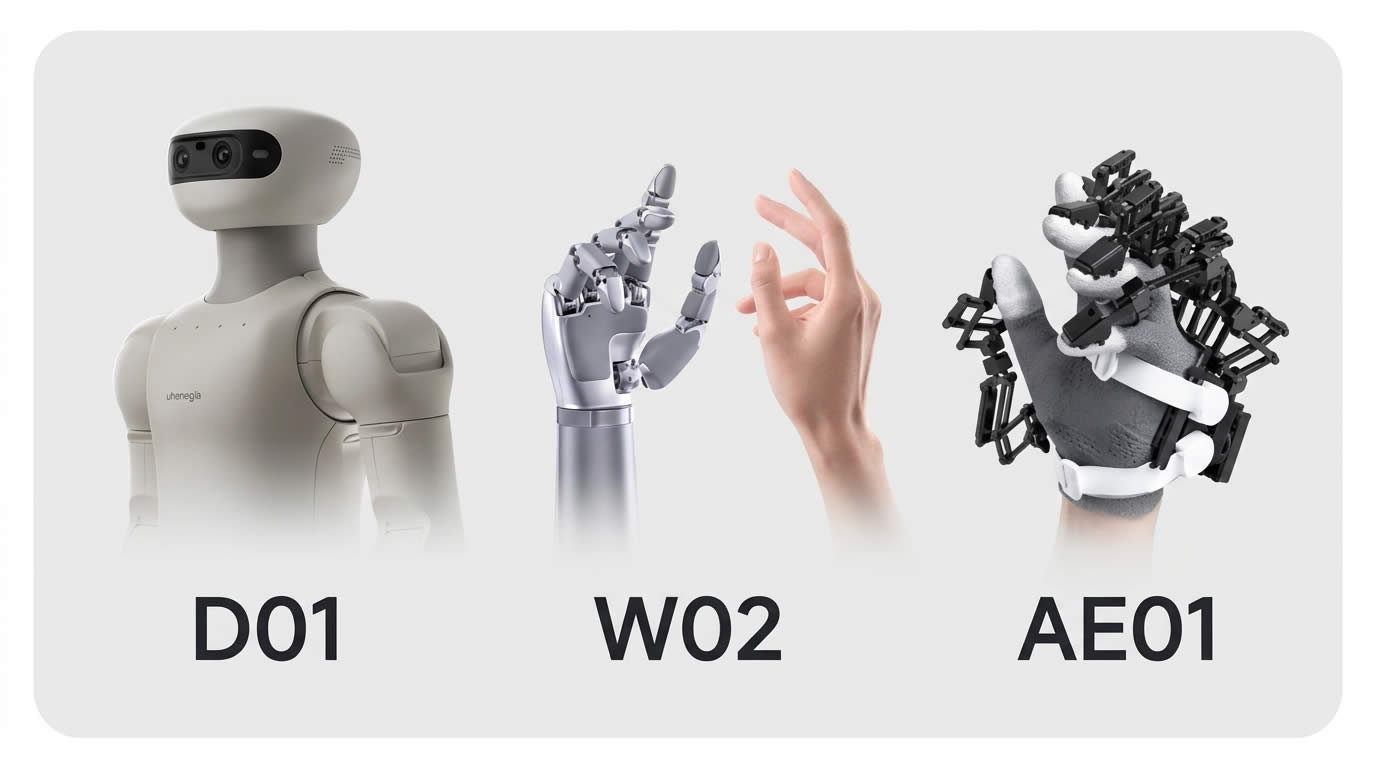
Sharpa unveiled three products on one table at booth 514 at Pittsburgh’s David L. Lawrence Convention Center this week. The D01 is a humanoid robot with whole-body tactile sensing. The W02 is a dexterous hand. The AE01 is an exoskeleton data glove for teleoperation. The lineup, announced on September 28 at IROS 2026, the IEEE/RSJ conference that skews academic rather than commercial, is Sharpa’s first coordinated release since the company started shipping hardware. Most exhibitors here bring one thing. Sharpa brought a chain.
The detail worth stopping on is buried in the W02 spec sheet. The hand has 21 active degrees of freedom. The hand it replaces, the W01, has 22.
In the dexterous hand business, subtracting a joint is not a neutral act. Joint counts are the primary scoreboard in this market, printed on datasheets and quoted in funding decks. Going backwards by one looks like a step down. Sharpa did it on purpose, and the reasoning says more about where this industry is heading than any of the new specifications do.
Three products, one manipulation loop
The three devices work better as a single circuit than as three separate products.
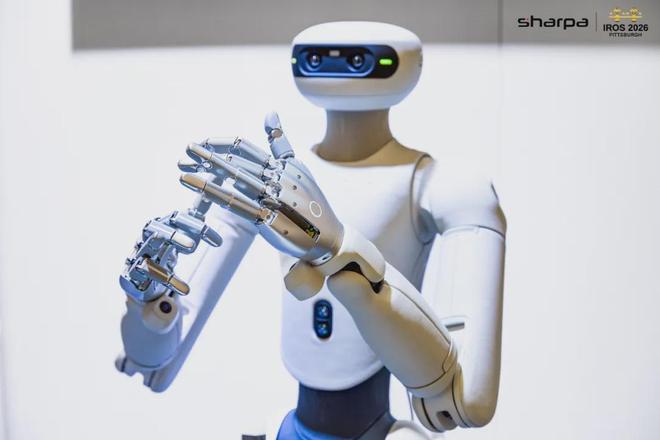
The AE01 is an exoskeleton glove that has 22 encoders and captures what a human hand does and maps it to a robot in real time. The D01 is the body: 66 degrees of freedom including its hands, roughly 40 kg without the chassis, 7-DoF arms, and end-effector repeatability of ±0.2 mm. The W02 is what goes on the end of those arms. Contact forces, positions and poses recorded during operation feed back into manipulation policies, which then improve the robot. Sharpa splits this into executing motion, making contact, and learning from human demonstration, though “learning” covers models the company develops separately rather than anything automatic inside these three boxes.
Anyone new to the name should know the commercial picture. Sharpa disclosed more than RMB 4.5 billion, about $669 million, in cumulative funding in late August at a reported RMB 22 billion post-money valuation, with Alibaba, Tencent, JD.com, Meituan and Transsion among the backers. Press reporting puts the team at just over 200 people, roughly 80% of them in research and engineering roles.
Why the W02 has 21 degrees of freedom
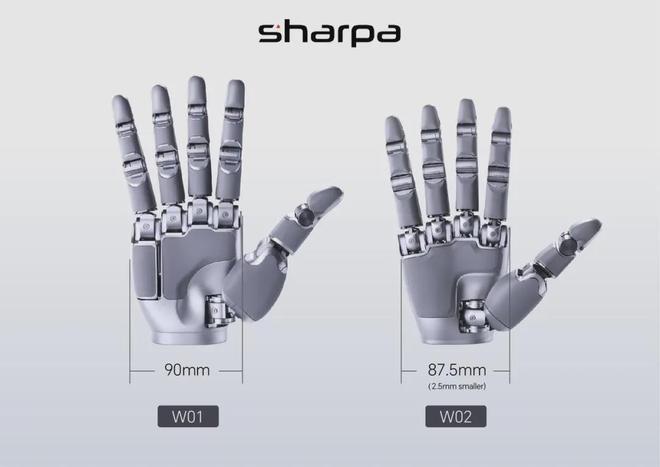
The W01 shipped with 22 active degrees of freedom and a 1.3 kg frame. The W02 keeps the tactile architecture but drops the joint count to 21 and the weight to under 750 grams, in a package measuring 188 × 87.5 × 40 mm. Sharpa says that is roughly 30% smaller than its predecessor.
The removed joint sits at the base of the pinky finger, where a rotation lets the little finger swivel on its own axis. Sharpa’s engineers concluded it was rarely engaged in everyday grasping. Removing it simplified the mechanism there and eliminated a failure point.
That is a plausible engineering argument, and the effect is measurable: less weight hanging off the forearm, which matters for arm speed, battery life and thermal load. The tradeoff is real too. Some grips that rely on the pinky’s independent rotation, particularly certain power grasps and in-hand repositioning, get harder. Sharpa is betting those cases do not come up often in the tasks its customers care about.
What makes the decision interesting is the standard being applied. When a dexterous hand is a standalone research product, more joints are straightforwardly better. Every added degree of freedom is another demonstration the hand can perform, and the cost of the motors, wiring and calibration work gets absorbed by a lab budget. Once the same hand is bolted to the forearm of a robot working an eight-hour shift, the math inverts. Dust, spills, knocks and long runtimes all climb the priority list. Reliability and serviceability start to outrank joint count.
Sharpa kept the touch sensing and gave up structure instead. The bare hand has an IP54 rating against dust and splashes, and an IP67 rating with an optional glove. Fingertip sensing spans 5 mN to 30 N at 1 mm spatial resolution, using the company’s vision-based Dynamic Tactile Array, in which a camera inside each fingertip images the deformation of the contact surface. Electronic skin covers the fingers and palm with a 0.1 to 20 N range. The minimum grasp diameter is listed as zero, which is what lets the hand pick up thin cards and fine cords.
The 22-versus-21 split across the AE01 and the W02 is not a contradiction. The glove keeps all 22 degrees of freedom of the human hand because data lost at the capture stage is unrecoverable. You can always drive a simpler hand with richer data, but you cannot recover detail you never recorded. The hand trims to 21 because hardware reliability beats kinematic completeness in the field. One number is about preserving information. The other is about surviving Tuesday afternoon.
Tactile sensing, in layers
The dense layer sits at the W02 fingertips, where the optical sensors resolve the location and character of contact down to a millimeter. This is the layer that detects slip, judges whether an object is giving or firm, and manages the edge of a thin item.
The second layer is electronic skin across the rest of the hand, covering the palm and the finger segments that contact an object during a power grasp rather than a pinch.
The third layer moves onto the D01 body. The robot carries electronic skin across its arms and chest, sampling at 100 Hz with a 0.1 to 20 N range per sensing element and 0.2 N force resolution. These numbers are not meant for fine manipulation. They exist to register collision, such as an object brushing past or a hand resting on the arm, and Sharpa frames them as the basis for working safely near people.
The fourth layer closes back on the operator. The AE01 provides 256 levels of vibration feedback at each fingertip, so a person teleoperating the robot can feel grip force change instead of inferring it from a screen.
Why bother, when cameras have gotten so good? Because a large class of manipulation failures happens after contact, where vision stops helping. How much force closes a lid without crushing it. When to stop tightening. Whether a thin sheet is slipping between two fingers. A camera can see the object. It cannot feel the resistance. Sharpa’s argument, and it is a fair one, is that the binding constraint on robot manipulation moved from perception to contact some time ago, and most hardware budgets have not caught up.
The data problem the AE01 is meant to solve
The glove’s real function has less to do with control than with supply.
Motion-capture gloves are common. What is less common is a glove that sends force back to the wearer, and that distinction matters for data quality. A recording of joint angles alone tells a model where the hand went. A recording that also captures contact force, slip onset and grip adjustment tells it what the hand was responding to. The second kind is worth far more per minute of labor, and labor is the scarce input here.
Teleoperation data is expensive to produce because a human has to sit there producing it. Simulated contact physics still does not reproduce the behavior of real materials under real force. A camera can generate millions of images of a cup. It cannot generate the sensation of a cup being about to slip. That is the gap the AE01 exists to narrow, and its calibration-free design points at the same goal: moving data collection out of the lab and into working environments, where the tasks actually are.
What the Dairy Queen store is actually testing
On August 29, in partnership with CFB Group, the franchise operator that runs Dairy Queen in China, Sharpa put a robot behind the counter at a DQ location on Wujiang Road in Shanghai. The robot runs from 10:00 to 22:00, and the company says it completes the full 55-step process of making a Blizzard. That includes separating a paper cup from a stack, aligning the metal blending ring, dispensing soft serve, adding Oreo crumbs, running the high-speed spindle mixer, and finishing with the inverted flip DQ uses as its thickness standard.
The important part is what did not change. The store kept its standard equipment, ingredients, tools and procedures. Nothing was rebuilt for the robot. That constraint is what makes the deployment worth watching, because the tools were designed around human hands. It is exactly the condition robots will face everywhere outside a purpose-built cell.
Sharpa says tactile feedback is involved in 98% of those 55 steps. Extracting a paper cup requires sensing friction and resistance. A spinning mixer demands continuous grip adjustment as vibration and load shift. The flip requires tracking the cup’s shifting center of gravity.
Now the caveats. The robot takes roughly six minutes per Blizzard against two to three minutes for an experienced employee, so it runs at about half human speed. Sharpa has acknowledged that the first-generation unit is not yet profitable and that a positive ROI in these early deployments is unlikely in the near term, with a long-run target of pushing hardware costs down to the RMB 100,000 range at volume. At least one outlet has also characterized the Shanghai deployment as teleoperated rather than fully autonomous, which the company disputes but has not publicly detailed. The distinction is not academic. If a person is standing by to intervene, the labor savings are smaller than the headline suggests, and the “fully autonomous” framing gets harder to defend.
None of that invalidates the project. It does mean the case for it rests on something other than near-term economics.
Where the cost curve points
That something is data.
Sharpa’s clearest strategic argument concerns where manipulation data comes from and what it costs over time. Purchased data gets more expensive as models iterate and the market tightens. Data generated on your own storefronts accumulates for free, hour by hour, for as long as the robot is working. If that gap holds, the company that owns the deployment owns a compounding input that competitors have to buy at rising prices.
It is a coherent thesis and a difficult one to execute. It requires the robot to be reliable enough to keep running, cheap enough to deploy at volume, and productive enough that a customer will tolerate the current speed penalty. Sharpa wants to move into hotel, retail and food service settings first, with household products on the roadmap from 2028.
The company’s chief executive has put the threshold bluntly. The question is not whether a robot can complete a task once, but whether a whole system can do complex work in an unmodified environment over the long run. That is a higher bar than most demonstrations clear.
The 55-step Blizzard, in the end, is a test of whether removing a joint from a hand makes the whole machine more likely to still be working next month. On a show floor in Pittsburgh, with the robot catching falling sticks and mixing drinks, that argument is hard to evaluate. At a store on Wujiang Road, at 9 p.m. on a Saturday, it will be harder to avoid.
