

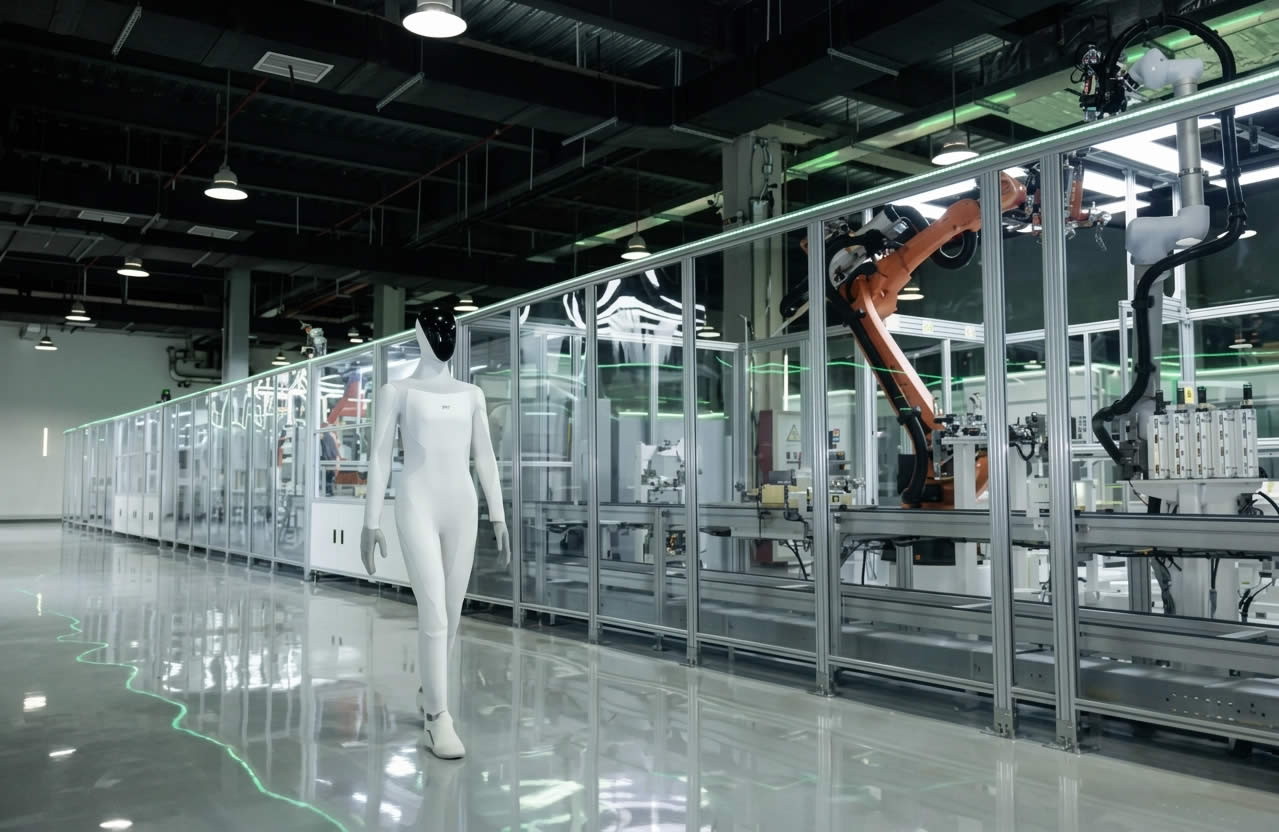
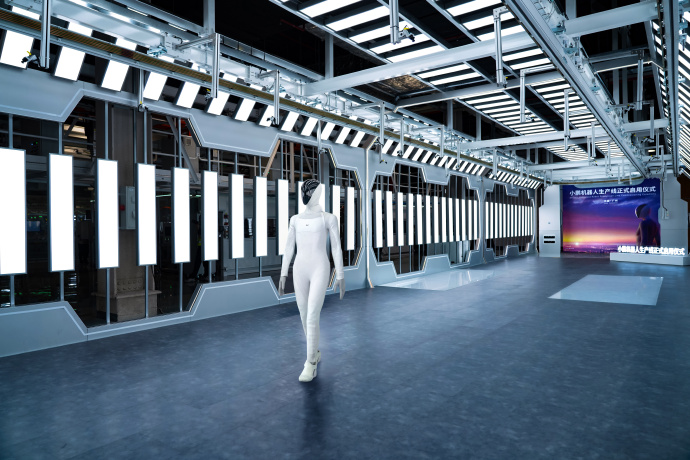
On September 8, an XPENG IRON humanoid robot walked off the production line at XPENG Robotics. No crane, no workers carrying it—it stepped in front of the cameras on its own. XPENG says this is the world’s first advanced general-purpose humanoid robot to complete automated assembly and walk off the line by itself.
Over the past year, XPENG’s public demonstrations of IRON have mostly centered on human-like design, motion control, and physical world large models. This time was different. The production line itself became the story. With automation above 80% for core processes, XPENG describes the facility as the world’s first automated production line for advanced general-purpose humanoid robots, designed and developed in-house from the ground up.
Humanoid robots have long been assembled in small batches with a heavy dose of manual work. Making one prototype perform complex movements is not the same as keeping hundreds or thousands of units consistent. Actuators, reducers, sensors, controllers, batteries—all of these components need to work together, and assembly precision, quality management, and supply chain stability are all non-negotiable. XPENG’s approach is to bring automotive industry quality systems into robot manufacturing and hold production to automotive-grade consistency standards.
XPENG Chairman and CEO He Xiaopeng said on the day the line started up that the robot production line was created from scratch with no precedent to follow, and that XPENG is building a production line for an entirely new product category.
The arrival of this line marks a shift for XPENG Robotics from R&D and trial production to building a manufacturing system. For a field long dominated by prototypes, launch events, and motion demos, the focus this time was not on what complex tasks the robot could perform, but on the line that builds it.
IRON’s hardware and the capital behind it
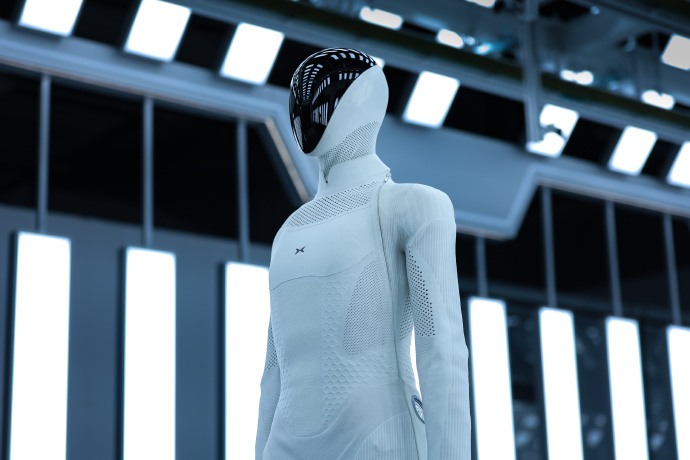
On the hardware side, the latest IRON stands about 170 cm tall, with 76 degrees of freedom across its body and 21 in each hand. It uses a fully enclosed flexible lattice structure. Three Turing AI chips provide 2,250 TOPS of effective computing power, and the physical AI model runs on-device, so the robot can execute complex tasks without teleoperation while keeping inference latency low and data secure.
The capital moves have come almost in lockstep with the production line. On August 24, XPENG Robotics closed its first equity financing round of more than $900 million, with a post-money valuation above $6.3 billion. IDG Capital led the round, with participation from Gaorong Ventures and strategic investors Tencent and Alibaba Group. XPENG remains the controlling shareholder. The round set a new record for a single private equity financing in China’s embodied AI sector. According to XPENG, the funds will go toward software and hardware R&D, model training, data collection, a mass production base, and global commercialization.
Only 15 days passed between the financing announcement and the production line launch. XPENG’s pace is shifting from technology validation to building out a manufacturing system. In June, He Xiaopeng took direct charge of the robotics business and said XPENG would replicate the supply chain, manufacturing, and globalization capabilities it built in the auto business. That path is now taking shape.
XPENG’s timeline puts IRON into volume production by the end of 2026, starting with roles like guiding visitors, assisting shoppers, and patrolling in XPENG stores and campuses. In 2027, the company plans to gradually deliver units to external customers and expand into overseas markets. XPENG has already been exploring industrial inspection applications with companies like Baosteel, and an embodied AI data factory in Guangzhou is providing data support for robot model training.
For automakers, volume production is the real dividing line
XPENG is not the only automaker pushing into humanoid robots. A September 7 report from the South China Morning Post said more than 10 Chinese smart vehicle makers have entered the robotics field. Tesla’s Optimus is an earlier reference point. The logic for automakers is straightforward: smart cars already have perception, decision-making, and execution systems, and capabilities in cameras, radar, chips, software, motors, and thermal management can be transferred to robots. More importantly, automakers have already gone through the full cycle of taking complex hardware from R&D and supply chain cost reduction to large-scale delivery.
Over the past two years, China has seen more than 150 humanoid robot companies, more than half of them startups or crossovers from other industries. Product launches, prototype deliveries, and even small-batch shipments have all happened. “Building a robot” is no longer a scarce capability. A 2023 roadmap from the Ministry of Industry and Information Technology called for batch production of humanoid robots by 2025, with demonstration applications in manufacturing and other settings, and accelerated large-scale development by 2027. Right now, the industry is moving from demos to mass production and commercial validation.
XPENG has chosen its own stores and campuses as IRON’s first stop, where tasks are clearly defined and data can be accumulated repeatedly. This is similar to factory and logistics settings—intermediate steps every humanoid robot must pass through before reaching ordinary consumers.
The first robot walking off an automated production line is only a starting point. The more important question is no longer whether it can perform complex movements, but whether XPENG can consistently replicate more IRONs at low cost and keep them working in real-world settings. From here, the race shifts to yields, costs, task success rates, and payback periods—not stage demos.
