

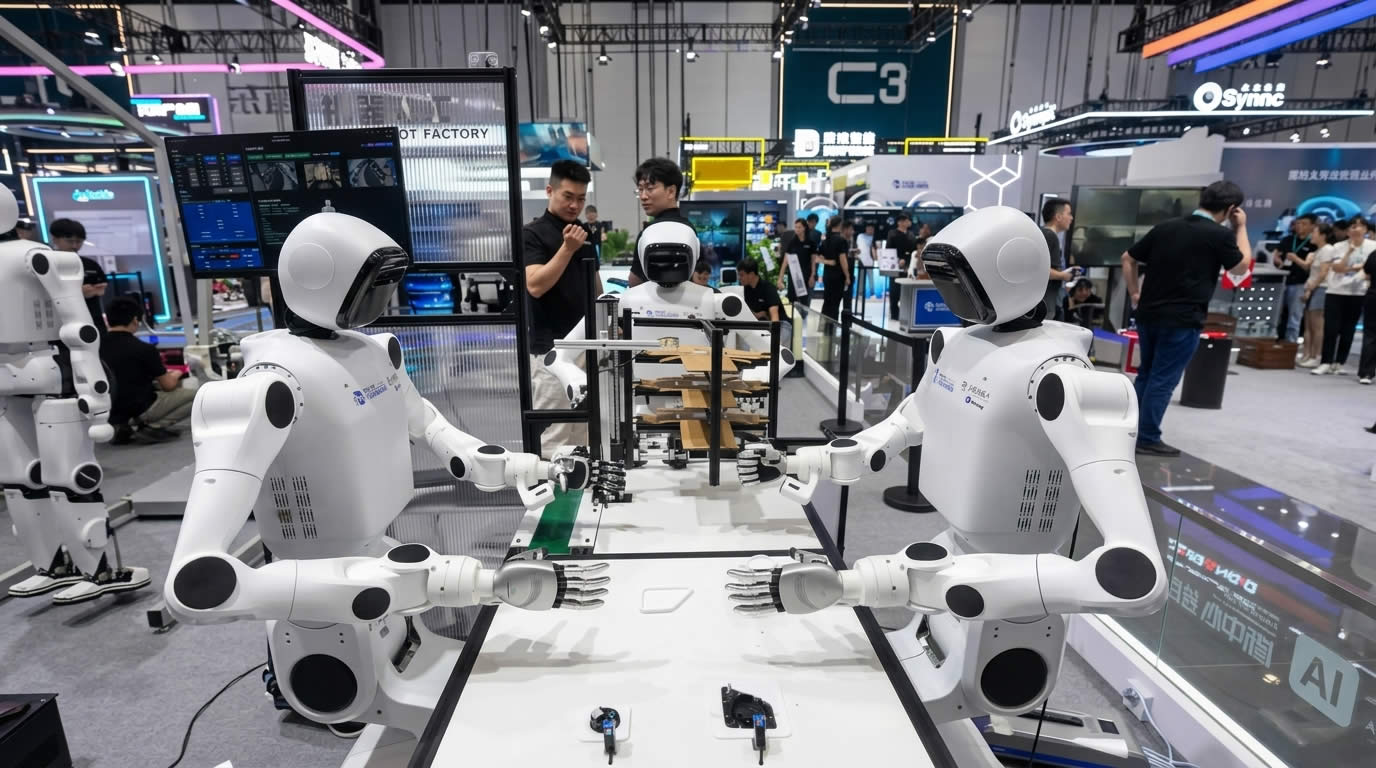
BEIJING — The music was still loud at Unitree Robotics’ booth, where the G1 and H2 humanoids went through their combat and group dance routines. A small crowd gathered, snapped a few photos, and moved on. A short walk away, robots sorting packages on conveyor belts, tightening screws at workstations, and pulling espresso shots had drawn a much bigger audience. Some visitors scribbled parameters into notebooks. Others chased sales reps for pricing. A few squatted down to inspect joint structures.
Reuters put it bluntly in a dispatch from the event: “Robots that can do kung fu are already obsolete.” That might sound extreme, but at this year’s World Robot Conference (WRC 2026), it matched the reality on the ground.
WRC 2026 drew more than 300 exhibitors, up 69 percent from last year, with over 3,000 products on display and more than 300 debuts across 50,000 square meters of exhibition space. New records all around. But the more interesting story lay in two simultaneous shifts: a move away from showmanship, and a slide toward homogenization. The first is a sign of an industry finally leaving the demo stage for the factory floor. The second should raise eyebrows — when everyone is doing the same thing, the sector may be drifting from exploration into something less healthy.
Robots stopped performing. They started working.
My first impression walking into the hall was simple: every robot was on the job.
At the parcel-sorting area, robotic arms from X Square Robot and other vendors worked a conveyor line with the intensity of couriers during China’s Singles’ Day shopping festival. Packages arrived, got grabbed, stacked, and hauled away. RealMan’s manipulator made mooncakes at the booth — kneading dough, wrapping filling, pressing molds, with a fluency that would embarrass most home bakers. Further down the aisles, robots flipped jianbing, pulled noodles, mixed cocktails, brewed coffee, and dispensed soft serve.
Yunji Technology’s noodle-making robot was a standout. It picked up the noodle portion, shook it loose, dropped it into boiling water, timed the cook, scooped it out, filled the bowl, and added hot broth — the whole sequence smooth, about a minute per bowl, 66 bowls an hour. “It’s already been through real breakfast rush hours at hotels,” a Yunji Technology staff member at the booth said with little fanfare. Yunji Technology was among the earliest to commercialize service robots; the little delivery bots that bring takeout to hotel rooms across China are mostly theirs. These robotic workers have already been quietly clocking in out of sight.
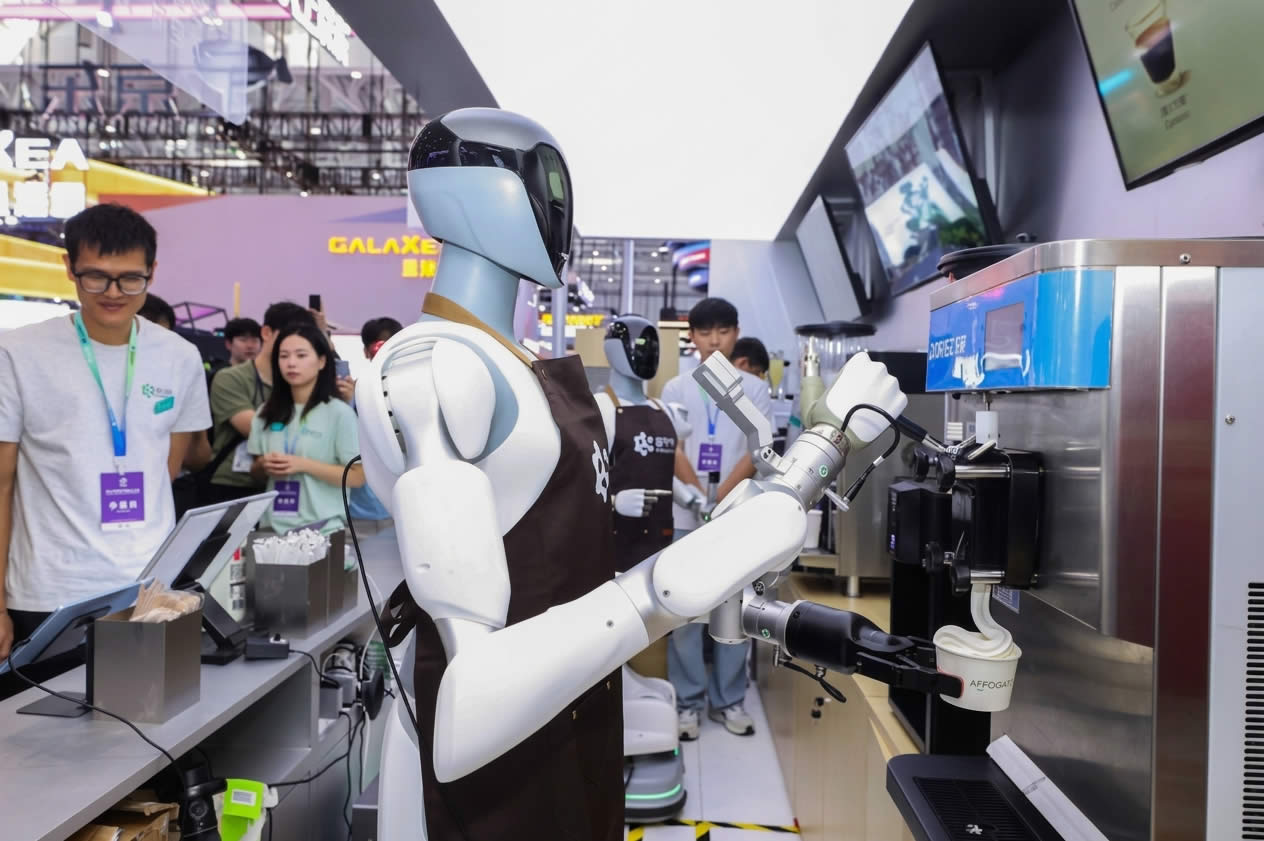
Coffee service was the most common live demo at the event, with at least one robot barista in every hall. AI²’s AlphaBot 2, known as Aibao, handled orders for coffee, ice cream, and cocktails. Visitors scanned a QR code to place an order; the robot identified the order, picked up the cup, operated the equipment, and finished the drink without human help. “Aibao has been running in commercial spaces in over a dozen provinces for quite some time now,” an AI² representative said. “The robot clerk you see on the booth isn’t really here to exhibit. It’s more like a worker on a business trip.”
One detail stood out during the live demos: human intervention was noticeably down from previous years. In 2025, most booths had an emergency stop button and an engineer on standby, with task changes requiring a system reset. This year, robots moved from brewing tea to handing over the cup, adjusted grip when the material changed, and never returned to a home position or re-trained their policy mid-task. Engineers stood nearby with their hands in their pockets. The gap between “performing for you” and “doing the job on its own” is a chasm of engineering work.
The reason for this shift is straightforward. Flips and dance moves are no longer enough to impress audiences. Capital and customers stopped being impressed by demos. Two years ago, investors asked, “Can it walk? Can it jump? Does it have a humanoid form?” Now the first question in the booth is: “How many units are running in real scenarios? What’s the ROI?” “Especially in logistics, more and more customers are willing to have real discussions. They calculate the ROI,” a Robot Era representative said on the show floor.
And technically, flashy motion is becoming less of a differentiator. Walking, jumping and even backflips are no longer enough to set the leading players apart. The real barrier has moved to something else: can a robot finish a task in an unstructured real-world environment, over a long period, with stability, at a cost that makes sense?
Industrial deployment: land now or fall behind
If last year’s WRC was a talent show, this year felt like a job interview. The subtext from every exhibitor was the same: enough talk, put the robot on the line.
Leju Robotics brought a 1:1 replica of a real production line to the show floor, down to the position of the screwdrivers. Its KUAVO humanoid robot worked through depalletizing, material transport, and loading tasks without flourishes. It didn’t look like it was there to exhibit. It looked like it had been pulled in for an overtime shift. The small-parts loading station even had a timer and a counter, with a screen rolling live data: units completed, time per unit, error count, pass rate.
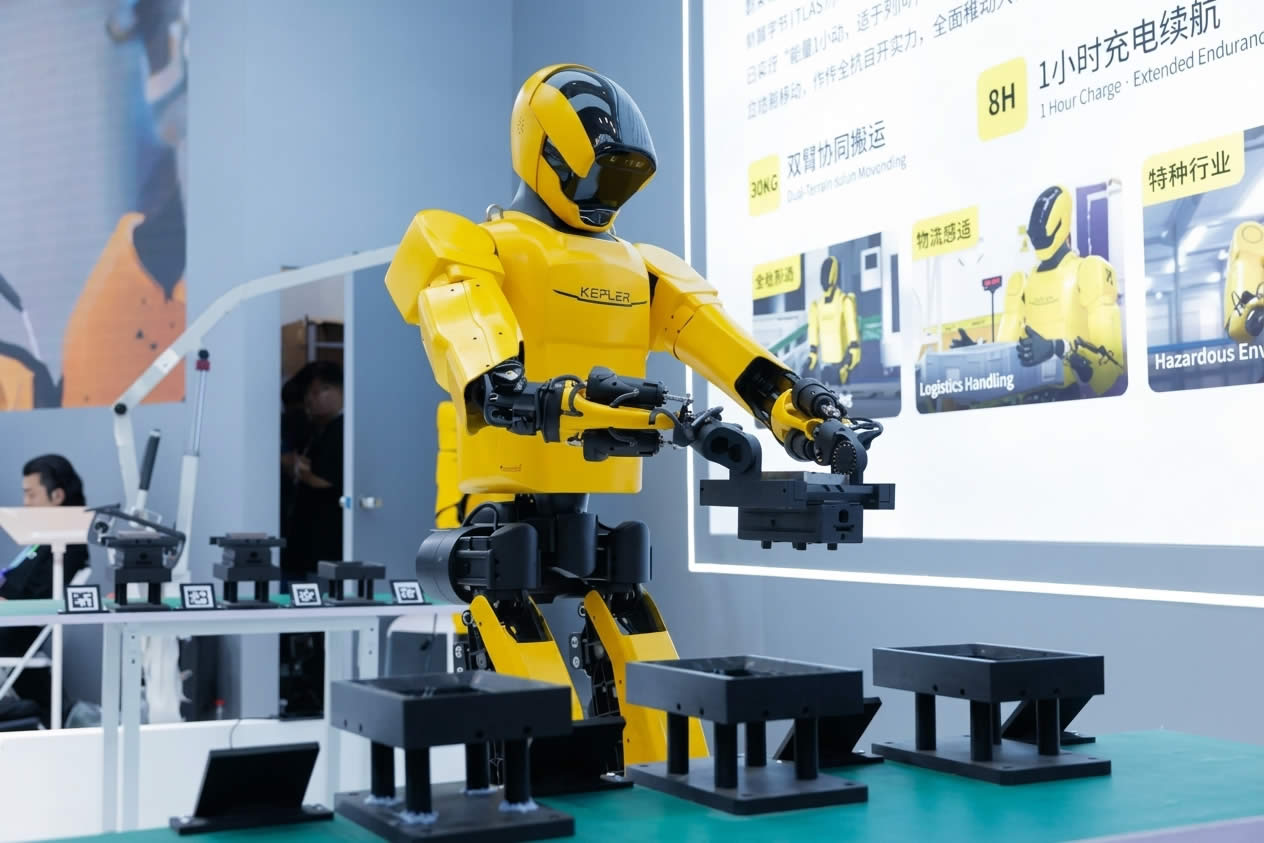
Kepler Robotics presented its updated lineup, led by the K3 Bumblebee — a heavy-duty industrial humanoid in bright yellow — and the K3W, a wheeled dual-arm humanoid with an elevating platform. The K3 Bumblebee stood there like a character out of a Transformers movie, or maybe a very disciplined factory worker in a safety vest. It lifted 30 kilograms, ran eight hours on a one-hour charge, and had an annual production capacity of 1,000 units. “It’s heading overseas,” a Kepler Robotics representative said.
DexForce hauled a Lens Technology smartphone assembly line onto the show floor, a 1:1 recreation of a real production station. Two robots worked a closed-loop line together: dynamic tracking, phone boxing and unboxing, inspection loading and unloading — the full sequence without a break. The task required continuous perception of the conveyor and workpiece states, with precise positioning and fine manipulation in a dynamic environment. These machines may already be turning screws on a daily basis in Lens Technology’s factories.
ROKAE debuted a 20 kg payload robotic arm, demonstrated by lifting a 20 kg dumbbell with the stability of a personal trainer who has spent years in the gym. The arm targeted industrial, logistics, and 3C electronics applications. The message was blunt: no tricks, just labor.
ENGINEAI took a harder-edged route. Its T800 full-size general-purpose humanoid, standing 1.73 meters tall, threw uppercuts and roundhouse kicks, and executed quick recoveries from the ground in a combat demo. The two test units were named Doujiang (soy milk) and Luzhu (a Beijing stew), which sounded like names for a breakfast stall rather than fighting robots. But company representatives stressed that the combat demos were only hardware stress tests, and that more than 60 percent of R&D resources had already been shifted to industrial deployment. “Fighting is a hobby, working is the job,” one engineer on the booth said. In August 2026, the T800 officially entered Luxshare Precision’s Suzhou factory.
The industrial trajectory is becoming clear. The robotics industry appears to be moving beyond the “concept hype” phase and into a much tougher test: delivering measurable value.
From kitchen to ping-pong table, robots are moving in
If industrial deployments feel distant, the domestic scenarios at WRC 2026 were impossible to ignore.
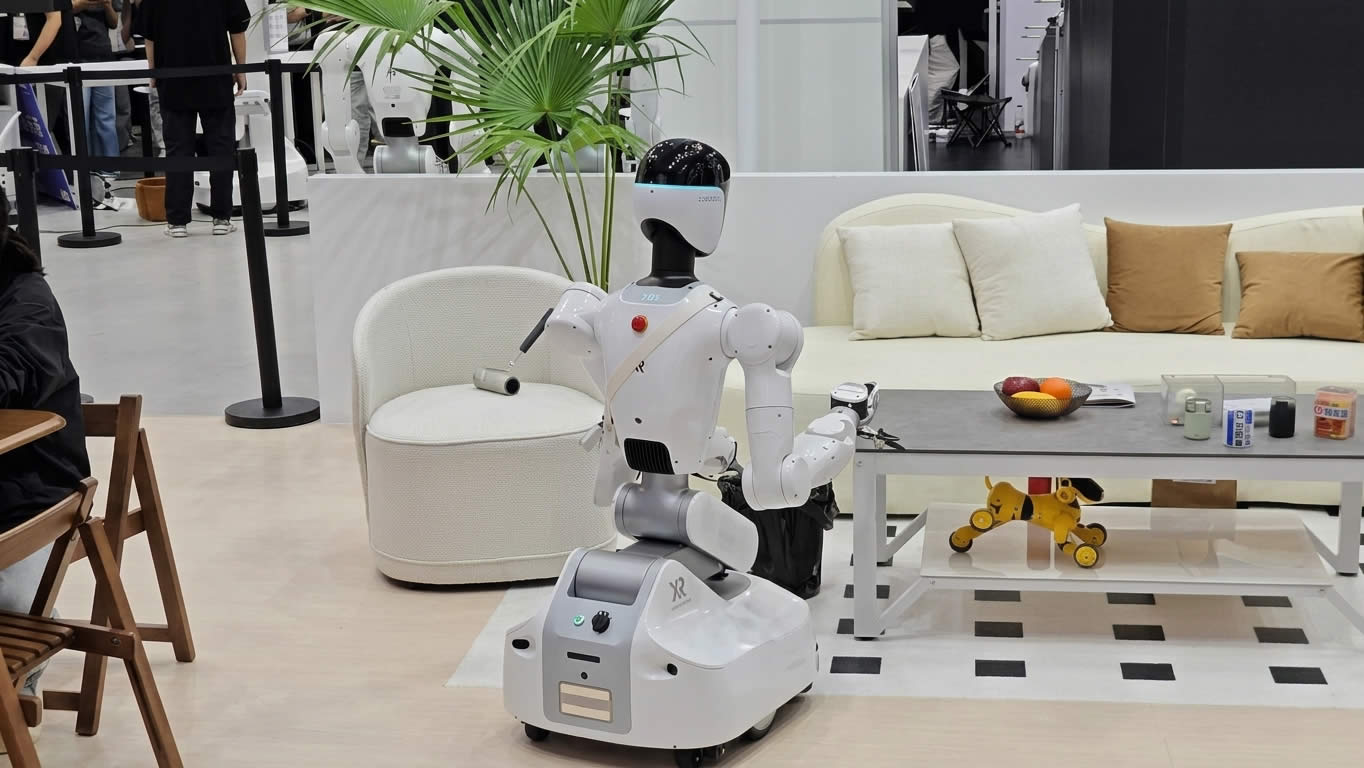
X Square Robot built what it called the “most general-purpose” booth at the event. Its robot completed dozens of tasks — tidying, cleaning, transporting, running errands — including folding soft clothes, retrieving takeout, grabbing drinks, clearing tables, watering plants, scooping cat litter, and changing trash bags. At one point it picked up a pet toy and teased a nearby robot dog, making it hard to tell who was the owner and who was the pet. This was not a concept video; it was a 1:1 recreation of real home service. In March, X Square Robot and 58 Daojia launched a robot-assisted home cleaning service, with the robot and a human cleaner working side by side. In May, the company started an “X Family Member Program” that places a robot in a user’s home for up to a month — a trial employment, essentially.
Spirit AI chose a long-horizon living room tidying task, then pitted its Moz1 against its own performance from the WAIC conference 30 days earlier. After a month of iteration, Moz1’s success rate on subtasks like putting a Coke in the fridge and loading a bowl into the dishwasher climbed to over 99 percent.
Ping-pong became the de facto test for dynamic perception and motion control among humanoid robots this year. Booths across the halls had robots rallying with visitors, turning the event into something like a cyber sports league. Unitree’s G1 tracked incoming balls in real time, executed forehands, backhands, and crossover steps, and adjusted its stroke and body posture based on the ball’s trajectory — sustaining rallies against human opponents.
PHYBOT showed a robot that could play both badminton and ping-pong. The machine runs on the company’s proprietary PhyAgents physical AI agent, which combines a decision-making agent with a motion-control model to build a complete perception-decision-action loop. Transferring from badminton to table tennis demonstrated the general learning ability of this architecture — the robot is escaping “single-task, single-machine” limitations and moving toward “one machine, many jobs.” Translation: today it plays with you, tomorrow it can go to a factory and take over your shift.
The signal from the life-scenario demos was clear: robots are not “preparing” to enter your life. They are already in it.
JD.com steps in, buying a robot gets closer to buying a phone
One notable development at WRC 2026 was JD.com serving as the event’s global strategic partner. The e-commerce giant set up a 600-square-meter exhibition zone with over 100 brands and more than 100 robot products, organized around three themed areas: “Cyber Training Camp,” “Real Industrial Park,” and “Future Life.” JD.com also announced a robotics strategy with a commitment of 10 billion yuan (about $1.49 billion) in resources. In the outdoor area, companion robots, exoskeletons, and educational robots sat on smart shelves, available for immediate testing and purchase.
What does this mean? Buying a robot is becoming as normal as buying a smartphone. Most products currently available are consumer-grade — companion, education, service categories — but the direction is obvious.
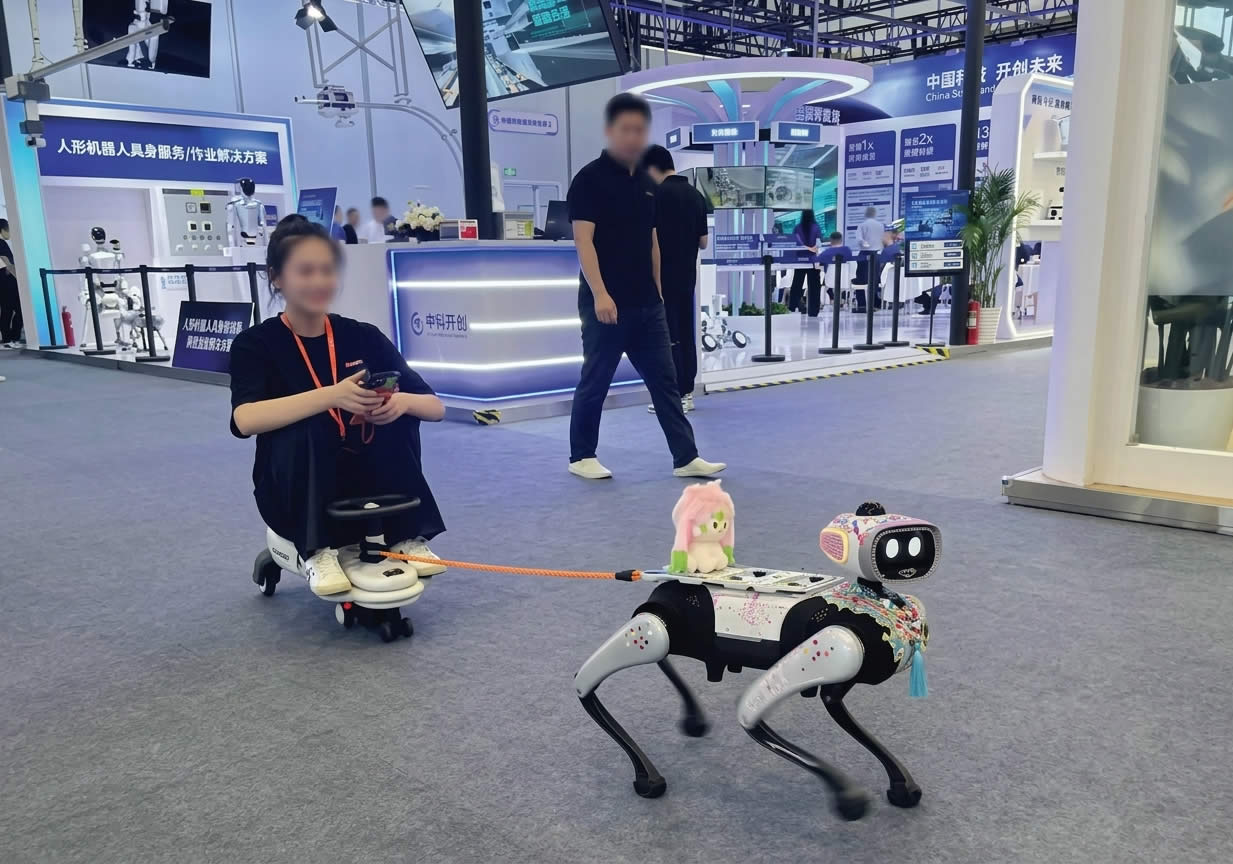
VBot is a good example. Its AI cargo dog BoBo, launched in December 2025, sold 6,540 units in its first batch, with orders approaching 100 million yuan (about $14.9 million). To date, BoBo remains the top-selling consumer embodied AI product in China, with more than 30 offline sales and experience points. At this year’s WRC, VBot formally launched VBot ATOM, a 160 cm tall humanoid embodied AI device with 31 degrees of freedom, aimed at home, retail, public, and office environments. The company also released the BoBo EDU-W wheeled-legged version, priced at 49,988 yuan (about $7,439). In a crowd-pleasing moment, the BoBo cargo dog pulled a staff member dressed in traditional Chinese clothing around the venue — smooth, steady, and very much the center of attention.
Bionic faces, brain-computer interfaces, and dexterous hands
The “appearance” of robots also got a major upgrade this year.
Noetix Robotics showed its bionic robot heads — X-Head1 (nicknamed Xiaoyue), the male version Xiaochen, and four new IP makeup designs. When visitors approached, the heads turned, greeted, and responded naturally. The Xiaobumi, which appeared on China’s Spring Festival Gala, also drew crowds while dressed in hanfu. Noetix Robotics founder Jiang Zheyuan recently set a target of 10,000 units delivered in 2026. The Xiaobumi was one of the few robots at WRC that visitors could actually buy and take home — small, priced under 10,000 yuan (about $1,488), and surprisingly approachable.
UBTECH’s U1, unveiled shortly before the event, made an appearance with 88 flexible joints and a proprietary bionic cervical spine that eliminated the mechanical stiffness in head movements. More important, the U1 carried the company’s Resonance-LM emotion-aware large language model, which could sense user emotions and respond with care. The shift from “looks like a human” to “understands a human” may be the most fundamental evolution in bionic robotics.
The most sci-fi demonstration at the event came from BrainCo. A volunteer sat next to a humanoid robot wearing an EEG cap. No controller, no body gestures. Brain signals were collected, processed by algorithms, and converted directly into commands the robot could execute. Even a researcher with no background in the field could learn to control a robot with their mind in about ten minutes. Brain-computer interfaces are moving out of the lab and onto the show floor. BrainCo also presented the Revo 3 dexterous hand and a new intelligent prosthetic hand, which reads muscle and nerve signals from the residual limb to recognize motor intent and drive grasping motions.
Dexterous hands were one of the biggest changes at this year’s event. They moved from “accessory” to center stage. Linkerbot and BrainCo both took large booths, no longer attached to humanoid robot vendors. Linkerbot is one of the few companies that have mass-produced direct-drive, linkage, and tendon-driven transmission solutions. Its most striking demo: a dexterous hand assembling another dexterous hand. The robotic arm had to complete component assembly inside the relatively tight space of a palm, involving pinching, picking, and placing with fingertip precision.
The brain matters more than the hands
Dexterous hands are useful, but the brain is where the real competition is heating up.
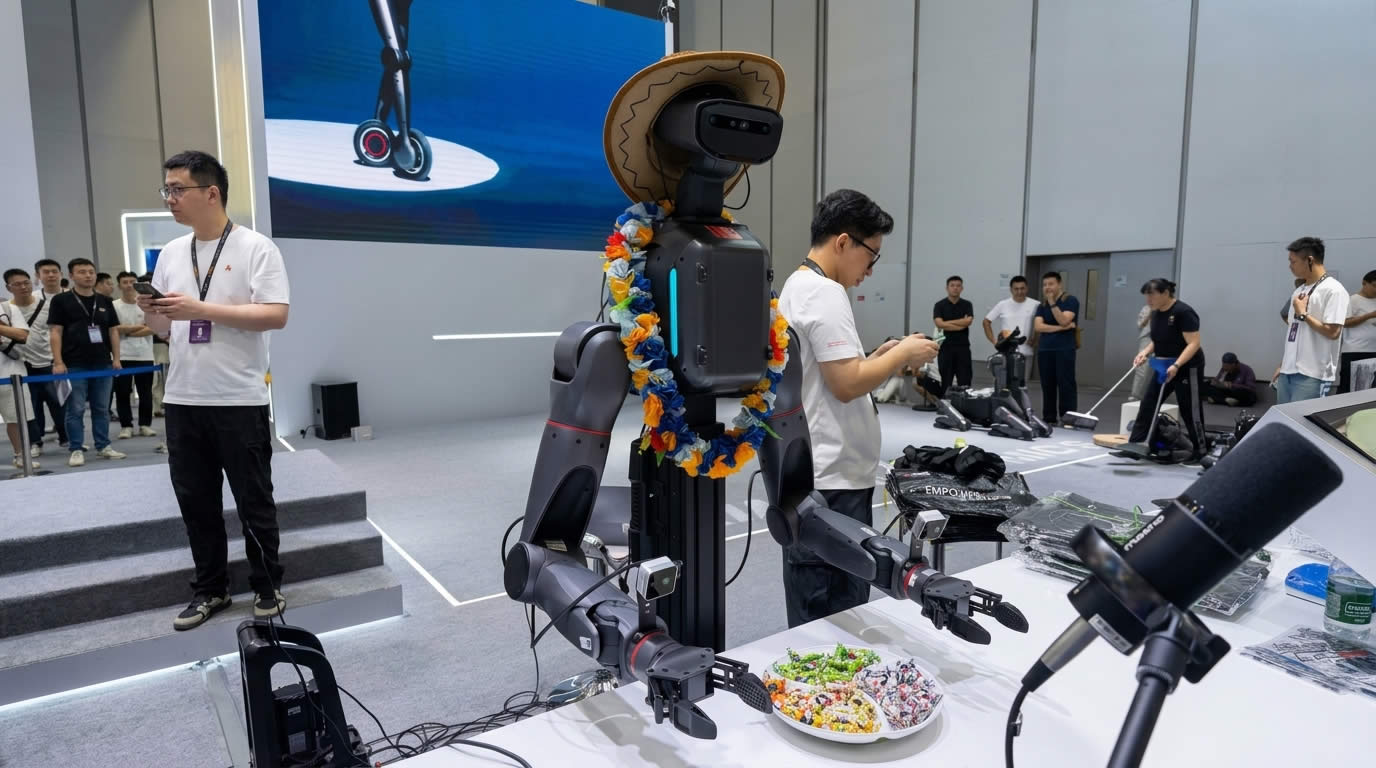
LimX Dynamics was among the most compelling “brain” exhibitors. Its full-size humanoid Oli acted as a “cyber MC,” chatting with visitors in 11 languages. The full-size interactive humanoid Luna performed samba and traditional Chinese dances using swarm control. The multi-form TRON 2 even combined bipedal legs with dual arms into a centaur-like configuration that walked steadily.
“The model is not the brain. The system is the brain,” said Zhang Wei, founder of LimX Dynamics. A true embodied brain is an entire operating system with three layers, each with its own role and asynchronous collaboration. The company also open-sourced the FluxVLA Engine enterprise platform, giving global developers access to the engineering infrastructure for model training, iteration, and deployment.
Galbot launched the GALBOT ET1, a robot with a different form factor from its previous G1 and S1, but one that shares the same AstraBrain. The core idea is “one brain, many bodies”: the “brain” understands the environment and plans tasks, the “cerebellum” controls the body and hands, and a middle layer translates high-level intentions into continuous actions.
AI² introduced and open-sourced NeuroVLA, a brain-inspired architecture for embodied models that maps the human brain’s cortex-cerebellum-spinal cord coordination onto robot control systems. The cortex handles semantic understanding and task planning, the cerebellum manages high-frequency motion coordination and dynamic correction, and the spinal cord executes millisecond-level actions and safety reflexes. This means a robot no longer has a single “brain” processing everything. It has multiple layers of intelligence working at different speeds — moving from “able to think” toward “able to react, correct, and adapt.”
Lightwheel is working on something even more foundational: building schools and exam halls for robots. The company, founded in 2023 with just 31 employees and a valuation exceeding 15 billion yuan (about $2.23 billion), open-sourced a 100,000-hour multimodal human behavior dataset at WRC. It also launched the RoboFinals pilot-scale simulation evaluation infrastructure and the RoboStack real-world deployment and feedback platform.
Foreign visitors crowd the aisles, Chinese robots stand tall
Two other things stood out at WRC 2026.
First, the number of foreign visitors. Huang Minshan, senior marketing director for NVIDIA’s robotics business — and Jensen Huang’s daughter — appeared on the show floor. She wasn’t there for a photo op. She visited the booths of DOBOT, Lightwheel, UBTECH, and others, and even tried Kepler Robotics’ heavy-duty Kirin quadruped robot. The day before arriving in Beijing, she had been in Seoul meeting with LG Electronics executives about robotics cooperation. Flying straight from Korea to Beijing to inspect Chinese robots — the itinerary sends a pretty clear signal.
There were plenty of other foreign attendees: buyers discussing procurement, engineers swapping technical notes, and visitors simply stunned by the scale of China’s robotics push, phones out and filming. China is now the world’s largest manufacturing base for many categories of robots, and the scale on display in Beijing was hard for overseas visitors to miss.
Second, China’s robotics industry is forming a complete closed loop. It’s no longer individual companies competing alone; it’s an industrial ecosystem moving together. Guangdong province sent 34 companies, spanning EVE Energy’s batteries, Orbbec’s vision technology, UBTECH and LimX Dynamics’ humanoid robots, Newgear’s lead screws, and PaXini’s tactile sensors — batteries, vision, complete robots, components, all in one place. Beijing’s E-Town, home to WRC’s permanent venue, brought more than 20 companies and nearly 100 new products, covering complete robots, application scenarios, and core components. The Beijing Humanoid Robot Innovation Center gave the global debut of its Tiangong Omni, which walked on plum blossom poles, climbed stairs, and crawled through obstacles with more stability than most commuters on a rush-hour subway. Yaskawa Shougang Robotics showed a MOTOMAN NEXT adaptive AI robot that sees, moves, and works on its own. Galaxea demonstrated a robotic fulfillment hub taking online orders and robots assembling robots — a full cybernetic loop.
The shift away from showmanship is real. The homogenization should worry you.
Walking from Hall A to Hall C, I saw more than a dozen humanoid robots. Closing my eyes and trying to recall them, it was hard to point out any fundamental difference between one and the next.
The forms are nearly identical. The well-known humanoids at this year’s event — Unitree G1, UBTECH Walker S2, Galbot G1, Robot Era L7, Galaxea Nexo, DOBOT’s second-generation humanoid, Kepler, CRP, PHYBOT M1, VBot ATOM, Wanda 2.0, X Square’s Quantum series, and others — all follow the “bipedal + dual-arm” standard configuration. Heights cluster between 1.6 and 1.8 meters. Degrees of freedom range from 30 to 55. Youyi Technology showed a “transformable essential humanoid” called T01, pitched as a differentiated design, but it’s still bipedal plus dual arms, just with a simplified head and waist. Zhejiang Humanoid Robot Innovation Center’s NAVIAI WA1 is a wheeled-arm design, not pure bipedal, but still a variation on dual-arm manipulation. The truly different form factors — quadrupeds, wheeled dual-arm bases, fixed manipulators — were also the least crowded and least photographed.
The demo tasks are even more homogeneous. You watch a robot sort packages at one booth, walk fifty meters, and there’s another robot sorting packages, just with different colored boxes. One robot tightens screws in Hall A, another tightens screws in Hall C, just with a different screw size. The top five most common demo tasks this year, by rough count: logistics sorting and transport, industrial loading and screwdriving, coffee and beverage preparation, item tidying, and teleoperation replication. Nearly every humanoid company did at least two of these.
Technical routes have converged as well. Almost every leading company told the same story this year: large models for perception and decision-making, small on-device models for motion control, teleoperation for human data collection, and simulation for data scaling. Galbot calls it AstraBrain, cramming the brain, cerebellum, and neural control into a single architecture. Galaxea emphasizes “training on fully real data.” Robot Era shows teleoperation data collection. UBTECH says “understanding people matters more than looking like people,” which is also multimodal perception plus semantic understanding. Different words, same underlying logic.
Dexterous hands followed the same pattern. Robot Era’s XHAND 1 has 12 active degrees of freedom and 80 newtons of grip force; the XHAND 1 PRO bumps that to 21 degrees. Linkerbot’s Linker Hand O30 has 20 fully independent active degrees of freedom, a monthly capacity of 4,000 units, and claims over 80 percent market share in high-degree-of-freedom dexterous hands. Everyone is competing on “fully direct-drive, high degrees of freedom, tactile perception,” with spec sheets that read like copies.
Application scenarios are equally concentrated. Logistics, automotive manufacturing, and 3C electronics — almost every company mentioned these three. Bowintec targets automotive parts, new energy, and 3C electronics. Robot Era focuses on logistics. DOBOT talks about precision industrial work. UBTECH claims coverage of industrial, commercial, and home scenarios, but the real deployments are industrial. Everyone piles into the same few tracks because those are the clearest, most standardized, and best-paying markets. But how many companies doing roughly the same thing can one track support?
To be clear, homogenization does not mean no technical progress. The robots at this year’s show were noticeably better at motion control precision, task continuity, and environmental adaptability than last year. Homogenization means the direction of progress is so consistent that the final products and capabilities look increasingly alike. Think of the smartphone industry between 2012 and 2015: every manufacturer made big screens, touch interfaces, Android systems. Spec sheets converged. The real differentiator was no longer “can you make a smartphone,” but supply chain cost, brand channels, and ecosystem services. The robotics industry may be entering a similar phase.
Why is everyone starting to look the same? There are the usual explanations. Technology routes have converged: large models plus on-device control plus teleoperation data plus simulation training was validated in 2025, and in 2026 it became the industry standard. The supply chain has standardized: the core components of humanoid robots — frameless torque motors, harmonic drives, six-axis force/torque sensors, IMUs — come from a handful of suppliers. Everyone buys the same parts, so the assembled robots perform similarly. Capital and customer demand also push toward uniformity: investors only recognize logistics and industrial manufacturing as paying markets, and customers only pay for those scenarios. Startups, to raise money and sell products, have to crowd into those directions.
But the deeper reason is that the industry’s exploration phase may be winding down. During exploration, companies were still testing what humanoid robots could do and how to build them. Weird and varied forms and routes appeared: wheeled, quadruped, bipedal, fixed-arm-plus-mobile-base, reinforcement learning, imitation learning, traditional control. Differentiation was natural because nobody knew which path would work. By 2026, after three or four years of trial and error, the industry has reached a few broad agreements: bipedal humanoids remain the industry’s dominant long-term bet, but wheeled and dual-arm designs are landing sooner; the large-model-plus-on-device-control framework works; logistics and industrial manufacturing are the most scalable near-term deployment scenarios.
Once those agreements take hold, the exploration phase starts to wind down. Companies no longer need to “find a direction.” They need to “execute” — same direction, same technical route, same target scenarios, competing on who is steadier, cheaper, and faster to deliver. In the execution phase, differentiation naturally shrinks because there are only one or a few optimal solutions, and everyone converges toward them. This is not a failure of any single company or a lack of creativity. It’s what happens when an industry reaches this stage.
From exploration to elimination
Homogenization signals the start of a shakeout.
In the exploration phase, the competition was about who had the newest technology, the flashiest demo, the best story. That’s how you raised money and got attention. In the elimination phase, the logic flips. When everyone is doing roughly the same thing, the competitive dimensions change.
Cost. One humanoid costs 200,000 yuan (about $29,762); another costs 150,000 yuan (about $22,321) with similar performance. Which one does the customer pick? Unitree shipped over 5,500 humanoid robots in 2025 (excluding wheeled dual-arm units), and Zhishen Technology has cumulatively produced over 15,000 units as of June 2026, with a monthly capacity exceeding 5,000 units. Those numbers translate into cost advantages through scale. Smaller companies without their own supply chain and manufacturing capability cannot compete on cost against the leaders.
Delivery. A customer doesn’t buy a single robot; they buy a solution that has to run in their facility. Can you deploy it on site? Can you train their engineers? Can you respond within 24 hours when something breaks? These delivery capabilities matter a hundred times more than a booth demo. And delivery capability comes from teams, processes, and experience — not from one brilliant algorithm engineer.
Reliability. Running for five minutes on a show floor without failure is not hard. Running for three months at a customer site, eight hours a day, without failure is another matter. Mean time between failures, long-term operational life, maintenance costs — these are what customers actually pay for. Reliability is built on data from a large number of real-world operating hours. The more you run, the more stable you get; the more stable you get, the more orders you win. It’s a positive loop, and the leaders will keep accelerating.
Data. When technical routes converge, model performance depends on the quality and quantity of training data. Whoever has robots running the most in real scenarios and collecting the most real interaction data will have the best models. Another positive loop: more deployments → more data → better models → more deployments.
All four dimensions favor scale. That means the industry will concentrate quickly, and the survival space for small and mid-sized players will shrink fast. There are dozens of humanoid robot companies on the show floor today. In two or three years, only a handful may remain. The rest will be acquired, pivot to components or niche scenarios, or simply disappear. The smartphone industry went from over a hundred brands in 2010 to around a dozen mainstream ones by 2015 — five years. The robotics shakeout could be faster because hardware costs are higher, technical barriers are steeper, and investor patience is thinner.
Homogenization isn’t automatically bad. Its other face is standardization, and standardization is a prerequisite for any industry moving from craft production to mass industry. Cars went through it. Phones went through it. Robots will too. When forms, interfaces, and technical routes converge, components can be purchased off the shelf, supply chains can scale, customers can compare brands, and developers can build on a unified platform. One founder reportedly said at the event that “you could assemble a complete humanoid robot right on the show floor” — all the core components were on display from independent suppliers, and an integrator could buy and assemble them like Lego bricks. That’s a sign of supply chain standardization, and it will lower entry barriers and manufacturing costs across the board.
So homogenization itself is not the problem. The question is whether new competitive advantages have been built after differentiation faded. If everyone looks the same and does the same tasks, but real gaps open up in cost, delivery, reliability, and data, that’s healthy homogenization — it means the industry has entered a phase of fine-grained competition. But if everyone looks the same, does the same tasks, and also has similar costs, delivery, and reliability, that’s a genuine danger. It means the industry is stuck in undifferentiated cut-throat competition: everyone doing the same thing, nobody with a clear edge, and the only way to survive is burning cash, cutting prices, and out-fundraising rivals. That kind of competition produces no winners. It just burns the industry’s profits and confidence.
Where is WRC 2026 in this cycle? It appears to be at the transition point from “exploration-phase homogenization” to “elimination-phase differentiation.” Hardware and demos are already highly similar, but the gaps in cost, delivery, reliability, and data are starting to widen — just not fully visible on the show floor yet.
The other thing worth watching: when everyone crowds into the same few scenarios, are we missing more valuable directions? Logistics and industrial manufacturing are the clearest near-term deployment opportunities. But the ultimate value of humanoid robots may not be replacing factory workers. It may be entering spaces that automation hasn’t touched yet — home services, eldercare, commercial operations, emergency response. Those scenarios still look distant, but if every company fixes its gaze on logistics and industry and nobody explores further out, the industry ceiling may be lower than anyone expects. The exploration phase may be winding down, but the exploration itself shouldn’t stop.
For visitors and media, future WRCs may feel increasingly “boring” — everyone does similar things, and there’s less novelty to gawk at. For people inside the industry, the next few years will be the real test. The visible differences on the show floor are fading; the real battlefield has moved elsewhere — to customer factories, supply chain negotiating tables, and investor due diligence checklists.
Robots that can do kung fu are yesterday’s news. Robots that can do the job are clocking in. But when so many robots can do the job, which ones will still be standing a few years from now? WRC can’t answer that. Time will.
