

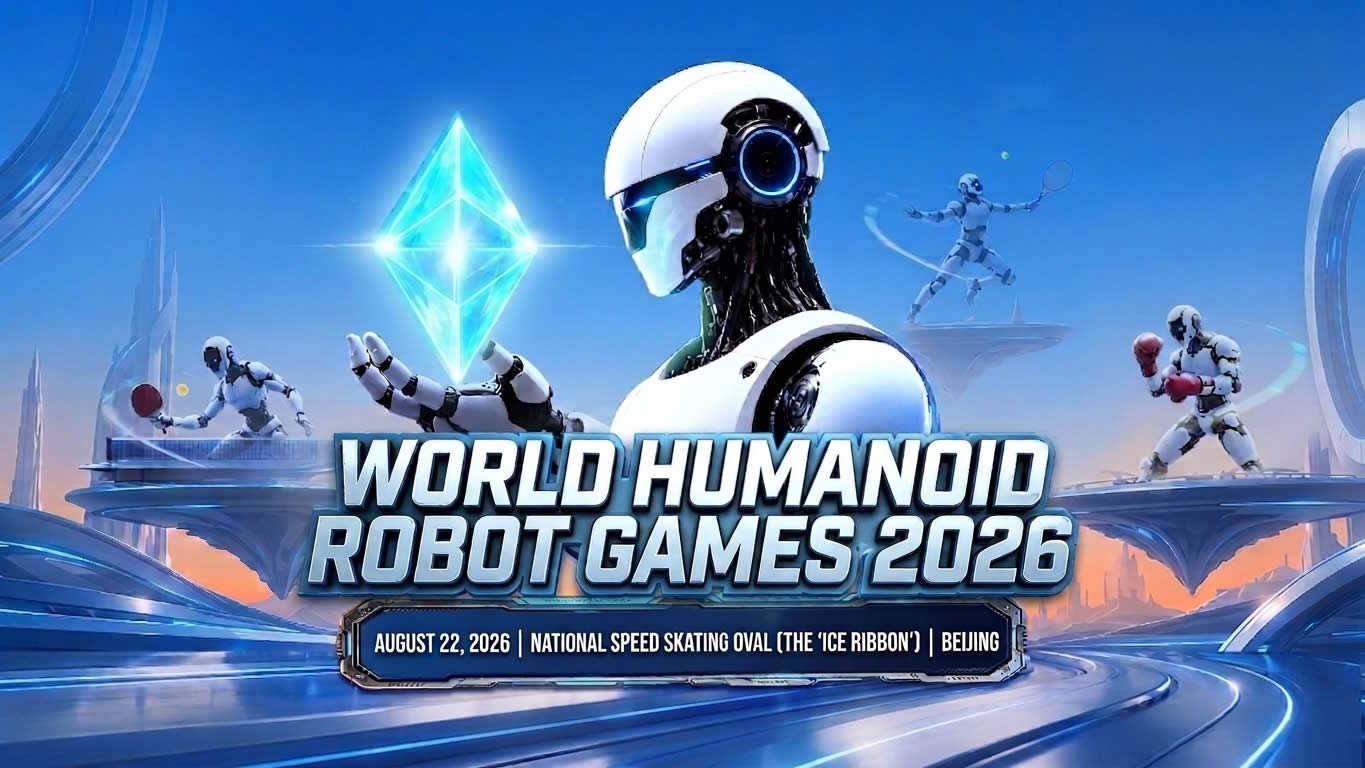

The second World Humanoid Robot Games open today, August 22, at the National Speed Skating Oval, known as the “Ice Ribbon,” in Beijing. Over the next five days, 666 teams from 16 countries across six continents will field 2,056 robots across 51 events and 1,301 competition sessions.
Compared with the inaugural Games, the number of events has nearly doubled, from 26 to 51. Scenario-based events have expanded from six to 21, covering real-world settings including industrial production, hotels, homes, emergency response, catering and office work. Athletic events have also added long jump, weightlifting, tug-of-war and table tennis.
The focus of the competition is changing as well. Instead of simply asking whether a robot can complete a task, this year’s Games place greater emphasis on whether it can do so autonomously and consistently.
The opening ceremony carries the theme “Intelligent Competition Toward the Future.” More than 1,000 humanoid robots will take part in a coordinated entrance, alongside athletes and children.
More Teams, Tougher Performance Standards
Of the 666 participating teams, 641 are from China, representing 157 companies and 200 universities and research institutions. Together, they account for 1,975 robots. International teams include competitors from the United States, Germany and Japan, while Brazil has brought together five teams from the RoboCup football community to compete as a national team.
Team participation has risen 138% from the inaugural Games, reaching 666 this year. The competition now includes 30 athletic events and 21 scenario-based events, with the number of competition sessions rising from 487 to 1,301.
The rules have become stricter at the same time.
The time limit for the 100-meter event has been cut from three minutes to one minute. The 400-meter limit has fallen from 15 minutes to five, while the 1,500-meter limit has dropped from 40 minutes to 15.
Except for the 100-meter and 400-meter obstacle races, robots must compete autonomously in all other track events and athletic events. In scenario-based events, fully autonomous runs receive a scoring weight of 1, while remotely controlled runs receive a weight of 0.5. Difficulty levels have also been raised in gymnastics, martial arts and dancesport.
For robot makers, the Games are becoming less of a technology showcase and more of an engineering test.
A 9.32-Second 100-Meter Run Has Already Made Headlines
One of the biggest stories has already emerged before the official races begin.
On August 22, the humanoid robot “Lightning,” fielded by Team Honor, ran the 100 meters in 9.32 seconds in a test, with a reported peak speed of 14.5 meters per second. That test time is faster than the 9.58-second men’s 100-meter world record, although it is not an official competition result and should not be treated as an official world record.
“Lightning” will also compete in the 100-meter event, the 400-meter large-robot event, and the 1,500-meter event. Its performance in the official races will be closely watched.
A sprint time like that depends on far more than raw speed. Leg design, actuators, sensors, control software, battery capacity and thermal management all have to work together. A weakness in any one area can affect the result.
Tug-of-War, Weightlifting and Table Tennis Put Strength and Control to the Test
Among the new events, tug-of-war is one of the clearest tests of whole-body control.
The two-on-two event is held on a track 12 meters long and 1.2 meters wide, with each match lasting two minutes. A robot is disqualified if any part of its body other than its feet touches the ground or if it steps outside the boundary. Competitors are divided into two weight classes: under 40 kg and 40–80 kg.
Robots have to grip the rope directly with their dexterous hands. The challenge is not simply to pull harder, but to keep their feet planted, control their body position, and respond to changing forces from both opponents and teammates. The event puts force sensing, balance, joint torque control and multi-robot coordination to the test at the same time.
Weightlifting creates a similar test under high loads. Each added kilogram puts more strain on the robot’s actuators, structure and control system.
Table tennis brings a different challenge. Robots have to track the position and motion of the incoming ball, move into position and return it within a short window while maintaining balance. Unlike a pre-programmed demonstration, a real match forces the system to respond continuously to an unpredictable environment.
Freestyle Combat: Full-Body Competition Inside an 8-Meter Ring
Freestyle Combat has three weight classes: 40 kg, 58 kg and 80 kg. The matches take place in an 8-by-8-meter ring, with three rounds of two minutes each. Teams can choose between wireless remote control, semi-autonomous operation and full autonomy.
For a humanoid robot, Freestyle Combat is about more than throwing punches. Footwork, evasive movement, recovery after impact and shifts in balance during continuous movement all require real-time control.
Unlike a fixed routine, Freestyle Combat involves a changing opponent. A robot has to maintain its balance while moving and striking, while also responding to changes in posture caused by physical contact. Punches can shift the robot’s center of mass, while kicks place greater demands on single-leg support. Once balance is lost, the robot must recover quickly.
Freestyle Combat will run across several competition sessions this year.
Dexterous Hands Become a Major Test of Practical Skills
This year’s Games have introduced a standalone dexterous hand competition with eight events: power tool assembly, powder weighing, block building, nail fastening, bottle opening and cap prying, package unpacking, picking beans with tweezers, and cable connection.
Some of the tasks look simple to a person but are difficult for a robot.
In bottle opening and cap prying, one hand has to hold the bottle steady while the other positions and uses an opener to remove the cap. Picking beans with tweezers requires the robot to identify small objects and pick them up one by one. Cable connection requires the system to distinguish between different connectors and cables before aligning and inserting them.
The challenge is not just hand strength. It is the coordination of vision, arm movement, end-effectors, force control and decision-making.
That matters for humanoid robots because many of the jobs they may eventually perform in factories, hotels, homes and retail environments will involve handling objects, carrying materials, assembly, sorting and tool use rather than running.
Scenario-Based Events Move From Demonstrations to Actual Work
The scenario-based events have expanded to 21, covering nine real-world settings.
Robots will take on tasks in industrial production, hotel services, catering, emergency response, office work, household services, library management, retail and new-energy vehicle charging.
Some events are held directly in real environments, including library and hotel tasks. Others recreate workplace settings inside the Ice Ribbon. Thirteen events will pit multiple teams against each other in the same environment, testing whether robots can carry out a complete sequence of tasks rather than a single isolated movement.
In the catering scenario, for example, robots are expected to handle tasks such as heating food, preparing drinks and packing orders. Office events include setting up rooms, printing and shredding documents. Industrial events include packing goods for storage and loading components for assembly.
The emphasis is increasingly on efficiency, success rate and autonomy. Robots are being tested on requirements that are much closer to those they would face in an actual workplace.
The Games Are Testing More Than Movement
At the first World Humanoid Robot Games, many events centered on whether robots could complete a prescribed movement or task. A year later, the rules place more weight on whether they can do it without human intervention.
Football is a clear example. This year’s competition adds a 3v3 U19 category alongside 5v5 matches. Robots have improved to the point where they can carry the ball while running, take powerful shots and make saves, bringing their movement control closer to the continuous action seen in human players.
Dancesport has also expanded sharply. The number of teams competing in street dance, ballroom dance and cheerleading has risen to 108, compared with 29 last year.
None of this means humanoid robots have caught up with human athletes. Falls, sharp turns, sudden stops and attempts to recover remain some of the clearest ways to see where current Embodied AI and robot-control systems still struggle.
For developers, the Games provide a common test environment where different platforms can be compared on speed, stability, autonomy and task performance.
Opening Night Brings 7v7 Football and Track Qualifiers
After the opening ceremony on August 22, the first events will include a 7v7 football exhibition match and qualifying rounds in the 400-meter and 100-meter races.
Competition will continue through August 26, with 12 gold medals up for grabs on August 23. The lightweight and heavyweight titles in weightlifting will be decided on the evening of August 24, while the finals of the dexterous hand competition will take place on August 23 and 24.
