


Workers at a Hyundai plant in South Korea recently staged a partial strike, but the dispute was not about wages or working hours. The union demanded a written guarantee from management that jobs would be safe as humanoid robots move onto the factory floor. It was the first labor standoff in the global auto industry triggered directly by the risk of humanoid replacement.
In China, however, those robots are already clocking in.
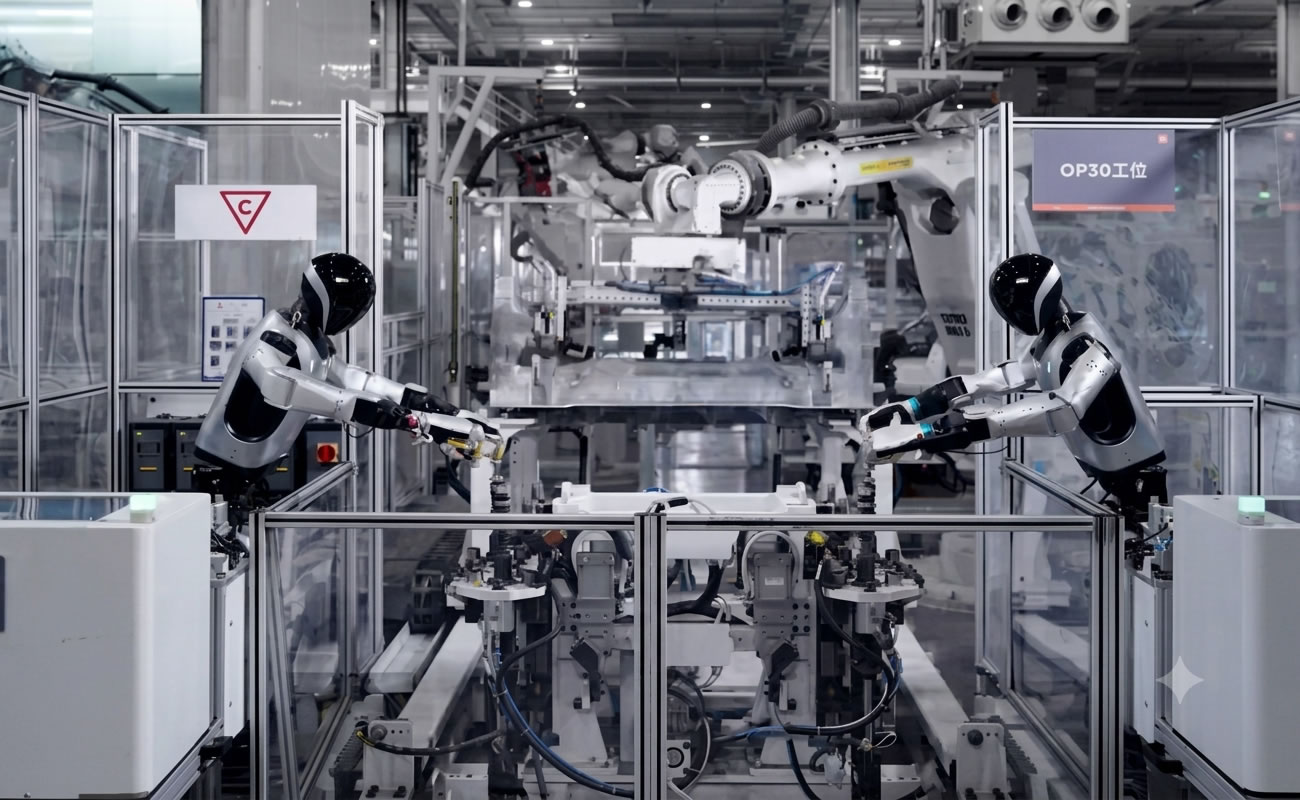
Xiaomi’s in-house humanoid robot has been operating at the company’s auto plant in Beijing’s Yizhuang district for less than six months. It has successfully handled a challenging assembly task: installing the center console cover, a flexible plastic part that deforms easily and has always required human hands. The robot uses whole-body multi-joint adjustment and fingertip force sensing to adapt to slight shape variations. The success rate now sits close to that of an experienced worker.
At CATL, the world’s largest electric vehicle battery maker, a heavy-duty humanoid robot called the Galbot S1 began work at a power battery component workshop in late June. Built by Beijing-based Galbot, the robot hauls 50-kilogram battery cell crates — lifting, stacking, and sorting scattered parts — and has been running around the clock without interruption. The company described it as the first humanoid robot to sustain continuous operation on such a core new-energy production line.
During the 2026 World Artificial Intelligence Conference in Shanghai, more than ten embodied AI robots recreated a full car manufacturing flow, completing battery module stacking, precision headlight assembly, wiring harness weaving, and two other major processes on a single demonstration line.
These moves stand in contrast to remarks by Tesla CEO Elon Musk, who has said publicly that humanoid robots are not yet ready for deep integration into factory production lines. The pace of deployment in Chinese factories suggests an entirely different trajectory.
Liu Bo, COO and co-founder of Shanghai Kunyuan Yuedong Robot Co., Ltd., argues that much of the public discussion misses what these robots are actually for. The common assumption, he said, is that humanoid robots are an upgrade on traditional industrial robotic arms and will eventually replace them. That is not the case. The two are complementary.
China’s auto manufacturing splits roughly into two spheres: vehicle final assembly and component production. The four core processes in a vehicle plant — stamping, welding, painting, and final assembly — have been heavily automated for decades. Stamping lines run above 90 percent automation, welding above 80 percent, painting between 60 and 80 percent, and even final assembly typically exceeds 50 percent. There are not many workers left to replace on those standardized, high-volume, repetitive jobs.
The spots where humans remain, Liu explained, are what the industry calls “long-tail non-standard processes.” Traditional robotic arms are fixed equipment without real perception. They perform a single standardized motion at a fixed station. If a part is not uniformly placed, if the workpiece does not match a standard shape, or if the process needs to change on the fly, the arm cannot adapt. These tasks have stayed manual for decades. Humanoid robots, with their ability to sense and adjust, are targeting precisely those leftover manual stations.
Inside vehicle final assembly shops, the most mature application right now is material handling. Moving large pallets around a factory can be done by AGVs, but loading and unloading crates, stacking them, and breaking down pallets still largely depend on people. The work is repetitive and physically demanding, which is why it has become the entry point. Several major robot makers had commercial deployments for palletizing and depalletizing by late 2024 and early 2025. In auto plants today, the first job a humanoid gets is usually moving, stacking, and de-stacking component crates.
Wiring harness installation — dealing with soft, easily deformed parts that demand flexible gripping and routing — remains a tougher problem. Current flexible grasping technology is not good enough, Liu said, and the addressable replacement space is limited. Based on the speed of technical improvements, he estimates it will take another two to three years before wiring harness stations see large-scale humanoid substitution.
The bigger frontier is not the vehicle plants but the parts factories. Component makers have far lower automation levels than OEMs. They deal with a huge variety of small parts, odd-shaped pieces, and injection-molded components. Adapting traditional automation to this mix is expensive. A large number of handling, assembly, loading, and fine-manipulation stations — such as trimming flash off injection-molded parts — have long relied on manual labor.
Some automotive plastic parts factories in Dongguan have already introduced humanoid robots on a small scale to handle flash trimming. The old routine had workers holding grinding tools in repetitive motions all day, leading to serious hand strain. Shifting the task to robots cuts injury risk and improves finishing consistency.
In CATL’s battery component workshops, the Galbot S1 is doing 50-kilogram crate transfers and random-part sorting and loading. Xiaomi’s robot is picking irregularly shaped plastic covers in the final assembly shop. These are unstructured settings where traditional industrial robots struggle and humanoid robots have their edge.
Even on tasks that look like obvious targets for replacement, the business case is still weak. A wheeled humanoid robot in China currently costs between 500,000 and 700,000 yuan (roughly $70,000 to $98,000), but its effective work pace runs at only 50 to 80 percent of a skilled human worker. If you calculate only the near-term labor cost, the investment is hard to justify. Liu put it bluntly: “At this stage, deploying humanoid robots in auto plants has elements of technical trial and brand signaling. There is a certain degree of industry hype.”
The speed at which the technology is moving into factories is now stirring real anxiety among workers. The Hyundai strike in Ulsan pulled that tension into the open.
Liu does not sugarcoat what happens next. Over a five-year horizon, humanoid robots moving into auto manufacturing will squeeze basic operator jobs. “We can’t push back against technological iteration,” he said. China’s full supply chain and enormous deployment scenarios are pushing its application speed ahead of the rest of the world. Automation will strengthen the global competitiveness of China’s auto sector and lift exports of vehicles and parts. But the transition will be painful, and the cost of adjustment has to be shared among policymakers, companies, and workers.
The situation looks different from overseas. In the United States and Europe, much of the auto parts industry has moved offshore, and local deployment scenarios are scarce. The pace of putting humanoid robots into factories is much slower than in China. China’s intact industrial chain gives it room to absorb the labor displacement that comes with these technologies. If supporting mechanisms are put in place, Liu argues, the short-term shock can be managed.
Shift the view to a ten- or fifteen-year horizon, and the nature of the problem flips. China’s population is shrinking and aging rapidly. Liu points to a projection: by 2035 to 2040, the manufacturing-age workforce could shrink by nearly 100 million people. Auto and component manufacturing are heavy, asset-intensive industries. The full production chain is not going to migrate overseas en masse. What lies ahead is a severe shortage of workers and a steep rise in labor costs. Humanoid robots and industrial AI become the core tool to fill that gap. Some traditional component factories in China already have chronic hiring shortfalls. Young workers do not want repetitive, physically draining assembly line jobs, and older workers are retiring. Making robots common on the production floor is turning into a necessity just to keep lines running.
In the long term, the division of labor between people and machines will settle around a clear line. Several industry observers now predict that basic physical tasks on the line will shift entirely to robots, while human workers concentrate in areas where machines fall short.
One area where human expertise will remain important is process development and flexible process tuning. Vehicle model cycles are speeding up. Processes for new-energy vehicles and power battery components change every year. Workers with years of hands-on experience will be needed to optimize assembly flows, adjust processing parameters, and solve new production problems using human perception and practical know-how. The multi-robot collaborative production line shown at the 2026 WAIC ran with process engineers constantly adjusting multi-machine coordination cadence and refining flexible assembly logic. That kind of integrative decision-making is not something a robot can handle on its own.
Another challenge involves full-process quality judgment. A robot can check against preset parameters. It cannot judge a subtle color mismatch, an uneven assembly gap, or hidden component wear with the same integrative eye as a person. End-of-line vehicle inspection, power battery safety spot-checks, and interior assembly acceptance will keep the human inspector at the center. The robot will collect raw data; the worker will make the final quality call and trace anomalies.
Custom-order adaptation and after-sales technical service form a third pillar that machines are not equipped to take over. Personalized configurations are rising in the new-energy vehicle market. Different trims require flexible assembly procedures that do not suit standardized robotic operations. After-sales repair, battery maintenance, and whole-vehicle diagnostics also depend heavily on human logical reasoning and accumulated hands-on experience. Those jobs will continue to absorb a large number of skilled workers from the shop floor.
“Tech iteration is irreversible,” Liu said. “Humanoid robots entering auto plants is an inevitable part of manufacturing upgrading. But humanoid robots and industrial workers are not in opposition. They are partners pushing the auto industry toward higher-quality production.”
