

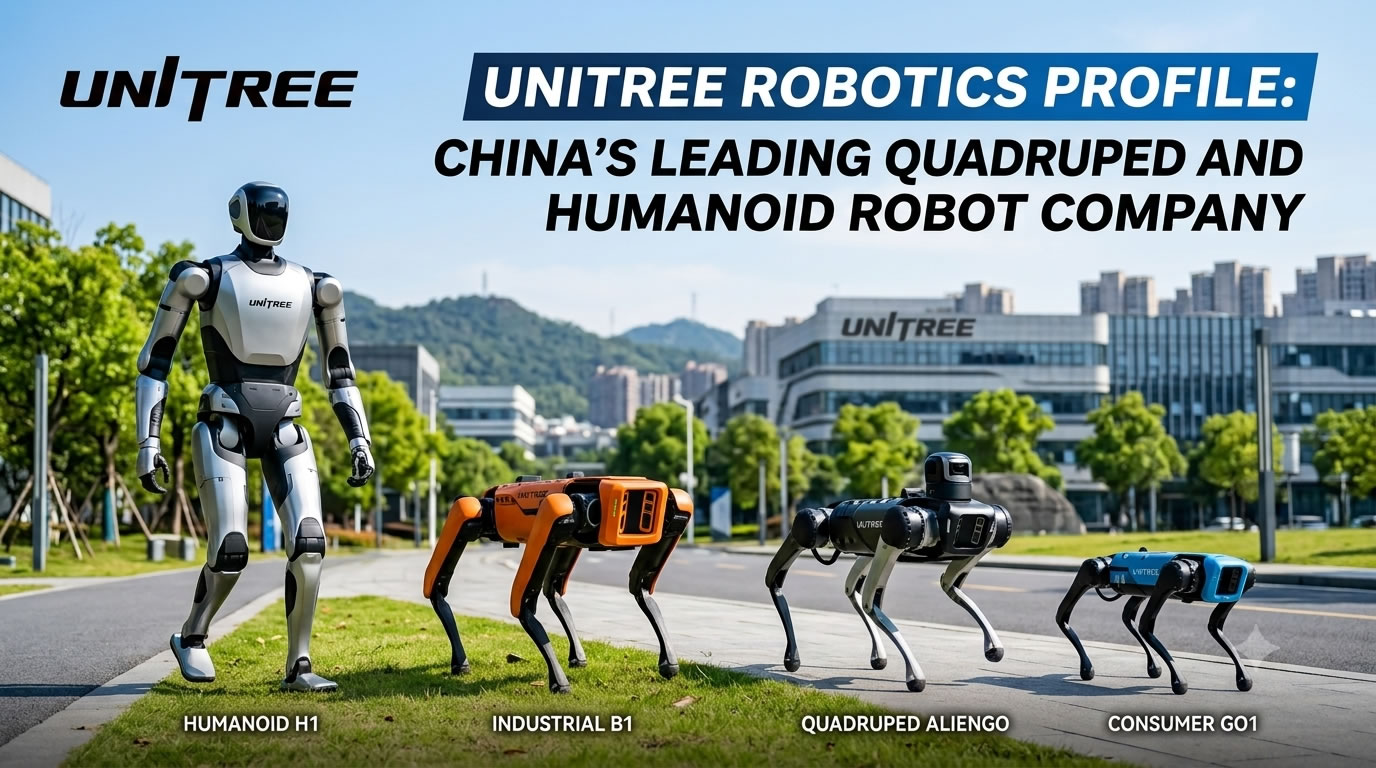

00. Key Takeaways / Company Highlights
- Founded in Hangzhou in 2016, Unitree Robotics has built a product portfolio covering quadruped robots, humanoid robots, and robotic components.
- The company gained global attention through its commercial quadruped platforms, including the Go series and B series, which helped lower the cost barrier for researchers, developers, and industrial users.
- Unitree expanded from quadruped robots into humanoid robotics with platforms such as the H1 and G1, focusing on making high-performance humanoid robots more accessible for research and early commercial applications.
- With in-house hardware development, manufacturing capabilities, and an open developer ecosystem, Unitree operates across quadruped and humanoid robotics markets.

01. Introduction
Founded in Hangzhou in 2016, Unitree Robotics focuses on bringing advanced robot platforms from research laboratories into a wider market through commercially available products.
The company initially became known for its quadruped robots, a category historically dominated by high-cost research and specialized robotic platforms developed by companies such as Boston Dynamics. Through products including the Laikago, AlienGo, Go1, Go2, B1, and B2 series, Unitree helped expand access to legged robots among universities, research institutions, developers, and industrial users.
In recent years, Unitree has expanded into humanoid robotics with platforms such as the H1 and G1. These robots combine mechanical systems, AI, perception, and autonomous control technologies for general-purpose humanoid development.
Unitree places strong emphasis on commercialization and manufacturing, focusing on moving robotics technology from prototypes into commercial applications. The company has developed its own motor systems, robot control technologies, and production capabilities to support commercial robot deployment.
02. Company At-a-Glance
| Item | Details |
|---|---|
| Company Name | Unitree Robotics (宇树科技) |
| Company Type | Private robotics company |
| Founded | 2016 |
| Headquarters | Hangzhou, Zhejiang Province, China |
| Founder / CEO | Wang Xingxing (王兴兴), founder and CEO |
| Core Focus | Quadruped robots, humanoid robots, robotic components, perception systems |
| Main Products | Quadruped robots (As2, As2-W, Go1, Go2, Go2-W, A1, A2, A2-W, B1, B2, B2-W, AlienGo, GD01), humanoid robots (H1, H1-2, G1, R1, R1 Air, H2, H2 Plus), robotic arms (Z1, D1-T), dexterous hands (Dex2/5, Dex1-1, Dex5-1, Dex3-1), and perception systems |
| Robot Categories | Quadruped robots, humanoid robots, robotic arms, dexterous hands, perception, components |
| Key Technologies | Electric joint systems, motion control, robot perception, reinforcement learning |
| Target Markets | Research institutions, education, industrial inspection, commercial services, and emerging humanoid robotics applications |
| Website | https://www.unitree.com |
| Funding / Investors | The company has received investment from institutional investors including HongShan and Meituan. |
03. History and Strategic Evolution
Unitree Robotics developed from early robotics experiments into a commercial robotics company.
The company’s origins can be traced back to founder Wang Xingxing‘s early interest in robotics. While studying automation and mechanical engineering, Wang experimented with robot designs and focused on developing more efficient ways to build legged robots.
During his university years, Wang explored robot design and electric actuator-based locomotion systems. At a time when many high-performance quadruped robots relied on expensive hydraulic systems, Unitree’s approach focused on using electric actuators to reduce complexity and improve commercial feasibility.
This approach became a key part of Unitree’s strategy: developing high-performance robots with a cost structure suitable for wider adoption.
Commercialization Timeline
| Year | Milestone |
|---|---|
| 2016 | Unitree Robotics was officially founded in Hangzhou, focusing on commercializing quadruped robots. |
| 2017 | Released Laikago, one of China’s early commercially available high-performance quadruped robots. |
| 2018 | Introduced AlienGo, targeting research institutions and professional applications. |
| 2020 | Expanded into education and developer markets with the A1 quadruped robot. |
| 2021 | Released Go1 commercially accessible quadruped robot and B1 industrial quadruped platform. |
| 2023 | Entered humanoid robotics with the launch of the H1 general-purpose humanoid robot. |
| 2024 | Released the G1 humanoid robot (officially introduced at ICRA 2024), targeting a broader developer and research market. |
| 2025 | Expanded its humanoid robot lineup with R1 and continued scaling commercial deployment. |
From Research Platforms to Commercial Robots
Unitree’s early products focused on proving that advanced legged robots could become more accessible outside specialized laboratories.
The Laikago quadruped robot, released in 2017, marked an important step in this direction. The platform introduced a commercially available quadruped robot with dynamic movement capabilities, including walking, running, jumping, and climbing stairs.
The following AlienGo platform further improved the company’s professional robotics capabilities, attracting attention from universities and research organizations around the world. These early products helped Unitree establish relationships with the global robotics research community.
The company’s breakthrough in commercially accessible robotics came with the Go1 quadruped robot released in 2021. Compared with traditional research robots, Go1 targeted a much broader audience, including developers, educators, and individual users.
The release demonstrated Unitree’s core business approach: using lower-cost hardware and scalable manufacturing to expand the robotics market.
Moving Into Humanoid Robotics
As the global robotics industry shifted toward humanoid robots and embodied AI, Unitree began expanding beyond quadruped platforms.
In 2023, the company introduced the H1 humanoid robot, marking its entry into full-size humanoid robotics. The H1 was designed as a general-purpose humanoid platform with capabilities including dynamic walking and advanced balance control.
In 2024, Unitree launched the G1 humanoid robot, a smaller and more accessible platform aimed at researchers and developers. Compared with earlier humanoid robots that often carried very high prices, the G1 was positioned as a lower-cost option for exploring humanoid applications.
The move marked a change in Unitree’s strategy, shifting from mainly quadruped robots to a broader robotics portfolio covering hardware, software, and embodied intelligence.
04. Core Robot Platforms & Ecosystem
Unitree Robotics has expanded its product ecosystem beyond quadruped robots and humanoid robots. The company’s current portfolio covers quadruped robots, humanoid robots, robotic arms, dexterous hands, perception systems, and robotics components.
The expansion extended Unitree’s portfolio from quadruped robots into humanoid platforms, manipulation systems, and robotics components.
This approach allows Unitree to serve different user groups, including researchers, educators, and industrial customers. It also expands the company’s experience in hardware, motion control, and software development.
Unitree Robot Product Portfolio Overview
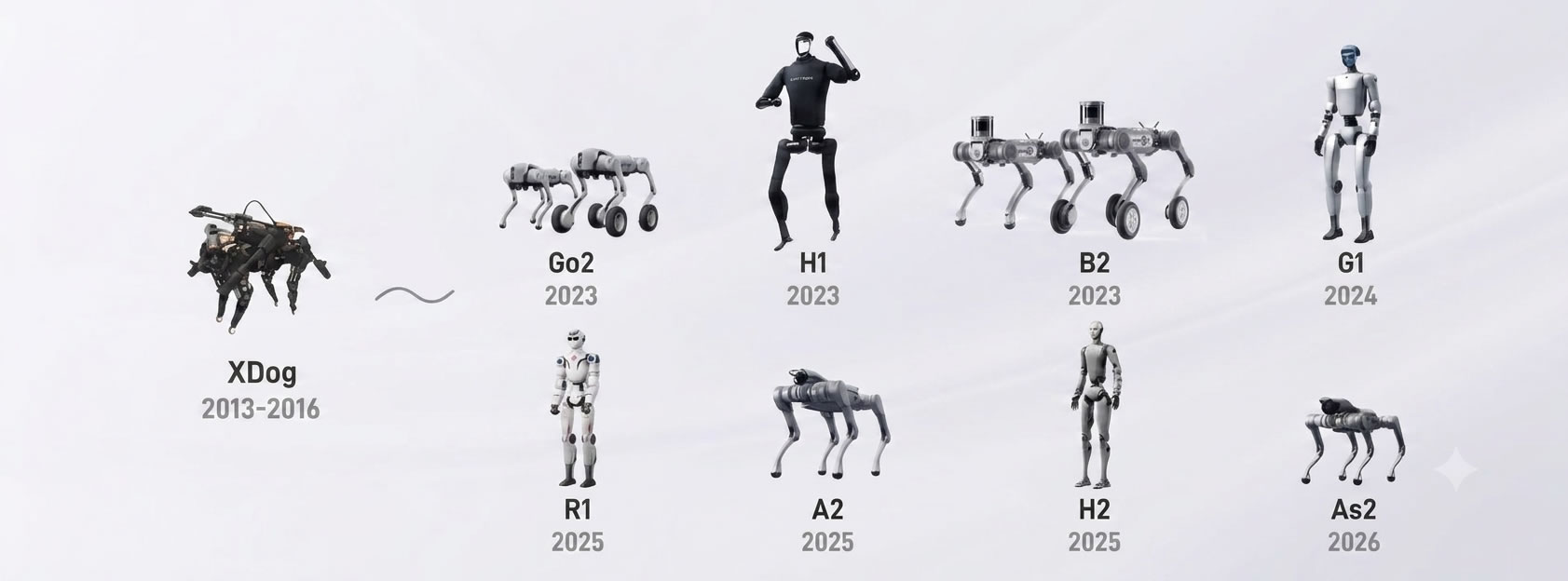
Unitree’s current robot portfolio covers compact quadrupeds, industrial robots, special platforms, humanoid robots, and robotic components. The product lineup is organized as follows:
| Category | Models | Positioning |
|---|---|---|
| Compact Quadruped Robots | As2, As2-W, Go1, Go2, Go2-W, A1 | Education, developers, research |
| Industrial Quadruped Robots | A2, A2-W, B1, B2, B2-W, AlienGo | Inspection, industrial applications |
| Special Robot Platforms | GD01 | Manned robotic systems |
| Humanoid Robots | H1, H1-2, G1, R1, R1 Air, H2, H2 Plus | Research and embodied AI |
| Robotic Arms | Z1, D1-T | Manipulation |
| Dexterous Hands | Dex2/5, Dex1-1, Dex5-1, Dex3-1 | Dexterous manipulation |
| Perception | 4D LiDAR, SV1-25 | Sensing |
| Components | Motors, batteries, controllers | Robot development |
Compact Quadruped Robots
Unitree’s compact quadruped lineup includes the As2, As2-W, Go1, Go2, Go2-W, and A1 platforms. While positioned for consumer and education markets, the As2 series is closer to compact industrial and research applications because of its stronger mobility performance and field-oriented design.
As2 and As2-W
As2 is a compact quadruped robot platform developed for agile mobility and research applications. Its smaller form factor and lightweight design make it suitable for education and experimental use.
As2-W is the wheeled-legged variant of the As2 platform, combining legged agility with wheeled efficiency for research and experimental applications.
A1
The A1 quadruped robot, introduced in 2020, helped Unitree expand into education and developer markets, offering a cost-effective platform for learning and prototyping.
Go1 Quadruped Robot
Released in 2021, the Go1 became one of Unitree’s most recognized products.
The robot was designed for developers, education, research institutions, and technology enthusiasts. Compared with traditional research quadruped platforms, the Go1 offered a smaller form factor and a significantly lower entry cost.
The platform combined dynamic locomotion capabilities, portable design, developer-friendly interfaces, and AI-based perception features.
The Go1 helped expand access to quadruped robots among universities, robotics developers, and technology enthusiasts.
Go2 Quadruped Robot
In 2023, Unitree introduced the Go2, an upgraded commercially accessible quadruped robot that incorporated improvements in perception, computing, and interaction. Features include optional 4D LiDAR-based perception, improved obstacle avoidance, enhanced motion control, voice interaction, and support for AI-based applications.
The Go2 provides a lower-cost platform for experimenting with robot perception, navigation, and AI applications.
Go2-W Wheeled-Legged Variant
Based on the Go2 platform, the Go2-W introduces a wheeled-legged mobility design that combines efficient movement on flat surfaces with the obstacle-crossing capability of legged robots. This hybrid design provides a practical platform for research into combined mobility methods.
Industrial Quadruped Robots
Unitree’s industrial quadruped portfolio includes the B series, A2 series, and the AlienGo platform. These robots are designed for inspection, security, and demanding field applications.
B Series (B1, B2, B2-W)
The B series targets industrial inspection, security, and emergency applications. B1 (2021) was designed for professional scenarios requiring stronger payload capability and environmental adaptability. B2 and B2-W (2023) improved movement speed, payload, battery endurance, and terrain adaptability. The B2-W variant adds wheeled-legged hybrid mobility.
A2 Series
The A2 series represents Unitree’s industrial quadruped platforms, focusing on high-performance mobility and adaptability for inspection, emergency response, outdoor exploration, and complex terrain operations. A2-W, the wheeled-legged version, combines legged agility with wheeled efficiency.
GD01 Manned Mecha
Unitree GD01 is a production-oriented manned robotic platform designed to explore new forms of human-machine interaction and heavy-duty robotic applications. It expands Unitree’s portfolio beyond autonomous robots into human-operated robotic systems.
AlienGo
Released in 2018, AlienGo was one of Unitree’s early professional quadruped robots, targeting research institutions, universities, and developers working on advanced robotics research and applications. Its adoption helped Unitree establish an international presence among the global research community.
Humanoid Robots
Unitree entered humanoid robotics with the H1 platform in 2023 and has since expanded its humanoid lineup to include H1-2, G1, R1, R1 Air, H2, and H2 Plus.
H1 and H1-2
The H1 was Unitree’s first full-size general-purpose humanoid robot, designed for bipedal walking, dynamic balance control, and whole-body motion research. Standing approximately 1.8 meters tall, it was positioned as a research and development platform. The H1-2 is an upgraded version featuring improvements in hardware design, motion capability, and system integration.
G1 Humanoid Robot
Released in 2024, the G1 is a more accessible humanoid platform aimed at developers, universities, and companies exploring humanoid applications. It features a compact design, flexible joint movement, integrated perception, and dexterous hand options. The G1 platform has been adapted into application-oriented variants (see Application Plan below).
R1 Series
The R1 series includes the lightweight R1 and R1 Air humanoid platforms, designed to lower the entry barrier for humanoid robotics development, education, and research. They offer a more accessible design compared with larger full-size humanoid robots.
H2 and H2 Plus
H2 is Unitree’s newer-generation humanoid platform, designed to explore higher-performance capabilities in mobility, manipulation, and system integration. The H2 Plus variant extends the platform for integrated R&D and manufacturing applications.
Application Plan: Robot Variants for Specific Scenarios
Unitree’s Application Plan includes G1-D, G1-Comp, G1-Boxing, R1-A, R1-A-D, and H2-D. These variants are designed for tasks such as data collection, competition, and rapid deployment, demonstrating how the underlying platforms can be adapted for different research and commercial scenarios.
Robotic Arms
Unitree’s manipulation systems include the Z1 and D1-T robotic arms. The Z1 provides six-axis motion control, compact structure, and developer-friendly control, extending the company’s ecosystem from mobility to manipulation.
Dexterous Hands
Unitree has developed a range of dexterous hands: Dex2/5, Dex1-1, Dex5-1, and Dex3-1. These systems are designed to enable grasping, object interaction, and more complex tasks.
Perception
Unitree offers 4D LiDAR and the SV1-25 stereo binocular camera as part of its perception product line, providing sensing capabilities for autonomous navigation and environment understanding.
Robot Components
Unitree also supplies robotics components including bionic robot joint motors, the SV1-25 stereo binocular camera, battery systems, controllers, and motion modules. These components support developers building customized robotic systems and embodied AI platforms.
Software & Ecosystem
Software, development tools, and ecosystem support are important parts of modern robotics platforms. Unitree has emphasized software accessibility through robot SDKs, development interfaces, ROS support, simulation tools, and open development resources.
These tools are used by universities, research laboratories, and robotics developers worldwide.
These tools allow developers to experiment with robot control, AI applications, and autonomous systems using commercially available hardware.
From Robot Manufacturer to Robotics Platform Company
Unitree’s product portfolio has expanded from quadruped robots to humanoid robots, robotic arms, dexterous hands, perception systems, components, and manned robotic platforms such as GD01.
The next challenge is developing robots that can perform reliable tasks in real-world environments and generate sustainable commercial value.
05. Technology Stack
Unitree Robotics’ development has been built around a combination of mechanical engineering, electric actuator systems, motion control, and software development.
Unitree focuses on developing complete robot platforms that can be manufactured, sold, and used by developers and commercial customers.
The company’s technology development focuses on three areas: hardware systems designed for dynamic movement, AI-based perception and motion control, and integrated robot platforms optimized for commercial accessibility.
Joint Actuators and Motor Systems
For legged robots, the actuator system is one of the most important technical components. Quadruped and humanoid robots rely on precise joint control to maintain balance and perform complex movements.
Unitree has invested heavily in developing proprietary motor systems, joint modules, and robot control technologies while also leveraging China’s manufacturing ecosystem. Electric actuators simplify robot architecture compared to hydraulic systems, improving scalability and precision for dynamic motion control.
Perception and Sensor Fusion
Unitree’s robot platforms integrate cameras, LiDAR sensors, IMUs, joint position sensors, and force feedback systems to enable environment perception, navigation, balance control, obstacle avoidance, and autonomous movement. For humanoid robots, perception is especially important for recognizing objects, people, and spatial relationships.
AI and Motion Control
Motion control is a core strength, allowing Unitree robots to perform walking, running, jumping, and recovering from disturbances. The company has explored reinforcement learning approaches to teach robots complex behaviors, demonstrating dynamic locomotion capabilities, though achieving reliable general-purpose intelligence remains an industry-wide challenge. Robot software includes control interfaces, SDKs, ROS compatibility, and development APIs.
06. Manufacturing & Supply Chain
One of Unitree’s notable strengths is its focus on productization and manufacturing. The robotics industry has historically struggled to move from lab demonstrations to scalable production. Unitree’s strategy has been to reduce this gap through cost control, supply chain integration, and production efficiency.
In-house development of mechanical structures, joint modules, motor systems, and control software allows for rapid iteration and system optimization. China’s manufacturing ecosystem provides efficient access to precision machining, electronics manufacturing, battery production, and semiconductor supply chains. This is especially important for humanoid systems, which require large numbers of precision components.
Unitree’s commercial strategy emphasizes standardized platforms, modular design, and broader market distribution. The Go series and G1 humanoid robot exemplify this by targeting developers and researchers who previously lacked access to high-performance hardware.
07. Robots Daily Analysis: Unitree’s Position in China’s Robotics Industry
Based on public information, industry developments, and product observations, Unitree is one example of China’s shift from robotics research toward commercial robot platforms.
Unitree’s development is notable for its focus on accessible robot platforms. While advanced legged robots were previously limited mainly to research institutions and specialized projects, Unitree has focused on creating commercially available platforms that can be purchased and developed by a wider user base.
This product-oriented approach has helped expand Unitree’s presence among universities, robotics developers, and technology communities worldwide. The company’s quadruped robots have appeared in research projects, education programs, industrial demonstrations, and public technology events. Meanwhile, its humanoid robots have attracted attention as global competition in embodied AI accelerates.
08. Market Position & Global Expansion
Unitree Robotics has become one of the most internationally visible Chinese robotics companies, particularly in quadrupeds and humanoids. Unitree’s growth is linked to two major trends in robotics: growing demand for commercial robot platforms and the increasing importance of manufacturing capability.
The company has established itself as one of China’s best-known quadruped robot manufacturers, leveraging multiple product generations, dynamic motion control experience, and lower-cost platforms. The commercial quadruped market remains early, with deployments concentrated in research, demonstration, and inspection.
In humanoid robotics, competition is intense from companies like Tesla, Boston Dynamics, and Agility Robotics. Unitree enters this market with advantages from quadruped development, focusing on lower-cost platforms, rapid iteration, and developer access.
Compared to Boston Dynamics’ enterprise focus, Unitree’s differentiation is commercialization accessibility. In global expansion, Unitree has built an international presence through research communities and developer adoption, though challenges remain in customer support, software ecosystem development, and long-term reliability.
09. Commercial Applications & Business Model
Unitree’s business model focuses on robot platforms, components, and emerging commercial applications. Its strategy: selling accessible robot platforms → building developer adoption → expanding toward commercial deployment.
Research and academia remain important early customer groups, using Unitree robots for motion control, reinforcement learning, and embodied AI research. Industrial inspection applications leverage legged robots’ terrain adaptability, though large-scale deployment is still in pilot stages. Education markets benefit from accessible platforms for teaching programming and AI.
Humanoid robots represent the long-term growth direction, with platforms positioned for research, AI training, and industrial automation exploration. The industry remains in early commercialization, focusing on manipulation reliability, autonomous decision-making, and cost reduction.
The model supports broader developer adoption and application development around Unitree platforms.
10. Competitive Landscape
Unitree operates in highly competitive segments including quadruped and humanoid robots, facing both Chinese startups and established international companies. The landscape includes advanced mobility companies, humanoid developers, and industrial automation firms entering embodied AI.
11. Key Facts – Company Snapshot
| Field | Data |
|---|---|
| Founded | 2016 |
| Company Type | Private robotics company |
| Headquarters | Hangzhou, Zhejiang Province, China |
| Founder / CEO | Wang Xingxing |
| Primary Robots | As2, Go2, Go2-W, A2, B2, B2-W, GD01, H1, H1-2, G1, R1, R1 Air, H2, H2 Plus, Z1, Dexterous Hands |
| Main Categories | Quadruped robots, humanoid robots, robotic arms, dexterous hands, perception, components |
| Core Technologies | Electric actuators, motion control, robot perception, embodied AI |
| Key Applications | Research, education, industrial inspection, robotics development |
| Global Markets | China and overseas research/developer markets |
| Official Website | Unitree.com |
12. Future Outlook and Industry Perspective
Unitree Robotics has grown from a quadruped startup into one of China’s most visible robotics companies. Its future depends on transitioning from selling platforms to enabling practical applications.
The robotics industry has produced impressive demonstrations, but commercial success requires reliable long-duration operation, safety, cost reduction, and clear customer value. Expanding into repeatable commercial deployments will be a key challenge.
Humanoid robots and embodied AI require advances in physical capability, AI models, autonomous learning, and manipulation skills. Successful companies will also need mature software ecosystems, developer communities, and application partners.
Unitree represents the shift from research-focused robotics toward commercially accessible platforms. Its experience across multiple robot generations gives it an advantage in the global robotics market. The coming years will determine whether it can turn advanced platforms into reliable, value-delivering systems.
