


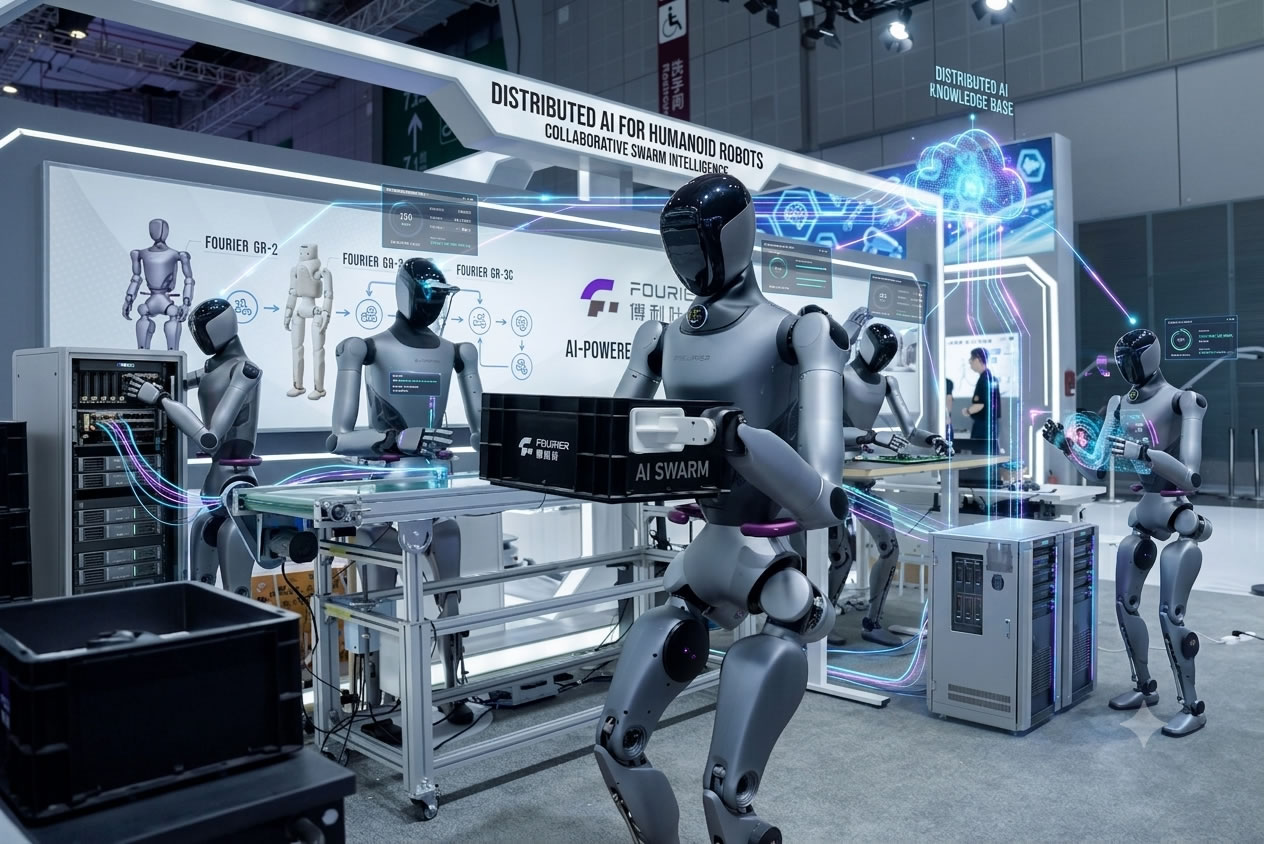
As humanoid robots move from demonstrations into factories and public spaces, the challenge is shifting from building a capable machine to designing the computing infrastructure that allows thousands of robots to operate reliably.
For years, the development of humanoid robots has focused on hardware: stronger actuators, more dexterous hands, better batteries, and more capable sensors. But as robots begin moving into real-world environments, another challenge is becoming harder to ignore — where should their intelligence actually run?
A humanoid robot does not necessarily need to carry its entire “brain” inside its own body.
Instead of placing all computing resources on the robot itself, a growing number of researchers and companies are exploring distributed AI architectures, where perception, reasoning, planning, and learning are divided across the robot, nearby edge computing systems, and cloud platforms.
The idea is not simply to copy the same AI model onto multiple machines. Distributed AI changes how robotic systems are designed by assigning different tasks to different computing locations based on requirements such as response speed, computing power, energy consumption, and reliability.
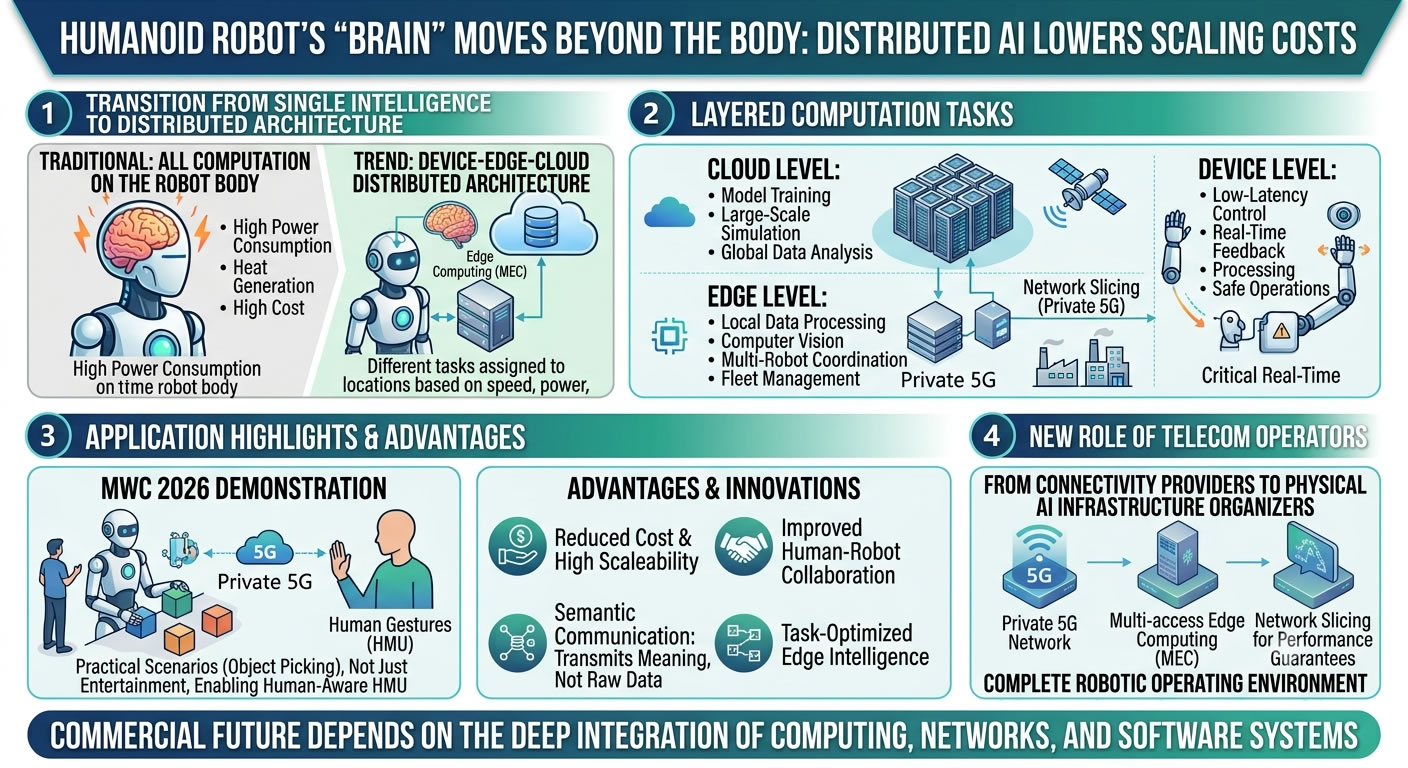
In robotics, this approach is often built around a device-edge-cloud architecture.
The robot itself handles tasks that require immediate responses, including balance control, joint movement, collision avoidance, and emergency stops. Edge servers located close to factories or warehouses can process heavier workloads such as computer vision, environment understanding, task planning, and coordination between multiple robots. Cloud platforms can then support model training, simulation, data analysis, and software updates.
For humanoid robots expected to work alongside people, this division of intelligence could become a key factor in determining whether large-scale deployment is economically practical.
A Robot Demonstration That Was Not About Dancing
At MWC Barcelona 2026, Cambridge Consultants, a technology development firm under Capgemini, presented a humanoid robot system built around private 5G connectivity and edge AI.
The demonstration focused on a different type of robot interaction. Instead of showing pre-programmed movements designed for entertainment, the system showed a robot responding to human gestures and completing tasks such as picking up objects with both arms and moving boxes.
The process reflected a more practical scenario: the robot observes its surroundings, interprets human actions, and decides how to complete a task.
According to Cambridge Consultants, the demonstration combined a fine-tuned NVIDIA physical AI foundation model with whole-body control, dexterous manipulation, and human-robot interaction technologies. A notable part of the system was that some advanced AI processing was not performed directly on the robot. Instead, the robot connected through a private 5G network to nearby edge computing resources.
The demonstration was later selected by technology publication Tom’s Guide as one of the highlights of MWC 2026. It was not part of the official GSMA GLOMO Awards, but it reflected a broader trend: communication networks and computing infrastructure are becoming increasingly important topics in robotics development.
The message from the demonstration was straightforward. The commercial future of humanoid robots will not depend only on designing a better robot. It will also depend on building the computing, networking, and software systems that allow robots to operate continuously in real workplaces.
Putting All Computing Inside the Robot Comes at a Cost
Humanoid robots generate large amounts of data through cameras, depth sensors, inertial measurement units, force sensors, and joint encoders. As newer AI technologies such as vision-language-action models, world models, and multimodal reasoning become part of robotic systems, the demand for onboard computing power continues to increase.
More onboard computing usually means higher power consumption, greater heat generation, and additional hardware costs.
For industrial robots expected to operate for several hours at a time, these factors directly affect battery size, cooling requirements, overall weight, and maintenance complexity.
A fully self-contained robot with powerful computing hardware may offer advantages in environments where network connections are unavailable or unreliable. However, equipping every robot with high-end processors and large memory capacity could make large-scale deployment more expensive.
This creates a practical question for the industry: should every robot carry the same level of computing power, or should intelligence be shared across a larger system?
Distributed AI is designed to address this balance.
However, this does not mean humanoid robots will become empty machines that rely entirely on external networks.
Tasks such as balance control, joint-level feedback, state estimation, collision protection, and emergency shutdown require extremely low latency and high reliability. These functions must remain on the robot, or at minimum operate in a mode that allows the machine to safely respond without a network connection.
If a remote server becomes unavailable, a robot must be able to stop safely rather than wait for a cloud connection to return.
The goal of distributed intelligence is therefore not to remove onboard computing, but to decide which parts of intelligence belong where. Real-time control stays on the robot, while more computationally demanding tasks — including visual reasoning, semantic mapping, complex planning, and fleet management — can move to edge infrastructure.
Humanoid Robots Need to Understand People, Not Just Commands
A robot operating inside a controlled factory workstation faces a relatively simple challenge: repeat the same task accurately and consistently.
A humanoid robot working around people faces a much harder problem.
In a shared warehouse, factory floor, or public environment, human behavior is constantly changing. A worker may suddenly turn around, stop walking, reach for an item, or change direction without warning. A robot cannot rely only on predefined voice instructions. It needs to interpret movement, attention, and surrounding conditions to predict what may happen next.
The challenge is not simply recognizing a command such as “move this box.” The robot needs to understand whether a person is making space, preparing to cross its path, or has not noticed the robot approaching.
This type of capability is becoming a key part of Human-Machine Understanding (HMU), a framework explored by Cambridge Consultants and Capgemini.
HMU is designed around three stages: perception, understanding, and support.
First, the system collects information from multiple sources, including human movement, environmental conditions, and potentially wearable devices. It then analyzes this information in context to estimate human intent. Finally, it provides a response through the robot itself, connected devices, or other interfaces.
The goal is not to give robots the ability to “read minds.” Instead, HMU uses available signals — including body posture, gaze direction, movement patterns, voice, workflow information, and environmental changes — to improve the probability that a robot correctly interprets human behavior.
For humanoid robots, this distinction matters.
A machine operating beside humans cannot treat every movement as an isolated event. It needs to understand the situation around that movement.
For example, if a worker suddenly changes direction in a warehouse aisle, the robot may identify this as a new safety condition. An edge computing system could recalculate the robot’s route, while the onboard controller immediately reduces speed. If a safe path cannot be confirmed quickly enough, the robot should stop locally.
The critical factor is not a single AI model, but whether the entire information chain can respond in time.
From sensor collection and wireless communication to edge inference and motion control, every stage affects the final decision.
This means networks are becoming more than simple channels for transferring robot data and video. They are gradually becoming part of the robot’s decision-making process.
The Data Challenge Behind Human-Aware Robots
Moving intelligence beyond the robot creates new technical challenges.
Systems that attempt to estimate human attention, stress levels, or behavioral intentions may involve sensitive information related to employees and workplace activities.
There are also risks associated with inaccurate predictions. AI systems can make incorrect judgments because of limitations in training data, changes in operating environments, or differences between individuals.
For companies deploying humanoid robots, accuracy alone will not be enough.
They will also need to consider data permissions, model bias, explainability, security, and responsibility when mistakes occur.
Cambridge Consultants includes safety, privacy, ethics, cost, and regulatory issues among the factors that need continuous evaluation in HMU systems.
As humanoid robots move into workplaces shared with humans, the question is no longer only whether robots can perform a task. It is whether they can make decisions safely when the environment is unpredictable.
Semantic Communication: Sending Meaning Instead of Raw Data
Another area connected with distributed robotic intelligence is semantic communication.
When a robot sends camera images or sensor data to an edge server, the most direct approach is to transmit the complete information stream. However, as multiple robots operate simultaneously, high-resolution images, point clouds, and sensor data can quickly consume network resources.
Semantic communication takes a different approach.
Instead of focusing on whether every transmitted bit can be perfectly reconstructed, it focuses on whether the receiving system obtains the information needed to complete a task.
A robot does not always need to send an entire video feed. In many situations, it may only need to communicate key information, such as:
- a worker is moving toward the left side of the corridor;
- a package is located on the second shelf;
- a person has changed direction;
- a specific object has been detected.
The robot can extract important features — including object categories, spatial locations, motion patterns, or model representations — and transmit these lighter-weight forms of information instead of continuously uploading raw sensor data.
Researchers believe this task-oriented communication approach could reduce network demand while shifting performance measurements away from traditional data accuracy toward factors such as inference accuracy and task completion.
However, semantic communication remains an emerging technology.
Before it can become a general infrastructure for humanoid robots, several challenges need to be solved. The sending and receiving systems need compatible models, shared knowledge representations, and a common understanding of context.
If AI models on different systems are inconsistent, or if important details are lost during compression, a robot may receive the data successfully but still make the wrong decision.
In complex or safety-critical situations, original sensor data may still need to be preserved for verification, accident investigation, and future model improvement.
As a result, semantic communication is more likely to appear first in structured industrial environments where tasks and objectives are clearly defined, rather than replacing all forms of raw data transmission.
Telecom Operators Are Becoming Part of the Robot Infrastructure Stack
As more intelligence moves from individual robots to edge computing systems, communication networks are becoming a more important part of robotic architecture.
In the past, industrial networks were mainly designed to connect machines and transfer operational data. Distributed robotic systems require something more: stable latency, high reliability, wide coverage, device authentication, and the ability to guarantee performance for critical tasks.
For humanoid robots operating in dynamic environments, a network connection is no longer just a data pipeline. It becomes part of the system that supports perception, decision-making, and coordination.
This is creating new opportunities for telecom operators.
Private 5G networks and multi-access edge computing (MEC) are increasingly being considered as part of humanoid robot deployment solutions. Instead of sending all data back to distant cloud servers, edge computing allows AI workloads to run closer to where robots are operating, reducing delays and improving reliability.
Network slicing is another technology being explored for industrial applications. It allows operators to provide different levels of network performance on the same physical infrastructure, ensuring that critical robotic operations receive the required bandwidth, latency, and reliability.
The 3GPP standards organization has introduced mechanisms related to network slicing service-level agreements and closed-loop automation management, providing a foundation for more flexible industrial connectivity.
For telecom companies, this could represent a shift from selling connectivity alone.
In future industrial deployments, enterprises may not simply purchase a network connection. They may purchase a complete robotic operating environment that combines connectivity, edge computing resources, device management, security policies, and performance guarantees.
Telecom operators could potentially become involved in areas such as robot fleet management, AI model hosting, and on-site operational support.
However, building a 5G network alone will not automatically create a robotics business.
The industry requires deeper cooperation between telecom providers, robot manufacturers, AI developers, cloud platforms, and industrial automation companies. These partners will need to define system responsibilities, security boundaries, and failure-handling mechanisms together.
From Connectivity Providers to Physical AI Infrastructure Organizers
Cambridge Consultants believes telecom companies could eventually move beyond their traditional role as connectivity providers and become organizers of physical AI infrastructure.
In this model, operators could provide edge computing capacity, host AI platforms, and help maintain the performance of large-scale robot systems.
However, this remains a potential business direction rather than an established market.
The transition will depend on whether telecom companies can adapt their capabilities to the needs of robotics.
Robots are different from traditional connected devices. A delayed video upload or temporary service interruption may be inconvenient for many digital services, but the same problem in a factory with moving robots could create physical safety risks.
The requirements for robotics networks are therefore much closer to industrial control systems than conventional consumer connectivity.
Scaling Humanoid Robots Requires More Than Better Hardware
The real test for humanoid robots will not be whether a single machine can successfully complete a demonstration.
The challenge will be whether dozens or thousands of robots can operate continuously in real workplaces.
Companies deploying humanoid robots will need to answer several practical questions:
Can robots continue operating safely when network conditions change?
Can AI models be updated across large fleets without interrupting production?
Can new robots be added without causing infrastructure costs to rise sharply?
Can companies manage failures in robots, edge servers, and cloud systems?
Distributed intelligence provides one possible path toward solving these challenges.
By sharing computing resources across robots, edge systems, and cloud platforms, companies may reduce the need to equip every robot with maximum computing capability. It could also make it easier to update models and distribute new skills across a robot fleet.
But this approach also introduces new risks.
Network congestion, edge server failures, inconsistent AI model versions, and cybersecurity attacks could become problems that directly affect physical machines.
A software failure in a traditional IT system may cause data loss or service disruption. A similar failure in a robotic environment could affect worker safety or industrial operations.
This means future robotic systems will need stronger reliability mechanisms, including local safety controls, fault recovery strategies, and clear boundaries between cloud intelligence and onboard decision-making.
The Next Competition Is About the Entire System
The future of humanoid robots will still depend on advances in hardware.
Actuators, sensors, batteries, mechanical structures, and control systems remain fundamental technologies. A robot cannot become useful without reliable physical capabilities.
But as humanoid robots move into factories, warehouses, and public environments, deployment scale may depend less on any single hardware specification.
The bigger challenge will be whether robots, edge computing infrastructure, and communication networks can operate together as one complete system.
The robot of the future may not have all of its intelligence inside its body.
Part of its “brain” may exist on the machine itself. Part may run on nearby edge servers. Another part may live in cloud data centers where models are trained and improved.
The question facing the industry is no longer only how to build a more capable humanoid robot.
It is whether distributed intelligence can remain safe, reliable, and controllable when thousands of machines begin operating in the real world.
For humanoid robots, the path to commercialization may depend not just on creating smarter machines, but on building the invisible infrastructure that allows those machines to work together.
